Excavator
316 models
 Backhoe Loader
54 models
 Crane
68 models
 Concrete Mixer
79 models
 Wheel Loader
65 models
 Compactor / Roller
45 models
 Motor Grader
42 models

 Concrete Pump
66 models
 Skid Steer Loader
11 models


A dumper working in an Indian coal mine has to carry 13 safety devices of its own, and a tipper truck 11, on top of the general list that every heavy earth-moving machine needs. The lists come from G.S.R. 987(E), the notification the Director General of Mines Safety (DGMS) issued on 1 October 2018, and they are meant to be fitted and working before the machine enters the mine.
The list is long for a reason. When DGMS looked at fatal accidents in 2023, 36 in every 100 in opencast coal mines were caused by dumpers, tippers, trucks and similar vehicles. Almost half of those were run-overs.
This guide takes the devices one at a time: what each one does, which accident it is meant to stop, and what the driver can check before the first trip of a shift. It is written for the owner of a few dumpers or tippers taking on mine work, and for the operator who drives them. It also covers the body prop, which protects the person working under a raised body.
Which safety features must a dumper have in a mine?
G.S.R. 987(E) has three parts. The first lists what every heavy earth-moving machine (HEMM) in a coal mine must have, whether it is an excavator, a drill, a dumper or a tipper. The second adds a list for each type of machine. The third says all of it must be provided before the machine is put to work in the mine. Two years later, DGMS Technical Circular 06 of 2020 set the minimum design for the most important devices. That circular was sent to coal and metal mines and to the machine makers.
The notification gives one list for dumpers and another for tippers and trucks. If you are not sure which of your machines is which, the guide to types of tipper truck and dumper explains the difference.
| Device | What it does | Dumper | Tipper or truck |
|---|---|---|---|
| Proximity warning device | Warns the driver of a person, vehicle or object in the path ahead or behind | Yes | Yes |
| Auto dipping system | Switches the headlights to low beam when a vehicle comes the other way at night | Yes | Yes |
| Load indicator | Weighs the load and shows outside and inside the cab whether the body is under-loaded, safely loaded or overloaded | Yes | Yes |
| Speed limiting device | Holds top speed to the limit set for the working conditions | Yes | Yes |
| Dump body raised position indicator with warning | Warns while the body is not fully down and keeps the truck in first gear | Yes | Yes |
| Mechanical lock for the raised body (body prop) | Holds a raised body so it cannot come down on someone | Yes | Yes |
| Cabin guard extension or canopy | Covers the whole cab against rock falling during loading | Yes | Yes |
| Propeller shaft guard | Guards the spinning shaft that carries drive to the rear axle | Yes | Yes |
| Retarder, or exhaust brake | Holds speed on a downhill haul so the service brakes stay cool | Retarder, in addition to service, parking and dump brakes | Exhaust or retarder brake |
| Head-to-tail collision device | A mechanical structure that absorbs or turns away the force if a dumper runs into the back of another | Yes | No |
| Mechanical steering lock | Stops the steering and wheels moving while people work below the cab with the engine running | Yes | No |
| Rock ejectors for tandem tyres | Bars that knock out stones caught between the twin rear tyres | Yes | No |
| Engine or battery cut-off on the front lower side | Lets a person on the ground stop the engine in an emergency | Yes | No |
| Dump body stabilisers | Stop the tipper toppling, or the body parting from the lift cylinder, while it tips | No | Yes |
| Tail gate protection | Listed by name only; the notification gives no detail, so ask the body builder what is fitted | No | Yes |
The general list applies to both, and it is just as long. It asks for safe access with three-point support for any climb over 1 m, an emergency exit from the cab, a roll-over protective structure to ISO 3471 and a falling-object guard to ISO 3449 where rock can fall (the guide to ROPS and FOPS cabins explains both), and a seat belt with a reminder. It adds service, emergency and parking brakes, a rear vision camera, blind-spot mirrors or a camera, a horn, an operator fatigue warning, an audio-visual reversing alarm and reflectors on all sides. Finally, it requires guards on moving parts and near the exhaust, and a portable fire extinguisher as well as an automatic fire detection and suppression system.
Why are dumpers and tippers checked so closely?
Because they are behind more than a third of the deaths in opencast coal mines. DGMS Technical Circular 03 of 2024, dated 21 August 2024, broke down the 2023 fatal accidents caused by dumpers, tippers and trucks in opencast coal mines. Run-overs and people hit by dumpers made up more than two-thirds of them.
| How the accident happened | Share | Devices aimed at it |
|---|---|---|
| Run-over | 46% | Proximity warning, rear camera, blind-spot mirrors, reversing alarm |
| Hit by a dumper | 23% | Proximity warning, reflectors, auto dipping at night |
| Head-on collision | 15% | Auto dipping, speed limiting device, proximity warning |
| Toppling | 8% | Load indicator, speed limiting device, body stabilisers, ROPS with the seat belt worn |
| Other, such as a dumper falling from a height | 8% | Mostly a matter of haul road and dump edge design, not a device on the machine |
The same circular lists ten fatal accidents from 2024, and several had nothing to do with a missing device. A tipper operator got down at the working face, the tipper rolled down the slope, and he was crushed between it and a parked tipper as he tried to climb back on. A water tanker driver stopped on a gentle 1 in 22 slope, fell from the ladder, and his own tanker rolled over him. DGMS’s answer to both starts with the parking brake and the written operating procedure. For the tipper, it adds the fail-safe brake that G.S.R. 987(E) requires.
That is the point to hold on to. Devices cut the risk; they do not replace the habits.
How does a proximity warning device work on a dumper?
A proximity warning device uses sensors at the front and rear of the dumper to spot people, vehicles and objects in the truck’s path, and sounds and shows a warning in the cab. It warns; it does not brake. DGMS Circular 06 of 2020 sets the size of the zone it has to watch.
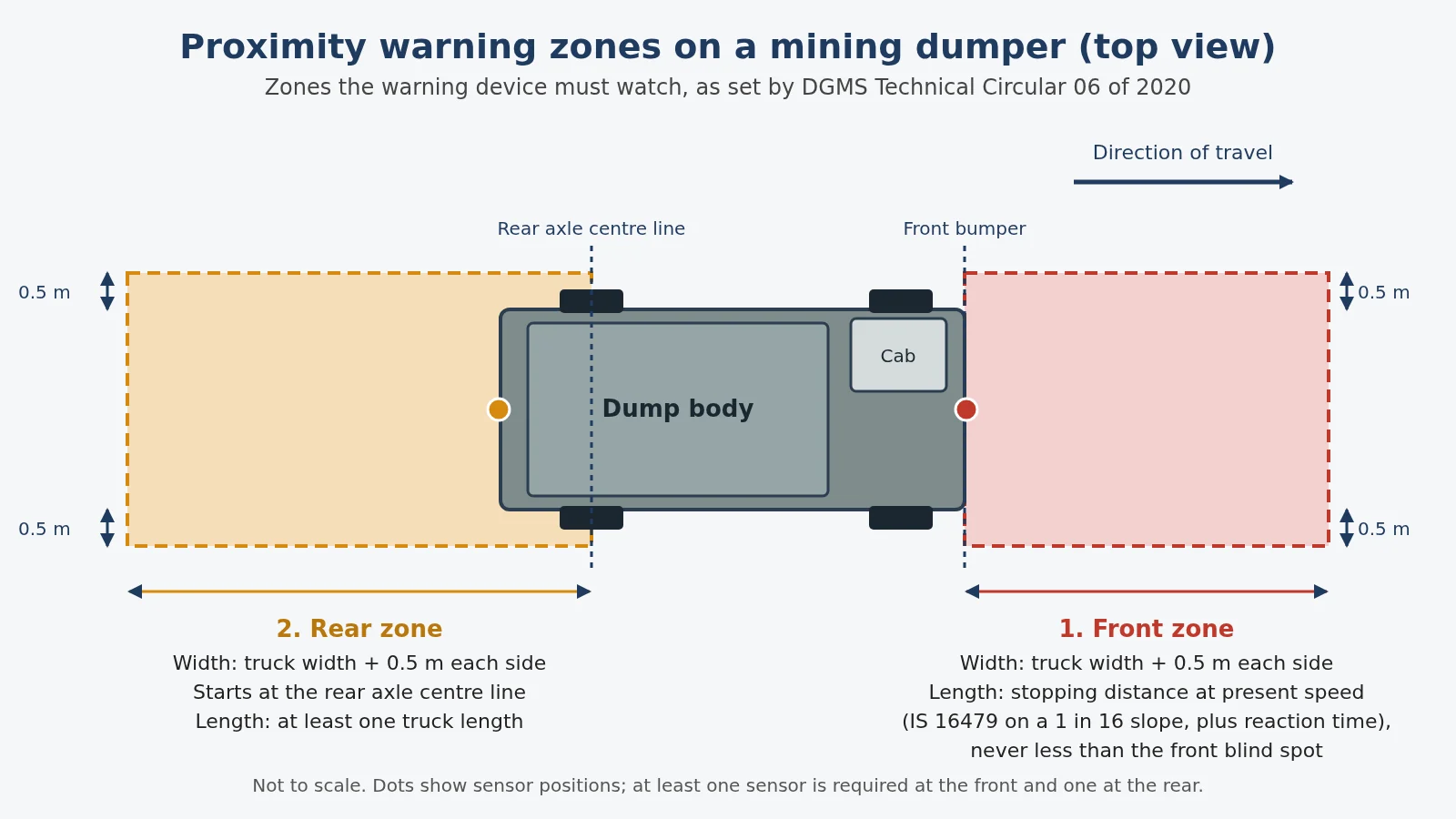
| Zone | Width | Where it starts | Length |
|---|---|---|---|
| In front | Width of the truck plus 0.5 m on each side | At the front bumper | The stopping distance at the truck’s present speed, worked out by the system as the truck moves, and never shorter than the blind spot in front of the cab |
| Behind | Width of the truck plus 0.5 m on each side | At the centre line of the rear axle | At least the full length of the truck |
The front zone stretches as the dumper speeds up. The stopping distance is worked out under IS 16479, the Indian brake test standard for wheeled earth-moving machines, on a slope of 1 in 16 (6.25%), which the circular calls the steepest haul road allowed in normal working. The driver’s reaction time and the brake’s response time are added on top.
The device must not raise an alarm for things outside the zone’s width, so a truck passing in the next lane does not set it off, and it should tell the driver whether the obstacle is left, right or centre. It keeps a record of its warnings for the last 96 hours of work. It also has to pass vibration, heat, cold, dust and water tests at a government or NABL-accredited laboratory that is not the maker’s own.
What does the dump body raised indicator do?
It tells the driver the body is not fully down, and it stops the dumper being driven away fast in that state. Circular 06 of 2020 asks for a light in the cab that comes on as soon as the body leaves its lowered position and stays on until the body is fully down again. If the driver tries to move off with the body still up, a sound warning joins the light, and the transmission will not go above first gear.
Left half-raised, a body is a hazard you cannot always see from the seat. Driven along a haul road, it can catch an overhead power line, a conveyor gantry or a hopper roof. The sensors must be sealed to IP68, which means dust-tight and waterproof.
What is a body prop, and when must it be used?
A body prop is a steel support, or a locking pin, that holds a raised tipper or dumper body mechanically so it cannot drop. G.S.R. 987(E) requires one on both machines: “body raised position mechanical locking arrangement” for dumpers and “dump body lifted position locking arrangement” for tippers. In workshops it is called a body prop, safety prop or body support. Ireland’s Health and Safety Authority gives the same advice for tipper trucks: fit a device that stops the body collapsing from the raised position during maintenance.
The rule is short. Nobody puts a hand, a head or a body under a raised body that is held only by the hydraulic cylinder. A hose can burst, a valve can leak, or someone can touch the tipping lever. Prop it first, every time, even for a two-minute look.
- Park on level ground, apply the parking brake, stop the engine and take the key out.
- Raise the empty body just high enough to fit the prop.
- Fit the prop or lock exactly as the maker’s manual shows, and lower the body gently onto it.
- On a dumper, also fit the mechanical steering lock if the engine has to run while someone works below the cab.
- Never use a timber block, a stack of bricks or a jack in place of the prop.
The tipping-gear maker Edbro adds that a loaded body must never be propped. The tipper maintenance checklist covers where the prop sits and the checks you do once it is in.
Which brakes must a mining dumper or tipper have?
Three brake systems, and at least one of them has to be fail-safe. G.S.R. 987(E) asks every HEMM for a service brake for normal stopping, an emergency brake for when the service brake fails, and a parking brake to hold the machine still. The notification gives the spring-applied, hydraulically released brake as the example: it comes on by itself if the pressure is lost. The brakes must meet ISO 3450.
On top of that, a dumper needs a retarder, and a tipper an exhaust brake or retarder. A loaded truck coming down a long haul road heats its service brakes until they fade, which means they grip less and less. The retarder or exhaust brake holds the speed, so the service brakes stay cool for the stop that matters. Circular 06 of 2020 says the exhaust brake adds to the service brake and never replaces it, and that its control must sit within the driver’s reach and be clearly marked.
The general list also asks for an emergency steering system, which must work in reverse too on a machine that can reverse faster than 20 km/h. If you are bringing the loading machine as well, compare excavators with prices before you sign the work order, because the mine checks that machine against its own list.
How do the load indicator, speed limiter and auto dipping help?
The load indicator weighs the body as it fills and shows the result on light indicators on both sides of the truck, so the loader operator sees under-load, safe load and overload without asking. The driver sees the same signal in the cab. A sound warning starts when the safe carrying load is reached and stays on if the truck is overloaded, and Circular 06 of 2020 says the driver cannot switch it off. Overloading strains brakes and tyres and makes a truck easier to topple, and the guide to tipper capacity explains how the rated load is worked out.
The speed limiting device holds the dumper to the speed set for the working conditions, which the mine sets in its transport rules. It is separate from the speed governor a road tipper must carry under the Motor Vehicles rules; that road rule is explained in speed governor for tipper.
Auto dipping is for night shifts. A sensor sees the high beam of a vehicle coming the other way at about 150 m and switches your lights to low beam, then back to high once the vehicles pass. Its filters are meant to ignore pole lights and haul road lighting, and the driver can override it.
What should a dumper driver check at the start of every shift?
Read the device lights first, then walk round. Circular 06 of 2020 makes most devices check themselves: the rear camera, fatigue warning, auto dipping and fire suppression must each show that they are ready, or that they have a fault, and the seat belt reminder warns until the belt is fastened. The driver’s job is to read those indications and look at the parts that cannot report on themselves. The Health and Safety Authority also says every vehicle should be inspected by its driver at the start of the shift.
This matters more than it sounds. DGMS wrote in the same circular that its inspectors kept finding devices fitted but not working, with “mere provisioning” taking the place of devices that work all the time.
| Device | What to check before the first trip | Sign of a fault |
|---|---|---|
| Rear camera and blind-spot mirrors | Camera shows ready when the engine starts and gives a picture when reverse is selected; lens clean; mirrors in place and set from the seat | Fault light, blank or blurred picture, cracked or loose mirror |
| Proximity warning | Front and rear sensors clean, undamaged and not knocked out of line; any status light the maker fitted shows normal | Sensor covered in mud or bent, status light showing a fault |
| Reversing alarm | Sounds and flashes when reverse is selected | Silent, or the light does not flash |
| Seat belt and reminder | Belt locks and releases; warning comes on with the ignition until the belt is fastened; belt cutter in the cab | Frayed strap, no warning, cutter missing |
| Fatigue warning and auto dipping | Each starts up and shows ready, with no fault indication | Fault indication |
| Fire suppression and extinguisher | “System healthy” indication; manual release inside and outside the cab not blocked; extinguisher in its bracket | Fault indication, extinguisher missing |
| Body raised indicator | On the first tip, the light comes on as the body rises and goes off when it is fully down | Light stays on with the body down, or never comes on |
| Body prop and steering lock | Stowed in place, pin present, no cracks or bends | Missing, bent or welded |
| Load indicator | Outside lights on both sides work | Dead lamp on one side |
| Parking brake | Holds the truck before you leave the bay | Truck creeps with the brake on |
| Rock ejectors, guards, canopy, reflectors | All in place; reflectors clean; no stone stuck between the twin tyres | Missing guard or ejector, stone lodged between tyres |
A fault on any of these is a reason to report the truck and keep it off the haul road until it is fixed. For the fire system’s own monthly and yearly checks, see the guide to fire suppression systems.
Can a road tipper work in a mine without these devices?
Not under these rules. The last clause of G.S.R. 987(E) says every HEMM, including dumpers and trucks, shall be provided with the listed devices before it is put into operation in a mine. A road tipper hired into a coal mine therefore needs the general list plus the tipper list, not only what it carries for road use.
A tipper bought for road work may not have all of these from the factory, so some will be fitted afterwards. Circular 06 of 2020 asks for test certificates from a government or NABL-accredited laboratory for several devices, including the rear camera, the load indicator and the proximity warning device, so ask the supplier for the certificate as well as the bill. Get in writing from your dealer which items are factory-fitted on your model, and price the rest before you quote for the mine job.
If you also bring the excavator that loads your dumpers, such as a Tata Hitachi EX 210 Infra, it has its own list in the same notification: an all-functions cut-off switch, swing brake and swing lock, a parking brake, stoppers on the hydraulic cylinders, a battery cut-off outside the cab and a two-way communication system other than a mobile phone. How many dumpers one excavator should keep busy is worked out in the guide to the shovel-dumper combination.
Mine safety law in India is moving under the Occupational Safety, Health and Working Conditions Code, 2020, and DGMS issues new circulars as the rules change. Before you send a machine to site, ask the mine’s safety officer which list and which circular they will inspect it against.
Sources and how this page was built
The device lists are from G.S.R. 987(E) of 1 October 2018, issued under regulation 216(2) of the Coal Mines Regulations, 2017, clauses 1.0, 2.1, 2.2, 2.3.1 and 3.0, as printed in DGMS’s compilation of gazette notifications. The design rules for the proximity warning device, body raised indicator, exhaust brake, load indicator, auto dipping and self-check indications are from DGMS (Tech) Circular 06 of 2020, dated 27 February 2020. The accident shares and cases are from DGMS (Tech)(SOMA) Circular 03 of 2024, dated 21 August 2024. Both circulars are in DGMS’s compilation of circulars from 2018 to 2024. The start-of-shift and body support advice from Ireland’s Health and Safety Authority is from its fact sheet on tipper trucks, and the Edbro rule is as reported in our tipper maintenance checklist. All were read in November 2026. No prices are quoted on this page.
More on the machines themselves is in the tipper and dumper guides, and on the wider fleet in mining equipment in India. For the machine that loads your dumpers, browse the range of excavators and backhoe loaders, and talk to a dealer about what each carries for mine work. The mine’s safety officer has the final word on what your machine needs. The decision on which machines to bring is yours.
Prices, specifications and features are indicative, vary by variant, location and date, and should always be confirmed with the official OEM or authorised dealer before any purchase decision. DesiMachines is not liable for decisions taken on the basis of information that may have changed after publication.