
 Excavator
294 models
 Backhoe Loader
51 models
 Crane
68 models
 Concrete Mixer
79 models
 Wheel Loader
54 models
 Compactor / Roller
45 models
 Motor Grader
42 models

 Concrete Pump
66 models
 Skid Steer Loader
11 models


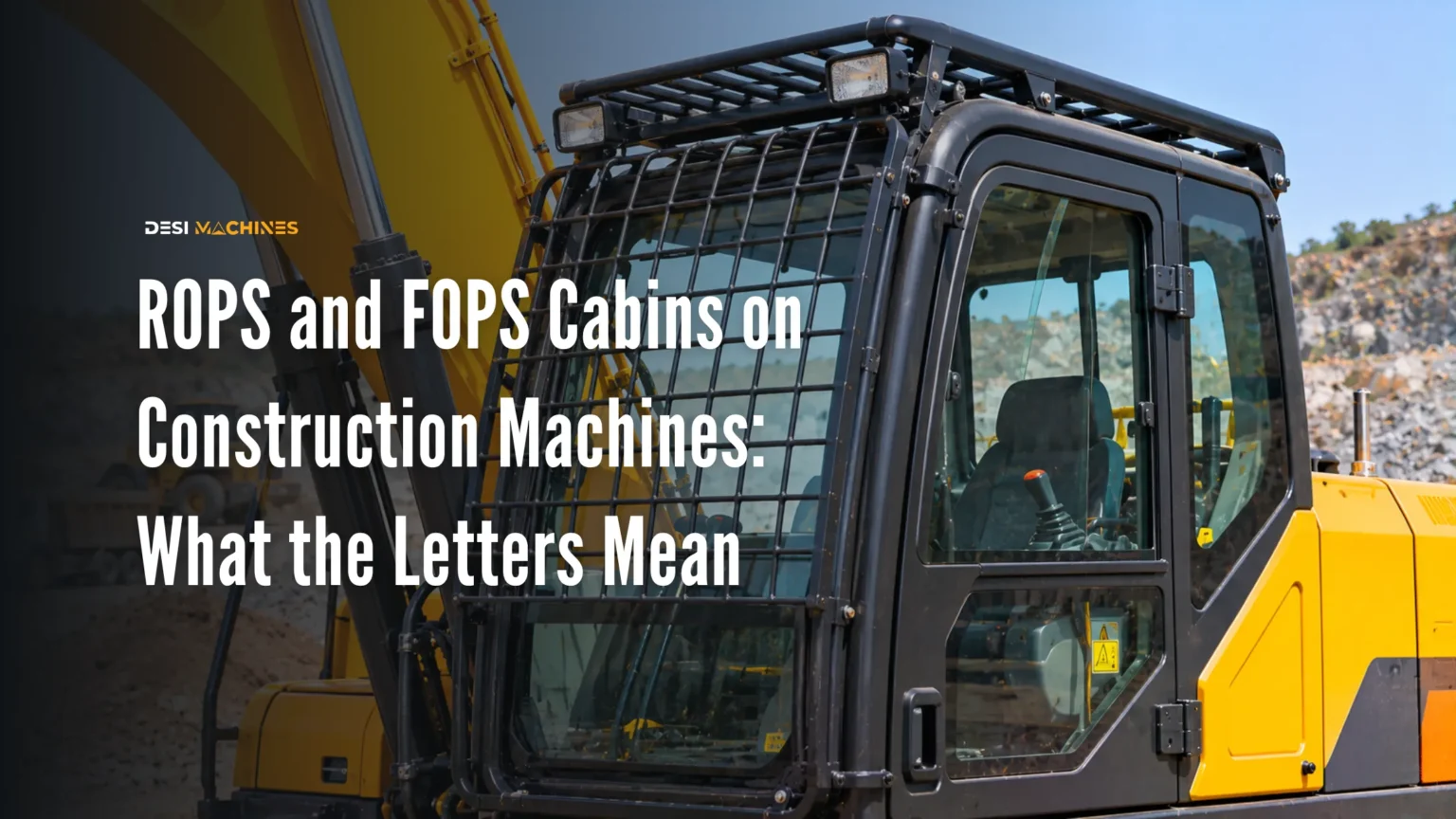
ROPS stands for roll-over protective structure and FOPS for falling-object protective structure: the first is the steel frame that keeps the operator’s space from being crushed when a machine tips over, the second is the guard above the operator’s head that takes a hit from above. On most machines one cab carries both jobs, which is why a specification sheet usually prints them together as a single line. Makers write that line several ways, so you will see “ROPS/FOPS cab”, “ROPS-FOPS cabin” and “ROPS and FOPS certified cabin” all meaning the same arrangement.
What the letters do not tell you is the part that matters on a site. A protective structure is tested against a seated operator wearing a seat belt, so what protects the operator is a frame plus a habit. This guide covers what each set of letters means, which machine classes carry which, how to read the plate riveted to the frame, and what to do when a structure gets bent. Replacement structures and cab glass are ordinary wear items on an old machine, and you can request spare parts for one the same way as any other assembly.
What do ROPS, FOPS and TOPS stand for?
Three sets of letters cover three different accidents.
A ROPS is a roll-over protective structure. The Indian Standard that governs it, IS/ISO 3471 : 2008, defines it as a system of structural members whose purpose is to reduce the chance of a seat-belted operator being crushed if the machine rolls over. The word system is doing real work there. The four posts you can see are only part of it: the sub-frame they sit on, and their brackets, mounts, bolts and pins, all count as the structure too. The simplest version is a rollbar, which is a ROPS of one or two posts with no cab around it, the kind you still see on older rollers and small loaders.
A FOPS is a falling-object protective structure. IS/ISO 3449 : 2005 covers it, and its job is narrower than people assume: it stops an object dropping through the roof onto the operator. The standard says plainly that a FOPS does not protect against being crushed from above in every situation. It is tested for penetration, not for a loaded truck body landing on the cab.
A TOPS is a tip-over protective structure, and in India you meet it on mini excavators rather than big machines. A mini machine working against a compound wall is far likelier to tip sideways into a trench than to roll a full turn, so the frame is designed and tested for that. The Hyundai R30Z-9AK is listed with a reinforced steel pillar canopy complying with TOPS, typical wording for the 3 ton class.
One more term, because the figures later depend on it. Testing is done against a deflection-limiting volume, or DLV, a boxy stand-in for a large seated man in normal clothes and a helmet. The structure passes if it bends without ever pushing into that box. That is the whole idea: the frame is allowed to deform, because deforming is how it absorbs the energy, as long as the space the operator occupies survives.
Which machines must have a roll-over protective structure?
IS/ISO 3471 : 2008 names its machines exactly, and the list is useful because it tells you where the question is settled and where it is not. The standard applies to machines with a seated operator weighing 700 kg or more, and it lists the dozer, the loader, the backhoe loader (the machine most people in India call a JCB), the dumper, the pipelayer, the grader, the landfill compactor, the roller, the trencher, and the tractor unit of a combination machine such as a tractor scraper.
Notice what is absent. An excavator is not on that list, and that is not an oversight: a machine that rotates on a slew ring and carries a boom fails differently from a dozer, so excavators have their own standard. The CAT 345 GC is listed with a ROPS cab meeting ISO 12117-2 : 2008, the excavator-specific test. Pick-and-carry cranes sit outside the earth-moving family too. Makers still certify their cabs, and the ACE 12XW is listed with a ROPS cabin plus a hoist cut-off and an overload alarm, but the governing test is not IS/ISO 3471.
A FOPS is never automatic. IS/ISO 3449 : 2005 applies to ride-on earth-moving machines generally, and what decides whether one is fitted is the work, not the machine’s weight. The standard covers a FOPS built in at the factory and one supplied separately and fitted later, which is why a guard can legitimately be added to a machine that left the works without one.
What does the ROPS plate on the cab tell you?
Every structure built to the standard carries a permanent label, and reading it takes ten seconds. IS/ISO 3471 : 2008 requires it to be fixed permanently to the structure, placed where it can be read easily, and protected from the weather. On most machines it is riveted to a cab pillar or inside the door frame.
It must state who made the structure and their full address, the structure’s own designation, the series or model of machine it was built for, its serial number, the year it was made, the standard it was tested to, and the figure that matters most to a second-hand buyer: the maximum machine mass for which the structure meets the requirements. Anything the maker has to say about fitting, repair or replacement goes on it as well. A FOPS carries its own label under IS/ISO 3449 : 2005, and where one structure passes both tests, the roll-over labelling follows the ROPS standard.
The maximum machine mass is the line to read before buying a used machine that has been altered. A structure is approved against a stated weight. Hang a heavier counterweight, a bigger blade or a rock guard on the machine and push it past that figure, and the approval no longer describes the machine you are sitting in. A cab lifted off one machine and bolted onto a heavier one is not a certified structure either, whatever the plate says, because the plate describes the machine it was tested for.
If the plate is painted over, missing or unreadable, treat the structure as unverified and ask the dealer for the paperwork. It is the only evidence the frame was ever tested.
FOPS Level I or Level II: what is the difference?
IS/ISO 3449 : 2005 sets two acceptance levels, and the gap between them is large. The level is chosen from what the machine is used for, so this is the one specification on the page that you select rather than inherit.
| Level | Impact energy the roof must take | Test object | Typical work it is meant for |
|---|---|---|---|
| Level I | 1,365 J | Round object, typical mass 45 kg, contact face 200 to 250 mm across | Small falling objects: bricks, hand tools, small concrete debris, site rubbish |
| Level II | 11,600 J | Steel or ductile iron cylinder, typical mass 227 kg | Heavy falling objects: rock, demolition material, trees, work under a face or a loading bench |
Level II asks the roof to absorb roughly eight and a half times the energy of Level I. The standard sets the drop height from the mass of the test object and gives worked examples: 45 kg falling 3.1 m develops the 1,365 J of Level I, and 227 kg falling 5.22 m develops the 11,600 J of Level II. Picture a 227 kg lump of rock coming off a bench a storey and a half above the cab, and you have the test.
So the level belongs in the purchase conversation. A machine loading trucks on a flat yard is a Level I situation. A machine under a quarry face, pulling down a building, or loading where material comes off a bench above it is a Level II situation, and a Level I roof is the wrong part for it. Makers state the level when they have tested to it: the Manitou MXT 840 K telehandler is listed with ROPS and FOPS Level 2 protection, and the Tata Hitachi EX 5600-7 mining excavator with a pressurised cabin certified for both. Where a sheet says only “FOPS” with no level, ask for the level in writing.
Demolition and breaker work usually adds guarding beyond the roof, because the danger comes at the glass as much as from above. The SANY SY240C-9HD GraMa is specified with front lower and top cabin guards on top of its ROPS cab, the normal arrangement for a machine that works under falling material.
Open canopy or closed cab: which does your site need?
This is the real decision for a first machine, and on a backhoe loader or a mini excavator you can usually buy either. Both can be certified; a canopy is not the cheap option with the safety left out.
An open ROPS canopy is a roof on posts with no glass and no doors. You get the roll-over frame, better all-round sight lines, air moving through on a hot day, and less to break when you work close to a wall. Several Indian backhoe loaders are built this way and certified for both structures: the Bull HD76 4WD and the Escorts Digmax Super both carry a ROPS and FOPS certified canopy. On compaction the canopy is close to universal: the CASE 1107NX soil compactor has a ROPS and FOPS canopy, and the Dynapac CA305 CEV-V a ROPS platform.
A closed ROPS/FOPS cab wraps the same frame in glass and doors and adds what keeps an operator working a full shift: air conditioning, a sealed and sometimes pressurised interior that holds dust out, and far less noise. The CASE 770 EX is listed with a ROPS/FOPS safety cabin and the E-Kubota BLX75 with a six-pillar one, so the closed route exists in the same class and horsepower band.
Three questions settle it. Does anything fall where you work? Then you want a roof rated for it, and probably glass in front of the operator. Is the machine on dusty crushing, mining or long highway shifts? A sealed cab pays for itself in hours worked, because an operator who is not breathing dust at four in the afternoon is still productive. Or do you work in tight urban pockets, close to walls and under cables? A canopy’s sight lines and its lack of breakable glass genuinely help there.
One warning on the middle path: fitting glass, a fabricated door or a sheet-metal roof onto an open canopy does not turn it into a certified cab.
Comparing machines rather than structures? Browse the full range of backhoe loaders and ask the dealer which cab options the variant you want is actually certified for.
Which machine classes carry ROPS and FOPS in India?
Across the machines listed on DesiMachines, a protective structure appears in the specification of more than 220 published models, and it is not spread evenly. Excavators are the largest group at 72, then backhoe loaders at 31, dozers at 28, compactors at 23 and pick-and-carry cranes at 22. The table below is what the makers’ own figures say class by class.
| Machine class | What the makers fit | Examples from the listings |
|---|---|---|
| Backhoe loader | Certified open canopy or closed cab, both ROPS and FOPS | Bull HD76 4WD, Escorts Digmax Super (canopy); CASE 770 EX, E-Kubota BLX75 (cab) |
| Excavator, 20 ton and above | ROPS cab to the excavator standard, with a falling-object guard where the work needs it | CAT 345 GC, SANY SY240C-9HD GraMa |
| Mini excavator, up to about 6 ton | Canopy or cab, usually certified to TOPS as well | Hyundai R30Z-9AK, Hyundai HX30AZ |
| Mining excavator | Pressurised cab certified for both structures | Tata Hitachi EX 5600-7 |
| Dozer | Closed ROPS and FOPS cab as standard; air conditioning often optional | BEML BD85 (hexagonal ROPS-FOPS cabin) |
| Soil compactor and roller | ROPS platform or canopy; FOPS on the models that work under a face | CASE 1107NX, Dynapac CA305 CEV-V, Ammann ARS 110.2 |
| Wheel loader | Closed ROPS/FOPS cab | Hyundai HL630I-V |
| Telehandler | ROPS with FOPS, and the level is usually stated | Manitou MXT 840 K (Level 2), SANY STH1056A |
| Skid steer loader | ROPS/FOPS as part of the standard operator station | L&T S315R |
| Self-loading concrete mixer | Certified cab on the larger models, sometimes an option | Apollo Carmix 30 FX |
| Pick-and-carry crane | ROPS cabin with load and hoist safety devices; not under the earth-moving standard | ACE 12XW |
| Motor grader | Named in the roll-over standard’s own machine list; a certified cab, often low-profile | Komatsu GD555, CASE 865B |
This table is a guide to how each class is normally built, not a fitment list for a particular machine. Options differ by variant and by year, so confirm the structure and its level with your machine’s operator manual or the manufacturer before buying or fitting. For the rest of the machine, the parts and components walk-throughs cover the excavator, the backhoe loader, the road roller and the wheel loader. On mining and tunnelling machines the cab also carries a fire suppression system, which is a separate assembly with its own checks.
Why does a ROPS only protect you with the seat belt on?
Because that is the condition it is tested under, and the standard is explicit about it. IS/ISO 3471 : 2008 defines a ROPS as protecting a seat-belted operator, and the test conditions spell out what the frame is expected to survive: a machine rolling through a full 360 degrees about its length on a hard clay slope of up to 30 degrees, at a starting speed of up to 16 km/h, without the machine leaving the slope.
Work through what happens inside the cab during that roll. The frame holds a protected space. An operator held in the seat by a belt stays inside that space while the machine turns over, and walks away. An unbelted operator is thrown around the cab or out of the door opening, and a machine that has rolled once usually keeps going. The frame did its job in both cases, but the second operator was never in the volume it protects. That is why the test uses the DLV: the protected space is drawn around someone still sitting in the seat.
FOPS roof guard
ROPS post
sub-frame and mounts
roll
DLV
So the belt and its anchorages are part of the structure’s safety system: a cut belt, a jammed buckle or a loose anchorage bolt takes a certified machine out of service as surely as a cracked post would. And note the starting speed in that test. A roll-over does not need speed, which is why the short shifting job inside a yard, the one where the belt gets skipped, is not the safe case it feels like.
Why a bent or welded ROPS has to be replaced, not repaired
A protective structure works once. It is designed to bend under load, and the bending is how it absorbs the energy of a roll, so a frame that has already deformed has spent the capacity it was certified for. Straightening it back to shape does not put that capacity back, and the steel is now worked and weaker where it bent.
The standard’s own test procedure shows how seriously this is taken: during the laboratory test no straightening and no repair is permitted at any point in the loading sequence. The structure takes the lateral, vertical and longitudinal loads in order, as built, or it fails. A structure in the field is held to the same logic, which is why the maker’s instruction after a roll-over is replacement rather than repair.
The same reasoning rules out the modifications that seem harmless in a workshop. Drilling a post to mount a light bar or a camera, welding a bracket to a cab pillar, cutting a section to fit new glass, or heating a member to straighten it all change a structure that was certified in one specific form. Mount the cab accessories to the brackets the maker provides, or to the machine body, and leave the frame untouched.
What to check, and roughly when:
- At every service, check each post and the roof for a crack, dent, kink or bulge, especially where a post meets the roof and where it meets the sub-frame.
- Check the bolts holding the structure to the machine frame for any that are loose, missing, rusted thin or of the wrong grade. The mounts are part of the structure, not fittings.
- Look for rust at the foot of each post and along the sub-frame, where water sits. On a ten-year-old machine this is the commonest real defect.
- Check the seat belt webbing, buckle and anchorage bolts at the same time, and replace a belt that is cut, frayed or stiff.
- Find the plate and read it. If it is painted over, clean it enough to read rather than guess.
- After any roll-over, tip or heavy strike from above, stop and get the maker’s instruction. Visible damage is not the test, because a frame can be spent without looking damaged.
What to settle before you buy
Four questions, and a dealer can answer all of them for a specific variant. Does it come with a certified canopy, a closed cab, or both as options? Is a falling-object structure fitted, and at which level? What is the maximum machine mass on the plate, checked against the machine as it will actually be configured? And are the seat belt and its anchorages in order?
On a used machine, ask what the frame has been through. A structure with no history, no readable plate and fresh paint over the posts is the one case where the sensible answer is to walk away or to price in a replacement. For the rest of the running-cost picture, the parts and running costs guides cover the wear items class by class. Comparing live machines instead? Browse the full range of excavators and have the dealer confirm the cab certification for the variant you are quoted.
The standards quoted above are the Indian Standards themselves, both published by the Bureau of Indian Standards and identical to the ISO standards of the same numbers: IS/ISO 3471 : 2008 on roll-over protective structures, and IS/ISO 3449 : 2005 on falling-object protective structures. Machine-level details are the specifications published by the machines listed on DesiMachines at the time of writing. Specifications and fitted options are indicative, vary by variant, location and date, and should always be confirmed with the official OEM or authorised dealer before any purchase decision. DesiMachines is not liable for decisions taken on the basis of information that may have changed after publication.
Get a rops or fops cab price from a dealer near you
Tell us your machine and what you need, and we will ask the nearest dealer to reach out to you with a price.