Excavator
316 models
 Backhoe Loader
54 models
 Crane
68 models
 Concrete Mixer
79 models
 Wheel Loader
54 models
 Compactor / Roller
45 models
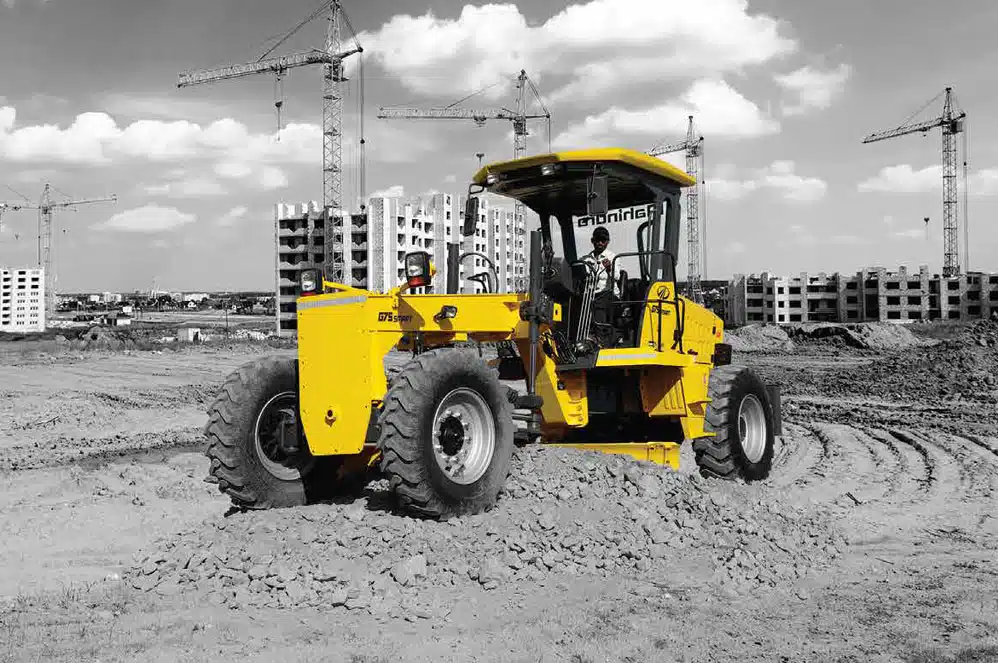
 Motor Grader
42 models

 Concrete Pump
66 models
 Skid Steer Loader
11 models



A speed governor for tipper work is compulsory, because a tipper carrying material on a public road is a transport vehicle: rule 118 of the Central Motor Vehicles Rules 1989 sets it at 60 km/h if the vehicle is a dumper, tanker, school bus or hazardous-goods carrier, and 80 km/h otherwise. Your excavator, backhoe loader, compactor roller, grader, dozer or mobile crane is a construction equipment vehicle, which rule 2(cab) calls a non-transport vehicle, so rule 118 does not reach it. On anything built on or after 1 October 2015 the maker or the dealer fits the device. On a transport vehicle registered before that date, the rule puts it on you as the operator.
The argument usually starts at a weighbridge or an RTO counter: one owner has been told every machine in the yard needs a speed governor, another has been told none of them do. Both are reading the same set of Rules. The rule turns on one word in the first line of rule 118, and it is not the machine.
What rule 118 actually says
Rule 118 was substituted by notification G.S.R. 290(E) dated 15 April 2015. It opens on “every transport vehicle notified by the Central Government under sub-section (4) of section 41 of the Motor Vehicles Act, 1988”, manufactured on or after 1 October 2015. Those vehicles must be fitted with a speed governor, which the rule also calls a speed limiting device or speed limiting function, with a maximum pre-set speed of 80 km/h conforming to the standard AIS 018/2001.
Three things in that sentence decide your answer, and owners usually read only the first. The vehicle has to be a transport vehicle. It has to be one of the types the Central Government has notified, under the Ministry of Road Transport and Highways notification specifying the types of motor vehicles. And the date of manufacture decides who does the fitting.
The rule then carves out exemptions. Two-wheelers, three-wheelers and quadricycles are out. So are fire tenders, ambulances and police vehicles. The exemption that matters on a construction fleet is the last one: a vehicle “verified and certified by a testing agency specified in rule 126 to have maximum rated speed of not more than 80 kilometre per hour” does not need a governor at all. A machine that cannot physically break the limit is not asked to carry a device that stops it.
A speed governor for tipper work: 60 or 80 km/h?
The second proviso to rule 118(1) pulls four categories down to 60 km/h: dumpers, tankers, school buses, and vehicles carrying hazardous goods, manufactured on or after 1 October 2015. The same proviso lets the Central Government add categories later by gazette notification.
This is where the word “dumper” causes real confusion on site, because it appears twice in the same set of Rules and means different things. In rule 118 it is a transport vehicle, a tipping truck registered to carry material on the road, and it gets 60 km/h. In rule 2(cab) it is one of the machines listed as a construction equipment vehicle, and that definition puts it outside rule 118 altogether. A site dumper that works inside the project boundary and a tipper that runs loaded to a batching plant are not in the same legal category, whatever the yard calls them.
A later insertion, G.S.R. 963(E) dated 7 October 2016, added a third group from 1 April 2017: articulated, truck-trailer and tractor-trailer vehicles engaged by automobile makers to carry vehicles from factory to sale outlets, also at 60 km/h, and it notes this holds until the matching Bureau of Indian Standards specification is notified. Rule 118(3) sets an airport passenger bus at 30 km/h.
| What you run | Rule 118 applies? | Pre-set speed |
|---|---|---|
| Tipper or tipping truck registered as a goods carriage | Yes | 60 km/h as a dumper, else 80 |
| Tanker, school bus, hazardous-goods carrier | Yes | 60 km/h |
| Excavator, backhoe loader, wheel loader, dozer | No, non-transport under rule 2(cab) | Not prescribed |
| Compactor roller, motor grader, mobile crane, fork lift | No, non-transport under rule 2(cab) | Not prescribed |
| Any notified vehicle certified at 80 km/h top speed or less | Exempt by the first proviso | Not required |
| Airport passenger bus under rule 93C | Yes | 30 km/h |
Your excavator and backhoe sit outside the rule
Rule 2(cab), inserted by G.S.R. 642(E) dated 28 July 2000, defines a construction equipment vehicle as a rubber tyred, rubber padded or steel drum wheel mounted, self-propelled excavator, loader, backhoe, compactor roller, dumper, motor grader, mobile crane, dozer, fork lift truck or self-loading concrete mixer, designed for off-highway work in mining, industry, irrigation and general construction but built with on-and-off highway capability.
Then comes the Explanation that settles the question. A construction equipment vehicle “shall be a non-transport vehicle the driving on the road of which is incidental to the main off-highway function and for a short duration at a speed not exceeding 50 kms per hour”. Non-transport is the operative word. Rule 118 only ever speaks to transport vehicles, so it has nothing to say about the JCB 3DX in your yard or a 20-tonne class machine like the Tata Hitachi EX 210 Infra.
If you want proof that the drafters knew how to include machines when they meant to, read the rule immediately before it. Rule 117, on speedometers, was amended by the same 2000 notification to read “every motor vehicle (including construction equipment vehicle)”, and sub-rule (2) requires a speedometer conforming to IS 11827-2008 from 1 April 2015 for new models and 1 April 2016 for existing ones. A proviso even exempts a construction equipment vehicle whose driver’s cabin rotates about a vertical axis, which is the excavator. The speedometer rule names your machines. The speed governor rule does not. For what your machine can actually do on the road, our guide to backhoe loader top speed and gears has the measured figures.
Who fits the device, and who pays
For a vehicle manufactured on or after 1 October 2015, rule 118(1) is specific: the fitment is done “by the vehicle manufacturer, either in the manufacturing stage or at the dealership stage”. It is a factory or dealer item, not something you source afterwards, and on a new tipper it should already be there when you take delivery. That makes it a question for the authorised dealer at purchase, alongside the rest of the handover paperwork.
Rule 118(2) handles the older fleet, and this is the part that costs owners money. State Governments were to notify, on or before 1 October 2015, the categories of transport vehicles registered before that date that were not already fitted and not covered by the exemptions. Those vehicles had to be fitted “by the operators of those vehicles” on or before 1 April 2016, at 80 km/h or a lower limit the state specifies, and at 60 km/h for dumpers, tankers, school buses and hazardous-goods carriers. If you bought a used tipper of that vintage, the obligation came with it.
Before you spend on a retrofit, check whether the machine is registered as a transport vehicle at all. Our walkthrough of construction equipment registration at the RTO covers which class your machine falls in, and the JCB fitness certificate piece explains when a machine is called in for inspection in the first place. If the fleet decision is a purchase rather than a retrofit, our equipment finance options page sets out what lenders look for.
What a state can and cannot add
Owners get contradictory instructions here, and in one case the matter went to court. Delhi issued a notification dated 17 July 2018 on speed limiting devices. In Rana Motors Pvt. Ltd. v. Government of NCT of Delhi, decided on 17 September 2020, the Delhi High Court held that the proviso to clause 1 of that notification, insofar as it dealt with vehicles registered on or after 1 October 2015, was beyond the powers the Rules give the state, and quashed it. The court’s reasoning was that rule 118 reserves the post-2015 fleet to the central rule, and a state cannot set a figure at variance with it.
Read that for what it is worth to you. A state’s say under rule 118(2) runs to vehicles registered before 1 October 2015. For a tipper registered after that date, a demand to re-fit or re-set the device to a state-specific figure is exactly what the Delhi High Court struck down in that notification. A judgment on one state’s notification does not repeal another state’s, so get the demand in writing and check it against the notification it claims to rest on.
The device, the seal and the paperwork
Rule 118 prescribes conformity to AIS 018/2001, as amended, and nothing about a certificate. Searching the whole of the Central Motor Vehicles Rules for “speed governor” returns only rules 117 and 118, so the Rules neither name a form nor list the device as a separate item in the fitness inspection. That is worth knowing before you pay for a document somebody tells you is mandatory.
What the paperwork actually consists of shows up in the Delhi notification reproduced in the Rana Motors judgment: the device is to be type approved for that particular vehicle model by one of the testing agencies specified under rule 126, retro-fitment follows the guidelines issued by the Ministry of Road Transport and Highways and the Supreme Court Committee on Road Safety, and the device is sealed by the vehicle manufacturer, the device manufacturer or their authorised representative, whoever fitted it. The seal, not a certificate, is the thing an inspector looks for. Since your state’s notification is the one that binds you, ask your RTO which document it accepts at the fitness test, and keep the fitter’s invoice with the machine file along with the road tax papers.
When the obligation comes from your contract, not the Rules
A machine can sit outside rule 118 and still be refused at a gate. Mine owners set their own fitment list, and it is usually stricter than the motor vehicle rules. Our note on NLC vendor registration records a tender where tippers entering the mine had to carry the safety devices listed in a DGMS circular, including a cabin canopy, seat belt reminder, retarder brake, speed limiter, proximity warning device, body-raised alarm and load indicator, with drivers holding valid vocational training.
So the question is not only what the Rules require of your vehicle, but what the client requires of a vehicle on their site. A tipper that is legal on the highway can be turned away from a mine gate for a missing device, and the idle day is yours to absorb. That is the same arithmetic as any other stoppage, which we work through in equipment downtime cost, and the kind of wear-and-replacement planning behind tipper tyre life.
Before your next fitness test, check these four things
- Class first. Is the machine registered as a transport vehicle or as a construction equipment vehicle? Rule 118 only follows the first.
- Then the date. Manufactured on or after 1 October 2015 means the maker or dealer owned the fitment. Registered before that date means the operator does, in the categories your state notified.
- Then the rated speed. If a rule 126 testing agency has certified the vehicle at 80 km/h or less, the first proviso exempts it.
- Then the seal. If a device is fitted, confirm it is type approved for that model and sealed by whoever fitted it, and keep the invoice in the machine file.
A tipper that spends its life between a quarry and a plant also needs its own cover for the road risk it carries, which is worth reading alongside our machine insurance options before the next renewal.
Rule references here are to the Central Motor Vehicles Rules 1989 as substituted by G.S.R. 290(E) of 15 April 2015 and amended by G.S.R. 963(E) of 7 October 2016, and to the Delhi High Court judgment in Rana Motors Pvt. Ltd. v. Government of NCT of Delhi dated 17 September 2020, all read on 17 November 2026. Rules, notifications, standards and state requirements change. Confirm the current position with your RTO, the OEM or the authorised dealer before you fit a device or pay for a certificate.