
 Excavator
316 models
 Backhoe Loader
54 models
 Crane
68 models
 Concrete Mixer
79 models
 Wheel Loader
65 models
 Compactor / Roller
45 models
 Motor Grader
42 models

 Concrete Pump
66 models
 Skid Steer Loader
11 models


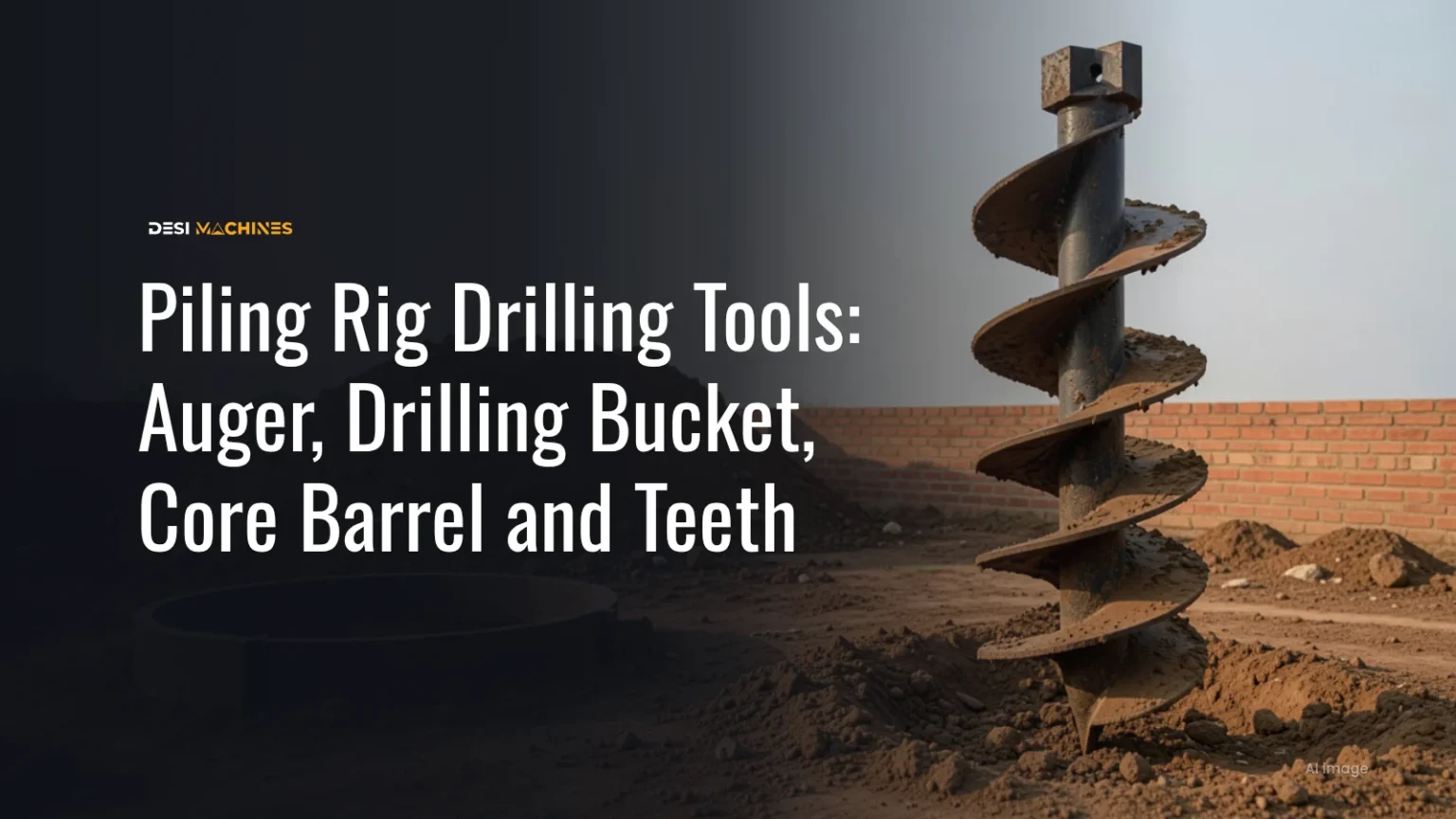
If your soil report shows clay, then wet sand, then weathered rock under one pile, no single tool will finish that bore. A piling rig works through it by changing the tool on the end of its kelly bar: an auger for dry or firm soil, a drilling bucket for wet and loose ground, a rock auger or core barrel for rock, and a cleaning bucket to clear the base before concrete goes in.
This guide explains what each piling tool is, how it cuts and holds the spoil, which teeth it carries, how hard a ground each one can handle, and how to size a tool to the pile and the casing. It is written for the contractor, site engineer or rig owner who has to decide which tools go to site with the rig. The tool data comes from two makers’ published catalogues, read in November 2026: Liebherr’s Kelly drilling tools brochure and Soilmec’s Drilling Tools catalogue (03-2016), with Bauer’s published tool notes alongside. The site rules come from the Indian piling codes, IS 2911 (Part 1/Sec 2):2010 and IS 14593:1998.
What tools does a piling rig use?
A rotary piling rig uses four families of drilling tools, all hung from the bottom of the kelly bar (the telescopic steel bar the rig turns and pushes down the hole): augers, drilling buckets, core barrels and a small set of special tools. Each one connects through a square socket on top called the kelly box, so the crew can lower one tool, lift it out and fit the next within the same bore.
An auger, the piling auger crews talk about, is a short, heavy screw. Its spiral blade, called the flight, cuts the ground with teeth on its leading edge and holds the loosened soil on the flight until the rig lifts it out and spins it off. A drilling bucket is a steel drum with cutting teeth on a bottom plate. Soil is cut and pushed in through slots in that plate, a flap closes them, and the full bucket is lifted out and emptied by opening its bottom. A core barrel is an open steel tube with teeth round its bottom rim. It cuts a ring into rock and leaves a solid cylinder of rock inside, which is then broken off and lifted out.
The special tools solve particular problems. A cleaning bucket clears loose material off the bottom of the bore. A cross cutter breaks old foundations, cores and boulders. A boulder extractor grabs and lifts a large boulder out whole. A belling bucket opens the base of the pile wider than its shaft. On older bailer-and-chisel and DMC rigs, the cutting tool is a heavy chisel dropped from a winch instead, as the guide to DMC piling explains.
| Tool | How it cuts and carries spoil | Ground it suits | Teeth it usually carries |
|---|---|---|---|
| Soil auger | Flight cuts and holds soil; spun off at the surface | Firm to stiff clay, and sand or gravel that stands up in a dry hole | Flat teeth, fishtail pilot bit |
| Rock auger | Cutter bar breaks rock; flight carries the pieces | Very dense soil and weak rock up to about 50 MPa; progressive types up to 100 MPa | Round shank chisels (bullet teeth) |
| Drilling bucket | Cut soil enters through bottom slots; flap closes; bucket lifted and emptied | Wet holes under water or bentonite slurry; loose sand and silt | Flat teeth on soil buckets |
| Rock drilling bucket | As above, with a rock cutting bottom | Dense soil and weak or fractured rock up to about 50 MPa, wet holes | Round shank chisels |
| Core barrel | Cuts a ring; rock core is broken off and lifted | Hard rock up to 100 MPa, unreinforced concrete | Weld-on blocks or round shank chisels |
| Core barrel with roller bits | Rolling carbide bits crush the ring | Compact rock from 100 up to 250 MPa | Tapered roller bits with carbide pins |
| Cleaning bucket | Bucket that scrapes and collects loose material off the base | Base of the finished bore, before the cage and concrete | A hard steel blade (Soilmec) or a reamer bar (Liebherr) |
| Cross cutter, boulder extractor | Breaks or grabs obstructions | Boulders, old foundations, broken rock cores | Round shank chisels (cross cutter) |
MPa (megapascal) here is the rock’s compressive strength, the pressure a sample can take before it crushes. It is the number a soil investigation report gives for rock cores, and it is how Liebherr and Soilmec state the limit of each tool.
Auger or drilling bucket: which one for which soil?
Use a piling auger where the hole is dry and the walls stand up, and a drilling bucket where the hole is full of water or bentonite slurry. That one rule decides most of the choice, and the reason is mechanical.
An auger holds its spoil only by friction on an open flight. In firm clay that works well: the clay sticks to the flight and comes up in one load. In wet sand the grains slide off the flight as it is lifted up through the water, and part of the load falls back into the hole. Bauer’s notes describe augers as the simplest and most cost-effective Kelly tools, for dry holes. They describe buckets as the most effective and safest tools for wet drilling, for three reasons: no material is lost while the bucket is pulled up through the water column, the closed bucket helps prevent the base of the hole from heaving up (a “hydraulic soil break”), and the spoil comes out where the crew chooses to empty it.
So in a typical Indian bored pile, the top layers above the water table are bored with an auger inside a short steel casing, and the bucket takes over once the hole is below the water table or under slurry. IS 2911 (Part 1/Sec 2) clause 5.3 warns that in soft layers and loose sands the bailer and chisel must be used with caution to avoid suction. The same piston effect applies to any closed tool pulled up quickly through loose sand: it draws the soil in behind it. That is why Liebherr’s buckets carry a ventilation channel or flow passage, which lets slurry pass the bucket as it rises.
Inside each family there are choices too. A single-start tool has one cutting edge and one flight or bottom slot; a double-start tool has two, set opposite each other, so the cutting force is balanced and the tool runs straighter. Liebherr lists its double-start rock tools for secant piled walls, where each pile cuts into its neighbour and has to stay on line. Soilmec also lists a guillotine bucket for clean sands and gravels, a conical-bottom bucket for sands with fines and clays, and a compact bucket with a 700 mm body. Most tools carry a pilot bit at the centre, a fishtail-shaped one for soil and a chisel-tipped one for rock, to hold the tool on centre as it starts to cut.
Need a crane beside the rig to lift casing, tools and reinforcement cages? A pick-and-carry machine such as the ACE FP 210 piling crane is built for that work; compare crane models and talk to a dealer near your site.
Flat teeth or bullet teeth: which tooth for which ground?
Flat teeth cut soil; round shank chisels, which crews call bullet teeth, break rock. The tooth is the part that wears out, so getting it right decides how fast the pile goes down and how often the crew stops to change teeth.
A flat tooth is a broad, flat steel blade, often carbide-tipped, set at an angle on the leading edge of an auger flight or bucket bottom. It shaves a wide strip of soil on every turn. Bauer calls flat teeth the most effective wear part for loose soils, with very efficient soil removal and good transport of the cut material onto the tool, and lists them for sand, silt, gravel and clay. Soilmec fits flat ESCO teeth (types V18, U20 and U25) to its soil augers and soil buckets, and notes that the tooth type has to suit the tool diameter.
A round shank chisel is a short pick with a hard carbide point on a round steel shank that sits in a holder welded to the tool. It puts the rig’s force onto a point, which cracks rock instead of shaving it. Soilmec’s rock augers and rock buckets come with either 25 mm or 30/38 mm shank picks, the heavier shank on tools meant for more fractured, harder rock. Liebherr’s rock tools add calibration chisels on the outer edge, which cut the hole to its full width and stop it narrowing as the main chisels wear.
For the hardest ground, the tooth changes again. A core barrel can carry weld-on cutting blocks or round shank chisels on its rim, and for rock above 100 MPa Liebherr fits tapered roller bits studded with carbide pins, which crush the rock as they roll.
| Tooth | What it looks like | How it cuts | Used on |
|---|---|---|---|
| Flat tooth | Broad blade, often carbide-tipped | Shaves a wide strip of soil | Soil augers and soil buckets in clay, silt, sand and gravel |
| Round shank chisel (bullet tooth) | Carbide point on a round shank in a holder; 25 mm or 30/38 mm shanks | Point attack that cracks rock | Rock augers, rock buckets, core barrels, cross cutters |
| Calibration chisel | Round shank chisel set at the outer edge | Cuts the hole to full diameter | Rock augers and rock buckets |
| Weld-on block | Hard block welded to the core barrel rim | Grinds a ring in rock or concrete | Core barrels up to 100 MPa |
| Roller bit | Tapered roller with carbide pins | Crushes rock as it rolls | Core barrels for 100 to 250 MPa rock |
How hard a rock can each piling tool cut?
Liebherr’s catalogue gives the clearest ladder, and it reads by compressive strength. A single-start or double-start rock auger, or a rock drilling bucket, handles very dense soil and low-strength rock up to about 50 MPa. A double-start rock auger without a pilot bit goes to about 60 MPa in fissured rock. A progressive rock auger, which carries its round shank chisels along a progressive auger section instead of on one cutter bar, goes up to 100 MPa. A core barrel with weld-on blocks or round shank chisels also reaches 100 MPa, and a core barrel with roller bits works in compact rock from 100 up to 250 MPa.
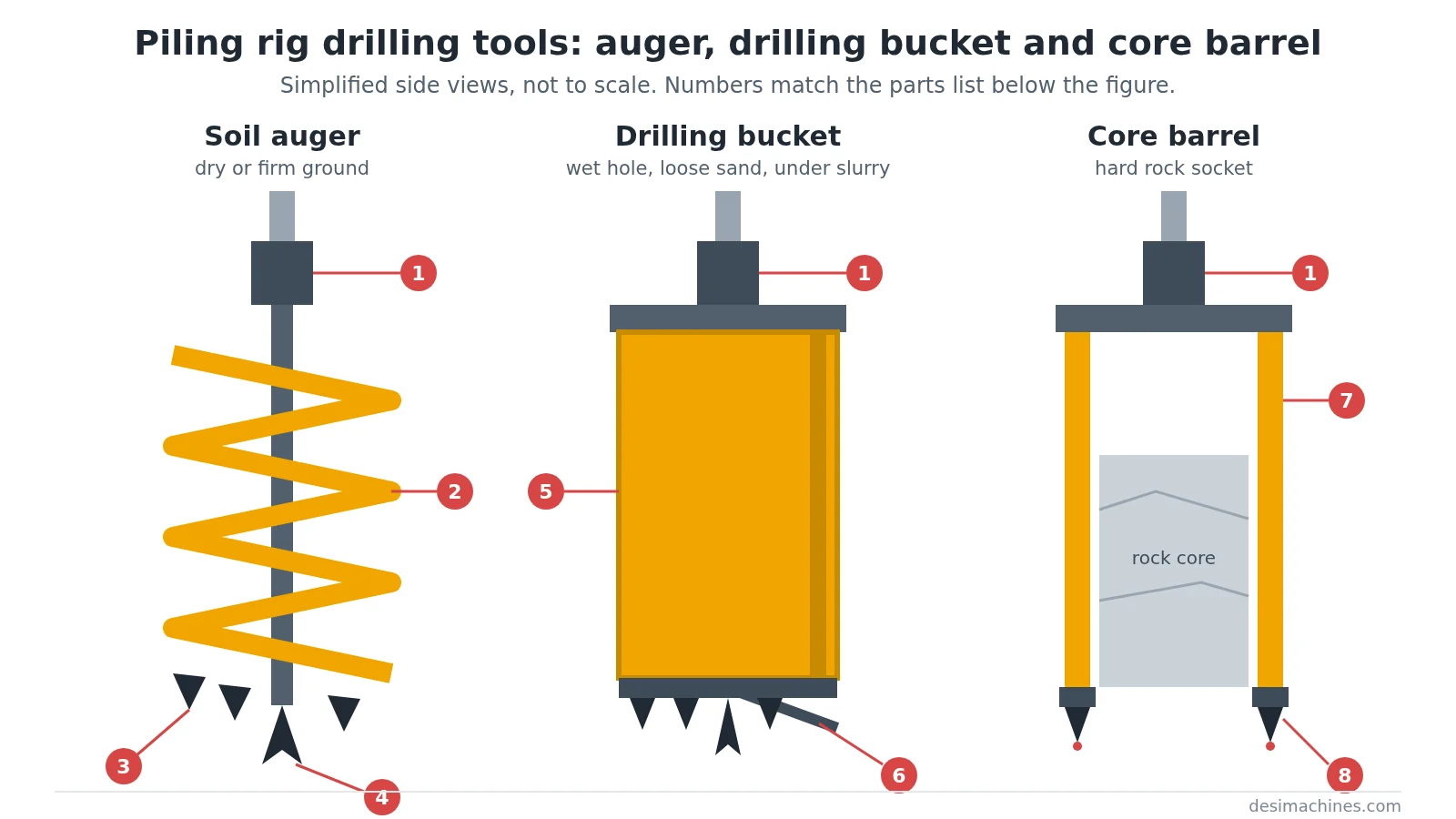
Parts shown in Figure 1
- Kelly box: the square socket that takes the end of the kelly bar.
- Flight: the spiral blade of the auger that holds the cut soil.
- Flat teeth on the auger’s cutting edge.
- Pilot bit: centres the tool as it starts to cut.
- Bucket body: the drum that holds spoil through water or slurry.
- Bottom flap and teeth: soil enters through the slots, and the flap closes before lifting.
- Core barrel tube.
- Cutting ring with round shank chisels.
Soilmec says the same in fewer steps: its tools cut rock up to 100 MPa, and sometimes harder rock when it is highly fractured, because broken rock comes away in pieces. It names three properties of rock that decide cutting speed: compressive strength, abrasivity (how much quartz the rock holds, which grinds carbide away) and structure (how many fractures it has, how far apart and in which direction). Two rocks of the same strength can wear teeth at very different rates if one is full of quartz.
What this means for the job is simple. Read the rock test results in the soil report before tools are chosen, and ask the piling contractor which tool they plan to use at each depth. A contractor who brings only soil augers to a job whose report shows a rock socket will lose days chiselling. Where the rock is too hard or too deep for the rig to core economically, a DTH hammer may be the faster answer; that choice is laid out in DTH piling vs rotary piling, and the hammer and its button bits are covered in the guide to the DTH hammer.
What size of tool does a pile need?
The tool must be close to the full pile diameter, but small enough to pass inside the casing where the hole is cased. Two rules set the size.
The first comes from the Indian code for bored piles socketed in rock. As per IS 14593:1998 clause 5.3, the cutting tool should not be smaller than the pile diameter by more than 75 mm. So a 1,000 mm pile needs a tool of at least 925 mm. A smaller tool leaves a thinner pile than the drawing assumes.
The second is the casing. Where the hole is held open with steel casing, the tool works inside it, so the tool’s diameter is set by the casing’s inside diameter, while the cutting shoe on the bottom of the casing cuts the outer ring of the hole. Below the end of the casing, in a rock socket, the hole is only as wide as the tool, which is where the 75 mm rule bites. Where the hole is held open with bentonite slurry instead, there is no casing in the way and Liebherr makes the tool the same diameter as the pile: a 1,000 mm tool for a 1,000 mm pile. For cased holes its catalogue pairs tool and casing like this:
| Casing outside diameter | Casing inside diameter | Tool diameter inside that casing |
|---|---|---|
| 620 mm | 540 mm | 520 mm |
| 800 mm | 720 mm | 700 mm |
| 1,000 mm | 920 mm | 900 mm |
| 1,300 mm | 1,220 mm | 1,180 mm |
| 1,500 mm | 1,420 mm | 1,370 mm |
| 2,000 mm | 1,910 mm | 1,840 mm |
Three more checks keep the tool matched to the rig. The kelly box must fit the end of the rig’s kelly bar: Liebherr fits a 200 x 200 mm box as standard, and Soilmec offers 130 x 130, 150 x 150 and 200 x 200 mm boxes on tools from 400 to 2,000 mm across. The tool must be rated for the rig’s torque: Liebherr rates its tools to 350 kNm up to 700 mm across and 480 kNm above that, and how much torque each rig class delivers is set out in the guide to piling rig specifications. And the tool’s weight adds to the load on the main winch. Liebherr’s single-start soil auger for a 1,000 mm uncased pile weighs about 995 kg with the standard 1.5 m working length and 1,525 kg with the 2.5 m length, while its roller-bit core barrel for the same pile weighs about 1,980 kg. The longer tool lifts more spoil per trip, but it is heavier and needs more headroom above the hole.
Which tools should go to site for one pile through mixed ground?
Take one pile and follow it down. Say the soil report shows 6 m of stiff clay, then 8 m of sand below the water table, then weathered rock, and the drawing asks for a 1.5 m socket in harder rock at the bottom. The tool list for that pile, using the catalogue rules above, would be:
- A soil auger with flat teeth for the clay, working inside a temporary casing at the top. IS 2911 clause 8.1.3 asks for at least 2 m of temporary casing at the top of every bored pile.
- A soil drilling bucket for the wet sand, with the hole kept full of bentonite slurry or cased right through, so the sand cannot run in.
- A rock auger or rock bucket with round shank chisels for the weathered rock, a rock bucket if the hole is still wet.
- A core barrel for the socket, sized to the rock strength in the report, and a cross cutter to break the core if it will not come up with the barrel.
- A cleaning bucket for the base. IS 2911 (Part 1/Sec 2) clause 8.3.1 says that where a rotary rig is used, the bore is to be cleaned with a cleaning bucket attached to the kelly, and flushed with fresh bentonite slurry after it where slurry is in use.
Add a boulder extractor if the report logs boulders, because one large boulder can stop an auger dead and push the bore off line. Where a boulder or rock lip sits at the surface, a hydraulic rock breaker on an excavator clears it before the rig sets up.
Two reasons make this list worth agreeing before work starts. Tools are heavy and slow to bring in once the rig is standing on a pile. And the bill depends on them: IS 2911 clause 8.6 asks that the depth bored in soft and hard rock, and the time spent chiselling, be recorded for every pile, and those records are what a per-metre piling rate is settled on.
Why does a piling tool stop cutting, and what do you check?
Slow progress, a short load or a bore going off line usually points to the tool, not the rig. Check these before blaming the machine.
| What you see | Likely cause | What to check or change |
|---|---|---|
| Auger comes up half empty in wet ground | Soil sliding off the open flight through water or slurry | Change to a drilling bucket below the water table |
| Bucket comes up empty or spills on the way up | Bottom flap not closing fully; slots blocked by clay | Clean the slots, check the flap and its opening rod |
| Sand runs in or the base heaves when the tool is lifted | Suction: tool lifted too fast, or vent channel blocked | Lift slowly, clear the vent, keep the slurry level up (IS 2911 cl. 5.3 caution) |
| Progress slows in the same layer, rig working hard | Teeth worn blunt, or flat teeth being used in rock | Replace worn teeth; change to round shank chisels or a core barrel |
| Hole narrower than the tool size, casing sticks | Calibration chisels and wear plates worn | Measure the tool across its outer cutters; rebuild before the next pile |
| Tool stops dead or the bore wanders | Boulder or a sloping rock face | Cross cutter, boulder extractor or chisel; check verticality after |
| Core barrel turns but the core will not come up | Core not broken off at its base | Use a cross cutter to break the core, then lift it with a bucket |
Liebherr builds its tools with exchangeable hard-metal wear plates and hardfacing (a hard weld layer) on the body, gives its core barrels an exchangeable cutting ring, and lists cutter bars, chisel holders, flat teeth and round shank chisels as wear parts, so worn parts can be swapped instead of scrapping the tool. Check them after every pile in abrasive ground. A tool that has lost its outer cutters drills an undersized hole, and an undersized hole is a thinner pile.
Teeth and wear plates are the running cost of piling tools. The intervals and checks for rock drill rigs, including bits and rods, are in the guide to drill rig maintenance.
How do piling tools fit with the rest of the rig?
The tool is the part that touches the ground, but it only works as well as the rig behind it. The guide to the drilling rig machine explains how a rotary piling rig turns and pushes the kelly bar, and where piling rigs sit among the other drill rigs. Piling is also the first big job on most elevated metro and flyover sites; where the piles sit in that build is explained in how an elevated metro is built.
Before a piling contractor starts, ask four questions: which tool for each layer in the soil report, how the hole will be kept open below the water table, which tool will cut the rock socket and up to what rock strength, and how the base will be cleaned before concrete. A contractor who answers each with a named tool has read the report. The decision on who to hire and what to accept stays with you.
For the cranes that work beside a piling rig, lifting casing, tools and reinforcement cages, compare crane models and speak to a dealer about the lift your heaviest cage needs. More on rigs and drilling sits in the drill rig guides.
Sources: Liebherr, Kelly drilling tools brochure (tool types, rock strength limits, diameters, weights, torque, wear parts); Soilmec, Drilling Tools catalogue 03-2016 (soil and rock tool ranges, ESCO and round shank teeth, kelly box sizes); Bauer Maschinen, Kelly drilling tools and flat teeth pages; Bureau of Indian Standards IS 2911 (Part 1/Sec 2):2010, clauses 5.3, 8.1.3, 8.3.1 and 8.6, and IS 14593:1998, clauses 5.1 to 5.3. Maker figures read November 2026.
Prices, specifications and features are indicative, vary by variant, location and date, and should always be confirmed with the official OEM or authorised dealer before any purchase decision. DesiMachines is not liable for decisions taken on the basis of information that may have changed after publication.
Get a piling rig drilling tools price from a dealer near you
Tell us your machine and what you need, and we will ask the nearest dealer to reach out to you with a price.
