Excavator
316 models
 Backhoe Loader
54 models
 Crane
68 models
 Concrete Mixer
79 models
 Wheel Loader
54 models
 Compactor / Roller
45 models
 Motor Grader
42 models

 Concrete Pump
66 models
 Skid Steer Loader
11 models


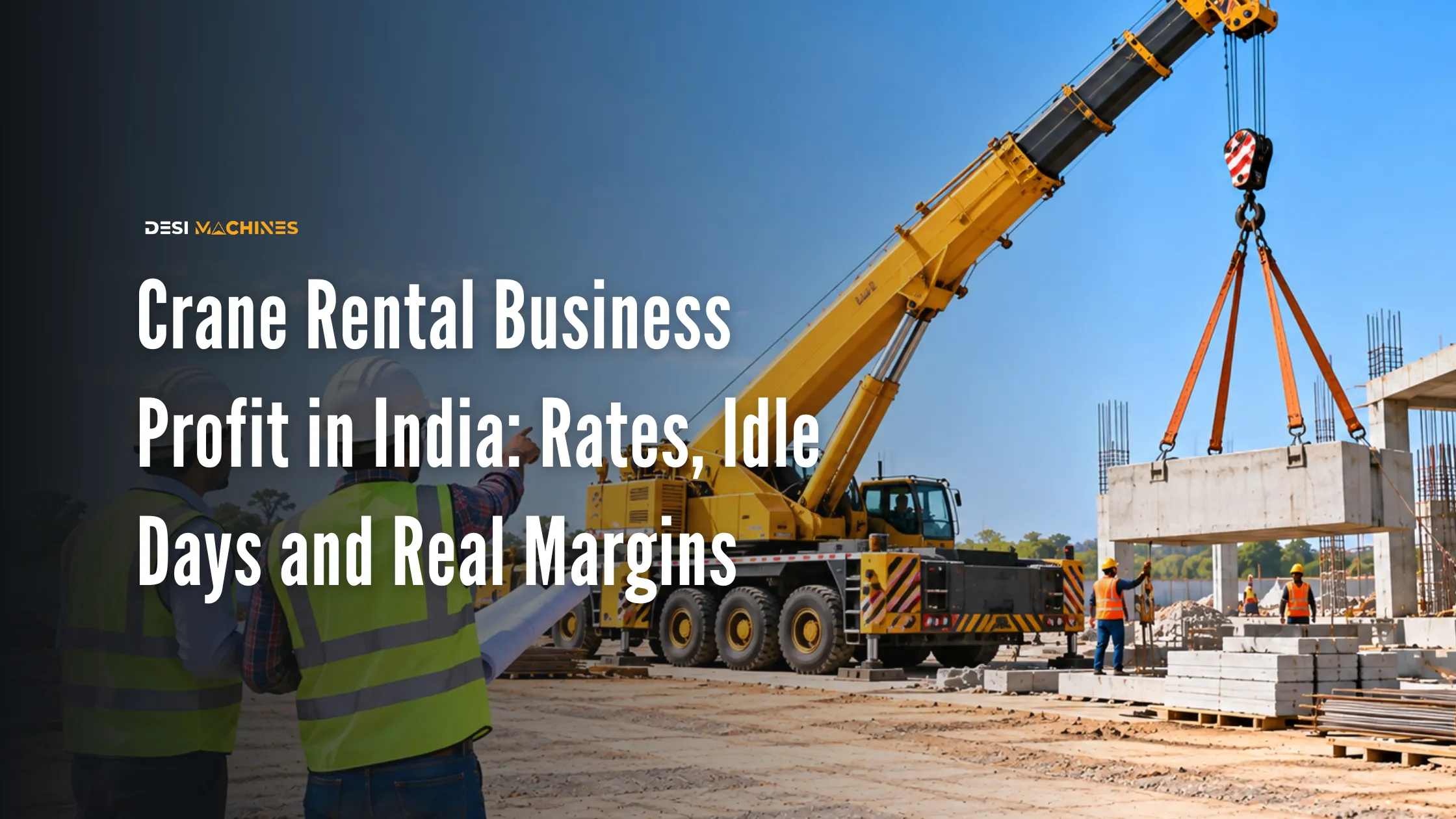
Crane rental business profit comes down to billable days, not the rate card. A hire crane is paid by the day or the shift, its costs are mostly fixed, and the owner’s real job is removing the things that stop it working: a lapsed twelve-month examination certificate, a mobilisation that eats half the booking, an operator who is not licensed for the road. Get the day count up and the margin follows; chase the rate and you will spend a year discovering that the rate was never the problem.
A 15-tonne pick-and-carry crane sat in a yard outside Nagpur for eleven days last season. Nothing was broken. The owner had three enquiries in that window and turned all of them down, because the annual thorough examination had expired and the contractor asking for the crane wanted to see the certificate before it entered the site. Eleven days of EMI, operator wages and zero revenue, for a document.
That is the shape of this business. The arithmetic is simple. The discipline is not.
What a hire crane is actually paid for
Cranes are billed differently from earthmoving machines, and the difference drives everything downstream. An excavator or backhoe is typically hired by the hour or the day with the clock running while it works. A crane goes out by the day or the shift, because the client is buying availability for a lift rather than continuous output.
That billing basis has three consequences worth internalising before you buy anything.
A half-day lift usually still costs the client a day. Good for you, until it is you paying for a half-used day of operator wages on a job that finished by noon and produced no second booking.
Travel time is rarely paid at the working rate. It is either recovered as a separate mobilisation charge or absorbed. Which of those two applies is the single most important line in your hire contract.
And utilisation is lumpy rather than steady. Lifts cluster around structural milestones, so a crane can be booked solidly for nine days and idle for the next twelve. The monthly average hides this; your EMI does not. The honest way to measure it is set out in equipment utilisation rate.
This page publishes no day rate. Rates move with tonnage, city, season and how badly the client needs you on Tuesday, and the current market position for hire is covered from the hirer’s side in the crane buying and rental guide and in the equipment rental rate card. Take your rate from those and from what your local market is actually quoting, then bring it into the sum below.
Crane rental business profit: the monthly sum, line by line
Build it monthly and build it twice: once at the utilisation you hope for, once at roughly half of it. The second version is the one that tells you whether the business survives a slow quarter.
| Line | How to size it | Behaviour |
|---|---|---|
| Hire revenue | Billable days or shifts times your rate | Variable |
| Mobilisation recovered | Per the contract; often undercharged | Variable |
| EMI | From the sanction letter | Fixed |
| Operator and rigger | Monthly wages plus site allowance | Fixed |
| Diesel | Working hours plus road kilometres | Variable |
| Moving the crane | Trailer, permits, escort where needed | Per job |
| Insurance | Annual premium divided by twelve | Fixed |
| Maintenance and wire ropes | A monthly provision, not a surprise | Wear-driven |
| Statutory testing | Annual examination, five-year test | Periodic, non-negotiable |
| Road tax and registration | Where the crane uses public roads | Fixed |
Count the fixed rows. The EMI, the crew, the insurance and the compliance line arrive in full whether the crane lifts anything or not, and on most owner-operated cranes they are the majority of monthly cost. This is why the whole business reduces to billable days, and why an owner who adds four working days a month usually improves their position more than one who negotiates a higher rate.
The operator deserves separating out from the general wage line. A crane operator is not an interchangeable hire. This is the person whose judgement decides whether a load swings, and on a pick-and-carry crane the same person is also driving a vehicle on public roads. Owners who treat this as a cost to minimise tend to meet the consequence as an insurance claim.
The rigger who slings the load is the other half of that judgement; what a rigging course covers and what riggers earn are set out in rigger course in India, and operator certificates in JCB, excavator and crane operator training.
Before you fix the tonnage, put the EMI against the days your area will realistically give you. Compare equipment finance options and indicative EMIs and run the second, pessimistic version of the sum against them.
The certificate that can stop the crane earning
This is the part that separates a crane business from the rest of the hire trade, and it is barely discussed.
The law under it changed on 8 May 2026. The Building and Other Construction Workers Central Rules 1998, which set the crane tests described below, were superseded that day by the Occupational Safety, Health and Working Conditions (Central) Rules, 2026 (G.S.R. 345(E)), and the new Rules contain no rule on testing or examining a lifting appliance. The OSH Code 2020 lists the periodical testing and examination of hoists, lifting appliances and lifting gear among the matters for safety standards under its section 18, and no such standard for building and construction work had been declared by November 2026. So the twelve-month certificate is no longer a central rule, but it is still the document a careful client asks to see before a crane enters site, and the 1998 schedule below remains a sound calendar to keep.
One duty under the new Rules is certain. The collapse or failure of a crane, or its overturning, is a dangerous occurrence under rule 7, and the employer must send an intimation within twelve hours to the Inspector-cum-Facilitator and to the District Magistrate or Sub-divisional Officer, whether or not anyone was hurt. States can also carry lifting provisions in their own rules, so check the rules of the state the site is in.
Until then, the Building and Other Construction Workers Central Rules 1998 treated a crane as a lifting appliance and imposed two separate obligations on its owner. Rule 56 required that a lifting appliance be tested and examined by a competent person before being taken into use for the first time, after any alterations or repairs liable to affect its strength or stability, after erection on a construction site, and at least once in every five years in the manner specified in Schedule I. Separately, it required that all lifting appliances be thoroughly examined by a competent person at least once in every twelve months. What to weigh before paying for a boom weld or a full overhaul, and when selling beats repairing, is set out in hydra crane repair: overhaul or sell.
Those are two different events, not one. The five-year item is a load test; the annual item is a thorough examination, which those rules defined as a visual examination supplemented if necessary by other means such as a hammer test. Cranes and hoists were certified in Form VI, signed by the competent person under a registration or authority number. Form VI under the 2026 Rules is an unrelated commencement notice, so a certificate should name the 1998 form or the examination itself.
Then the clause that cost money. Under the 1998 rules, where the competent person making the examination formed the opinion that the lifting appliance could not continue to function safely, the rule said “he shall forthwith give notice in writing of his opinion to the owner of the lifting appliance”. A written adverse finding still works the same way in practice: the notice goes to you, and from that moment a serious site will not take the crane.
| Obligation under the 1998 rules | Interval | Who signs |
|---|---|---|
| Test and examination of the lifting appliance | Before first use, after relevant repair, after erection, and every five years | Competent person, Form VI |
| Thorough examination of the appliance | At least every twelve months | Competent person |
| Thorough examination of lifting gear | At least every twelve months | Competent person, Form VII |
| Examination of a chain in use | At least every month | Responsible person |
The loose gear is where owners get caught. Slings, hooks, shackles and chains carried their own regime under rule 70 of the 1998 rules, including a monthly examination of a chain in use by a responsible person, and those rules added an annealing cycle for smaller chains, rings, hooks, shackles and swivels. A crane with a current certificate and a frayed unexamined sling is not a safe crane, under any version of the rules.
When a rope has to be discarded, by broken wires or loss of diameter, is set out in crane wire rope specification.
Treat all of this as a scheduling problem rather than a legal one. Book the annual examination in your slow season, never in the month you expect to be busiest, and keep the certificate where you can send a photograph of it within a minute of a client asking. On better-run sites that document is now part of being shortlisted at all, which quietly turns a compliance cost into a commercial advantage over the informal operator down the road.
Mobilisation: the cost that decides which jobs are worth taking
A crane is the one hire machine whose travel can cost more than its work.
Depending on class, moving it may mean a trailer, a route check for height and weight, permits, and sometimes an escort. Those hours are not lifting hours, and the fuel and crew time are spent either way. The result is that distance changes the economics of a booking far more sharply than it does for an excavator that simply walks onto the next plot.
Which gives you a decision rule that is easy to apply and widely ignored. For every enquiry, work out the recovered revenue after the cost of getting there and back, then compare it against what the same days would earn on a nearer job. A well-paid job two hundred kilometres away for two days is frequently worse than an ordinary job in the city for the same two days, and owners discover this after accepting rather than before.
Where the crane is a pick-and-carry machine driven on public roads, it also carries vehicle obligations: registration, tax and a properly licensed operator. The tax side for self-propelled machines on Indian roads is worked through in road tax on a JCB and similar machines, and the principle carries across.
Where the margin actually leaks
Five leaks account for most of the gap between the projection and the bank statement.
Idle days are the largest and the least visible, because nothing goes wrong on an idle day. Second is unrecovered mobilisation, which is a contract failure rather than an operational one. Third is wire rope and hook maintenance deferred past the point where the examination will pass. When a rope does need replacing, the wire rope manufacturers in India that make crane rope, and the BIS paperwork to ask for with each reel, are set out separately. Fourth is waiting time on site, where the crane arrives to find the load or the access not ready, which is billable only if your contract says so and your site records show it.
The fifth is insurance that does not cover what you assumed. A crane overturn or a dropped load is a different claim from a machine breakdown, and the policy that covers your plant may not cover your liability to the client’s property or to third parties. What the standard covers actually include, and the exclusions owners meet at claim time, are set out in the construction equipment insurance guide. On a lifting business this is not an optional read.
If the fixed-cost burden here looks heavy against the day count your area supports, the comparison worth running is a machine that finds its own work more easily. The equivalent arithmetic for a backhoe is in JCB business profit, and for a concrete fleet in transit mixer business profit.
Matching tonnage to the work that exists
The most common and most expensive error in this business is buying capacity the local market does not ask for.
Bigger cranes earn better rates per day and are bid for less often. They cost more to move, need more preparation on site and carry a larger EMI into every slow month. Smaller pick-and-carry machines are quoted constantly for routine lifts, which is unglamorous work with steadier days. In Indian hire markets the pick-and-carry segment is where most of the enquiry volume sits, which is why the familiar yard machines are 12 to 15 tonne class rather than anything larger.
The sensible method is to count real enquiries before buying. Ask three contractors in your area what they hired last quarter and at what capacity, and buy for that, not for the largest machine the bank will sanction. If the honest answer is routine lifts, machines such as the Escorts Hydra 12 at about ₹17–19 lakh, the Hydra 14 at about ₹19–22 lakh and the Hydra 15 at about ₹20–22 lakh (indicative, November 2026) cover most of that work, and a second machine later is a better use of capital than one oversized first machine.
Browse live crane models and indicative prices against the enquiries you can actually name.
Where crane hire margin comes from
Crane rental business profit is a fixed-cost business decided by billable days. The EMI, crew, insurance and statutory testing arrive in full every month, so the owner’s leverage is almost entirely in removing the obstacles to working: keeping the twelve-month thorough examination and the five-year test current so no client can refuse the machine, writing mobilisation recovery into the contract instead of absorbing it, and sizing tonnage to the enquiries your area genuinely produces.
Count the days before you count the rate. Then compare equipment finance and indicative EMI options and keep the monthly fixed cost low enough that a quiet month is survivable rather than fatal.
Rates, schemes, specifications and prices change, so confirm current terms with the OEM, dealer, bank or insurer before deciding. Statutory requirements are summarised here for general guidance; read the current rules and your own contract before relying on either.