Excavator
294 models
Excavator
294 models  Backhoe Loader
51 models
Backhoe Loader
51 models  Crane
68 models
Crane
68 models  Concrete Mixer
79 models
Concrete Mixer
79 models  Wheel Loader
54 models
Wheel Loader
54 models  Compactor / Roller
45 models
Compactor / Roller
45 models  Motor Grader
42 models
Motor Grader
42 models  Dozer
41 models
Dozer
41 models  Concrete Pump
66 models
Concrete Pump
66 models  Skid Steer Loader
11 models
Skid Steer Loader
11 models  Telehandler
13 models
Telehandler
13 models 


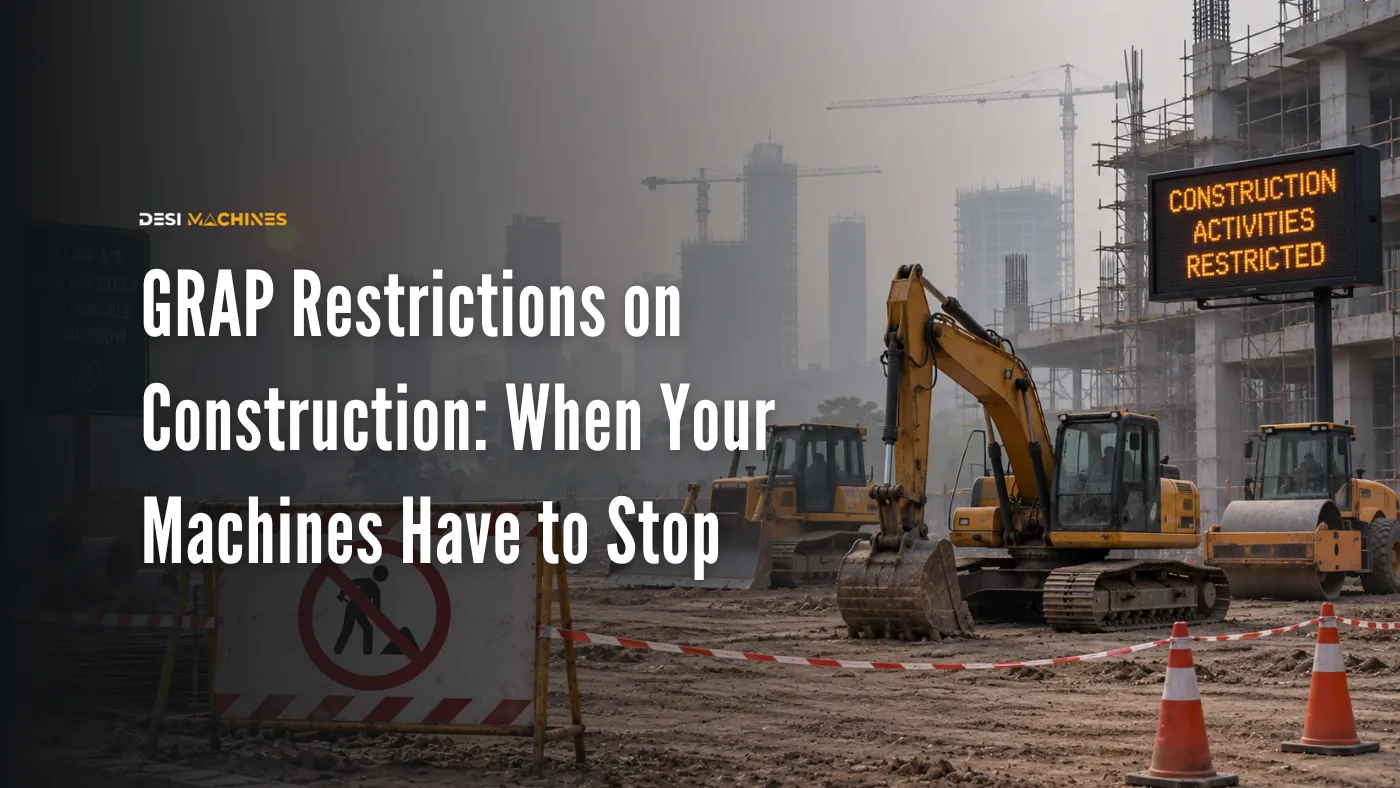
GRAP restrictions on construction are triggered by Delhi’s air quality index, not by a date on the calendar, and they bind across the whole NCR. Stages I and II tighten dust control. Stage III is where your machines stop — earthwork, boring, piling, demolition, open trenching, masonry and batching plants are all restricted. Stage III also closes every stone crusher in NCR and shuts down all mining, which is the point owners on the quarrying side most often get a stage too late. Stage IV extends the construction ban to highways and other linear projects. Your EMI does not pause for any of it, which is why the planning has to happen before October, not during it.
How GRAP restrictions on construction actually work
The Graded Response Action Plan is a schedule of measures that switch on in stages as air quality worsens. It is administered by the Commission for Air Quality Management for the NCR, and the stage is set by the Delhi air quality index together with the forecast:
| Stage | Delhi AQI | Category | What it means for a machine owner |
|---|---|---|---|
| Stage I | 201–300 | Poor | Work continues. Dust control, site registration and covered transport are enforced. |
| Stage II | 301–400 | Very Poor | Work continues under intensified inspection. Genset rules bite. |
| Stage III | 401–450 | Severe | Earthwork, piling, demolition, trenching and batching stop, except on listed projects. Stone crushers and all mining close across NCR. |
| Stage IV | Above 450 | Severe Plus | Linear projects stop too. Truck entry into Delhi stops and the BS-IV heavy goods vehicle ban bites. |
Two points that owners regularly get wrong. First, the trigger is Delhi’s index but the restrictions apply in the entire NCR, so a site in Gurugram, Faridabad, Ghaziabad or Gautam Budh Nagar stops on a Delhi reading. Second, the stages are invoked and revoked through the season rather than running for a fixed block. In the 2025-26 winter, Stages I, II and III came into force on 14 October, 19 October and 11 November 2025.
The schedule itself is revised from year to year. The version described here is the one the Commission revised by its order of 21 November 2025, published by the Delhi environment department. Check the current schedule and the stage in force before you act on any of it.
What Stage III actually stops
This is the stage that matters to anyone who owns an excavator, a backhoe, a piling rig or a batching plant. Stage III enforces strict restrictions on these categories of work across NCR:
- Earthwork for excavation and filling, including boring and drilling
- Piling works
- All demolition works
- Laying of sewer, water, drainage and electric cabling by open trench system
- Brick and masonry works
- Operation of RMC batching plants
- Major welding and gas-cutting work, though minor welding for mechanical, electrical and plumbing work stays permitted
- Painting, polishing and varnishing work
- Cement, plaster and other coatings, except minor indoor repairs and maintenance
- Cutting, grinding and fixing of tiles, stones and other flooring materials, except minor indoor repairs and maintenance
- Road construction activities and major repairs
- Transfer, loading and unloading of dust generating materials such as cement, fly-ash, bricks, sand, murram, pebbles and crushed stone, anywhere within or outside the project site
- Movement of vehicles carrying construction materials on unpaved roads
- Any transportation of demolition waste
Read that list against your fleet and the position is blunt. An excavator on an earthwork contract has nothing left to do. A piling rig stops outright. A backhoe digging a service trench stops. So, and this is the part owners read past, does the same machine transferring, loading or unloading cement, sand, murram, bricks, fly-ash or crushed stone — that is a restricted category in its own right, anywhere within or outside the site, whatever job the material was headed for.
Construction work that is less dust generating and not on that list continues, subject to the C and D waste rules and dust control norms. So a site is rarely shut completely; it is the earth-moving and the noisy, dusty trades that stop while finishing work carries on.
The projects that keep working
Even the restricted activities continue on a listed set of projects, provided dust norms are met: railway services and stations, metro rail services and stations, airports and inter-state bus terminals, national security and defence work and projects of national importance, hospitals and healthcare facilities, linear public projects, sanitation projects such as sewage treatment plants and water supply, and ancillary activities supplementing those categories.
That list is worth knowing before the season rather than after. If your machines are deployed on a metro package or an STP contract, a Stage III call does not idle them. If they are on private plot work, it does. Owners who have a mix can often move a machine from one to the other, and the ones who plan that in September do it at a better rate than the ones bidding for it in November.
Stage IV, when even the exempt projects stop
Stage IV is the one that catches owners who assumed a highway contract was safe. It extends the Stage III ban on C and D activities to linear public projects as well — highways, roads, flyovers, overbridges, power transmission, pipelines and telecom. The shelter that kept those machines running at Stage III is withdrawn.
What Stage IV does not do is close the crushers and the quarries, because that has already happened. Stone crushers and all mining and associated activities close across the entire NCR at Stage III, one stage earlier than most owners plan for. For anyone running crushers or supplying machines to a quarry, the full stop arrives with the Stage III call, not the Stage IV one.
On the transport side the two stages bite differently. Restrictions on BS-III petrol and BS-IV diesel light motor vehicles in Delhi, Gurugram, Faridabad, Ghaziabad and Gautam Budh Nagar arrive at Stage III, along with limits on Delhi-registered BS-IV and below diesel medium goods vehicles. Stage IV stops truck entry into Delhi altogether, except for essential commodities and LNG, CNG, electric and BS-VI diesel trucks, and bans Delhi-registered diesel BS-IV and below heavy goods vehicles from running in Delhi except those carrying essential commodities. If you are unclear where your tipper or trailer sits, the explainer on BS3, BS4 and BS6 engine differences covers what the norms mean and how to read your own registration.
The generator rules that catch site owners
Gensets are regulated separately and by capacity, under the schedule that references Direction No. 76 dated 29 September 2023. This catches people who assumed a shutdown only applied to the machines:
| Genset capacity or fuel | What is required |
|---|---|
| Any capacity on LPG, natural gas, bio-gas, propane or butane | No restrictions |
| Up to 800 kW (1000 kVA) meeting the MoEFCC standards notified by GSR 804(E) dated 03.11.2022 | No restrictions |
| 800 kW (1000 kVA) and above with an emission control system meeting the prescribed standards | No restrictions |
| 41 kW (51 kVA) to under 800 kW (1000 kVA) | Dual fuel mode, or retro-fitted emission control devices through certified agencies |
| 19 kW (23 kVA) to under 41 kW (51 kVA) | Dual fuel mode |
| Portable sets below 19 kW (23 kVA) | Not generally permitted, except for prescribed emergency services |
A set that is not in dual fuel mode only because gas infrastructure is unavailable is permitted for prescribed emergency services alone. The retrofit is the part worth costing early, because certified agencies get busy exactly when everyone needs them. Outside the GRAP season, and outside NCR, the standing rules still apply: type approval, noise limits, stack height and your state’s electrical inspection, set out in DG set permission on a construction site.
What the dust rules require even when work continues
From Stage I onward, the site obligations apply whether or not your machines are running. Projects with a plot size of 500 square metres or more must be registered on the relevant state or Delhi web portal for remote monitoring of dust mitigation, and work is not to be permitted on qualifying projects that are not registered. Anti-smog guns are required at C and D sites in proportion to the built-up area of the project. C and D material and waste must be stored covered and transported only in covered vehicles.
These are the obligations that generate notices and penalties during a season when everyone is being inspected. They are cheaper to meet in September than to argue about in December.
What a shutdown actually costs you
Here is the part no order will tell you. A Stage III call does not reduce your equipment loan EMI by a rupee. Insurance runs. If you keep an operator on the payroll through the stoppage you are paying him, and if you let him go you will be hiring in a tight market in February.
The crew is the other half of it. A general crew stood down for a fortnight is a fortnight of wages you either pay for nothing or save at the cost of losing the team, and the statutory floor under those wages is set out in the note on the labour rate per day in India. Owners who have run a full winter in NCR usually plan for a stoppage of some weeks rather than days.
Three things soften it, and all three have to be arranged in advance. Redeploy outside NCR, since a machine that can reach a site in another state keeps earning. Get onto exempt work, because a metro or railway package holds through Stage III. Price the risk into the quote, so a winter job in NCR carries the idle-day exposure in its rate rather than in your pocket. The walk-through of quoting earthwork per cubic metre shows where an idle-day allowance sits in a unit rate, and the equipment rental rate card gives you the day-earning figures the exposure is measured against.
If a stoppage has already put you in a cash squeeze rather than a planning problem, look at the funding options in equipment finance before you sell a machine into a winter market, which is the worst time to be a seller.
Read the GRAP schedule in September, not in November
GRAP is a predictable annual event with an unpredictable timetable. The stages, the banned activities and the exempt project list are published in advance; only the dates move. A machine owner working in NCR who reads the schedule in September can decide which contracts to chase, which machines to move, whether a genset needs a retrofit and what an idle fortnight should add to a winter quote. The one who reads it in November is finding out from an inspector.
Plan the season around the fleet you have. Browse live excavators and backhoe loaders with current prices if you are sizing a machine that can work outside NCR, see which tenders and work opportunities fall in the exempt categories, and if idle machines are the problem rather than the plan, renting them out is worth costing.
The GRAP stages, restrictions and exemptions described here are taken from the Commission for Air Quality Management schedule as revised by its order dated 21 November 2025, published by the Delhi environment department and current at the time of writing. The schedule is revised from year to year and the stage in force changes through the season on the air quality index. Restrictions, exemptions, genset requirements and vehicle rules are indicative here and can change without notice. Always confirm the current schedule and the stage in force with the official source, and confirm your own site obligations with the concerned pollution control committee, the project authority or your contractor before you stop, mobilise or quote. DesiMachines is not liable for decisions taken on the basis of information that may have changed after publication.