
 Excavator
294 models
Excavator
294 models  Backhoe Loader
51 models
Backhoe Loader
51 models  Crane
68 models
Crane
68 models  Concrete Mixer
79 models
Concrete Mixer
79 models  Wheel Loader
54 models
Wheel Loader
54 models  Compactor / Roller
45 models
Compactor / Roller
45 models  Motor Grader
42 models
Motor Grader
42 models  Dozer
41 models
Dozer
41 models  Concrete Pump
66 models
Concrete Pump
66 models  Skid Steer Loader
11 models
Skid Steer Loader
11 models  Telehandler
13 models
Telehandler
13 models 


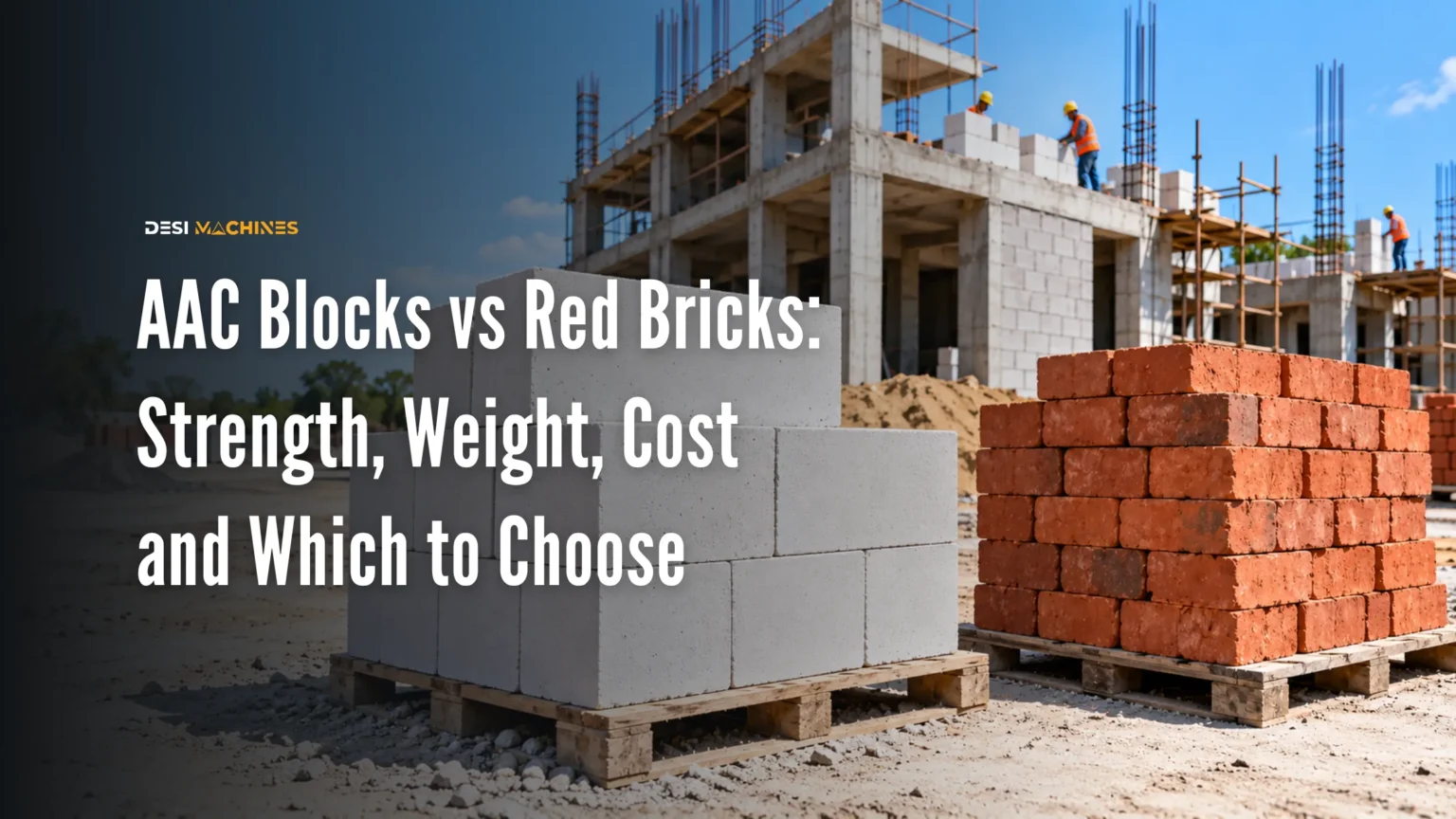
If the wall sits on an RCC frame above the plinth, an AAC block usually beats a red brick on weight, heat and speed of laying. Below the damp-proof course, under heavy fixings and between rooms where noise matters, the red brick still earns its place.
This AAC blocks vs red bricks comparison goes property by property, using what the Indian Standards for each material actually require: IS 1077 for common burnt clay bricks and IS 2185 (Part 3) for autoclaved aerated concrete (AAC) blocks. Autoclaved means the blocks are cured with high-pressure steam in a closed vessel at the factory, which is what gives them their strength. Every figure below comes from those codes or from simple arithmetic on them, so you can check it yourself. Rates for both materials change from district to district and month to month, so this page carries none. It gives you the quantities to price instead.
Which is better, AAC blocks or red bricks?
Neither is better everywhere. Each one wins in different places on the same house, and the table below shows where.
Table 1: AAC block and red brick compared
| Property | Red clay brick | AAC block |
|---|---|---|
| Indian Standard | IS 1077:1992 | IS 2185 (Part 3):1984 |
| Common size | 230 x 110 x 70 mm (traditional); 190 x 90 x 90 mm (modular) | 600 x 200 mm face, 75 to 250 mm thick |
| Units in one square metre of wall | About 100 (230 mm wall) | 8.33, whatever the thickness |
| Density | About 1,820 kg/m³ | 451 to 1,000 kg/m³ by class; 551 to 650 is usual for houses |
| Weight of one square metre of wall, before plaster | About 410 kg (230 mm) | About 125 to 145 kg (200 mm) |
| Compressive strength | Classes from 3.5 to 35 N/mm² | 4.0 N/mm² minimum for the usual class (Grade 1) |
| Thermal conductivity (lower keeps heat out better) | 0.811 W/m.K | 0.24 W/m.K maximum for the usual class |
| Water absorption limit | 20% up to class 12.5; 15% above it | No limit set; the code caps shrinkage instead |
| Before laying | Soak in water | Keep dry; no soaking |
| Below the damp-proof course and in foundations | Used | Not allowed |
Brick density and conductivity are the values in the thermal property table of IS 3792, the Indian guide to heat insulation of buildings. AAC strength and conductivity are the IS 2185 (Part 3) limits for the 551 to 650 kg/m³ class. The wall weights and unit counts are worked out below.
The short reading: for the walls of a framed house above the plinth, AAC is lighter, cooler and quicker. For anything that touches the ground, takes a heavy load without a frame or has to stop sound, brick holds its ground.
Is an AAC block stronger than a red brick?
On paper, a typical AAC block and an ordinary brick are close. A well-burnt high-class brick is far stronger than either.
IS 1077 sorts clay bricks into classes by average compressive strength, which is the load a brick takes before it crushes, measured in newtons per square millimetre. The classes run from 3.5 up to 35 N/mm². IS 2185 (Part 3) sets a minimum for each AAC density class: 2.0 N/mm² for the lightest blocks, 4.0 N/mm² for the 551 to 650 kg/m³ blocks most houses use, and 7.0 N/mm² for the heaviest, all at Grade 1. Grade 2 blocks are allowed a little less, 3.0 N/mm² in that usual class.
So a 4.0 N/mm² AAC block sits in the same range as the lower brick classes. The catch on the brick side is that most country bricks are sold with no class written anywhere. The catch on the AAC side is that a lighter class trades strength for insulation.
In a house with an RCC frame, the columns and beams carry the floors and roof. The walls between them carry only their own weight, so either material is strong enough there. Strength starts to matter when the walls themselves hold up the roof. IS 6041, the Indian code for building with AAC blocks, allows load-bearing AAC walls but sets their minimum thickness at 200 mm outside and 150 mm inside, designed to the masonry code. Get that wall designed by an engineer. Do not let anyone assume it.
How much lighter is an AAC wall than a brick wall?
About one third of the weight, square metre for square metre.
A traditional brick laid with a 10 mm joint takes up 240 x 120 x 80 mm, so a cubic metre of wall holds about 434 bricks. A 230 mm wall therefore needs about 100 bricks per square metre, and about 23% of its volume is mortar. At 1,820 kg/m³ for the brick and 1,648 kg/m³ for cement mortar, both from IS 3792, one square metre of that wall weighs about 410 kg before plaster.
A 600 x 200 mm AAC block covers 0.12 square metres of wall, so a square metre takes 8.33 blocks. A 200 mm wall of 551 to 650 kg/m³ blocks, with 10 mm joints, weighs about 125 to 145 kg per square metre. Those densities are measured oven-dry; a block in a wall holds a little moisture, so add a few per cent.
Figure 1: One square metre of wall, red brick (230 mm) against AAC (200 mm)
Bar lengths are to scale within each pair. Worked from IS 3792 densities and conductivities, IS 2185 (Part 3) class limits and the block and brick sizes above.
That weight saving is where the real money in AAC sits, and it never shows on a block quotation. Every kilogram of wall rides on a beam, then a column, then a footing. Lighter walls can let the structural engineer reduce those sizes, and a smaller footing means less trench to dig, whether by hand or with a backhoe loader such as the JCB 3DX. Only the engineer can take that saving, so settle the wall material before the frame is sized, not after.
Which keeps a house cooler, AAC or brick?
AAC, by a wide margin. Thermal conductivity measures how readily heat passes through a material, and a smaller number keeps the room cooler in summer and warmer in winter.
IS 3792 lists burnt brick at 0.811 W/m.K. IS 2185 (Part 3) caps the usual AAC class at 0.24 W/m.K, and lighter classes lower still. Divide wall thickness by conductivity and you get the wall’s resistance to heat flow. A 230 mm brick wall comes to about 0.28; a 200 mm AAC wall comes to about 0.83. The thinner AAC wall resists heat about three times as well.
On a west-facing wall in a hot district, that difference is felt by evening. The brick wall still has one thing going for it: its sheer mass soaks up the day’s heat slowly and gives it back slowly, so the inside temperature swings less over the day.
Which costs less per square metre of wall?
The block or brick rate is only one line of the sum, and it is the line that misleads most often. Compare the full cost of one square metre of finished wall, using your own local rates in each line.
Table 2: Quantities for 10 square metres of wall
| Item | Red brick, 230 mm wall | AAC block, 200 mm wall |
|---|---|---|
| Units laid | About 1,000 bricks, plus about 10% for breakage | About 84 blocks, plus a few for cuts |
| Mortar in the joints (10 mm joints) | About 0.53 m³ | About 0.13 m³ |
| Cement for 1:6 joint mortar | About 2.9 bags of 50 kg | About 0.7 bag, or the block maker’s jointing adhesive instead |
| Water for soaking units before laying | Yes | None |
| Weight carried by the frame and footings | About 4.1 tonnes | About 1.2 to 1.4 tonnes |
Then add the lines that never appear on a material bill:
- Labour: a mason places about 8 blocks per square metre against about 100 bricks. Each block is bigger and slower to set, but the wall goes up in far fewer moves, and IS 2185 (Part 3) names this first among the savings of block masonry.
- Plaster: factory-cut blocks give a truer face, and the same standard notes that the plaster needed on block walls is much less. A brick wall’s uneven face takes more plaster to bring it flat.
- Structure: the weight saving above can shrink beams, columns and footings, but only if the engineer designs for it.
- Fixings: AAC needs proper anchors for anything heavy, a small cost per fixing that brick does not carry.
Multiply each line by this month’s rate where you are building. Brick tends to hold its own where good bricks are fired close by and the house is small. AAC tends to pull ahead where bricks travel far or the building is tall and framed, because those are the jobs where the structure and labour lines grow. Our guides to calculating building materials and the compound wall cost per running foot show the same quantities-first method, and the tax on each material differs too, as the guide to GST on building materials explains.
Which lasts longer, and how does each handle water?
Neither IS 1077 nor IS 2185 (Part 3) states a service life in years, so anyone quoting one is quoting their own claim. What shortens the life of either wall is water, and the two materials fail in different ways.
A clay brick soaks up water. IS 1077 allows up to 20% of its weight in water after a day’s soaking for classes up to 12.5, and 15% for stronger classes. Water carries salts to the surface, which leave the white powdery patches called efflorescence; IS 1077 allows no more than moderate efflorescence up to class 12.5 and slight above it. Bricks are soaked before laying, as IS 2212, the code for brickwork, requires, so that they do not pull water out of the mortar.
An AAC block is the opposite. IS 6041 says the blocks should be stacked off the ground, covered against rain and laid dry, at most lightly moistened in hot weather. Its weakness is shrinkage: a cement-based block shrinks a little as it dries, and IS 2185 (Part 3) caps that at 0.05% for Grade 1 and 0.10% for Grade 2. On a 3 m wall that is 1.5 mm to 3 mm, enough to open hairline cracks in plaster where blocks went up wet. That is why the code asks for dry blocks, and why the grade matters.
Outside walls of AAC need a sound plaster. IS 6041 asks for two coats in heavy rainfall areas, a 15 mm backing coat and a 5 to 10 mm finishing coat, and at least one 10 to 15 mm coat elsewhere. On a wall that faces driving rain, a waterproof exterior coating adds a second line of defence.
Where should you still use red bricks?
Four places, and the first is fixed by the code.
- In foundations and the plinth below the damp-proof course. IS 6041 does not allow AAC blocks there. Ground moisture rises into any masonry below the damp-proof course, which is a waterproof layer laid at plinth level to stop it climbing further. Use brick, stone or solid concrete blocks below it, tied in with a plinth beam.
- In walls that carry the roof with no frame. A load-bearing house can be built in either, but brick gives the designer more strength classes to choose from.
- In walls that must stop sound. Heavier walls stop more airborne sound, and a brick wall weighs about three times an AAC wall. Between a bedroom and a road, or two flats, brick or a thicker AAC wall helps.
- Where heavy fixings go. AAC does not grip an ordinary nail or plain screw the way solid brick does. A geyser, a wall-hung basin or a heavy shelf needs an anchor made for aerated concrete, or a solid block built into that spot.
Door and window frames can go into either. IS 6041 shows frames fixed into AAC with 200 mm flooring nails with screwed ends, no more than 400 mm apart and the first within 200 mm of a corner.
How is each one laid differently on site?
A mason who has always laid bricks will lay AAC well once the four differences are clear.
- Water: bricks are soaked until the water reaches right through, as IS 2212 requires. AAC blocks are laid dry.
- Joints: IS 2212 allows bed joints up to 12 mm in brickwork. IS 6041 asks for 10 mm joints in AAC, in 1:2:9 cement-lime-sand mortar for normal work, 1:1:6 where loads or exposure are high, or 1:6 cement-sand where good lime is not available. Many block makers also sell a ready-mixed jointing adhesive laid much thinner; follow the bag.
- Rising evenly: IS 2212 keeps every part of a brick wall within 1 m of the rest as it rises. IS 6041 adds reinforced concrete bond beams in AAC walls at places such as lintel and sill level, and wire reinforcement in the joints where the wall may move.
- Curing: IS 2212 asks for brickwork to be kept wet for at least seven days in hot, dry weather.
Unloading differs as well. AAC usually arrives stacked on pallets, which can be lifted off the truck by a pick-and-carry crane such as the Escorts Hydra 14, while bricks are mostly unloaded by hand. If the site needs footings dug or material moved, compare backhoe loader models and prices and connect with a dealer near you.
A simple rule for your own house
Use brick or solid block from the footing up to the damp-proof course. Above it, on an RCC frame, use AAC for the outside walls and most partitions, and keep brick or a thicker block where you need quiet or heavy fixings. On a small load-bearing house where good bricks are made nearby, brick throughout is still a sound choice.
Whichever you buy, ask for the class in writing: the strength class for bricks, the density class and grade for AAC. The sizes, weights and block counts for every AAC thickness are in our guide to AAC block sizes and density, and how walling fits the rest of a budget is in the guide to low-cost house construction. The mortar and plaster need the right cement too, set out in choosing cement for house construction. For who makes AAC blocks in each state, see our list of AAC block makers in India, and for every other material, the building materials guides.
Planning the slab, the plaster and the mortar for the build? Compare concrete mixer models and prices and connect with a dealer. The brick requirements quoted on this page are published as IS 1077:1992, Common Burnt Clay Building Bricks, and the AAC block requirements as IS 2185 (Part 3):1984, Autoclaved Cellular (Aerated) Concrete Blocks.
Prices, specifications and features are indicative, vary by variant, location and date, and should always be confirmed with the official OEM or authorised dealer before any purchase decision. DesiMachines is not liable for decisions taken on the basis of information that may have changed after publication. Material properties on this page are as published in the Indian Standards named, read in October 2026; always follow the data sheet supplied by your block maker or kiln.
Machines, tenders and news for this industry: Building Construction