
 Excavator
294 models
Excavator
294 models  Backhoe Loader
51 models
Backhoe Loader
51 models  Crane
68 models
Crane
68 models  Concrete Mixer
79 models
Concrete Mixer
79 models  Wheel Loader
54 models
Wheel Loader
54 models  Compactor / Roller
45 models
Compactor / Roller
45 models  Motor Grader
42 models
Motor Grader
42 models  Dozer
41 models
Dozer
41 models  Concrete Pump
66 models
Concrete Pump
66 models  Skid Steer Loader
11 models
Skid Steer Loader
11 models  Telehandler
13 models
Telehandler
13 models 


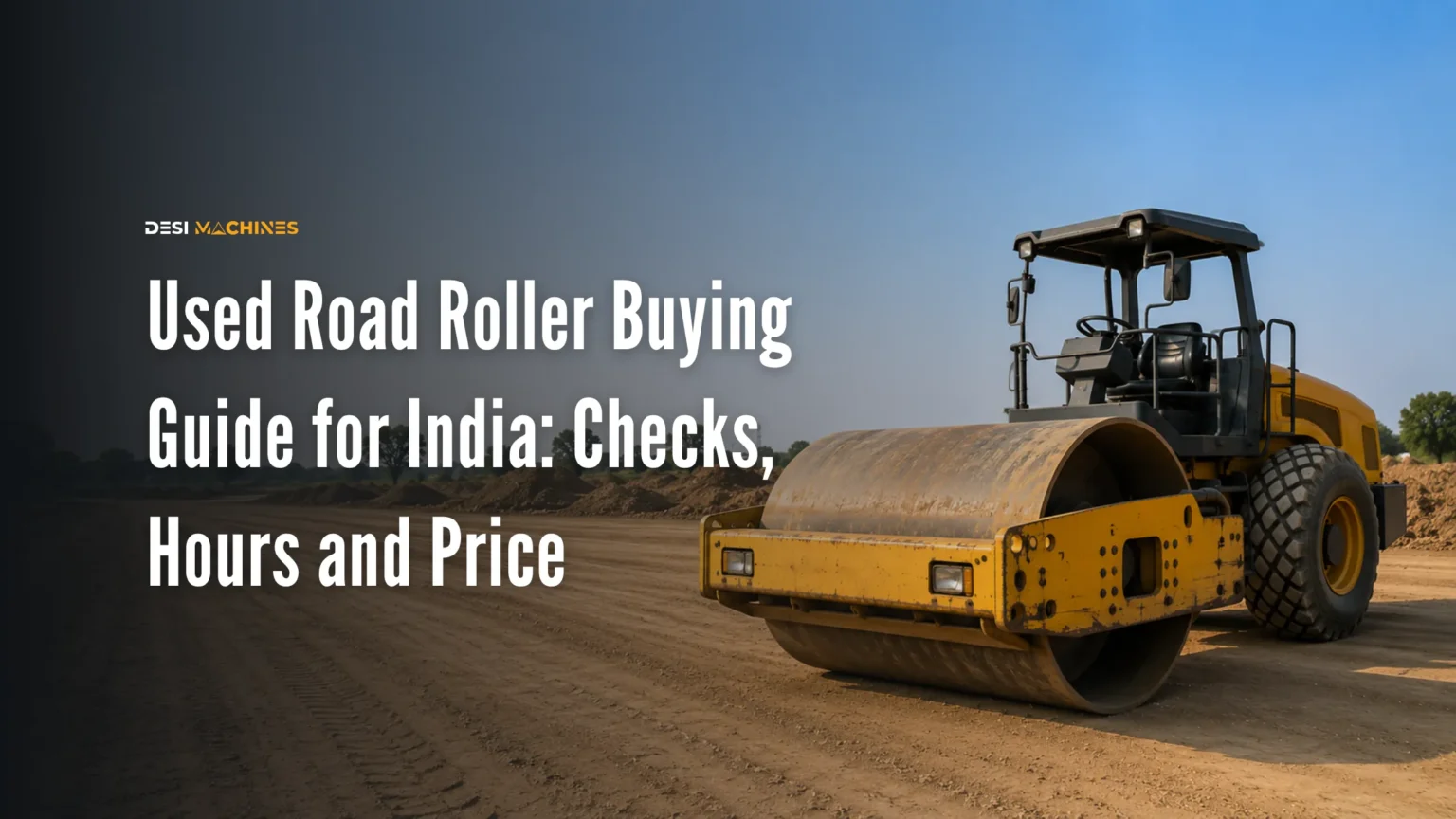
A used road roller is a second-hand compaction machine bought from a previous owner, a dealer’s resale yard or an auction rather than as new stock. In India these are mostly single-drum soil compactors, tandem (double-drum) rollers and pneumatic tyre rollers that have already worked a few seasons on road, canal or building jobs. The machine is simple, so age alone rarely kills it. What decides whether a second-hand roller is a good buy is the state of the drum, the honesty of the hour meter and whether the papers are clean.
This guide walks through what to check, how to read the hours, what a new roller costs so you can judge a used price, and which papers must come with the machine.
What should you check on a used road roller?
Start with the drum, because it is the one part that decides everything else. Walk the full width of it and look for dents, flat spots and welding repairs. A drum that has been patched is a drum that has already worn thin somewhere. Run your hand along the edge: a lip or a step means the shell has been ground down. Replacing or relining a drum is the single most expensive thing you can be handed on a roller, so this check comes before the engine.
Then the vibration system. Start the machine, let it warm up, and put the vibration on with the roller standing on firm ground. It should come on cleanly and settle into a steady hum. A rattle, a delay, or a machine that shakes the seat harder than it shakes the drum points at worn bearings or a tired eccentric shaft (the weighted shaft inside the drum that creates the shaking). Sellers know this repair is costly, which is why some find a reason not to demonstrate it. If vibration is not demonstrated, walk away.
After that, work through the ordinary items:
- Scrapers and pads. The steel strips that keep soil off the drum. Cheap to replace, but missing ones tell you the machine was run carelessly.
- Water spray system. On a tandem roller the spray keeps hot bitumen from sticking to the drum. Fill the tank and check every nozzle sprays. Blocked nozzles and a corroded tank are common and are a fair bargaining point.
- Articulation joint. The pivot in the middle of the machine. Rock it and watch for play. A sloppy joint means the two halves no longer track straight, and on a roller that shows up as an uneven finish.
- Hydraulic leaks. Look at the drive motors and the hoses running to the drum. Wet, dust-caked patches mean a leak that has been there a while.
- Tyres, on a soil compactor or a pneumatic roller. A matched set with even wear is a sign of steady work; odd sizes mean corners were cut.
- Engine. Cold start it yourself and watch the exhaust for the first thirty seconds. Blue smoke that clears is worn valve seals; blue smoke that stays is worse.
The general checks that apply to any second-hand machine, including how to structure the payment and when to walk, are set out in the used equipment inspection checklist.
How many hours is too many on a used road roller?
As a working line: under about 4,000 hours on a well-kept roller is a straightforward buy, 4,000 to 8,000 hours is normal second-hand territory where condition decides the price, and past 8,000 you are buying the state of the drum and the engine rather than a number on a meter.
But hours on a roller need reading differently from hours on an excavator. A roller’s meter runs whenever the engine runs, and a roller spends a great deal of its life idling at the edge of a job waiting for the paver or the tipper. Two machines showing 6,000 hours can have had very different working lives.
So ask what the machine was compacting. A roller that spent its life on soil and murram for rural roads has had an easier time than one that worked hot asphalt on a highway contract, where heat and bitumen attack the drum and the spray system. Ask how many seasons it worked, and for whom. A machine that came off a single contractor’s fleet with a rough service diary is worth more than one with three owners and no history.
One more thing the meter cannot tell you: whether the roller was used as a roller. Some soil compactors get pressed into towing and pushing work they were never built for, which quietly wears the drive and the articulation joint.
What does a new road roller cost in India?
You need this before you can judge any second-hand quote. Work down from the new price rather than up from the seller’s asking figure. Across the 45 compactors listed for sale in India, the classes sit at clearly different levels.
| Class | Operating weight | New price (indicative, as of Aug 2026) | Engine power | What it does |
|---|---|---|---|---|
| Light tandem (baby roller) | 1,575 to 3,450 kg (1.6 to 3.5 tonne) | ₹12 to ₹20 Lakh | 24 to 49 HP | Lanes, footpaths, patch repairs, tight sites |
| Heavy tandem roller | 8,700 to 10,060 kg (8.7 to 10 tonne) | ₹32 to ₹44 Lakh | 74 to 99 HP | Asphalt finishing on roads and highways |
| Soil compactor (single drum) | 9,700 to 22,000 kg (9.7 to 22 tonne) | ₹30 to ₹40 Lakh | 74 to 197 HP | Earthwork, embankments, sub-base layers |
| Pneumatic tyre roller | 10,500 to 18,000 kg (10.5 to 18 tonne) | ₹25 to ₹40 Lakh | 99 to 131 HP | Sealing and kneading the asphalt surface |
Prices and specifications indicative, as of August 2026, taken across 45 compactor models listed at the time of writing. They vary by variant, state and dealer. Compare live road roller and compactor models and prices before you accept any second-hand quote as a bargain.
Two things fall out of that table. Weight sets the price far more than the badge does: a JCB VMT330 at ₹15 to ₹20 Lakh and a Volvo DD90 at ₹42 to ₹44 Lakh (both indicative, as of Aug 2026) are both tandem rollers, and the gap between them is size, not brand. And the tandem class has a hole in the middle of it, which matters more than it first looks.
Why the tandem roller class has a gap, and what it means second-hand
Sort every tandem roller on sale here by weight and they land in two groups with nothing in between. Eight machines run from 1,575 to 3,450 kg (1.6 to 3.5 tonne). The other twelve start at 8,700 kg (8.7 tonne) and go to 10,060 kg (10 tonne). Between 3.5 tonne and 8.7 tonne there is no machine at all.
That gap is why so many first-time buyers end up with the wrong roller. A contractor sizing up from footpath work looks for the next size up from a baby roller and finds it is nearly three times the weight and roughly double the money. There is no middle rung to step onto.
Second-hand, this cuts both ways. A used heavy tandem is often the cheapest route into asphalt work a small contractor can find, because that class sits in the ₹32 to ₹44 Lakh band when bought new. But do not buy a 9 tonne machine to do 3 tonne work: it will not fit the lanes, it will over-compact thin layers, and you will have bought fuel and transport costs you never needed. The tandem roller guide sets out what each size is for, and the baby roller guide covers the small end.
Which type of roller should you buy second-hand?
Match the machine to the layer you compact, not to the price you can afford. The three types are not interchangeable.
A soil compactor (a single-drum roller, often called a single drum on site) compacts earth, murram and sub-base. Its drum is smooth or padded, and its rear wheels are tyres. If your work is site levelling, embankments, canal banks or the earthwork stage of a road, this is your machine. It is also the most standardised class you can buy, which changes how you shop for one second-hand. All 21 soil compactors listed here carry a drum between 2,100 and 2,150 mm wide, and 15 of them weigh between 10,350 and 11,800 kg (10.4 to 11.8 tonne). On paper they are nearly the same machine. So when you are looking at a used soil compactor, the model on the badge tells you very little, and the condition of the machine in front of you tells you nearly everything.
A tandem roller has a steel drum front and back and is built to finish asphalt. It is the wrong tool for loose earth, because with no tyres it has nothing to knead with and it will simply ride over soft ground.
A pneumatic tyre roller (PTR) runs on rows of rubber tyres instead of drums. It kneads and seals the asphalt surface after the tandem has flattened it. It is a finishing machine on bigger road contracts and rarely the first roller a small contractor should own. Only four are listed here, so the second-hand pool is thin and prices are less predictable.
If you are not sure which class your work needs, the compactor buying guide works through it for new machines and the logic is the same second-hand. For how vibration actually does the compacting, see static versus vibratory rollers.
Why the drum decides the price you should pay
The drum is a steel shell, and that shell has a published thickness. It is the wear part that cannot be bolted back on, and how much metal it started with tells you how much life it can lose before it becomes scrap.
| Class | Drum shell thickness | Drum width | What that means used |
|---|---|---|---|
| Soil compactor | 20 to 40 mm | 2,100 to 2,150 mm | Thick shell, built for abrasive earth; tolerates a hard life |
| Heavy tandem roller | 16 to 19 mm | 1,675 to 1,750 mm | Thinner shell; asphalt work is kinder, but repairs cost more |
| Light tandem (baby roller) | 12 to 14 mm | 800 to 1,250 mm | Least metal to lose; check for dents and flat spots closely |
<.div>
Thicknesses as published across the 40 rollers that state a drum shell figure, as of August 2026.
Read that table alongside the machine in front of you. A baby roller starting life with a 12 mm shell has far less to give away than a soil compactor that started at 30 mm, so dents and grinding marks on a small tandem matter more than the same marks on a big single drum. What each part of the machine does, and which parts wear first, is covered in the guide to road roller parts and components.
How much should a used road roller cost?
Work down from the new band for that class, and then make three adjustments before you compare two machines.
The deferred spend. Add up what you will have to spend in the first six months and take it off the asking price. On a roller that list is usually scrapers, spray nozzles, a hydraulic service, tyres on a soil compactor, and drum work if it is due. A machine ₹2 Lakh cheaper that needs drum attention is not cheaper.
The emission norm on the engine. This is where age shows up as money. Of the 45 rollers listed new today, 32 carry a CEV Stage V engine, 7 are CEV Stage IV and 2 are BS-III, while the remaining 4 do not state a norm. A used machine from a few seasons back will sit at the older end of that, and on some government and larger contracts the norm on the engine plate decides whether the machine can be deployed at all. It also shapes what you can sell it for later. Check the plate, not the seller’s word, and read BS-CEV emission norms for construction equipment before you commit.
The finance. Used-machine loans carry higher rates and shorter tenures than new ones, so two rollers at the same headline price can cost very different amounts across the term. Work the full outgo through the equipment finance options and compare it honestly against a new machine. First-time buyers are often surprised how small the monthly gap turns out to be once a used machine’s repairs are counted in.
Used values also move by region far more than new prices do. A roller priced sensibly in Maharashtra can look dear in Tamil Nadu, because what a machine is worth depends on how much road work is running nearby.
Which papers must come with a used road roller?
A roller is not a fast machine, but it is a wheeled one that travels between sites on a trailer and sometimes under its own power, so the paperwork matters.
- The invoice trail from the original purchase, and proof that any loan against the machine has been closed. An unreleased hypothecation is the most common reason a used-machine sale collapses late. The process for clearing it is set out in the guide to RC transfer and hypothecation removal.
- Registration papers where the machine is registered, with the chassis and engine numbers matching what is stamped on the machine. Check the metal, not the photocopy.
- Insurance, current, plus the claim history if the seller will share it. A repaired accident on the articulation joint is worth knowing about.
- Service records. Even a rough diary beats nothing. You want to see regular oil changes and any record of drum or bearing work already done.
- A clear seller. The person signing must be the registered owner or hold written authority. Sales run through an intermediary who “manages” the deal are where disputes come from.
The full sequence, from first call to final payment, is in how to buy used construction equipment in India.
Is a used road roller worth buying?
Often yes, and for a plain reason: compaction does not care how old the machine is. A layer of earth is either compacted to the density the job demands or it is not, and a seven-year-old drum that is still round does that as well as a new one. That is a different situation from machines whose value sits in electronics or precision.
Buy used when your work is seasonal or contract-to-contract, when you want a second machine to cover a peak, or when a heavy tandem at new prices would swallow money you need for working capital. Buy new when the roller will run most days of the year, when a contract specifies an emission norm you cannot meet second-hand, or when you cannot afford a week of downtime.
And if the work is a single job rather than a steady stream, price the alternative honestly first. Hiring a machine for a fortnight costs a fraction of owning one, and road roller rental rates in India will tell you quickly whether buying is the right call at all.
The same trade-off across other machines is covered in the used wheel loader, used backhoe loader and used excavator guides.
Buying a used road roller, in short
Check the drum before the engine, and refuse any machine whose vibration is not demonstrated on firm ground. Read hours as a rough guide and ask what the roller compacted rather than trusting the meter. Anchor your offer to the new price for that class, then subtract the first six months of repairs. Confirm the emission norm on the plate, and never pay before the hypothecation is cleared.
Get those five right and a second-hand roller is one of the soundest used buys in Indian construction equipment. Get the drum wrong and it is one of the most expensive.
Ready to compare? Browse soil compactors, tandem rollers and pneumatic tyre rollers to see what the new equivalents cost, then judge the used machine against that. If this is your first second-hand purchase, start with the complete used construction equipment buying guide.
Disclaimer: Prices, specifications and features are indicative, vary by variant, location and date, and should always be confirmed with the official OEM or authorised dealer before any purchase decision. DesiMachines is not liable for decisions taken on the basis of information that may have changed after publication. Prices and specifications quoted here are taken from our listings at the time of writing.
Frequently Asked Questions (FAQ)
Under about 4,000 hours on a well-kept roller is a straightforward buy. From 4,000 to 8,000 hours is normal second-hand territory where condition sets the price. Past 8,000 hours you are buying the state of the drum and engine rather than a number on a meter. Read hours carefully, because a roller idles a great deal while waiting for the paver or tipper, so two machines at the same reading can have had very different working lives.
The drum, before the engine. Walk its full width looking for dents, flat spots and welding repairs, and feel the edge for a lip or step that shows the shell has worn down. Relining or replacing a drum is the most expensive thing you can be handed on a roller. Then insist on seeing the vibration run on firm ground: a rattle or delay points at worn bearings or a tired eccentric shaft.
Across the 45 compactors listed for sale, light tandem or baby rollers run about Rs 12 to Rs 20 Lakh, heavy tandem rollers about Rs 32 to Rs 44 Lakh, single-drum soil compactors about Rs 30 to Rs 40 Lakh and pneumatic tyre rollers about Rs 25 to Rs 40 Lakh (all indicative, as of August 2026). Use the new band for the class as the anchor, then work down from it rather than up from the seller’s asking price.
Often yes, because compaction does not care how old the machine is. A layer is either compacted to the density the job needs or it is not, and a seven-year-old drum that is still round does that as well as a new one. Buy used for seasonal or contract-to-contract work. Buy new when the roller runs most days, or when a contract specifies an emission norm you cannot meet second-hand.
The original invoice trail plus proof that any loan against the machine has been closed, since an unreleased hypothecation is the most common reason a sale collapses late. Registration papers with chassis and engine numbers matching what is stamped on the machine. Current insurance and, if the seller will share it, the claim history. Service records, even a rough diary. And a seller who is the registered owner or holds written authority.