
 Excavator
294 models
Excavator
294 models  Backhoe Loader
51 models
Backhoe Loader
51 models  Crane
68 models
Crane
68 models  Concrete Mixer
79 models
Concrete Mixer
79 models  Wheel Loader
54 models
Wheel Loader
54 models  Compactor / Roller
45 models
Compactor / Roller
45 models  Motor Grader
42 models
Motor Grader
42 models  Concrete Pump
66 models
Concrete Pump
66 models  Skid Steer Loader
11 models
Skid Steer Loader
11 models  Telehandler
13 models
Telehandler
13 models 


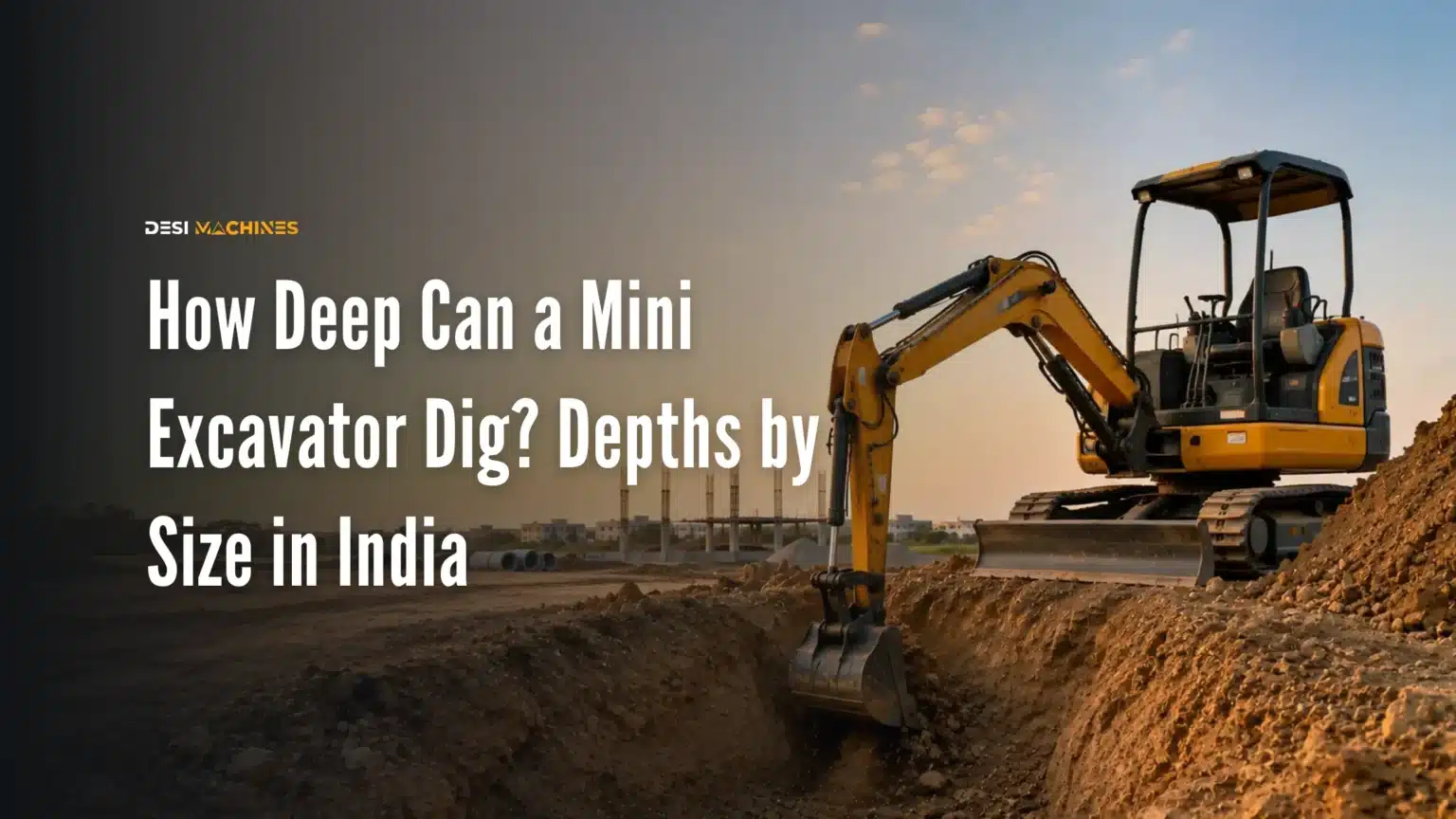
A mini excavator digs between about 2.3 and 4.7 metres deep, and the exact figure follows the machine’s operating weight almost exactly. A 1.8 tonne machine reaches roughly 2.3 m; a 3.5 tonne machine reaches around 3.1 m; a 7.5 tonne machine reaches about 4.1 m. That single relationship is the most useful thing to know before hiring or buying, because it decides whether the machine can finish your trench or leave you digging the last half metre by hand.
The specification to look for is called maximum digging depth, and it appears on every machine’s spec sheet. The tables below give the real figures for the mini excavators listed on DesiMachines, so you can match a depth to a machine rather than guess.
How deep can a mini excavator dig?
Maximum digging depth is measured from the ground the machine stands on down to the lowest point the bucket teeth can reach, with the boom and arm fully extended. It is a straight-line measurement to the deepest point, not the depth of a trench you can comfortably work in all day.
| Machine class | Operating weight | Typical maximum digging depth |
|---|---|---|
| Micro | 1.8 – 2.4 tonnes | 2.27 – 2.40 m |
| Small mini | 2.7 – 3.0 tonnes | 2.50 – 2.91 m |
| Mid mini | 3.4 – 3.9 tonnes | 3.04 – 3.42 m |
| Large mini | 4.7 – 5.8 tonnes | 3.36 – 3.82 m |
| Compact (7–8 tonne) | 7.0 – 7.9 tonnes | 4.02 – 4.66 m |
Ranges compiled from the maximum digging depth published for 60 machines listed on DesiMachines, August 2026.
The pattern is worth reading twice. Doubling the machine weight does not double the reach. Going from 1.8 to 3.5 tonnes buys you about 0.8 m of extra depth; going from 3.5 to 7.5 tonnes buys you about another metre. Depth comes from arm length, and arm length is limited by what the machine can lift at full extension without tipping.
What is the digging depth of specific mini excavator models?
Here are the published figures for machines commonly seen on Indian sites, ordered by weight.
| Model | Operating weight | Max digging depth | Bucket capacity |
|---|---|---|---|
| Kubota U17-3 | 1,800 kg | 2,310 mm (2.31 m) | 0.04 m³ |
| SANY SY20U | 1,980 kg | 2,385 mm (2.39 m) | 0.05 m³ |
| Tata Hitachi TMX 20 Neo | 2,300 kg | 2,323 mm (2.32 m) | 0.04 – 0.07 m³ |
| JCB 30 PLUS | 2,870 kg | 2,740 mm (2.74 m) | 0.08 m³ |
| Tata Hitachi NX30 | 2,900 kg | 2,625 mm (2.63 m) | 0.04 – 0.07 m³ |
| SANY SY35U | 3,780 kg | 3,105 mm (3.11 m) | 0.12 m³ |
| Tata Hitachi NX 50 | 5,190 kg | 3,547 mm (3.55 m) | 0.1 – 0.22 m³ |
| Tata Hitachi EX 70 Prime | 7,200 kg | 4,660 mm (4.66 m) | 0.13 – 0.68 m³ |
| SANY SY80C-9 | 7,920 kg | 4,020 mm (4.02 m) | 0.32 m³ |
Specifications as per the August 2026 listings on DesiMachines. Figures are for the standard arm; long-arm variants dig deeper.
Notice the EX 70 Prime and the SY80C-9. They sit within 700 kg of each other, yet one digs 640 mm deeper, because arm length and boom geometry differ between models. Weight predicts depth well across the range, but never assume it within a class. Read the number for the machine you are actually hiring.
Is that depth enough for common Indian jobs?
For most work a mini excavator is hired to do, yes.
Water and sewer connections in a residential lane usually sit between 1 and 2 metres down, well within a 2 to 3 tonne machine. Electrical and telecom cable trenches are shallower still, often under a metre. Both are comfortable jobs for the smallest machines, and their narrow width matters more than their depth.
Foundations are where it gets tighter. Column footings for a two or three storey building commonly go 1.5 to 2.5 m deep, which a 3 tonne machine handles. A basement, a lift pit or a deep septic tank pushes past 3 m and needs the 5 to 8 tonne class or a full-size machine.
The safety point matters more than the specification. Any trench deeper than about 1.2 m that a person will enter needs its sides battered back or shored, and battering back means the machine has to remove far more soil than the trench width suggests. Plan the excavation, not just the depth.
If the job is bigger than this class, excavator size classes in India maps out what sits above the mini range.
What else limits how deep you can actually dig?
The spec sheet number assumes conditions that a real site rarely provides.
Ground type comes first. Maximum digging depth is a geometric reach, not a promise about material. In soft soil the machine reaches its full depth easily; in hard murram, weathered rock or old concrete rubble, the bucket stops making progress long before the arm runs out of travel. A rock breaker attachment solves that, and the hydraulic rock breaker guide covers sizing one to the machine.
Where the machine stands matters next. The published depth is measured from the machine’s own ground level. If the machine sits on a ramp or a mound above the trench, you gain depth; if it must stand back from a soft edge, you lose reach and therefore effective depth.
Bucket choice changes the last few centimetres. A narrow trenching bucket reaches slightly deeper into a cut than a wide grading bucket of the same class, and it moves far less soil per pass. Our guide to excavator bucket types covers matching the two.
Finally, stability sets a practical limit. At full depth and full reach the machine is at its least stable, particularly over the side. That is why an operator digs a deep trench in stages rather than trying to reach the bottom in one movement.
How do you choose a machine by digging depth?
Work backwards from the deepest point on the job, then add a margin.
Start with the deepest single excavation you need, whether that is a footing, a pit or a service trench. Add roughly half a metre of headroom, because a machine working at its absolute limit is slow, unstable and hard on itself. Then find the lightest machine that clears that figure, since a lighter machine costs less to hire, moves between sites more easily and does less damage to finished ground.
Check access at the same time. A machine that digs deep enough but cannot get through the gate is no use, and on tight urban plots the width and tail swing decide the choice as often as the depth does. The mini excavator guide covers the zero-tail-swing and reduced-tail-swing types built for exactly that problem.
Gehra kaam ho toh machine bhaari lo, warna chhoti hi theek hai. Take the heavier machine when the work is genuinely deep; otherwise the smaller one will serve you better and cost less.
Ready to compare? Browse the full range of excavators and check the digging depth listed against each model.
How deep the machine goes and how far it stretches out are set by the same boom and arm, so the two move together: our guide to excavator digging reach gives the horizontal figures by size class.
A note on the figures in this guide
All specifications quoted here are taken from our listings at the time of writing (August 2026) and describe standard-arm configurations. Long-arm and offset-boom variants reach deeper, and figures vary by variant and model year, so confirm against the exact machine you are hiring or buying.
Related reading: excavator and backhoe weight by class, excavator components and how they work, and excavator boom types and design, which explains where reach actually comes from.
Long-reach machines built for silt work dig deeper again, roughly 11.6 to 17.2 metres depending on class, and those figures are compared in the guide to excavators for dredging and canal desilting.
Depth also decides what kind of hole a machine can finish in one pass. For open wells, farm ponds and recharge pits, the excavator for well digging guide explains how deeper wells are dug in benched stages.
If your work goes beyond the mini range, our guide to excavator digging depth by size class carries the full ladder from mini to mining, including the vertical wallcut figure for straight-sided trenches.
Prices, specifications and features are indicative, vary by variant, location and date, and should always be confirmed with the official OEM or authorised dealer before any purchase decision. DesiMachines is not liable for decisions taken on the basis of information that may have changed after publication.