
 Excavator
294 models
Excavator
294 models  Backhoe Loader
51 models
Backhoe Loader
51 models  Crane
68 models
Crane
68 models  Concrete Mixer
79 models
Concrete Mixer
79 models  Wheel Loader
54 models
Wheel Loader
54 models  Compactor / Roller
45 models
Compactor / Roller
45 models  Motor Grader
42 models
Motor Grader
42 models  Dozer
41 models
Dozer
41 models  Concrete Pump
66 models
Concrete Pump
66 models  Skid Steer Loader
11 models
Skid Steer Loader
11 models  Telehandler
13 models
Telehandler
13 models 


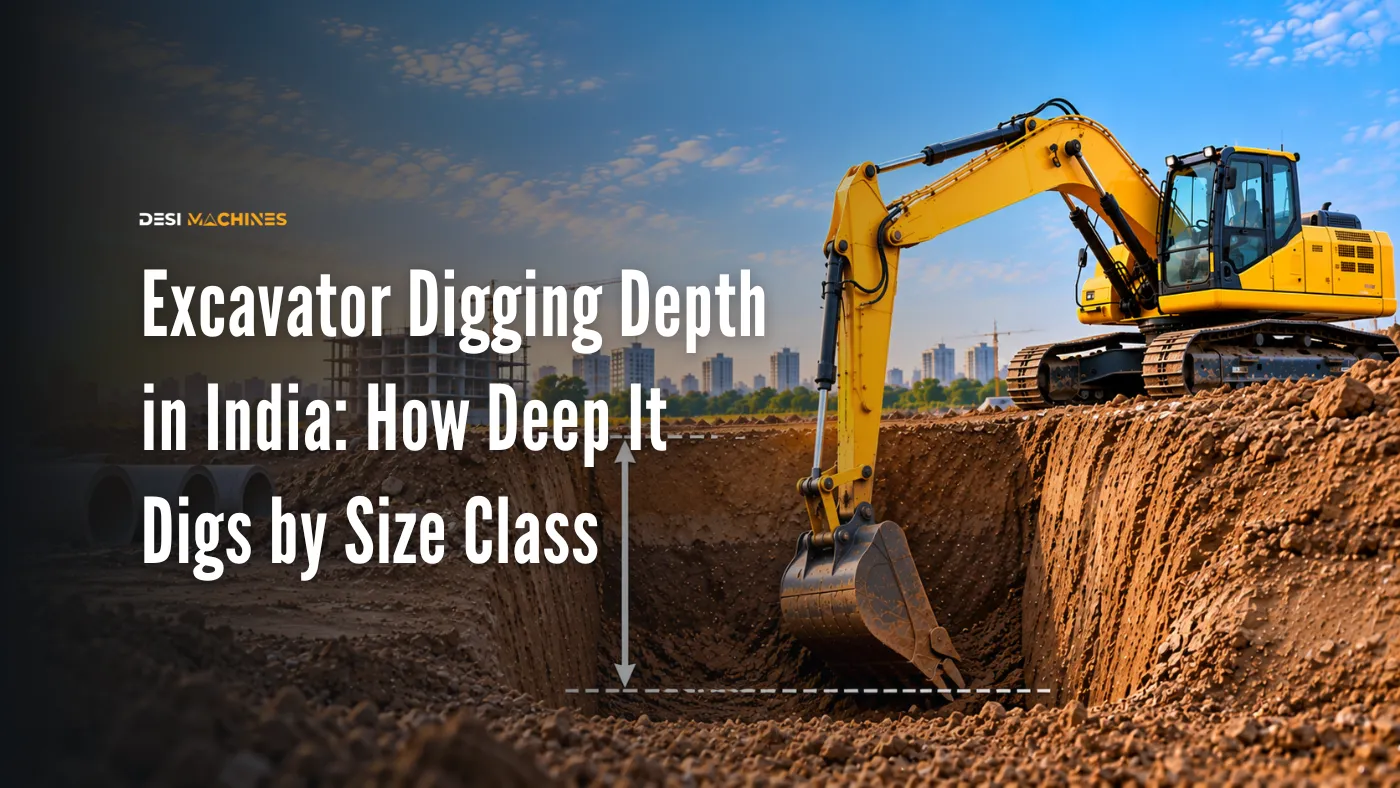
Excavator digging depth is how far below the ground the bucket teeth can reach when the machine is standing on level soil, measured straight down from the tracks to the deepest point the bucket can touch. It is printed in millimetres on every spec sheet, and it is the number that decides whether a machine can bottom out your foundation, your drain or your pipeline trench in one go.
Across the 294 excavators listed on DesiMachines, every single one publishes this figure, and it runs from 2,270 mm (2.27 m) on a 1.8 tonne mini machine to 10,000 mm (10.0 m) on a 175 tonne mining machine, as per the current September 2026 spec sheets. Long reach machines go further still, to 17.21 m.
There is a second depth figure on the same spec sheet, and it is the one that decides your day on site. Maximum vertical wallcut depth is how deep a straight-sided cut the machine can hold, and it is always less than the headline depth. On the 211 machines that publish both, the wallcut figure works out at a median of 84% of maximum digging depth. Plan a 6 m trench with straight walls off a 6 m spec sheet and you will come up short.
What is digging depth on an excavator?
Digging depth is the greatest vertical distance the bucket teeth can travel below the surface the machine is standing on. Picture the excavator parked on flat ground, boom lowered, arm pulled in and the bucket curled at its best angle: the distance from the ground line down to the bucket teeth is the digging depth.
The figure assumes ideal conditions. The machine is level, the soil holds its shape, and the bucket is at the exact angle that gets the last few centimetres. On a real site none of that is guaranteed, which is why the spec sheet number is a ceiling rather than a promise.
Two related numbers sit beside it on the same block of the spec sheet, and mixing them up is the most common mistake buyers make.
Maximum digging depth is the deepest single point the bucket can reach, at one particular boom and arm position.
Maximum vertical wallcut depth is how deep a cut with straight, vertical sides the machine can make. This is lower, because holding a vertical face needs the bucket to come down flat against the wall rather than curling in at the bottom of an arc.
There is also digging reach, the horizontal stretch, which moves together with depth because the same boom and arm produce both. The full sheet is worked through in our guide to reading an excavator spec sheet.
How deep can an excavator dig? Depth by size class
Digging depth climbs with machine weight, but not evenly, and it flattens out sharply once you pass the 20 tonne class. The table below is built from the operating weight and working range figures published for all 294 excavators listed on DesiMachines, grouped into the five weight classes the Indian market actually uses. Long reach and long front machines are shown separately, because their boom geometry puts them outside the normal pattern.
| Size class | Machines | Maximum digging depth | Vertical wallcut depth | Wallcut as % of depth |
|---|---|---|---|---|
| Mini (up to 6 tonne) | 50 | 2.27 – 3.81 m | 1.61 – 3.07 m (40 publish) | 81% |
| Small (6–15 tonne) | 48 | 3.13 – 5.83 m | 2.57 – 5.05 m (45 publish) | 89% |
| Medium (15–25 tonne) | 78 | 5.91 – 6.98 m | 3.85 – 6.47 m (61 publish) | 87% |
| Large (25–50 tonne) | 48 | 5.92 – 7.72 m | 2.50 – 7.11 m (34 publish) | 80% |
| Extra-large (above 50 tonne) | 55 | 6.38 – 10.00 m | 2.71 – 7.62 m (31 publish) | 68% |
| Long reach and long front | 13 | 9.94 – 17.21 m | Too few publish it to give a band | – |
Read the table and one thing stands out. Going from a 6 tonne machine to a 20 tonne machine buys you roughly two extra metres of depth. Going from 25 tonne to 50 tonne buys you well under one more metre. Weight beyond the medium class is bought for bucket size, breakout force and durability, not for depth, and our guide to excavator size classes in India sets out what each class is really for.
The mini class is the exception worth knowing. A 3.8 m dig on the largest mini is deeper than many buyers expect, and it covers most village drainage, water line and house foundation work.
What is vertical wall cut depth, and why does it matter more?
Vertical wall cut depth is the deepest straight-sided cut the machine can make without the wall having to slope back. It matters more than maximum digging depth for a simple reason: most paid work needs straight walls. A footing trench, a septic tank pit, a lift pit, a cable or pipeline trench, a basement edge against a boundary.
The physical reason for the gap is easy to picture. Maximum digging depth is reached at one point in the bucket’s arc, with the bucket curled and the arm at its best angle. To hold a vertical face, the bucket has to come down flat along the wall, and that costs you depth.
Across the 211 machines on our books that publish both figures, the wallcut number sits at a median of 84% of maximum digging depth, and 90% of machines fall between 56% and 93%. Not one machine publishes a wallcut figure greater than its own digging depth, which is what you would expect and a useful sign that the published data holds together.
A practical rule follows from that. If you know only the maximum digging depth, assume you will get about four-fifths of it as a straight-sided cut, then check the machine’s own wallcut figure before you commit. Two of our own references already point at this number: the guide to excavator digging reach calls it the figure buyers miss, and the spec sheet walkthrough tells you to compare against it rather than the headline depth.
Be careful with the spread. A handful of machines publish a wallcut far below the pattern, and the reason is not always clear from the sheet. The Komatsu PC500LC-10R publishes 2,495 mm against a 6,640 mm digging depth, and the Komatsu PC2000-8 publishes 2,710 mm against 9,235 mm, both well under half. Those two set the low end of the Large and Extra-large bands in the table above. Where a machine’s wallcut looks far off its class, ask the dealer to confirm it in writing before you plan a job around it.
How deep can a 20 ton excavator dig?
A 20 tonne excavator digs about 6.1 m at maximum depth and holds a vertical wall of roughly 5.1 to 5.7 m. This is the class most Indian contractors buy first for serious work, and it is remarkably consistent: across the 50 machines we list between 19.5 and 22 tonnes, maximum digging depth runs from 5.91 m to 6.73 m, a band under a metre wide, with a median of 6.14 m.
| Machine | Operating weight | Maximum digging depth | Vertical wallcut depth |
|---|---|---|---|
| JCB NXT 205 | 20,500 kg (20.5 Ton) | 6,140 mm (6.14 m) | 5,570 mm (5.57 m) |
| Tata Hitachi EX 200 Infra | 19,800 kg (19.8 Ton) | 5,920 mm (5.92 m) | 5,440 mm (5.44 m) |
| Hyundai R220LS SMART Plus | 22,000 kg (22 Ton) | 6,220 mm (6.22 m) | 5,720 mm (5.72 m) |
| Kobelco SK220XD | 21,800 kg (21.8 Ton) | 6,160 mm (6.16 m) | 5,570 mm (5.57 m) |
| Komatsu PC210LC-10M0 | 22,000 kg (22 Ton) | 6,000 mm (6.00 m) | 5,080 mm (5.08 m) |
The practical meaning is that depth should almost never decide which 20 tonner you buy. Every machine in the class lands within a few hundred millimetres of the others. Choose on dealer support, fuel burn, resale and excavator digging force, and treat depth as a box that all of them tick. Compare live excavator models and prices and talk to a dealer before you shortlist.
How deep can a mini excavator dig?
A mini excavator digs between 2.27 m and 3.81 m at maximum depth, with the median mini on our books at 3.04 m. That covers house foundations, village drain work, water and cable trenching, and septic tank pits, which is most of what a mini is bought for in India.
| Machine | Operating weight | Maximum digging depth | Vertical wallcut depth |
|---|---|---|---|
| SANY SY60C | 5,780 kg (5.78 Ton) | 3,815 mm (3.82 m) | 3,070 mm (3.07 m) |
| Kubota U50-5S | 4,780 kg (4.78 Ton) | 3,560 mm (3.56 m) | 2,890 mm (2.89 m) |
| JCB 50Z | 4,946 kg (4.95 Ton) | 3,330 mm (3.33 m) | 1,970 mm (1.97 m) |
Notice the JCB 50Z line. Its maximum depth sits in the middle of the mini pack, but its vertical wallcut is the lowest of the three, at 59% of its own digging depth against 80% for the other two. If your work is straight-sided trenches rather than open pits, that difference is worth more than the headline number. The mini class is covered model by model in our reference on how deep a mini excavator digs, and the wider buying picture sits in the mini excavator guide.
Why is the real digging depth on site less than the spec sheet?
The spec sheet figure is measured under ideal conditions, and four things on a real site take depth away from you.
The machine has to be level. Digging depth is measured from the plane the tracks sit on. Park on a slope and the effective depth on the downhill side changes. On soft or uneven ground the tracks sink, which moves the reference line as you work.
The soil has to hold. In loose sand, black cotton soil or wet ground, the walls of a deep cut will slump inward long before the machine runs out of arm. That is a soil problem, not a machine problem, and it is why deep trenches get benched or shored.
The bucket has to fit the hole. A wide bucket cannot reach the corners of a narrow trench at full depth. Bucket choice changes what you can actually finish, and our guide to excavator bucket capacity covers how size is matched to the machine.
Ground pressure decides where you can stand. A machine that sinks cannot dig to its rated depth, and on soft sites the limit is the tracks rather than the arm. The figures by class are in our reference on excavator ground pressure.
For anything deeper than about 3 m in ordinary soil, plan for the walls, not just the machine. That usually means a wider top cut, a bench halfway down, or shoring.
What about long reach and mining machines?
Thirteen of the machines we list are built with a longer boom and arm, and they dig from 9.94 m to 17.21 m. These are long reach and long front machines, normally a 22 to 30 tonne base fitted with extended assemblies so the machine can dig a canal, desilt a pond or cut a slope while standing safely back on the bank. They trade bucket size and breakout force for that stretch, so they are specialist tools rather than deeper versions of a standard machine. Canal and pond work is covered in our guide to excavator dredging and canal desilting.
At the other end, the very largest mining machines do not follow the depth pattern at all. Two of the machines we list are built in a front shovel configuration, where the bucket faces away from the machine and loads from a bench face rather than digging below itself. Their published digging depth is shallow by design, and they are excluded from the class bands in the table above. The difference between the two layouts is explained in our comparison of a power shovel and a hydraulic excavator.
How do you choose a machine by digging depth?
Work backwards from the deepest cut your regular work needs, not from the deepest cut you can imagine.
Write down the depth you actually need, in metres. Add the thickness of any blinding, bedding or sand layer below the finished level, because that is dug too. Then divide by 0.85 if the job needs straight walls, which gets you back from a wallcut requirement to the maximum digging depth you should be shopping for. A 4 m straight-sided footing trench points at a machine with roughly 4.7 m of maximum depth, which is the small class rather than a mini.
Then check three things before you commit: the machine’s own published wallcut figure, whether the boom and arm combination quoted matches the one in the table, and whether your site will let the machine stand where it needs to stand. A machine that cannot get close enough loses depth to reach.
If depth is the only thing pushing you up a class, ask whether the extra depth is needed on most jobs or on one job a year. Hiring for the deep job is often cheaper than owning a bigger machine all year. Browse the full range of excavators and compare what each class gives you.
A note on the figures in this guide
Every depth and weight figure here is taken from the spec sheets published on DesiMachines product listings at the time of writing, covering 294 excavators. Maximum digging depth is published by all 294. Vertical wallcut depth is published by 211 of the 279 standard-configuration machines, so around a quarter of the range does not carry it and you will need to ask the dealer.
Four machines were left out of the wallcut bands because their published figures do not hold up. The SANY SY20U lists a 210 mm wallcut against its own 2,385 mm digging depth. The BEML BE700 and the XCMG XE215i each list a wallcut exactly equal to their maximum digging depth, which is not physically possible. The Komatsu PC300LC-8M0 carries two different wallcut figures in two places on its own listing. These have been reported for correction, and they are named here rather than quietly dropped.
Class bands group machines by operating weight using the five classes the Indian market works with. Long reach, long front and front shovel machines are reported separately because their geometry sits outside the pattern.
Prices, specifications and features are indicative, vary by variant, location and date, and should always be confirmed with the official OEM or authorised dealer before any purchase decision. DesiMachines is not liable for decisions taken on the basis of information that may have changed after publication.
Excavator digging depth, in short
Maximum digging depth tells you the deepest point the bucket can touch. Vertical wallcut depth tells you how deep a straight-sided trench you can actually cut, and it is about 84% of the headline figure on a typical machine. Plan from the second number.
A mini digs 2.3 to 3.8 m, a small machine 3.1 to 5.8 m, and the 20 tonne class settles at about 6.1 m with barely a metre separating the whole class. Above 25 tonnes, extra weight buys bucket size and force rather than depth. If you need to go deeper than about 10 m, you are looking at a long reach machine, not a heavier one.
Read next: excavator digging reach for the horizontal half of the same geometry, and excavator operating weight for the number that sets the class in the first place.
Frequently Asked Questions (FAQ)
It depends on the size class. Across the 294 excavators listed on DesiMachines, maximum digging depth runs from 2,270 mm (2.27 m) on a 1.8 tonne mini machine to 10,000 mm (10.0 m) on a 175 tonne mining machine, as per the current September 2026 spec sheets. A mini digs 2.27 to 3.81 m, a 6 to 15 tonne machine 3.13 to 5.83 m, and the common 15 to 25 tonne class 5.91 to 6.98 m. Long reach machines go from 9.94 m to 17.21 m.
Vertical wall cut depth is the deepest straight-sided cut a machine can make without the wall sloping back. It is always less than maximum digging depth, because holding a vertical face needs the bucket to come down flat against the wall instead of curling in at the bottom of its arc. On the 211 machines we list that publish both figures, wallcut works out at a median of 84% of maximum digging depth, with 90% of machines between 56% and 93%. For a footing trench, a lift pit or a pipeline trench, this is the number to plan from.
About 6.1 m. Across the 50 machines we list between 19.5 and 22 tonnes, maximum digging depth runs from 5.91 m to 6.73 m with a median of 6.14 m, so the whole class sits inside a band under a metre wide. Vertical wallcut for the class runs roughly 5.1 to 5.7 m. Because every 20 tonner lands within a few hundred millimetres of the others, digging depth should rarely be the thing that decides which one you buy.
A mini excavator digs between 2.27 m and 3.81 m, with the median mini on our books at 3.04 m. That covers house foundations, village drain work, water and cable trenching and septic tank pits. Watch the wallcut figure within the class, because it varies more than the headline depth does: the JCB 50Z holds a 1,970 mm vertical wall against a 3,330 mm digging depth, while the SANY SY60C holds 3,070 mm against 3,815 mm.
No. Digging depth is how far down the bucket teeth go below the ground the machine stands on. Digging reach is how far out they stretch horizontally from the centre of the turntable. The two move together because the same boom and arm produce both, but they answer different questions: depth decides whether you can bottom out a trench, reach decides whether you can dig the far side of it without moving the machine.