EMS Limited has converted a Varanasi sewerage bid into a firm order, and disclosed three more lowest-bidder positions in Rajasthan on the same day. For anyone running a trenching fleet in eastern Uttar Pradesh, the useful part is not the headline total. It is knowing which of these jobs can actually put machines on the ground, and which cannot yet.
Update, 8 October 2026: the Jodhpur package has now converted. EMS disclosed a Letter of Award from Municipal Corporation Jodhpur for sewerage work under AMRUT 2.0, company-stated at Rs 12,980.13 lakh (about Rs 129.80 crore) including GST, with a 24-month execution period. The scope is new sewer lines in left-out areas plus rebuilding old and damaged lines and laterals, which is backhoe-loader and compaction work along city streets rather than a plant build.
The quick facts
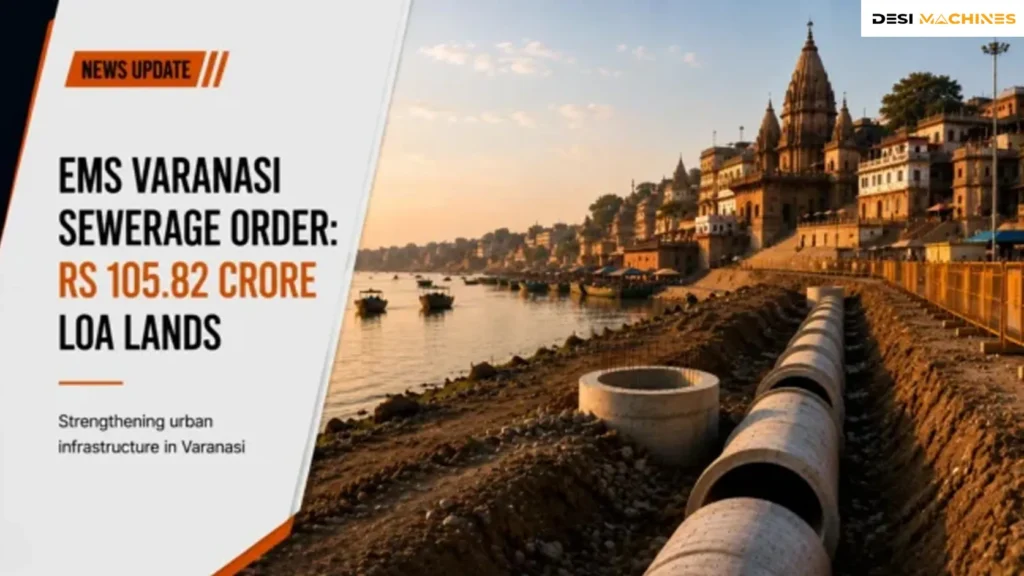
- The firm order: a Letter of Acceptance from UP Jal Nigam (Urban), Varanasi, company-stated at Rs 105.82 crore excluding GST, turnkey, with a 24-month execution period.
- Scope: sewerage works for the extended Ramnagar Zone under Nagar Nigam Varanasi, covering a 10 MLD sewage treatment plant with co-treatment, a pumping station, and the laying and jointing of rising mains and sewer network with house connections.
- Still only L-1: Kota water supply under AMRUT 2.0 for Rajasthan’s PHED at a company-stated Rs 190.86 crore including GST, plus Udaipur at Rs 222.46 crore and a Jodhpur sewerage package at Rs 129.8 crore.
- A number to distrust: several national desks put the Kota job at Rs 1,908 crore. The company’s own figure is Rs 19,086.27 lakh, which is Rs 190.86 crore.
What EMS actually disclosed
The Varanasi award is the only one of the four that is an award. EMS had disclosed lowest-bidder status on that same Ramnagar package on 13 July 2026, and the Letter of Acceptance followed about five weeks later. The three Rajasthan items announced alongside it are bid outcomes, not contracts. The Kota scope, as disclosed, covers a 100 MLD water treatment plant near Shivaji Park with roughly 10,665 metres of clear-water rising main. All values are company-stated, and the GST basis differs between the Varanasi and Kota figures, so the two are not directly comparable.
What it means for buyers
Sewerage and water-distribution work is trenching work, and trenching work is backhoe loader country. Buried pipe over 10.6 km of rising main at Kota means open-cut, backfill and compaction repeated along a corridor: backhoe loaders as the workhorse, mid-size excavators where the trench deepens or the ground turns, plate compactors and small rollers behind them, tippers shuttling spoil. That is a hire-grade fleet profile rather than a purchase-grade one.
The treatment plants invert it. A 10 MLD plant at Ramnagar or a 100 MLD one at Kota is a single-site build: a short front-loaded window to cut and grade the platform and tank pits, then a long concrete train where compaction equipment and batching matter more than excavation. On a 24-month contract, the earthmoving phase is a few months of it.
Our take: the most transferable thing here is the timing evidence, not the money. EMS’s Varanasi package sat at L-1 from 13 July to around 20 August before the acceptance letter arrived. If the three Rajasthan positions run to a similar clock, they are late-September conversations at the earliest, with mobilisation later still. Treating an L-1 announcement as a demand signal is how hire fleets end up idle on speculation. Only the Rs 105.82 crore Varanasi job is real work today; the other Rs 543 crore is pipeline that may or may not convert.
The reporting error is worth carrying into your own reading of order-win news. A tenfold overstatement on the Kota package came from reading a lakh figure as a crore figure, and it ran on desks that equipment buyers trust. When an announced value looks out of proportion to the physical scope, and Rs 1,908 crore for a 100 MLD plant and 10 km of pipe badly is, the number is usually wrong rather than the project.
What to watch
- Whether the Kota, Udaipur and Jodhpur L-1 positions convert to acceptance letters, and how closely they track the roughly five-week lag the Varanasi package took.
- Mobilisation at Ramnagar. The 24-month clock runs from the appointed date, not the acceptance letter, so the first trenching spread is the signal that matters.
- Whether the Rs 1,908 crore figure gets corrected, or hardens into the number everyone quotes for Kota.
FAQ
Is EMS Limited’s Rajasthan water project worth Rs 1,908 crore?
No. The company’s disclosed value is Rs 19,086.27 lakh, which converts to Rs 190.86 crore including GST. The Rs 1,908 crore figure carried by several desks is that same number misread by a factor of ten.
Does lowest-bidder status mean EMS has won the Rajasthan projects?
No. L-1 means EMS submitted the lowest bid. A contract exists only once the authority issues a Letter of Acceptance or Award. On its Varanasi package, that step took about five weeks after the L-1 disclosure.
Which machines does this kind of water and sewerage work need?
Mostly backhoe loaders for trenching, mid-size excavators for deeper runs and tank pits, compactors and rollers for backfill, and tippers for spoil. Treatment-plant sites add a short bulk-earthmoving phase followed by concrete work.
Related on DesiMachines: VVIP Infratech’s Rs 198.49 crore Delhi Jal Board sewer contract, the same trenching-led fleet profile on a bigger network job.
Source: EquityBulls
Machines, tenders and news for this industry: Pipelines and Water Supply

 Excavator
294 models
Excavator
294 models  Backhoe Loader
51 models
Backhoe Loader
51 models  Crane
68 models
Crane
68 models  Concrete Mixer
79 models
Concrete Mixer
79 models  Wheel Loader
54 models
Wheel Loader
54 models  Compactor / Roller
45 models
Compactor / Roller
45 models  Motor Grader
42 models
Motor Grader
42 models  Dozer
41 models
Dozer
41 models  Concrete Pump
66 models
Concrete Pump
66 models  Skid Steer Loader
11 models
Skid Steer Loader
11 models  Telehandler
13 models
Telehandler
13 models