
 Excavator
294 models
Excavator
294 models  Backhoe Loader
51 models
Backhoe Loader
51 models  Crane
68 models
Crane
68 models  Concrete Mixer
79 models
Concrete Mixer
79 models  Wheel Loader
54 models
Wheel Loader
54 models  Compactor / Roller
45 models
Compactor / Roller
45 models  Motor Grader
42 models
Motor Grader
42 models  Dozer
41 models
Dozer
41 models  Concrete Pump
66 models
Concrete Pump
66 models  Skid Steer Loader
11 models
Skid Steer Loader
11 models  Telehandler
13 models
Telehandler
13 models 


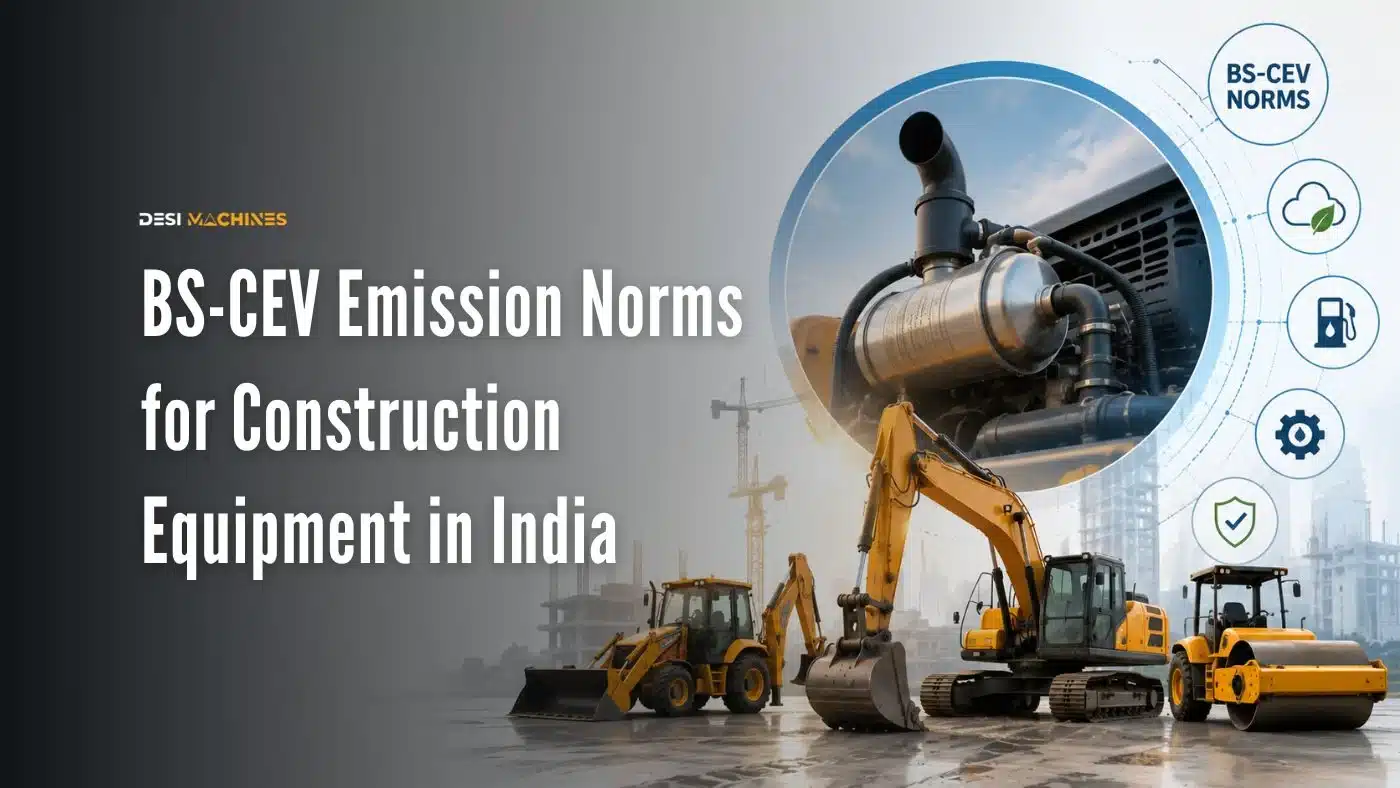
If you are buying a construction machine in India today, you will keep hearing terms like CEV Stage IV, CEV Stage V, AdBlue and emission norms. This guide explains all of it in plain language. In short: emission norms are government rules that limit the smoke and harmful gases a machine’s engine is allowed to release. India tightened these rules for construction equipment in stages, and since 1 January 2025 almost every new machine sold is built to the strictest stage yet, called CEV Stage V. Older machines built to earlier stages are still legal to own and run. Below we cover what each stage means, why AdBlue matters, how it changes the price you pay, and how to check which stage your own machine follows.
What “emission norms” actually mean
An emission is anything the engine sends out through its exhaust: black smoke, soot, and gases like nitrogen oxides. An emission norm is a legal limit on how much of this a new engine may release while it works.
The government sets these limits and makes them stricter over time, in steps called stages. Each new stage allows less pollution than the one before. A machine has to meet the stage that is in force on the day it is manufactured and sold. So a roller made in 2019 follows the rule of 2019, and a roller made in 2026 follows the tighter 2026 rule. The old machine does not become illegal later; the norm simply applies at the point of manufacture.
This matters to you as a buyer because the stage decides three practical things: how clean and modern the engine is, what running items you will need (like AdBlue, explained below), and how much the machine costs.
CEV or Trem? Construction machines follow a different track from tractors
You may have seen both “CEV” and “Trem” written on engine plates. They are two separate rule sets.
- CEV stands for Construction Equipment Vehicle. Excavators, backhoe loaders, wheel loaders, motor graders, rollers, cranes and similar site machines follow the CEV Stage norms.
- Trem covers agricultural tractors and farm equipment, which follow their own Trem Stage norms.
Until 2020 the two were bundled under one label. In September 2020 the government split them, because a highway excavator and a farm tractor run very differently. If you are buying construction equipment, the label to look for is CEV.
The three stages you will meet: CEV III, IV and V
Three CEV stages are relevant in the Indian market right now. The table gives the plain version. Engine sizes are shown in kW (kilowatt, the metric unit of engine power) with a rough horsepower figure next to it, since 1 kW is about 1.34 HP.
| Stage | In force from | Engine sizes covered | What it did |
|---|---|---|---|
| CEV Stage III | April 2011 | Up to 560 kW (up to about 750 HP) | The base rule most older machines on Indian sites were built to. |
| CEV Stage IV | October 2021 | 37–560 kW (about 50–750 HP) | Cut nitrogen oxides and soot sharply. Many machines in this band began using AdBlue. |
| CEV Stage V | 1 January 2025 | All sizes, from below 8 kW to above 560 kW | The strictest yet. Adds a soot-particle count limit and brings even small engines under the rule. |
Each stage was actually announced years before it started and pushed back a few times, which is normal for a big change. The dates above are when the stage finally came into force. Notice that CEV Stage IV skipped the smallest engines (below 37 kW, roughly under 50 HP). CEV Stage V closed that gap: from January 2025 even a small compactor or mini machine engine has to meet a clean standard.
What changed with CEV Stage V from January 2025
CEV Stage V is the rule for new construction machines today. Three things are new compared with Stage IV:
- Every engine size is covered. Small engines that were earlier at Stage III jumped straight to Stage V. That is a big leap for compact machines.
- A particle-count limit was added for engines between roughly 19 and 560 kW (about 25 to 750 HP). Earlier norms limited the weight of soot; Stage V also limits the number of tiny soot particles, which are the ones most harmful to health.
- A diesel particulate filter (DPF) is effectively needed. A DPF is a filter in the exhaust that traps soot before it leaves the machine. Most Stage V machines carry one. On a backhoe loader it sits in the exhaust line ahead of the silencer, as the guide to silencer and exhaust parts shows.
The industry ratings agency ICRA estimated that meeting Stage V, along with new safety rules that arrived around the same time, would raise equipment prices by roughly 12 to 15 percent, spread out over many months rather than all at once. To help the switch, machines built to the older CEV Stage IV were allowed to be registered up to June 2025, which is why you may still see brand-new Stage IV units around.
What is AdBlue (DEF), and will you need it?
AdBlue is the common brand name for DEF, or Diesel Exhaust Fluid. It is a clear liquid made of purified water and urea. It is not fuel and it does not go in the diesel tank. It sits in its own small blue-capped tank.
Here is how it works in simple terms. A cleaning system called SCR sprays a little AdBlue into the hot exhaust. This turns much of the harmful nitrogen oxide gas into plain nitrogen and water vapour, which are harmless. Many CEV Stage IV and most Stage V machines use this system, so they need AdBlue top-ups.
For you, AdBlue means two small habits. First, keep it filled, like you keep an eye on coolant, because most machines lose power or refuse to work if the AdBlue tank runs dry. Second, buy good-quality AdBlue and clean diesel, because a modern low-emission engine is fussier about dirty fuel than an old one. Budget a small amount for AdBlue in your monthly running cost. It is cheap on its own, but it is one more thing to track.
A machine’s servicing and running discipline matter more once you move to Stage IV and V. If you are new to owning machines, our guide to running and maintaining construction equipment walks through the day-to-day care these engines expect.
Buying a new machine in 2026: which stage, and does it cost more?
Any genuine new construction machine you buy in 2026 from an authorised dealer will be CEV Stage V. That is the current rule, so there is no separate choice to make on the norm itself. What you should know is what comes with it:
- The engine is cleaner and more modern, usually with an AdBlue system and a DPF.
- The price is a little higher than the same model was under the older norm, going by the roughly 12 to 15 percent industry estimate for the full upgrade.
- It asks for cleaner diesel, timely servicing and AdBlue top-ups to keep running well.
Because the price step is real, plan the money side before you sign. A higher on-road price can mean a larger loan and a slightly higher monthly instalment. Our equipment finance page lists the banks and NBFCs that fund construction machines, so you can compare loan terms before you commit. For actual model prices, the JCB equipment price list for India and our brand pages carry the current numbers.
Buying a used machine: is a CEV Stage III or IV unit still legal?
Yes. A machine that was built and sold under CEV Stage III or Stage IV is legal to own and to run. The norm applied when it was made; it is not banned afterwards. Plenty of good used excavators, backhoe loaders and rollers on Indian sites are Stage III or Stage IV, and they do honest work.
A few sensible points if you go used:
- Match the machine to your work. A simpler Stage III engine has no AdBlue system to maintain, which some small contractors prefer for remote sites where AdBlue is harder to find.
- Think about resale and future rules. As norms tighten, the newest and cleanest machines tend to hold value better in the long run, especially near cities and large government projects.
- Check the papers. Confirm the RC (registration certificate) and the engine data plate, so you know exactly which stage you are buying.
Choosing between a new Stage V machine and a used older one is really a cost-versus-simplicity decision. Our excavator buying guide works through that trade-off model by model.
How to check which stage your own machine follows
You do not need any special tool. Look in two places:
- The engine data plate. This is a small metal plate on the engine. It usually states the emission stage the engine was certified to, along with the engine model and power.
- The RC book and the dealer invoice. The registration papers and the original sale documents record the machine’s build details.
If a used-machine seller cannot show you either, treat that as a reason to slow down and ask more questions. A clear paper trail protects your resale value later.
Why emission norms sit at the centre of the Indian equipment market
Cleaner-engine rules are part of a bigger shift in Indian construction equipment: local manufacturing, tighter safety, and technology moving up a level. The same policies that push emission stages forward also shape which machines get built here and what they cost. If you want that wider picture, read how Make in India is changing construction equipment manufacturing and our overview of the Indian construction equipment market. For the brands building to these norms, see our guide to construction equipment manufacturers and the construction industry outlook for 2025 to 2030.
Stage V had one effect well beyond Indian sites: it made Indian-built machines saleable in Europe, the United Kingdom and the United States, which is a large part of why construction equipment exports from India grew 31.5 per cent in FY 2025-26.
The official rules and notifications are published by the Ministry of Road Transport & Highways, if you want the source documents.
See CEV Stage V ready machines →
Prices, model availability and emission specifications change over time and vary by dealer and region. Always confirm the current emission stage, AdBlue requirement and on-road price with our team before you buy.
Emission stage is only one part of the engine question. Which company actually built the engine in a given machine is set out in construction equipment engine brands in India, along with what that means for spares and service.