
 Excavator
294 models
 Backhoe Loader
51 models
 Crane
68 models
 Concrete Mixer
79 models
 Wheel Loader
54 models
 Compactor / Roller
45 models
 Motor Grader
42 models
 Dozer
41 models
 Concrete Pump
66 models
 Skid Steer Loader
11 models
 Telehandler
13 models


When the front shovel of a backhoe loader starts pushing soil along instead of slicing into it, the first part to look at is the bucket cutting edge. It is the replaceable strip of hardened steel bolted or welded along the bottom lip of the bucket, and it takes the wear so that the bucket itself does not.
Most people in India call every backhoe loader a JCB, and the part works the same way on all makes. This guide explains which buckets carry a cutting edge and which carry teeth, bolt-on against weld-on edges, how to size a replacement from the bucket width, what the steel is, and when to flip or change the edge. It gives no prices, because these change with the size, the steel and the seller.
What is a bucket cutting edge?
Every bucket ends in a thick steel lip, called the base edge. On a bucket that digs with teeth, the tooth adapters are welded to that lip. On a bucket that works with a straight edge, a separate flat bar is fixed along the lip. That bar is the cutting edge.
It has two jobs. It gives the bucket a sharp front to slice into the pile or the ground, and it wears away in place of the lip behind it. A worn edge costs a part. A worn lip costs a welding job on the bucket body, which is why the edge is treated as a consumable.
A bolt-on edge is held by plough bolts, also called plow bolts. Wikipedia’s article on carriage bolts describes the plow bolt as a flush-fitting bolt whose head is countersunk beneath the surface, first made to hold replaceable plough shares and still used to hold cutting edges onto earthmoving implements. The flat head matters. A bolt head standing proud of the edge would be ground off within days.
Which buckets use a cutting edge and which use teeth?
It depends on the machine and on the job the bucket was built for. Loading buckets that scoop loose material usually run a straight edge. Digging buckets that break hard ground run teeth.
| Machine and bucket | Usual front edge | What to know |
|---|---|---|
| Backhoe loader, front shovel | Bolt-on straight cutting edge | Some machines take bolt-on teeth over the edge for harder ground |
| Backhoe loader, rear bucket | Teeth and adapters on the lip, with side cutters | The tooth system is covered in the guide to bucket teeth |
| Excavator, general purpose or rock bucket | Teeth and adapters on a heavy lip | The lip is the edge here, and it is protected by the teeth |
| Excavator, ditching or cleaning bucket | Bolt-on straight cutting edge, no teeth | Made to leave a smooth floor and to trim slopes |
| Mini excavator, dozer blade | Bolt-on cutting edge on the blade | Often one piece and reversible |
| Wheel loader bucket | Bolt-on edge, or teeth with segments between them | Segments are short bolt-on pieces that guard the lip between teeth |
| Skid steer loader bucket | Bolt-on straight cutting edge | Bobcat lists clear sight of the bucket corners and cutting edge from the seat on its S-series loaders |
Table 1: The usual front edge on each kind of bucket
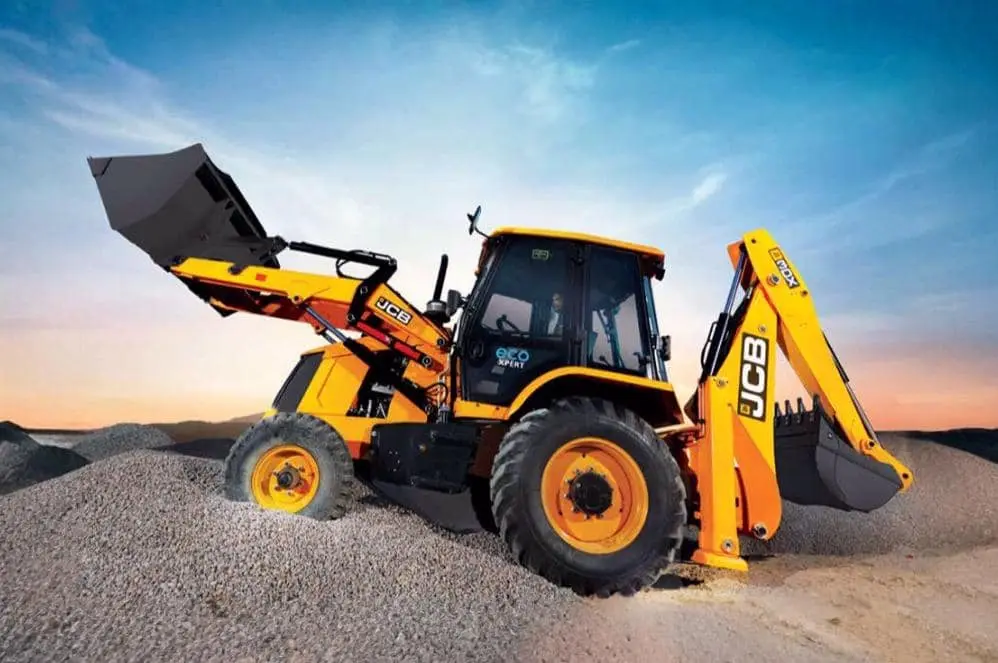
The JCB 3DX shows both kinds on one machine: a straight-edged front shovel for loading and a toothed rear bucket for digging.
The machines’ own specifications show the same split. The Bobcat E37 Xtra HD lists a bolt-on, one-piece and reversible cutting edge on its backfill blade, and notes that it is easier to reverse and replace than a welded-on edge. The Volvo L260H describes its bucket the other way round: bolt-on edges protect the bottom edge of the bucket, while segments protect the cutting edge. Wikipedia’s article on the bucket as a machine part describes the ditching bucket as a wider bucket with no teeth, used for larger excavations and for grading.
Motor graders carry a cutting edge too, under the moldboard, and that edge is sized and ordered differently. It has its own section in the guide to motor grader parts.
Bolt-on or weld-on cutting edge: which is better?
For most owners, bolt-on. A bolt-on edge comes off with a spanner, and a reversible one can be turned over and used a second time.
A reversible edge is ground with a bevel on both long sides, so when the front side has worn down you unbolt it, flip it end over end and bolt it back with the fresh bevel at the front. You get two wear lives from one part and one set of holes. A single-bevel edge only cuts on one side and is simply replaced.
A weld-on edge is welded straight to the lip. It cannot loosen and it adds no bolt holes to the bucket, which suits a bucket that takes heavy impact all day. The cost comes at change time: the old edge has to be cut off, the lip cleaned up and a new edge welded on to the steel maker’s welding procedure, which takes a workshop and a skilled welder. Do it badly and the lip cracks behind the weld.
| Point | Bolt-on edge | Weld-on edge |
|---|---|---|
| Change time | Hours, on site, with hand tools | A workshop job: cut, clean, weld |
| Second life | Yes, if the edge is reversible | No |
| Loose or lost edge | Possible if bolts are not checked | Not possible |
| Bolt holes in the lip | Yes | No |
| Best suited to | Loading, levelling, backfilling, daily site work | Heavy rock and quarry buckets |
Table 2: Bolt-on against weld-on cutting edges
For a backhoe loader that spends its day loading tippers, backfilling trenches and levelling plots, a bolt-on reversible edge is the sensible choice. A worn edge can be swapped in the yard before the next shift.
How do you find the right size of cutting edge?
Start with the bucket width, then measure the old edge. The edge runs along the bucket lip, so its length follows the bucket width. On a wide loader bucket it can come in more than one section, and on some buckets it stops short of the corners where the side cutters sit.
None of the bucket machines listed on DesiMachines publishes a cutting edge thickness or bolt pattern. The only machines that publish a cutting edge figure at all are the motor graders, all 42 of them. What the loaders do publish is the bucket width, and that tells you roughly how long the edge is.
Of the 54 wheel loaders listed, 44 give the same bucket width in both of their specification tables. Table 3 groups them by operating weight. Machines with an open data query on their specifications are left out, so each row says how many machines it is built from.
| Operating weight class | Bucket width | Machines counted |
|---|---|---|
| Under 10 tonnes | 2,202 to 2,430 mm (2.2 to 2.4 m) | 2 |
| 10 to 15 tonnes | 2,550 to 2,750 mm (2.6 to 2.8 m) | 7 |
| 15 to 20 tonnes | 2,880 to 3,010 mm (2.9 to 3.0 m) | 7 |
| 20 to 30 tonnes | 3,000 to 3,300 mm (3.0 to 3.3 m) | 9 |
| 30 to 60 tonnes | 3,400 to 3,970 mm (3.4 to 4.0 m) | 9 |
| Over 60 tonnes (mining) | 4,610 to 6,240 mm (4.6 to 6.2 m) | 4 |
Table 3: Wheel loader bucket width by operating weight, as published in October 2026
| Class | Narrowest to widest bucket, drawn to scale against 6,240 mm |
|---|---|
| Under 10 t | |
| 10 to 15 t | |
| 15 to 20 t | |
| 20 to 30 t | |
| 30 to 60 t | |
| Over 60 t |
Figure 1: How bucket width grows with machine size
The grey bar runs to the narrowest bucket in each class and the orange bar shows the spread up to the widest. Between 10 and 60 tonnes each class is only a few hundred millimetres wider than the one below it, so two machines a class apart can still be close in edge length. Measure, never assume.
Backhoe loaders are much closer to each other. Of the 38 that give the same front shovel width in both specification tables, 35 fall between 2,230 and 2,500 mm (2.2 to 2.5 m), and 13 give exactly 2,350 mm. The JCB 3DX is one of those at 2,350 mm, and the JCB 4DX lists 2,440 mm. Across the eight skid steer loaders that publish it, bucket width runs from 914 mm on the smallest machine to 2,032 mm (0.9 to 2.0 m).
Two backhoe loaders with the same shovel width can still take different edges, because the hole pattern and thickness differ by make and bucket. So before you order, take these off the old edge:
- Overall length, end to end, and how many sections it is in.
- Width, front to back, and thickness, measured on an unworn part near the ends.
- Number of bolt holes, the distance between hole centres, and the hole size.
- Bolt diameter and length, and whether the holes are countersunk for plough bolts.
- Single bevel or double bevel (reversible).
Sizes and fitment in this guide are a guide only. Confirm the exact part with the machine maker or an authorised dealer, using the machine’s serial number, before you order.
Choosing a machine and want the bucket that suits your work? Compare backhoe loader models and wheel loaders with the shovel width in hand.
What steel is a cutting edge made of?
Cutting edges are made from hardened wear-resistant steel, much harder than the mild steel of a fabricated frame. The steel has to do two things that pull against each other: resist sand and stone grinding it away, and stay tough enough not to crack when the edge hits a buried boulder.
Steel makers sell plate graded for exactly that balance. SSAB, for example, names its Hardox 500 Tuf plate for buckets and attachments because it combines high hardness with high toughness. Hardness for these steels is quoted on the Brinell scale, and what the 400, 450 and 500 grades mean, and how they compare, is explained in the guide to bucket wear plates. The same reasoning applies to an edge.
Harder is not always better. A very hard edge on a bucket that works in rock can chip or crack. On sandy, abrasive ground the same edge simply lasts longer. Tell the seller what your machine digs or loads most of the day.
When should you flip or replace a cutting edge?
Look at the edge every time you grease the machine. These are the signs that it needs attention:
- The front is rounded and blunt, and the bucket pushes material instead of cutting into it.
- The edge has worn thin enough that the plough bolt heads are being ground down.
- Bolt holes have stretched into ovals, or bolts keep working loose.
- The edge has worn in a wave or a dip, usually from working one corner harder.
- There is a crack across the edge, or a piece has broken out.
- Wear has passed the edge and started on the lip behind it.
Flip a reversible edge once the front bevel has worn away, while the bolt heads are still whole. Left longer, the bolts wear through and the edge can no longer be removed cleanly. Replace any edge before the wear reaches the lip; the guide to backhoe loader bucket prices makes the same point about the bucket floor, because a lip worn into the bucket shell turns a bolt-on part into a fabrication job.
Fit new plough bolts and nuts with every new edge. Old bolts have stretched and their heads are worn, so they do not hold the new edge flat. Check them again after the first few days of work, when the new edge beds in.
How is a bolt-on cutting edge changed?
On a backhoe loader or skid steer this is a yard job for two people.
- Lower the bucket onto solid blocks with the edge clear of the ground, stop the engine and lock the controls. Never work under a bucket held up only by the hydraulics.
- Undo the nuts. Worn bolt heads often spin, so expect to cut or drive some bolts out.
- Clean the lip where the edge sits. Mud and rust under a new edge stop it bedding flat.
- Offer up the new or flipped edge, fit new plough bolts from the front and tighten the nuts evenly along the length.
- Run the machine for a few hours, then check every nut again.
A weld-on edge is a workshop job. The guide to bucket repair costs sets out when rebuilding a worn bucket is worth it.
What decides the price of a cutting edge?
Five things, in roughly this order:
- Size: a longer, wider and thicker edge uses more steel.
- Steel grade and heat treatment: harder, tougher plate costs more to make.
- Reversible or single bevel: a reversible edge costs more but gives two wear lives.
- Number of sections and whether segments or end pieces are included.
- Whether the plough bolts and nuts come with it.
Compare quotes on the same size, steel and hole pattern, and count the wear lives you get from each. A reversible edge that lasts twice as long is usually the cheaper part per working hour. The other parts that wear on the front end are covered in the guide to backhoe loader parts, and the whole list sits in the parts and running costs guide.
Where the facts in this guide come from
The plough bolt, a flush countersunk bolt used to hold cutting edges onto earthmoving implements, is described in Wikipedia’s article on carriage bolts. The ditching bucket with no teeth is described in Wikipedia’s article on the bucket as a machine part. The Bobcat E37 Xtra HD’s reversible bolt-on blade edge, the Volvo L260H’s bolt-on edges and segments, and every bucket width in Table 3, Figure 1 and the backhoe and skid steer figures come from each machine’s own specifications, read in October 2026; a width is counted only where both of a machine’s specification tables give the same figure. SSAB’s description of Hardox 500 Tuf for buckets comes from SSAB’s Hardox page.
Your machine’s operator manual and parts book give the right part number, bolt size and tightening torque for your bucket, and should always be checked first.
Prices, specifications and features are indicative, vary by variant, location and date, and should always be confirmed with the official OEM or authorised dealer before any purchase decision. DesiMachines is not liable for decisions taken on the basis of information that may have changed after publication.
Get a bucket cutting edge price from a dealer near you
Tell us your machine and what you need, and we will ask the nearest dealer to reach out to you with a price.