
 Excavator
294 models
Excavator
294 models  Backhoe Loader
51 models
Backhoe Loader
51 models  Crane
68 models
Crane
68 models  Concrete Mixer
79 models
Concrete Mixer
79 models  Wheel Loader
54 models
Wheel Loader
54 models  Compactor / Roller
45 models
Compactor / Roller
45 models  Motor Grader
42 models
Motor Grader
42 models  Dozer
41 models
Dozer
41 models  Concrete Pump
66 models
Concrete Pump
66 models  Skid Steer Loader
11 models
Skid Steer Loader
11 models  Telehandler
13 models
Telehandler
13 models 


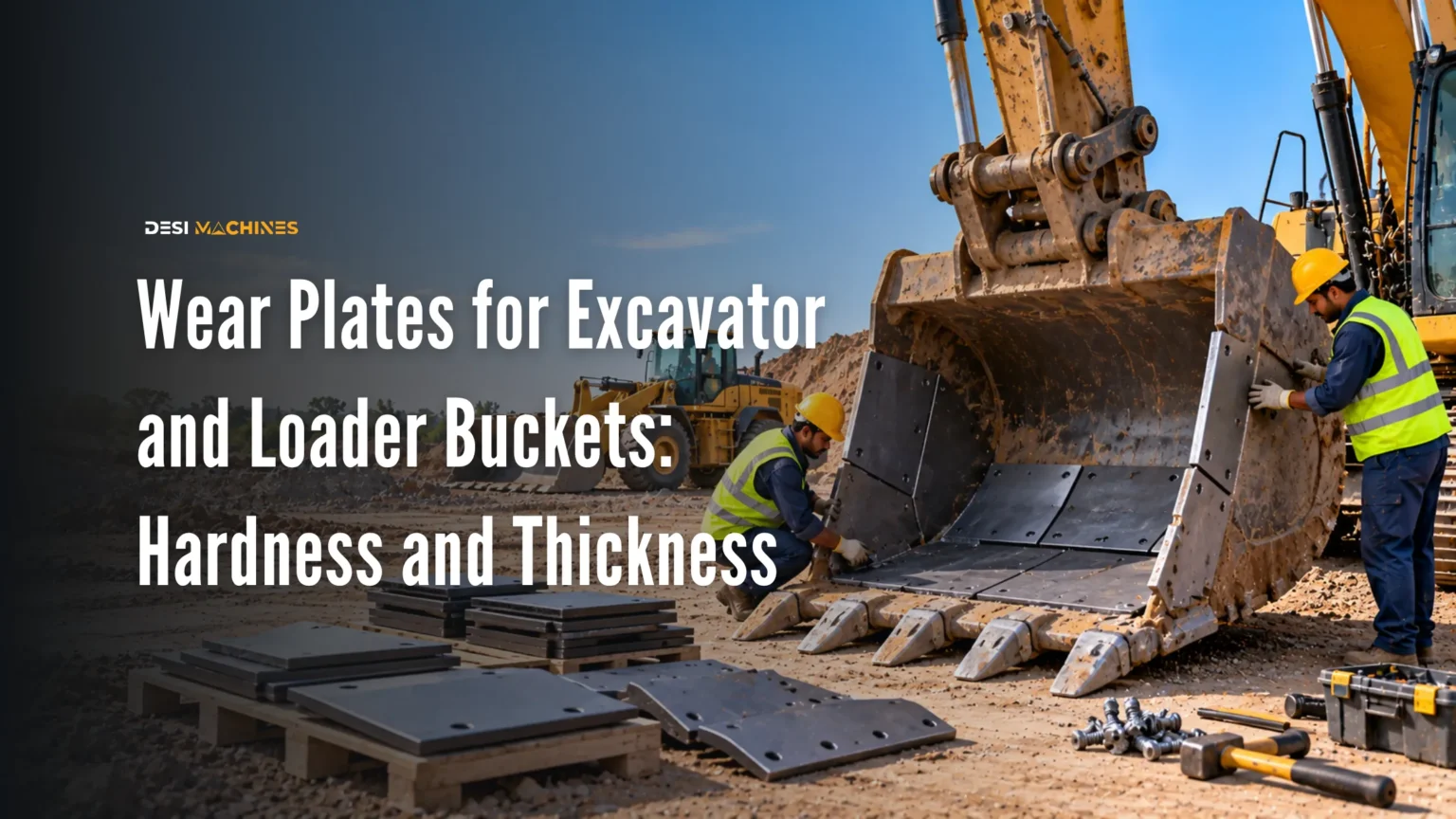
Between 400 and 500 on the Brinell hardness scale (HB) is where most wear plate for bucket lining on excavators and loaders sits, against roughly 120 HB for ordinary mild steel. The harder the plate, the slower it wears in sand, murram and rock, but the less well it takes a hard knock, so the right grade depends on whether your bucket mostly scrapes or mostly hits.
A wear plate, also called a wear liner or bucket liner, is a piece of extra-hard steel welded or bolted onto the parts of a bucket that rub the ground: the floor, the heel, the sides and the lip. It wears away so the bucket’s own steel does not. When the plate is thin, it is cut off and a new one goes on, and the bucket shell keeps working.
This guide explains what the hardness numbers mean, how the 400, 450, 500 and 600 grades compare, how thick the plate comes, where makers fit it on excavators, loaders and graders, how it is fitted and when to change it. It gives no prices. Whether a badly worn bucket is worth repairing at all is answered in the blog on excavator bucket repair cost.
What is a wear plate on a bucket?
It is a sacrificial layer. The bucket body is built from steel chosen for strength and easy welding, and that steel is not very hard. Wherever soil or stone slides across it, it wears thin. A plate of much harder steel placed over those areas takes the wear instead.
Most buckets carry several kinds of wear part, each with its own job. The teeth, adapters and side cutters on the lip are a separate family, covered in the bucket teeth guide. This page is about the plates and strips that protect the rest of the bucket.
| Wear part | Where it sits | What it protects |
|---|---|---|
| Floor wear plate (bucket liner) | Inside the bucket, across the floor | The floor, where loaded material slides out every time the bucket is emptied |
| Heel plate and wear strips | Under the bucket, behind the lip | The underside that drags on the ground while digging and levelling |
| Side wear plates | On the outside of each side plate | The sides, which rub the trench walls and the stone pile |
| Cutting edge and lip | Along the front edge | The front edge, where the bucket first meets the ground |
| Wear buttons | Small round pieces welded in rows on the heel or corners | Spots that a full plate cannot cover neatly |
Figure 1: Where wear parts sit on an excavator bucket
- Yellow parts are covered in the bucket teeth guide.
- Red, blue and grey parts are the wear plates this guide is about.
- A heavy-duty or rock bucket carries more of all four.
What does HB mean in a wear plate grade?
HB is the Brinell hardness number. In the test, a hard ball is pressed into the steel under a set load, and the size of the dent it leaves gives the number. A small dent means hard steel and a high number.
The gap between ordinary steel and wear plate is large. Wikipedia’s table of Brinell values puts mild steel at about 120 HB and quenched and tempered wear plate at 400 to 700 HB. Quenched and tempered means the plate is heated, cooled fast to make it hard, and then reheated gently so it is less brittle.
The grade name is the middle of a band, not an exact figure. SSAB’s data sheet for its Hardox 400 plate, for example, guarantees a hardness of 370 to 430 HBW, measured to the EN ISO 6506-1 test method on a surface milled 0.5 to 3 mm below the skin of the plate. The same data sheets say the plate is hardened right through, with the core at least 90% of the guaranteed minimum. That matters on a bucket. As a through-hardened plate wears down, the steel underneath is still hard, which is not true of a thin hard layer laid on top of soft steel.
How do the 400, 450, 500 and 600 grades compare?
The table puts SSAB’s published figures for its four main Hardox grades side by side, with mild steel for scale. Hardox is one maker’s brand name. Other steel mills sell plate at the same hardness levels under their own names, and the grade is usually named by its number alone. Compare plates by the hardness band and thickness on the mill’s test certificate, not by the name.
Table 1: Wear plate grades compared (maker data sheets, read October 2026)
| Grade | Hardness band | Plate thickness made | Typical yield strength | Typical impact energy at -40 °C |
|---|---|---|---|---|
| Mild steel (for scale) | About 120 HB | Any | Not compared here | Not compared here |
| 400 | 370 to 430 HBW | 4 to 130 mm | 1,100 MPa | 45 J |
| 450 | 425 to 475 HBW up to 80 mm; lower floor on thicker plate | 3.2 to 160 mm | 1,250 MPa | 50 J |
| 500 | 470 to 530 HBW up to 32 mm; 450 to 540 HBW from 32.1 to 103 mm | 4 to 103 mm | 1,400 MPa | 37 J |
| 600 | 570 to 640 HBW up to 51 mm; 550 to 640 HBW from 51.1 to 65 mm | 6 to 65 mm | Not listed in the table read | Not listed in the table read |
Two of those columns need a word of explanation. Yield strength is the load at which steel starts to bend and stay bent. Impact energy comes from the Charpy test, in which a swinging hammer breaks a notched bar and the energy it soaks up shows how well the steel takes a sudden blow. SSAB gives both as typical values, not guarantees, and the impact figures are for 20 mm plate.
Read across the rows and the trade-off shows. Hardness and yield strength climb from 400 to 500. The impact figure for 500 is lower than for 400 or 450. A harder plate resists scraping better, but it is less forgiving when a boulder lands on it.
Thickness moves the band too. On the thickest sizes of 450, 500 and 600, the maker guarantees a wider band with a lower floor, so check the band for the exact thickness you are buying.
Is 400 or 500 better for an excavator bucket?
Neither is better everywhere. Match the plate to the kind of wear your bucket sees.
- Sliding wear, where sand, murram, gravel or crushed stone pours across the floor all day, rewards hardness. A 450 or 500 plate lasts longer here. SSAB’s own page for Hardox 450 says the extra 50 HBW over the 400 grade gives longer wear life, or lets you use a thinner plate for a lighter bucket.
- Impact wear, where blasted rock and boulders are dropped into the bucket or the bucket is rammed into a rock face, punishes brittleness. A plate that is too hard for the job can crack. Here 400 or 450 is the safer choice, and the bucket’s design matters as much as the plate.
- Mixed work, the usual case on a contractor’s 20-tonne class machine that digs soil one week and loads quarry muck the next, points to the middle of the range. A 400 or 450 plate gives up some wear life against 500 and keeps more toughness, as the impact column above shows.
- 600 is a specialist grade. SSAB describes it as an extra-hard steel designed for wear parts in harsh wear.
The softer grade is also easier to work. SSAB says its 400 plate can be welded with the same consumables as mild steel and needs no preheating up to 20 mm thick, and can be drilled with ordinary workshop equipment. Harder and thicker plate asks for more care, so give your fabricator the grade before the job starts.
How thick should a bucket wear plate be?
There is no single right number, and a seller who quotes one without seeing the bucket is guessing. Plate in the common grades is made from a few millimetres up to more than 100 mm, so the choice is wide. Three things decide it.
The bucket’s own build comes first. A liner much thicker than the floor plate it covers adds weight without adding life where it counts. Then the ground: a bucket working in sharp, abrasive stone wears plate faster than one in soft soil. Then the grade, because a harder plate can be thinner for the same life.
Weight is the cost people forget. Steel weighs about 7.85 tonnes per cubic metre, which works out to roughly 7.85 kg for every square metre of plate per millimetre of thickness. A 10 mm liner over 2 square metres of floor adds about 157 kg. Every kilogram added to the bucket is a kilogram the machine lifts on every cycle and a kilogram less of payload, so ask the bucket maker or dealer what the bucket was designed to carry before you add plate.
Which machines come with wear plates fitted?
Heavy-duty and mining buckets usually leave the factory with wear plate already on them. These are the machines whose own listings name it, as read in October 2026.
Table 2: Wear plate named in the maker’s machine features
| Machine | Class | What the listing says |
|---|---|---|
| SANY SY120C-9 | Small excavator, 6 to 15 ton | Anti-wear plates added to its buckets for a longer bucket life |
| SANY SY240C-9HD GraMa | Medium excavator, 15 to 25 ton | A scoop bucket built fully from Hardox plate, shaped to lift granite blocks |
| SANY SY390C-10HD GraMa | Large excavator, 25 to 50 ton | The same full Hardox plate scoop bucket for granite block work |
| SANY SY870C-10HD and SY980C-10HD | Extra-large excavators, over 50 ton | Anti-wear plates for longer bucket life in mining |
| Volvo EC750D and EC950E | Extra-large excavators, over 50 ton | Heavy-duty bucket built from wear-resistant plates for quarrying and mining |
| Tata Hitachi EX 1200V | Extra-large excavator, over 50 ton | A replaceable wear-resistant plate at the arm tip boss, where the bucket pin sits |
| Cat 994K | Large wheel loader | Wear plates on both standard and optional buckets |
| BEML BG825 | Large motor grader | A moldboard built with wear-resistant steel, with reversible overlay end bits |
The pattern is clear. The bigger the machine and the harder the ground, the more of the bucket is protected from new. The Tata Hitachi entry is a reminder that wear plate is not only for buckets: pins, bosses and grader blades get the same treatment. On an ordinary 20-tonne class digger such as the Tata Hitachi EX 210 Infra or a backhoe loader such as the JCB 3DX, the standard bucket usually gets its extra plate later, from the owner, once the work shows where it wears.
Thinking of a new heavy-duty bucket instead of re-lining the old one? Ask a dealer for a quote on an excavator bucket built for your ground, and see how the types of excavator bucket differ before you choose.
Is a wear plate welded or bolted on?
Both, depending on the part. On most Indian buckets the floor liner, heel plate and side plates are welded on. A fabricator cuts the plate to the shape of the area, sets it in place and runs a weld around the edges. Bolt-on wear parts use countersunk bolts set flush with the surface, so nothing sticks out to be knocked off. They are quicker to change in the field and are common on loader cutting edges and on the bolt-on edge of a ditching bucket.
A few points decide whether a welded plate lasts:
- Clean, dry steel underneath. Old paint, rust and mud make a weak weld.
- The edges welded all the way round, so soil cannot pack in under the plate and lever it off.
- Controlled heat. Hard plate gets its hardness from heat treatment, and too much welding heat in one place can soften the steel next to the weld.
- The plate’s maker’s welding advice followed for thick or very hard plate, including any preheat it asks for.
Hardfacing is a different repair. It lays beads of very hard weld metal straight onto the bucket instead of adding a plate. The blog on bucket repair cost explains when that pays.
When does a bucket wear plate need replacing?
Change it before it wears through. While the plate is there, you are replacing a cheap, flat piece of steel. Once it has gone, the ground starts eating the bucket floor, and a liner job becomes a fabrication job.
Look for these signs when you grease the machine each day:
- The leading edge of the liner is worn to a knife edge, or the plate has grooves worn into it along the line the material flows.
- Holes have worn through, and you can see the bucket’s own steel underneath.
- The weld around the edge has worn away and the plate has started to lift.
- The heel has worn round, so the bucket rocks on the ground instead of sitting flat.
- The bucket floor has started to bulge or crack under the plate.
Measure, do not guess. A plate’s remaining thickness can be checked at a worn edge with calipers, or anywhere with an ultrasonic thickness gauge, which reads the steel from one side. Write the reading down at each service, and you will learn how many hours a plate lasts on your ground. The greasing guide covers the daily walk-round that this check fits into, and the excavator components guide shows how the bucket links to the arm.
What decides the price of a wear plate?
This guide gives no price, because a quote for wear plate is mostly a quote for steel and labour. The things that move it are:
- The grade. Harder plate costs more to make than softer plate.
- The thickness and area, which together set the weight of steel you are buying.
- Cutting to shape. A plate cut to your bucket’s drawing costs more than a plain sheet.
- The mill test certificate. Plate sold with the mill’s certificate showing grade and hardness lets you check what you paid for.
- Fitting. Removing the old plate, preparing the steel and welding in the new one is labour, charged on top.
Ask for the grade, thickness and certificate on the quote, and for parts and labour on separate lines. For a whole new bucket instead, the bucket price guide explains what moves that price.
If the machine itself is due for replacement, browse current excavators, mining excavators and wheel loaders and talk to a dealer. Other wearing parts are explained in the parts and running costs guides.
Where the facts in this guide come from
The hardness bands, thickness ranges, typical yield strength, typical impact energy, test method, through-hardness guarantee and welding notes come from SSAB’s product data pages for Hardox 400, 450, 500 and 600, read in October 2026. The Brinell values for mild steel and quenched and tempered wear plate come from Wikipedia’s article on the Brinell scale. Each machine’s wear plate details come from its own features list, read in October 2026.
Wear plate grade, thickness and fitting method for your bucket should always be confirmed with the bucket or machine maker before fitting.
Prices, specifications and features are indicative, vary by variant, location and date, and should always be confirmed with the official OEM or authorised dealer before any purchase decision. DesiMachines is not liable for decisions taken on the basis of information that may have changed after publication.
Get a wear plate price from a dealer near you
Tell us your machine and what you need, and we will ask the nearest dealer to reach out to you with a price.