
 Excavator
294 models
Excavator
294 models  Backhoe Loader
51 models
Backhoe Loader
51 models  Crane
68 models
Crane
68 models  Concrete Mixer
79 models
Concrete Mixer
79 models  Wheel Loader
54 models
Wheel Loader
54 models  Compactor / Roller
45 models
Compactor / Roller
45 models  Motor Grader
42 models
Motor Grader
42 models  Concrete Pump
66 models
Concrete Pump
66 models  Skid Steer Loader
11 models
Skid Steer Loader
11 models  Telehandler
13 models
Telehandler
13 models 


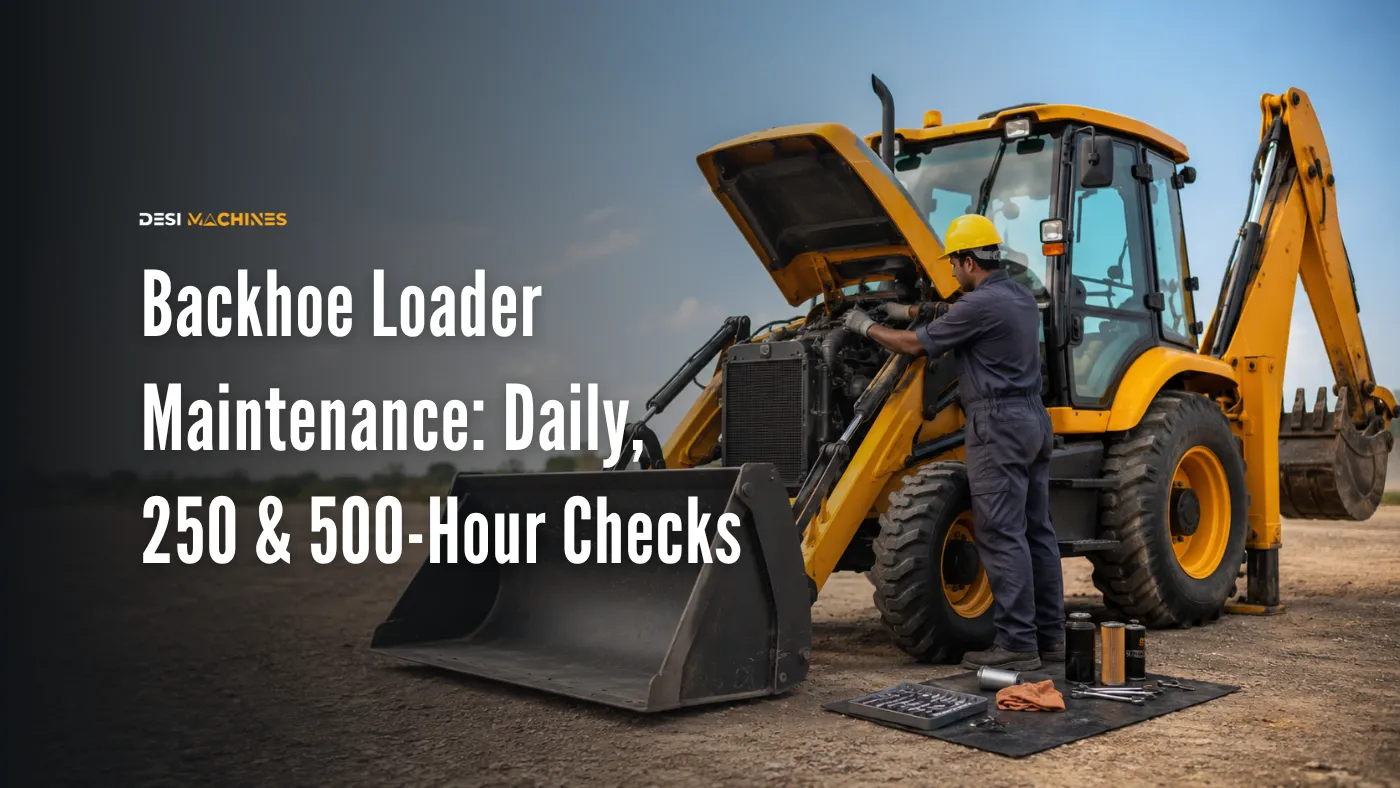
A backhoe loader maintenance schedule is the fixed list of checks, greasing and oil changes a machine needs, counted in engine hours instead of days. The hour meter on the dashboard decides when a service is due, so a machine that works ten hours a day reaches its 250-hour service in about a month, while one that works three hours a day takes three months to get there.
Nearly every backhoe loader sold in India follows the same shape of schedule: a walk-round every morning, greasing through the day, a short first service when the machine is new, then engine oil around every 250 to 500 hours and the heavier jobs at 1,000 and 2,000 hours. The exact numbers belong to your model, and the operator’s manual that came with the machine is the only authority for them. This guide explains what each service covers, how much oil each listed model actually holds, and which checks a first-time owner can do himself.
The hydraulic side of that routine has its own checks and failure signs: see hydraulic system maintenance for construction equipment.
What do you check on a backhoe loader every day?
Check the levels, the leaks and the tyres before the engine starts, and grease the digging end during the day. This ten-minute walk-round prevents more breakdowns than any workshop visit, and it costs nothing.
With the machine parked level and the engine cold:
- Engine oil on the dipstick, between the two marks. Top up with the grade printed in the manual, not with whatever is open in the shed.
- Coolant in the overflow bottle. Never open a hot radiator cap.
- Hydraulic oil in the sight glass, with the loader bucket down on the ground and the backhoe folded in, which is the position the level is meant to be read in.
- Water in the fuel — drain the water separator bowl until clean diesel runs. In the monsoon this matters most, because water condenses in a half-empty tank overnight.
- Leaks — walk around and look at the ground under the machine. A fresh oil patch is information; a dry patch is also information.
- Tyres — pressure and cuts. A backhoe drives on public roads between sites, so a soft front tyre becomes a steering problem at speed.
- Grease — pump grease into the pins on the boom, dipper, bucket and loader arm. Most operators do this at the start of every shift, and again after working in water or slush.
Then two things while it runs: watch the gauges for the first minute, and listen. An operator who has run the same machine for a year hears a new noise long before a mechanic sees a fault.
What is the first service on a new backhoe loader?
The first service is an early engine oil and filter change, usually somewhere between 50 and 100 hours on a new machine, and it is normally covered by the dealer under the warranty terms. It exists because a new engine sheds fine metal particles as its parts bed in, and that oil has to come out before it goes round again.
Book it through the dealer who sold you the machine and get it recorded in the service book. A missing first service is the fastest way to lose a warranty claim later, and it is the first thing a buyer looks for when you sell the machine. Ask the dealer at handover for the exact hour figure for your model and write it on the cab window in marker; hour meters are easy to forget in the first busy month.
How often should you change backhoe loader engine oil?
Most backhoe loaders in India run on an engine oil and filter change every 250 to 500 hours, with the heavier fluid changes stacked at 1,000 and 2,000 hours. The table below is the common pattern across the brands sold here. Treat it as the shape of the schedule and confirm each figure against your own manual, because a 49 HP machine and a 100 HP machine do not always share intervals.
| Engine hours | What the service usually covers |
|---|---|
| Every 8 to 10 hours (daily) | Walk-round checks, all fluid levels, water separator drain, greasing of all pins |
| First service, about 50 to 100 hours | Early engine oil and filter change on a new machine, bolts checked and retightened |
| Every 250 hours | Engine oil and oil filter on most models, air filter cleaned, battery and belts checked |
| Every 500 hours | Fuel filters replaced, air filter element replaced, hydraulic return filter, transmission and axle oil levels |
| Every 1,000 hours | Transmission and axle oil changed, hydraulic filters replaced, cooling system checked |
| Every 2,000 hours or two years | Hydraulic oil changed, coolant changed, brake system and injectors checked by the dealer |
Two things shorten these intervals in real Indian conditions. Dust is the first: a machine working on a crusher yard or an unmade village road loads its air filter far faster than one on a city drainage job, and a choked air filter costs fuel every hour it stays choked. Water is the second: after working in slush or a flooded trench, grease the pins again the same day rather than waiting for the next morning.
Hours also decide what the machine is worth later. Buyers pay for a full service file, which is why the checks in our used backhoe loader buying guide start with the service book before they get to the machine.
How much engine oil and hydraulic oil does a backhoe loader take?
Backhoe loaders sold in India run from 49 HP to 100 HP, and across the 51 machines listed here they hold 8 to 15 litres of engine oil. The hydraulic side is bigger and varies more: the tank on its own holds 42 to 135 litres, and the full system, which is the tank plus the pump, hoses, rams and cooler, holds 42 to 125 litres. Two machines from the same brand can take different amounts, so read the figure for your own model. Not every maker publishes every figure: engine oil is listed for 49 of the 51 machines, the hydraulic tank for 33 and the full system for 32, current as of the September 2026 specification.
| Model | Engine power | Engine oil | Hydraulic tank | Hydraulic system | Fuel tank |
|---|---|---|---|---|---|
| JCB 3DX Plus | 74 HP (55 kW) | 15 L | Not listed | 92 L | 128 L |
| JCB 2DX | 49 HP (36.4 kW) | 8 L | Not listed | 60 L | 60 L |
| Mahindra EarthMaster SXE | 55 HP (41 kW) | 13.7 L | Not listed | 102 L | 140 L |
| Tata Hitachi Shinrai Power | 74.3 HP (55.4 kW) | 13.2 L | 86 L | Not listed | 128 L |
| CASE 770 NX Magnum | 74 HP (54.6 kW) | 8.5 L | Not listed | 96 L | 129 L |
| Bull HD76 4WD | 76 HP (56.7 kW) | 12 L | 100 L | 120 L | 115 L |
| Escorts Digmax II | 75 HP (55 kW) | 11.5 L | Not listed | 110 L | 134 L |
| ACE AX 130 | 79 HP (59 kW) | 11 L | 135 L | Not listed | 160 L |
The same figures for excavators, from mini machines to the 34-tonne class, are in our table of excavator engine oil and hydraulic oil capacity.
Read the table as a purchase list, because that is what it is for. If your machine takes 15 litres of engine oil, buying a 20-litre pack covers the change and leaves a little for topping up; buying a 10-litre pack means a second trip to the dealer in the middle of a service. Our full reference to backhoe loader oil and fluid capacities lists engine, hydraulic, transmission and coolant figures for every machine on our books, and explains why the hydraulic tank figure and the full hydraulic system figure are two different numbers. Excavator owners can look up the same figures for their machines in the reference table of fuel tank capacity of excavators and backhoe loaders.
Use the oil grade the manual specifies. Tractor oil is cheaper and it is the substitution people make most often in rural workshops, but a backhoe’s wet brakes, transmission and hydraulics are built around a particular specification, and the saving disappears with the first seal that fails. Where a machine has no published capacity, the dealer for that model will give you the figure in writing.
What needs greasing on a backhoe loader?
Every pin joint on the machine needs grease, and there are more of them on a backhoe than on any other machine of its size. The digging arm swings sideways as well as up and down, so its joints wear in two directions at once.
Work through them in a fixed order so none is missed: the loader arm pivots and the loader bucket pins at the front, then the king post and swing pins where the backhoe mounts, the boom pivot, the dipper pins, the bucket pins and linkage at the back, and finally the stabiliser legs. A machine that has run a hydraulic breaker needs more attention here than the hour meter suggests, because breaking work hammers the same joints all day. What each attachment does to the machine under it is set out in our guide to backhoe loader attachments.
Signs a joint has been missed for too long: a dry squeak when the arm moves, a bright metal ring around the pin, or visible play when you shake the bucket by hand. Once a pin and its bush wear out of round, greasing no longer fixes it, and the repair becomes a workshop job. If you are not sure which joint is which, our guide to backhoe loader parts and components names every one of them, front to back.
Comparing machines before you buy? See the full range of backhoe loaders with prices, specifications and dealer contacts.
What does backhoe loader servicing cost in India?
The labour rate depends on your dealer and your district, so no single figure holds across the country. What you can pin down before you walk into a workshop is the quantity of each item, and that is where the capacity table above earns its keep.
Take three things to the dealer and ask for a written rate card: litres of engine oil for your model, the part numbers of the filters changed at that interval, and the labour charge for the service. Multiply the oil quantity by the per-litre rate you are quoted and you have most of the bill before the machine goes in. Ask separately what an annual maintenance contract covers, because a contract that includes only oils and filters is a different product from one that includes wear parts.
For the wider arithmetic of turning services into a cost per hour, and what a year of ownership adds up to, our note on equipment maintenance cost and service intervals works the method through on an excavator, and the same method applies to a backhoe. If the machine is bought on finance, that per-hour figure sits alongside the equipment finance and EMI options in your monthly outgoing, and both belong in the same calculation.
What are the signs a backhoe is overdue for service?
The machine tells you before it stops. Four signals are worth acting on the same week you notice them.
- Black smoke and falling power usually point at a choked air filter or a fuel filter that is past its interval. This is the cheapest fault on the list and the most commonly ignored.
- Slow or jerky hydraulics, especially when the oil is hot in the afternoon, means the oil or the filter is due, or the pump is tiring. Raising the engine speed to compensate only hides it.
- Rising fuel burn per day on the same kind of work is the number most owners track anyway, and it moves before anything breaks.
- Fresh oil where the machine parks is a seal or a hose, and a hose that bursts mid-lift is a safety problem, not only a repair bill.
Operator habits matter as much as the schedule. Warming the machine before working it, lowering the loader bucket to the ground at shutdown and keeping the radiator clean of dust do more for a backhoe’s life than any additive sold in a bottle. The wider routine around those habits sits in our guide to construction equipment operations and maintenance.
Why the service file decides your resale price
A complete service file is worth real money when you sell, because it is the only proof a buyer has that the hours on the meter were kind hours. Keep every job card and invoice in one folder from the day the machine arrives, and note the hour reading against each entry.
Record four things per service: the date, the hour meter reading, what was changed, and who did it. A machine with a full file from an authorised dealer sells faster and holds its price better than an identical machine with no papers, which is why buyers ask for the file before they ask for the price. Drivetrain choice moves that resale number as well, and the difference is set out in our comparison of 2WD and 4WD backhoe loaders. If the machine is new to you, start the file from the first day you own it, even for a second-hand purchase.
A new backhoe loader today runs from about ₹22–24 Lakh for the 49.5 HP CASE 770 NXe Series to about ₹36–40 Lakh for the 74 HP JCB 4DX (both indicative, as of September 2026). Against a machine of that value, a service done on time is the cheapest insurance available.
Ready to buy or upgrade? Compare backhoe loader models and prices across brands, or start with what the machine is and how it works in the complete backhoe loader guide.
A rising diesel bill is often the first sign a service is overdue, so it is worth tracking alongside the schedule — our guide to backhoe loader mileage and fuel consumption covers how to measure it and what a sudden jump usually means.
Every service on this schedule needs parts, and the grade you buy matters while the machine is still under warranty. The spare parts buying guide covers genuine, OEM and aftermarket, and where each one belongs.
The same hour-based logic applies to every machine in the yard, not just backhoe loaders. For the cross-category view of what falls due at each service point, and how many separate oil systems each machine type carries, see the construction equipment service schedule.
A warning lamp on the dashboard is often the first sign that one of these checks has been missed, and backhoe loader warning lights explains what each symbol is telling you before it becomes a repair.
What wears on the stabiliser legs themselves, and how to tell a sinking leg from a leaking one, is covered in the guide to backhoe stabilizer legs.
Prices, specifications and features are indicative, vary by variant, location and date, and should always be confirmed with the official OEM or authorised dealer before any purchase decision. DesiMachines is not liable for decisions taken on the basis of information that may have changed after publication. Specification figures are taken from our listings at the time of writing.

