
 Excavator
294 models
Excavator
294 models  Backhoe Loader
51 models
Backhoe Loader
51 models  Crane
68 models
Crane
68 models  Concrete Mixer
79 models
Concrete Mixer
79 models  Wheel Loader
54 models
Wheel Loader
54 models  Compactor / Roller
45 models
Compactor / Roller
45 models  Motor Grader
42 models
Motor Grader
42 models  Concrete Pump
66 models
Concrete Pump
66 models  Skid Steer Loader
11 models
Skid Steer Loader
11 models  Telehandler
13 models
Telehandler
13 models 


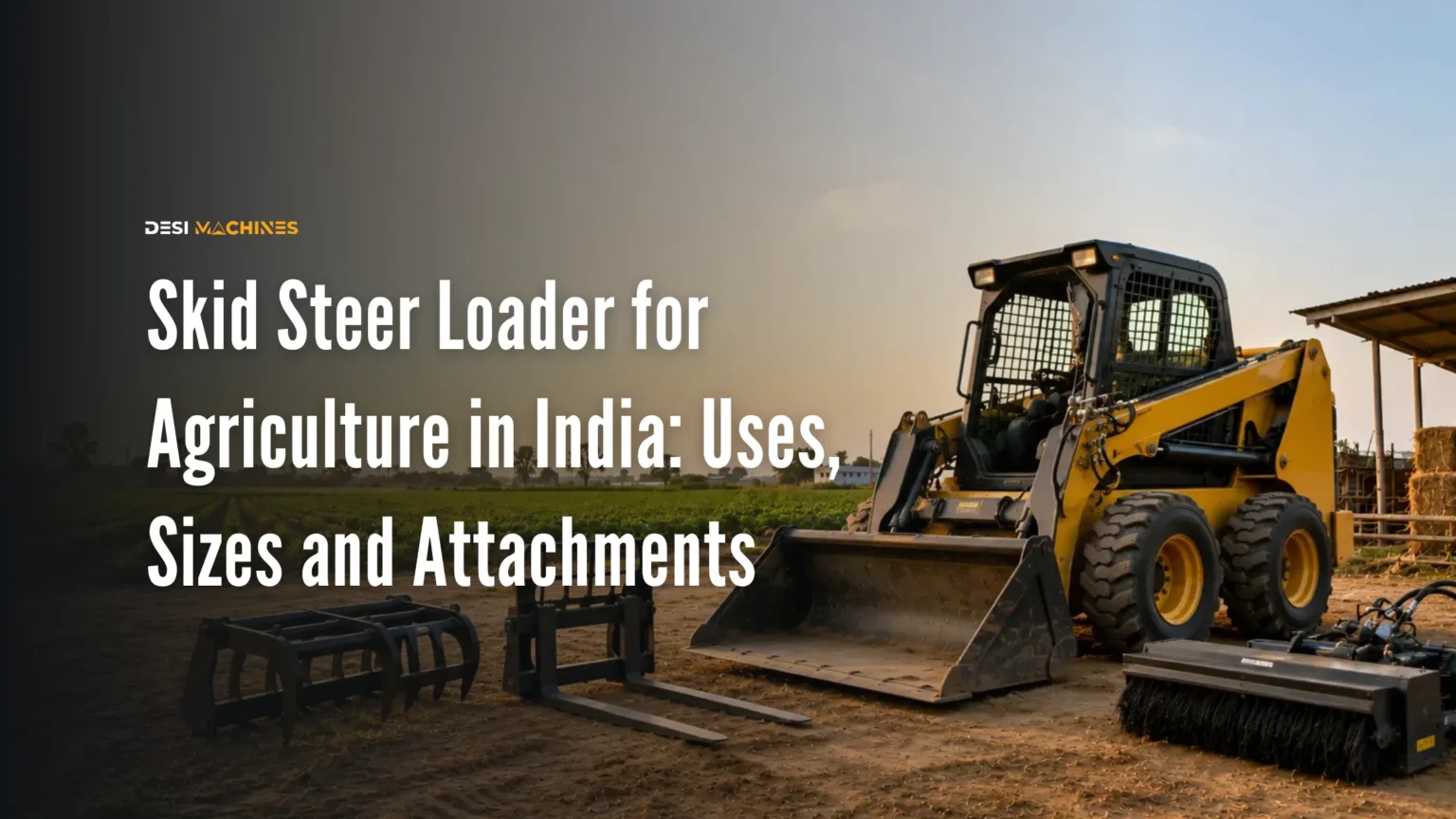
A skid steer loader is a small four-wheeled loader that turns by driving the wheels on one side faster than the other, which is why it can spin inside its own length. On an Indian farm that matters more than horsepower: the machine works in cattle sheds, between orchard rows and inside compound walls where a tractor with a loader simply cannot turn. Fitted with the right attachment, one skid steer handles muck cleaning, silage, loading, levelling and post holes.
This guide covers what the machine can genuinely do on a farm, what size fits through a normal gate, and where a tractor is still the better buy. All figures come from the machines listed on DesiMachines.
Why does a skid steer suit farm work?
Three things make it a farm machine rather than only a construction one.
The first is turning. Because the machine skids round rather than steering with its front wheels, it needs no turning circle at all. It pivots on the spot, which is the difference between cleaning a shed in one pass and shunting back and forth twenty times.
The second is size. Most skid steers sold in India are between 1.5 and 1.7 metres wide, and the smallest are far narrower than that. A machine that fits through a farm gate can work everywhere on the holding.
The third is the quick coupler at the front. One machine becomes a loader, a bale handler, a post-hole digger or a leveller in a couple of minutes, so a farm that cannot justify four machines can justify one. How skid steer loaders work explains the steering and controls in more detail.
Will a skid steer fit through a farm gate?
Usually yes, and the exact answer is on the specification sheet as width over tyres. Standard farm gates and shed doors in India tend to run from about 1.8 m upward, and most skid steers sit comfortably under that. The very small machines go much lower.
| Model | Width over tyres | Operating weight | Rated operating capacity | Bucket capacity |
|---|---|---|---|---|
| Bobcat S70 | 900 mm | 1,291 kg | 318 kg | 0.23 m³ |
| Bobcat S450 | 1,488 mm | 2,365 kg | 608 kg | 0.38 m³ |
| L&T S315R | 1,504 mm | 3,275 kg | 750 kg | 0.4 m³ |
| JCB SSL 135 | 1,520 mm | 2,950 kg | 612 kg | 0.36 m³ |
| CAT 216B Series 3 | 1,525 mm | 2,581 kg | 635 kg | 0.63 m³ |
| ACE SS75 | 1,645 mm | 2,850 kg | 750 kg | 0.4 m³ |
| Bobcat S590 | 1,656 mm | 3,069 kg | 907 kg | 0.5 m³ |
Specifications as per the August 2026 listings on DesiMachines. Widths are over standard tyres; optional wider tyres add to the figure.
Rated operating capacity is the number to read carefully. It is the safe lifting load, set at half the weight that would tip the machine forward, and it runs from 318 kg on the smallest machine to 907 kg on the largest here. A 50 kg fertiliser bag is nothing; a full pallet of them is not. Measure your narrowest gate before you shortlist anything, because width is the one specification you cannot work around later.
What farm jobs can a skid steer actually do?
Shed and yard cleaning is the job that sells most machines to Indian dairy farms. Scraping out a cattle shed by hand takes hours; a skid steer with a bucket does it in minutes, and its pivot turn means it can work between the stalls without a three-point turn.
Loading is the second job. Farmyard manure into a trolley, gravel for a farm road, sand for construction on the holding, grain bags onto a truck: all of it is bucket or fork work that would otherwise be done by hand or by hiring a machine.
Silage and fodder handling suits the machine well, especially with a grab bucket that clamps loose material instead of letting it spill. Bale handling needs a bale spike, and here the rated operating capacity decides how many bales you can lift at once.
Ground work rounds it out. Levelling a threshing floor, backfilling a pipe trench, digging post holes for fencing, clearing an overgrown plot before ploughing. None of these fills a machine’s year on its own, but together they justify the purchase on a mid-sized holding.
What a skid steer is not good at is deep digging or field cultivation. It has no three-point linkage and no PTO shaft, so it cannot run a rotavator, a seed drill or a trailer pump. That limit is the whole reason the next section exists.
Skid steer or tractor: which should a farmer buy?
For most Indian farms the honest answer is that a tractor comes first and a skid steer comes second, if at all. A tractor with a front-end loader does field work, road haulage and loading, all from one purchase. A skid steer does none of the field work.
The skid steer earns its place when the farm’s bottleneck is handling rather than cultivation. A dairy with sheds to clean daily, a poultry operation, a mandi trader moving sacks, a farm with a contracting sideline in levelling and site clearing: in each of these the machine works enough hours to pay.
| Job | Better machine | Why |
|---|---|---|
| Ploughing, sowing, spraying | Tractor | Needs PTO and three-point linkage; the skid steer has neither |
| Daily shed and yard cleaning | Skid steer | Pivot turn in confined space; far faster per shed |
| Road haulage with a trailer | Tractor | Built for road speed and towing |
| Loading in a tight compound | Skid steer | No turning circle needed |
| Trenching and site work for hire | Backhoe loader | Reach and digging depth a skid steer cannot match |
If your work leans toward digging and roadwork rather than handling, look at a tractor-loader-backhoe instead, which combines a loader at the front with a proper digging arm at the rear.
Which attachments matter on an Indian farm?
Buy the machine for the attachments you will use weekly, not for the ones that sound useful. On a farm that usually means four.
A general purpose bucket comes with the machine and does most of the work. A grab or 4-in-1 bucket, which opens like a jaw, handles loose fodder, manure and brush far better than a plain bucket and doubles as a small dozer blade. Pallet forks turn the machine into a yard forklift for bags, crates and bales. A post-hole auger pays for itself on any farm that fences regularly.
Two more are worth considering if the work exists: a bale spike for round bales, and a leveller or box blade for maintaining farm tracks and threshing floors.
Check hydraulic flow before you buy any powered attachment. The machines above run from 37 to 82 litres per minute of pump flow, and an attachment rated for high flow will simply work slowly on a low-flow machine. Our guide to skid steer attachments covers fitment, couplers and what each tool is for.
Wheels or tracks on soft field ground?
A standard skid steer runs on four tyres. On dry yards, concrete sheds and firm tracks that is the right choice: tyres are cheaper, simpler and easier to replace in a rural market.
On wet or soft ground, tyres are the machine’s weak point. The skid steer’s turning method scrubs the surface every time it pivots, so on a wet field it digs itself in and tears up the ground. A compact track loader, which runs on rubber tracks instead, spreads its weight far better and keeps working when a wheeled machine cannot.
For most Indian farms the honest recommendation is tyres, because the machine will spend nearly all its life on yards, sheds and tracks rather than in wet fields. If soft ground is genuinely where the work is, read the compact track loader guide before committing.
What should you check before buying one for farm use?
Measure first. The narrowest gate, the lowest shed doorway, and the tightest corner the machine must work in. Width over tyres and height to top of cab are both on the specification sheet, and the cab height on these machines runs around 1.8 to 2.1 m.
Then match capacity to the heaviest thing you lift regularly, with room to spare. Buying at the limit of the rated operating capacity means working at the limit every day, which is hard on the machine and unsafe on uneven ground.
Ask about dealer support before you ask about price. A skid steer that waits three weeks for a hydraulic hose is worse than a slightly less capable machine with a dealer in the next town. Check that the attachments you want are stocked locally too, since a coupler standard that no local supplier fits leaves you with a machine that only does bucket work.
Finally, sit in it. These are small cabs, and an operator who is uncomfortable will use the machine less. Bhaari kaam ke liye chhoti machine, so the seat and the controls matter more than the brochure does.
Ready to compare? Browse the full range of skid steer loaders and send an enquiry to a dealer near you.
A note on the figures in this guide
All specifications quoted here are taken from our listings at the time of writing (August 2026) and describe standard configurations. Widths, capacities and hydraulic flow vary by variant and by the tyres and attachments fitted, so confirm against the exact machine you are buying.
For the wider picture on this machine family, see the skid steer loader guide, and for the loader family as a whole, wheel loader types by size class.
Prices, specifications and features are indicative, vary by variant, location and date, and should always be confirmed with the official OEM or authorised dealer before any purchase decision. DesiMachines is not liable for decisions taken on the basis of information that may have changed after publication.

