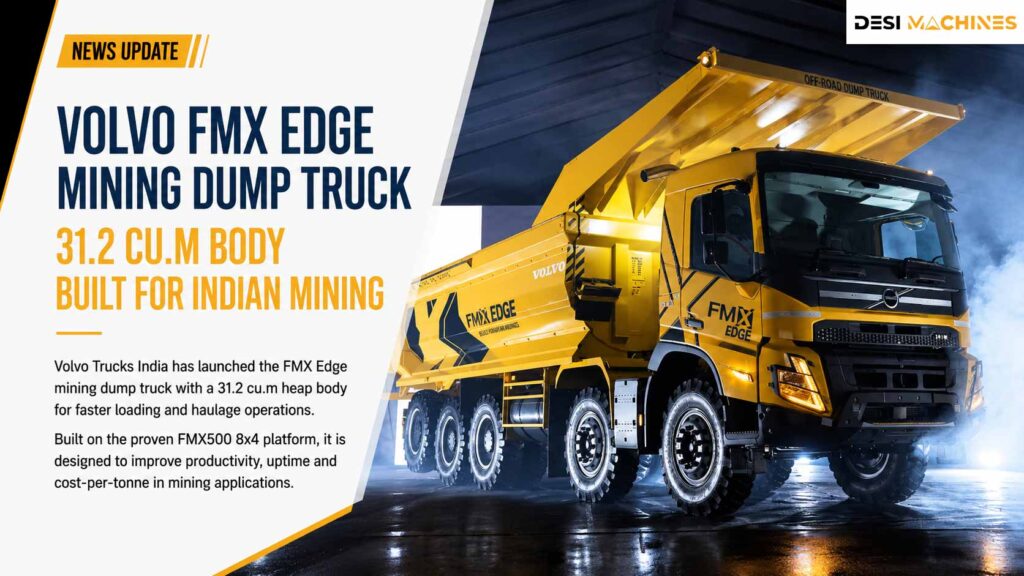
Key Facts:
- Volvo Trucks India launched the Volvo FMX Edge, a purpose-built off-road mining dump truck, on 26 May 2026 at its Hoskote facility near Bengaluru.
- The truck carries a 31.2 cu.m SAE heap body with a 2.8 m-wide body, sized for faster loading with high-capacity excavators (specs per Volvo).
- It builds on the Volvo FMX500 8×4, which Volvo says has more than 3,000 units in Indian mining over five years.
- Volvo positions it around “total operating outcomes” — productivity, safety, uptime, fuel efficiency, lifecycle value — not a single headline spec.
- The launch tied Volvo Trucks to Volvo Construction Equipment’s excavator ecosystem, with a combined mining-productivity pitch.
The Development:
Volvo Trucks India has launched the Volvo FMX Edge, an off-road dump truck built specifically for Indian mining, unveiling it on 26 May 2026 at its Hoskote plant near Bengaluru, Karnataka, before mining customers and Volvo Group leadership. The truck pairs a 31.2 cu.m SAE heap body with a 2.8 m-wide body designed to load efficiently alongside large excavators and move overburden faster per cycle. It extends the Volvo FMX500 8×4 platform, which the company says has built up more than 3,000 units in Indian mines over five years. The launch — first reported by Motorindia and covered by International Mining and Autocar Professional — was staged jointly with Volvo Construction Equipment, signalling a packaged truck-plus-excavator approach to mine haulage.
Why it Matters:
The FMX Edge is a road-going OEM’s answer to a job usually associated with rigid haulers: a tipper-class, on/off-highway truck pitched at overburden and bulk movement rather than the largest rigid dump trucks. A big slice of Indian mining and large-quarry haulage runs on this 8×4 tipper class, where the trade-off is flexibility and lower entry cost against the payload of a rigid hauler. A wider, higher-capacity body that loads cleanly with bigger excavators is a direct play at cycle-time economics — the metric that decides cost per tonne on a haul road.
The deliberate pairing with Volvo CE’s excavators is the more telling signal. Selling loading tool and hauler as a matched system competes on fleet productivity and single-vendor uptime, not just truck price. For operators, that simplifies the loading-to-hauling match but concentrates the relationship with one OEM — a familiar trade-off on every fleet decision.
The installed base is the quiet strength: more than 3,000 FMX500 trucks already in Indian mines means parts, service and operator familiarity are in place — the practical factors that often decide a haulage purchase more than spec sheets.
DesiMachines Industry View:
The FMX Edge looks aimed less at the largest rigid-hauler operations and more at the productivity-conscious middle of Indian mining and bulk earthmoving — operators running tipper fleets who want more payload per cycle without changing vehicle class. Whether the bigger body lowers cost per tonne will depend on haul-road conditions, loading-tool match and duty-cycle durability; manufacturer productivity claims typically need site validation before they show in an operator’s numbers.
Strategically, the truck-and-excavator bundle is worth watching. If it gains traction, rivals may respond with their own matched loading-and-hauling packages, gradually shifting mine-fleet buying from line-item purchases toward system-level deals — which would favour suppliers with both a loading tool and a hauler in their range, a smaller field in India than the broad truck market.
What Buyers Should Watch?
- Cost-per-tonne validation — look for operator/third-party cycle-time data, not just launch-spec claims.Service and parts depth — confirm dealer coverage and turnaround near the mine.
- Bundled commercial terms — if buying truck and excavator together, watch matched-fleet pricing, financing and uptime guarantees vs mixing vendors.
- Competitor responses — whether other OEMs counter with their own loading-plus-hauling packages or larger-bodied tippers; that competition usually improves buyer terms.
Machines, tenders and news for this industry: Mining

 Excavator
294 models
Excavator
294 models  Backhoe Loader
51 models
Backhoe Loader
51 models  Crane
68 models
Crane
68 models  Concrete Mixer
79 models
Concrete Mixer
79 models  Wheel Loader
54 models
Wheel Loader
54 models  Compactor / Roller
45 models
Compactor / Roller
45 models  Motor Grader
42 models
Motor Grader
42 models  Dozer
41 models
Dozer
41 models  Concrete Pump
66 models
Concrete Pump
66 models  Skid Steer Loader
11 models
Skid Steer Loader
11 models  Telehandler
13 models
Telehandler
13 models