
 Excavator
294 models
Excavator
294 models  Backhoe Loader
51 models
Backhoe Loader
51 models  Crane
68 models
Crane
68 models  Concrete Mixer
79 models
Concrete Mixer
79 models  Wheel Loader
54 models
Wheel Loader
54 models  Compactor / Roller
45 models
Compactor / Roller
45 models  Motor Grader
42 models
Motor Grader
42 models  Dozer
41 models
Dozer
41 models  Concrete Pump
66 models
Concrete Pump
66 models  Skid Steer Loader
11 models
Skid Steer Loader
11 models  Telehandler
13 models
Telehandler
13 models 


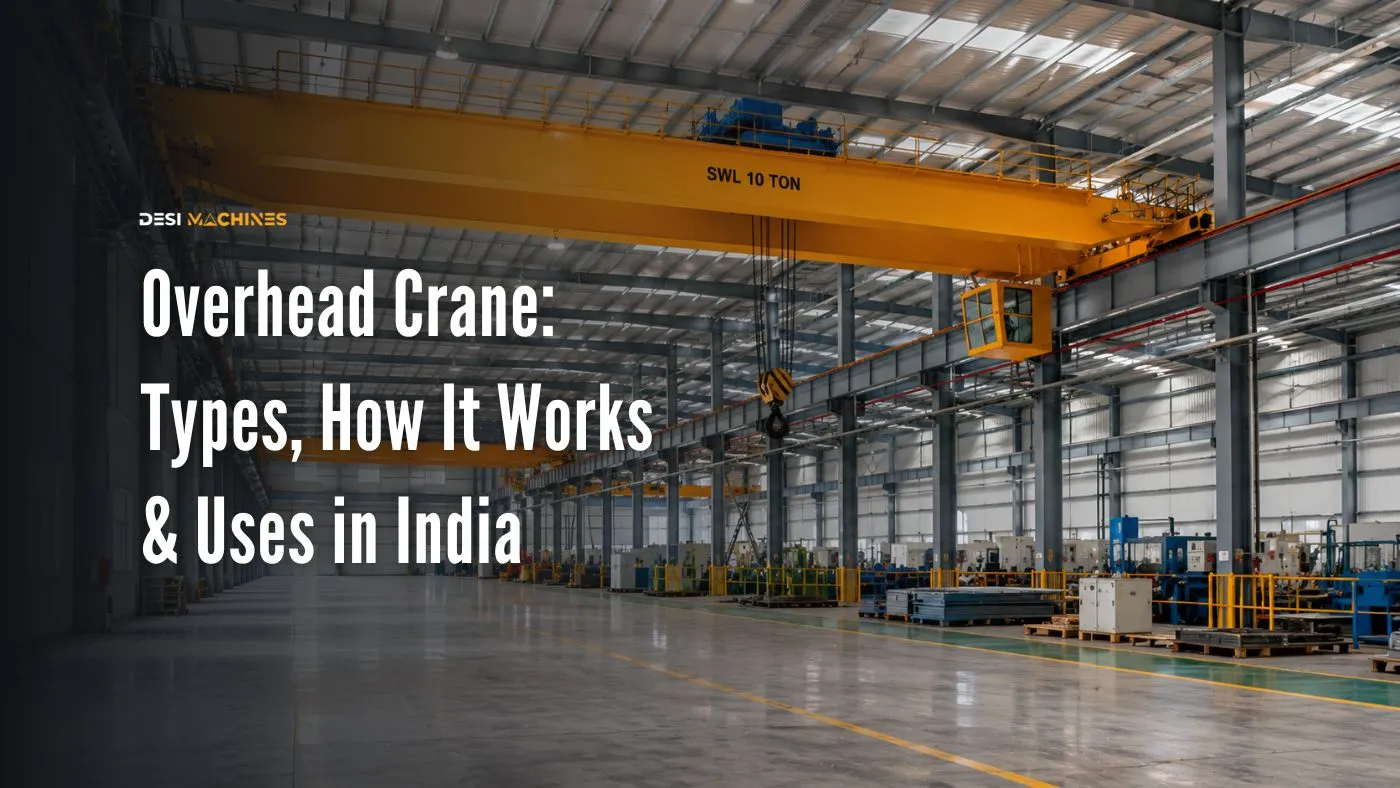
An overhead crane is a lifting machine that hangs from a beam running along the roof of a workshop, factory shed or casting yard, and moves a load left-right, forward-back and up-down inside that fixed area. People also call it an EOT crane (Electric Overhead Travelling crane), a bridge crane or, in factory talk, the “shop crane”. It is the crane you have seen sliding along the roof of a big railway workshop or steel fabrication shed, carrying a heavy piece from one end to the other without any truck or driver on the ground.
Unlike a mobile crane that drives to the job, an overhead crane stays in one building and lifts the same kind of load again and again. That makes it the wrong machine for open-ground construction lifting, and the right machine for a covered area where the same heavy work repeats every day. This guide explains how it works, its main types, where Indian projects actually use it, and which crane you should look at if your work is on an open site instead.
How does an overhead crane work?
An overhead crane works by hanging a lifting unit from a beam that travels along two rails fixed high up on the building. Three simple movements do the whole job, and each has its own name worth knowing:
- Long travel: the whole crane rolls along the length of the shed on rails called the runway (the two beams fixed on top of the building columns). This is the “forward-back” motion.
- Cross travel: a small trolley (a wheeled cart carrying the hoist) rolls sideways across the main beam, called the bridge or girder. This is the “left-right” motion.
- Hoisting: the hoist (the motor-and-drum unit that winds the wire rope or chain) lifts and lowers the load. This is the “up-down” motion.
Put the three together and the hook can reach almost any point inside the building rectangle. An operator runs it from a hanging pendant (a button box on a wire), a radio remote, or a small cabin fixed to the crane. Because the crane hangs from the roof structure, the floor below stays completely open, so trucks, welders and workers move freely underneath. That open floor is the whole reason factories choose it over a machine standing on the ground.
What are the main types of overhead cranes?
The main types of overhead crane are single-girder, double-girder, gantry and semi-gantry, and they differ mainly by how much weight they carry and how they are supported. A workshop lifting a few tons uses a light single-girder crane; a steel plant lifting a ladle of molten metal uses a heavy double-girder machine. Here is a plain comparison:
| Type | How it is built | Typical capacity | Common use in India |
|---|---|---|---|
| Single-girder EOT | One main beam; hoist hangs below it | Up to about 20 Ton (20,000 kg) | Light workshops, assembly sheds, small fabrication units |
| Double-girder EOT | Two main beams; hoist sits on top between them | About 5 to 100+ Ton (5,000 to 100,000+ kg) | Heavy fabrication, steel plants, powerhouses, precast yards |
| Gantry crane | Bridge stands on its own legs that run on ground rails, no building needed | A few Ton to 500+ Ton (very large ones) | Outdoor casting yards, port and rail depots, segment-casting for bridges |
| Semi-gantry | One side on a runway beam, other side on a ground leg | Small to medium loads | Sheds where one wall can take a runway but the other cannot |
There are lighter cousins too, like the jib crane (a small arm fixed to a wall or pillar that swings in an arc) used for a single machine or work station. But for whole-building lifting, the four above are what you will see on Indian sites.
EOT crane vs gantry crane: what is the difference?
The difference between an EOT crane and a gantry crane is simply what holds the bridge up. An EOT crane’s bridge rests on a runway fixed to the building columns, so it needs a shed or roof structure to hang from. A gantry crane carries its own legs that stand on the ground and run on rails laid on the floor, so it needs no building at all and can work in the open air.
In practice this decides where each one goes. If the heavy work happens inside a covered shop, an EOT crane is cheaper because it borrows the building’s steel. If the work is outdoors, say a yard where bridge segments are cast, a gantry crane is the answer because there is no roof to hang from. Both are still “overhead” cranes in the sense that the load hangs from a bridge above the work.
Where are overhead cranes used on Indian construction and infrastructure projects?
Overhead and gantry cranes are used on Indian infrastructure wherever heavy pieces are made or handled in one fixed spot, day after day. Even though you rarely see them on an open building site, they sit behind a lot of big projects:
- Precast and segment-casting yards: metro viaducts, flyovers and long bridges are built from concrete segments cast in a yard, then trucked to site. Those heavy segments are lifted and shifted by gantry cranes running on ground rails.
- Launching girders for metro and bridges: a launching gantry (a special long overhead machine) sits on the piers and places each viaduct segment in the air. This is overhead lifting on a huge scale.
- Steel fabrication shops: the girders, gates and structures for dams, plants and bridges are welded inside sheds, and an EOT crane moves the heavy steel between cutting, welding and painting.
- Workshops and depots: railway, road and mining equipment depots use a shop EOT crane to lift engines, axles and machine parts off vehicles for repair.
- Power and process plants: powerhouses, cement plants and steel mills keep double-girder cranes for handling turbines, ladles and heavy machinery.
So the overhead crane is a factory-and-yard machine. It shapes the parts that later reach your construction site, but the lifting on the actual site, out in the open, is a different job that needs a different crane.
How much capacity do you need, and what does an overhead crane cost?
You size an overhead crane by the heaviest single load it will ever lift, plus a safety margin, and the price is quoted project by project rather than sold off a price list. A light workshop may need only 2 to 5 Ton (2,000 to 5,000 kg); a fabrication shop often runs 10 to 20 Ton; a steel or power plant can need 100 Ton or more. Along with capacity you fix the span (the shed width the bridge must cross) and the lift height (how high the hook must rise).
Because every overhead crane is built to the exact span, height, capacity and duty of one building, there is no single “on-road price” the way there is for a machine you drive home. It is engineered and quoted by EOT crane makers against your drawings, so the honest answer to “what does it cost” is price on request, based on your specification. Treat any flat number you see online with care, and always get a written quote against your own span and tonnage.
One more running cost to plan for: an overhead crane is a fixed asset tied to Indian factory safety rules. Lifting machines must be tested and certified periodically under the Factories Act and state factory rules, and the runway and hoist follow Indian Standards such as IS 3177 and IS 807. Budget for that inspection and for a maintenance contract, not just the crane itself.
Overhead crane vs mobile crane: which one for your work?
Choose an overhead crane for repeated lifting inside one covered area, and a mobile crane for lifting that moves around an open site. This is the split that matters most for buyers, so here it is side by side:
| Question | Overhead / gantry crane | Mobile / pick-and-carry crane |
|---|---|---|
| Where it works | Fixed inside a shed or yard | Drives anywhere on the site or road |
| Best for | Same heavy lift, repeated daily | Different lifts at changing spots |
| Setup | Needs a building or ground rails | Turns up on its own wheels, ready to lift |
| Typical Indian buyer | Factory, plant, precast yard | Contractor, builder, rental fleet |
For most construction contractors in India, open-ground lifting is the real need, and that is where a pick-and-carry crane (the machine everyone calls a Hydra or Farana) does the work. These small, wheeled cranes lift a load, carry it across the site and place it, all on their own. Popular models are priced one by one rather than as a block. The Escorts Hydra 1565 is listed at ₹22.6 Lakh onwards — its product page quotes a starting price rather than a band, so read that figure as the floor and let the fitted variant decide the rest — and the 14 Tonne (14,000 kg) Indo Power 14T at ₹18–22 Lakh (indicative, as of September 2026). Across the whole pick-and-carry range the spread is far wider. The 9 Tonne (9,000 kg) ACE Rhino 90C sits at ₹12–14 Lakh and the 35 Tonne (35,000 kg) ACE F350 at ₹62–66 Lakh, so the 66 of the 68 pick-and-carry cranes we list a price for run from ₹12 Lakh to ₹66 Lakh (indicative, as of September 2026). Rank machines by their starting figure, not their top end: the upper figures overlap between models, because price follows the series and the road-going build rather than tonnage alone. If you are choosing between the two families, the difference is spelt out in our Hydra vs Farana comparison.
Ready to price the right machine for open-site lifting? Compare live pick-and-carry crane models and prices and get the best current offer.
Overhead crane in short
An overhead crane is a roof-mounted lifting machine for repeated heavy work inside a factory, workshop or casting yard, with EOT (building-supported) and gantry (self-standing) being the two main families. It sits behind Indian infrastructure through precast yards, launching gantries and fabrication shops, but it is not the machine for lifting out on an open construction site. For that, a wheeled pick-and-carry crane is what Indian contractors actually run.
To go deeper into the crane family, start with our full guide to the types of cranes, then read up on the tower crane and crawler crane. When you are ready to buy, the crane buying and rental guide walks through cost, hire and the checks to run. You can also browse the complete crane guide for every crane type in one place.
Disclaimer: Prices, specifications and features are indicative, vary by variant, location and date, and should always be confirmed with the official OEM or authorised dealer before any purchase decision. Prices shown are taken from our listings at the time of writing. DesiMachines is not liable for decisions taken on the basis of information that may have changed after publication.