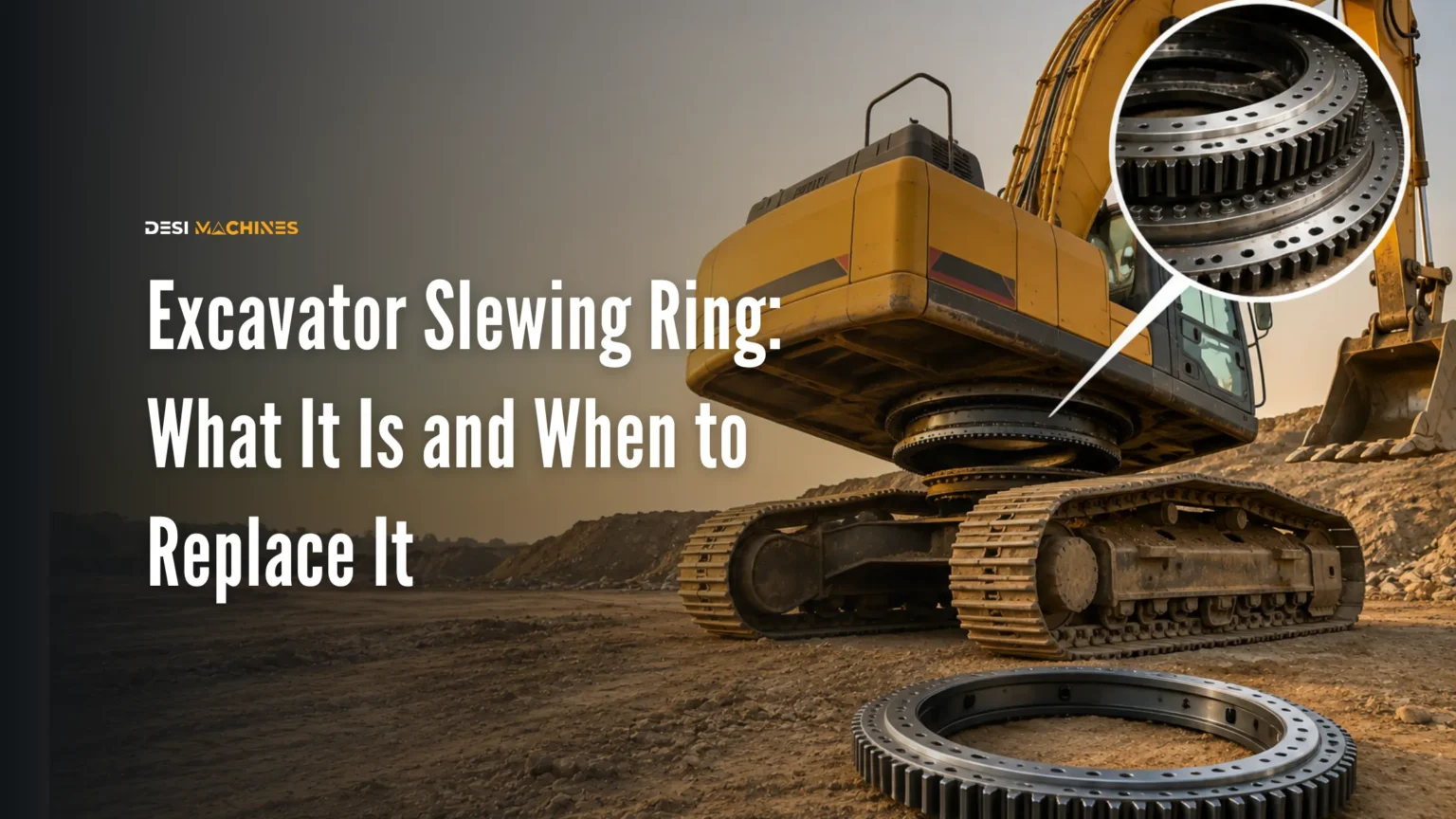
An excavator slewing ring is the large toothed bearing that sits between the undercarriage and the upper house, and it is the single part that lets the machine turn a full circle while the tracks stay still. It is also called the slew bearing, the swing bearing or the turntable bearing. Everything above it, the cab, the engine, the counterweight and the boom, rests on that one ring. When it wears out the machine does not stop working straight away; it starts swinging roughly, knocking at the ends of the turn, and eventually rocking under load.
For a buyer, the slewing ring matters for one reason above all: it is among the most expensive single repairs on an excavator, and on a used machine it is the defect that is easiest to hide for one demonstration and impossible to hide for one week. This guide explains what the ring does, how to spot wear before you pay, and how to make one last.
What does a slewing ring do on an excavator?
The slewing ring does three jobs at once, which is why it is built the way it is.
It carries the weight. The whole upper structure sits on hardened steel raceways inside the ring, with rows of balls or rollers between them. It resists tipping. When the boom is out and loaded, the machine is trying to tip forward, and the ring has to take that bending force, not just the downward weight. And it drives the rotation. One face of the ring is cut into gear teeth, and a swing motor with a planetary gearbox meshes into those teeth to turn the house.
That third job is why a slewing ring is not simply a bearing. It is a bearing and a gear in one piece, and the two wear differently. The raceways wear from load and dirt. The teeth wear from the swing motor pushing against them thousands of times a day, always hardest in the arc the operator uses most, which on a truck-loading job is a narrow 90-degree band that gets punished while the rest of the ring stays fresh.
How fast does an excavator swing, and why does size change it?
Swing speed is measured in rotations per minute (rpm), and across the 288 excavators with a published figure it runs from 3.1 rpm on the largest mining machines to 13.8 rpm on a 12 tonne class machine. Bigger machines swing slower, and that is deliberate: the further the mass sits from the centre, the more force the ring and the swing motor have to absorb at the start and end of every turn.
Specifications as per the current Aug 2026 listings. Two practical points come out of that table. First, a slow swing speed on a big machine is normal and is not a fault. Second, if a 20 tonne machine that should turn at around 13 rpm is visibly slower than a similar machine beside it, that is worth investigating before you buy, because a tired swing motor and a worn ring both show up the same way.
Swing circuit pressure, quoted in megapascals (MPa), is the hydraulic pressure the swing motor works at, and on the listed machines it runs from about 16.6 MPa on small excavators to 32.4 MPa on larger ones. It matters here because the harder that circuit works, the harder the teeth are being pushed.
Compare working specifications across the full range of excavators, and read the excavator size classes guide to place a machine in its class before comparing its numbers to anything else.
What are the signs of a worn slewing ring?
A slewing ring rarely fails suddenly. It gives warning for months, and the warnings are easy to feel from the seat:
A knock at the start and end of every swing. This is backlash, the free play between the gear teeth and the swing pinion. A small amount is normal on any machine. A distinct clunk you can hear over the engine is not.
Rocking under load. Boom out, bucket loaded, and the house tips or settles slightly. That means the raceways are worn and the upper structure is no longer sitting flat.
Grinding or a gritty feel through the swing. Usually dirt that has got past the seal, and it is the stage at which greasing still helps.
Grease coming out black with metal flecks. Grease should come out dirty. Grease that glitters is the ring wearing itself away.
Uneven wear across the circle. Swing the empty machine slowly through 360 degrees. If it is smooth for three-quarters of the turn and rough in one arc, that is the arc the last operator worked in, and it tells you the machine’s history better than the hour meter does.
That last check is the useful one, because it separates a machine that has done light hours everywhere from one that has done hard hours in one place.
How do you check the slewing ring on a used excavator?
The standard trade check is the tilt test, and it needs nothing but a helper and something to measure with. Park the machine level. Put a dial gauge or a fixed reference mark between the house and the undercarriage at the front. Now raise the machine’s front off the ground on the boom and bucket, and measure how far the house lifts away from the undercarriage.
That gap is the wear in the raceways. Every manufacturer publishes a limit for its own machines, so the number to compare against comes from the dealer or the service manual for that model, not from a general rule. What matters is that you take the measurement, write it down, and ask the dealer what the limit is for that model before money changes hands.
Alongside it, do three things:
Swing the full circle twice, once empty and once with the bucket loaded and the boom extended, listening for the change.
Look at the seal around the ring. A split or hardened seal means dirt and water have been getting in, whatever the grease looks like.
Check the bolts. The ring is bolted to the frame above and below with a large number of high-tensile bolts. Any that are missing, replaced with a mismatched bolt, or showing paint cracked around the head have been moving.
Almost every early slewing ring failure comes down to grease and dirt, and both are within the owner’s control.
Grease it on schedule and grease it turning. The ring has grease points that feed the raceways, and pumping grease into a stationary ring only fills one spot. The correct method is to grease, swing the house part of a turn, grease again, and repeat until you have been all the way round. On most machines the interval is measured in tens of hours, so it belongs on the daily or weekly card rather than the service visit.
Grease the gear teeth separately. The teeth usually sit in an open or semi-open bath at the bottom of the ring and take a different, heavier grease from the raceways. Check the level; do not assume it is full because the raceway points took grease.
Keep the seal intact. A split seal costs a fraction of the ring it protects. In dusty conditions and through the monsoon, inspect it rather than waiting for a service.
Change the operator’s habit, not just the grease. Slamming the swing from full speed into a stop, and using the swing to push spoil sideways, both load the teeth in exactly the way they are not designed for. Working the machine across a wider arc rather than the same narrow 90 degrees also spreads the wear.
The motor that drives the ring has its own guide too: the excavator hydraulic motors page explains the swing motor, its holding brake and the travel motors in the tracks.
What does slewing ring replacement involve?
Replacement is a workshop job, not a site job. The upper structure has to be lifted clear of the undercarriage with a crane, the old ring unbolted, the mating faces cleaned and checked for flatness, the new ring fitted with its bolts torqued to a specified pattern, and the whole thing reassembled. On a 20 tonne machine that is typically several days off work, and the machine downtime often costs more than the part.
We do not list slewing rings as a catalogue item, so there is no price to quote here; the figure comes from your dealer for your specific model, and it varies a great deal between a genuine ring and an aftermarket one. What is worth knowing before you ask is that the choice between genuine and aftermarket matters more on this part than on most, because the hardness of the raceway is what determines whether you do this job once or twice.
Two things make the difference between a repair that lasts and one that does not. The mating surface has to be genuinely flat, because a ring bolted to a distorted frame is loaded unevenly from the first hour. And the bolts must be new and torqued correctly, in the right sequence; reused bolts are a common shortcut and a common reason a rebuilt swing fails early.
If the machine you are looking at needs one, treat the cost as part of the purchase price and negotiate on that basis. Compare it against a machine that does not need the work: browse the range of excavators and connect with a dealer, or start from the excavator guide hub for the rest of the series.
Slew-bearing life starts with greasing: the lubrication guide covers how often to grease the race and the gear teeth, and why over-greasing a sealed bearing does harm.
Prices, specifications and features are indicative, vary by variant, location and date, and should always be confirmed with the official OEM or authorised dealer before any purchase decision. DesiMachines is not liable for decisions taken on the basis of information that may have changed after publication. Specifications are taken from our listings at the time of writing.
Frequently Asked Questions (FAQ)
Ans.
A slewing ring is the large toothed bearing that sits between the undercarriage and the upper house of an excavator, and it is what lets the machine rotate a full circle while the tracks stay still. It is also called the slew bearing, swing bearing or turntable bearing. It does three jobs at once: it carries the weight of the whole upper structure, it resists the tipping force when the boom is out and loaded, and its gear teeth are what the swing motor drives to turn the house.
Ans.
The usual warnings are a distinct knock at the start and end of every swing, the house rocking or settling when the boom is out and loaded, a gritty or grinding feel through the turn, and grease coming out with metal flecks in it. The most telling check is to swing the empty machine slowly through 360 degrees: if it is smooth for most of the turn and rough in one arc, that arc is where the previous operator worked, and it says more about the machine’s history than the hour meter does.
Ans.
Use the tilt test. Park the machine level, set a dial gauge or fixed reference between the house and the undercarriage at the front, then lift the front of the machine off the ground on the boom and bucket and measure how far the house lifts away from the undercarriage. That gap is the raceway wear. Each manufacturer publishes a limit for its own models, so compare the reading against the dealer or service manual figure for that exact machine, not a general rule.
Ans.
Across the 288 listed excavators with a published figure, swing speed runs from about 3.1 rpm on the largest mining machines up to 13.8 rpm on a 12 tonne class machine (as per the current Aug 2026 specifications). Heavier machines swing slower by design, because the further the mass sits from the centre the more force the ring and swing motor absorb at each start and stop. A slow swing on a big machine is normal, not a fault.
Ans.
Grease it on schedule and grease it while turning: pump grease, swing part of a turn, grease again, and continue all the way round, because greasing a stationary ring only fills one spot. Grease the gear teeth separately, as they usually take a heavier grease than the raceways. Keep the seal intact, since dirt and water are what destroy raceways. And avoid slamming the swing to a stop or using it to push spoil sideways, which loads the teeth in the way they are least able to take.
Desi Machines is a platform where you can see and compare construction equipment. It showcases images, brochures, features, technical specifications, brand details & dealer information. All these are taken from respective brand websites, brochures, and other public resources. We do not claim ownership of these materials and strive to ensure their accuracy. However, the disparity may happen and we advise users to verify directly with respective brands and dealers. Desi Machines is not liable for any inaccuracies or reliance on the information provided. Use of this website is at your own discretion.

 Excavator
294 models
Excavator
294 models  Backhoe Loader
51 models
Backhoe Loader
51 models  Crane
68 models
Crane
68 models  Concrete Mixer
79 models
Concrete Mixer
79 models  Wheel Loader
54 models
Wheel Loader
54 models  Compactor / Roller
45 models
Compactor / Roller
45 models  Motor Grader
42 models
Motor Grader
42 models  Concrete Pump
66 models
Concrete Pump
66 models  Skid Steer Loader
11 models
Skid Steer Loader
11 models  Telehandler
13 models
Telehandler
13 models  Dozer
Dozer