
 Excavator
294 models
 Backhoe Loader
51 models
 Crane
68 models
 Concrete Mixer
79 models
 Wheel Loader
54 models
 Compactor / Roller
45 models
 Motor Grader
42 models

 Concrete Pump
66 models
 Skid Steer Loader
11 models


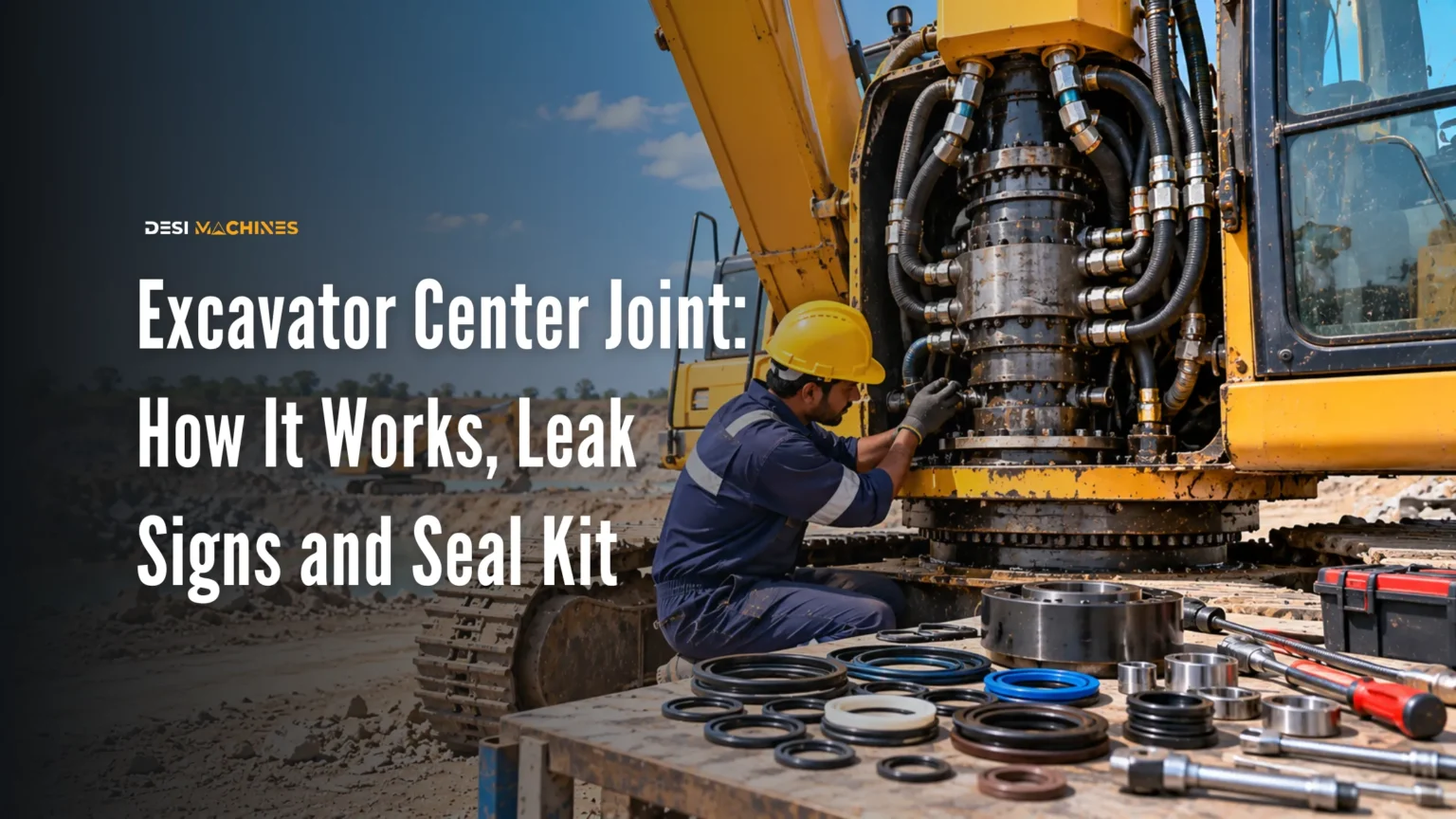
An excavator that travels weakly on one side, or loses its travel speed once the oil is hot, while the boom, arm and swing still work normally, very often has a worn center joint. The center joint, also called the swivel joint or rotary joint, sits in the middle of the slew ring and carries hydraulic oil from the pump in the upper body down to the travel motors in the undercarriage while the upper body turns a full circle above it.
Most people in India call any excavator a JCB or a Poclain, whatever the brand, and the part is the same idea on all of them. This guide explains what the center joint does, which oil lines pass through it, how it is built and sealed, the signs of a leak, how to tell a leaking joint from a weak travel motor, what a seal kit contains and how to make the joint last. It gives no prices, because these change with the machine and the seller.
What does the center joint on an excavator do?
It lets oil cross a joint that never stops turning. On a crawler excavator the engine, pump, oil tank and control valve all ride in the upper body, which people call the house. The two travel motors, one driving each track, sit on the undercarriage. A hose run straight from one to the other would wind itself up after a single swing. So the oil goes down through the exact centre of rotation instead, through what Wikipedia’s excavator article calls a hydraulic swivel at the axis of the centre pin, where the upper body turns around it without twisting anything.
Two different parts share that centre and they are often confused. The slewing ring is the big toothed bearing that carries the weight of the upper body and lets it turn. The center joint is the much smaller part standing inside that ring, and it carries oil, not weight. A worn ring knocks and rocks. A worn joint leaks.
One naming trap is worth knowing. Kubota’s spec sheets use “swivel” to mean swing: the Kubota U17-3 is described as moving its “boom, arm, and swivel” together. On those machines a “swivel motor” is the swing motor, a different part from the swivel joint this guide is about.
Cable-powered electric excavators have the same problem twice over. The Volvo EC500 Electric lists a 360-degree cable turning joint, which lets its power cable cross the turning point without wearing out or limiting how far the upper body can rotate.
How does oil pass through the center joint while the upper body turns?
A center joint has two main pieces: a shaft and an outer body fitted closely around it. One is bolted to the undercarriage and the other turns with the upper body. In Komatsu’s patent on a swivel joint seal (US20210003219A1), the outer body (Komatsu calls it the rotor) is fixed to the undercarriage and the shaft turns with the upper body. Caterpillar’s patent describes it that way round too, and notes it can be built upside down.
Each oil line enters the joint through its own port and runs down a drilled passage to a groove cut all the way round, called an annular groove. Because the groove is a full circle, it always lines up with the matching port on the other piece, at any swing angle. The oil fills the groove, finds the port and carries on down to the motor. Seal rings sit between neighbouring grooves so each line stays separate from the next.
hoses from control valve
A shaft (turns with upper body)
B outer body
(fixed to undercarriage)
1 travel, left forward
2 travel, left reverse
3 travel, right forward
4 travel, right reverse
5 two-speed pilot line
6 drain back to tank
C seal ring between grooves
Legend. A Shaft: carries the drilled passages from the hoses above. B Outer body: holds the ports that feed the hoses to the travel motors. C Seal rings: sit between the grooves and wear first. 1 to 6: the six lines in the example Caterpillar describes. Other machines carry more or fewer, and the order shown is only for illustration.
Which oil lines run through an excavator center joint?
Only the lines for things on the undercarriage. The boom, arm, bucket and swing are all fed from the upper body, so their oil never goes near the joint. That one fact is the most useful clue in fault finding. The Caterpillar patent for a swivel joint (US10968605B2) describes a typical layout: one pilot line, four high-pressure lines to the travel motors and one drain line.
| Line through the joint | What it feeds | Pressure it carries | What a leak on it usually shows |
|---|---|---|---|
| Four main travel lines | The two travel motors, one line for each direction of each track | Main system pressure while travelling | One track slow, or slow in one direction only; weak travel once the oil is hot |
| Two-speed pilot line | The valve that shifts the travel motors between low and high speed (the tortoise and rabbit switch) | Low pilot pressure | High speed will not engage, or drops back out on its own |
| Drain line | Returns oil that leaks inside the travel motors, and oil that seeps past the joint’s own grooves, to the tank in the upper body | Very low | Oil collecting around the joint; trouble at the travel motors if the drain is blocked |
| Dozer blade lines (machines with a blade) | The blade cylinder, which sits on the undercarriage | Main system pressure while the blade moves | Blade drifts down or lifts weakly |
The blade lines follow from the same logic: on a mini excavator with a dozer blade, the blade cylinder is mounted on the undercarriage, so its oil has to cross the joint like the travel oil does. How the two-speed travel switch works is covered in the guide to excavator travel speed, and the pressures these circuits run at are in the guide to excavator hydraulic pressure and flow.
What are the signs of a leaking center joint?
A center joint leaks in two ways. An internal leak is a worn seal ring between two grooves, so oil slips from a pressurised line into its neighbour or into the drain without ever reaching the motor. You cannot see it. An external leak is a failed outer seal or a fitting, and you can see it as wet oil. The signs:
- One track is slower than the other, or a track is slower in one direction than the other. Each direction has its own groove, so a single worn ring can affect one direction of one track.
- Travel is fine first thing in the morning and fades as the day warms up. Hot oil is thinner and slips past worn seal rings more easily.
- The machine drives straight on flat ground but struggles to turn, climb a ramp or push through soft ground, which are the moments travel pressure peaks.
- High speed travel will not engage, or the machine drops back to low speed by itself.
- A track can creep slightly when only the other track’s lever is moved, a sign that oil is crossing between lines.
- Wet oil and caked dirt around the bottom of the joint, on the top of the track frame at the centre, or dripping off the belly guard.
- Through all of this, swing, boom, arm and bucket work normally, because none of their oil passes through the joint.
One more sign usually follows a repair rather than wear. Komatsu’s patent explains that a seal fitted too tight makes the joint grab and slip as it turns, which shows up as an abnormal noise or vibration on swing and can damage the hoses and the joint itself. A new groan from the centre of the machine after a seal job points to the wrong seal or a poor fit.
Is it the center joint or the travel motor?
Both make a track weak, so the joint is easy to miss. The guide to excavator swing and travel motors covers the motor and final drive side. Work through these checks before anything is taken off the machine:
- Time the tracks. On flat, firm ground, run a measured straight distance in each direction, in low and in high speed, once cold and again when the oil is hot. Note which way the machine pulls and when it gets worse. A fault that grows with heat and affects one direction points toward the joint.
- Look at what still works. If swing and digging are also slow, the problem is upstream at the pump or main valve, not at the joint.
- Check the temperature. After a hot working spell, a mechanic can compare the joint body with the travel motor casing using an infrared thermometer. Oil leaking inside the joint heats the joint, while a starved motor stays cooler.
- Test the pressure. With gauges fitted at the travel motor ports, a hydraulic mechanic can compare what arrives at the motor with what leaves the control valve on the same line. A large drop between the two means oil is being lost inside the joint. The test figures come from your machine’s service manual.
The order matters. A travel motor changed for a joint fault will not cure the weak track, and the same drop in power will still be there on the new motor.
If an older machine is collecting repairs like this, it may be time to compare current excavator models and prices before spending more on it.
What is in a center joint seal kit?
The main parts are the seal rings that sit between the grooves, because they are what wears. Komatsu’s patent describes a two-layer ring: a harder ring of nylon resin that runs against the shaft, backed by a softer ring of urethane behind it. The kit also carries the O-rings for the cover and the port fittings and the seals at the top and bottom of the joint. The exact list changes from model to model, and your machine’s parts book shows every ring by its position.
Which kit fits depends on a few facts about the machine:
| What to check | Why it matters |
|---|---|
| Make and model | The joint is designed for the machine; sizes are not shared across brands |
| Serial number or year of build | A maker can change the joint partway through a model’s life |
| Number of lines through the joint | Each groove needs its own seal rings, so the ring count follows the line count |
| Dozer blade or not | A machine with a blade carries extra lines and a different joint |
| Weight class | A bigger excavator carries more oil at higher flow through a larger joint |
This is a general guide based on machine size class. Always confirm the fit with your machine’s operator manual or the manufacturer before buying or fitting.
What the job costs depends on those same facts plus the work around them. A joint with more lines needs more rings. A larger machine needs larger ones. If the shaft is scored, it has to be polished or replaced before new seals will hold. And labour is real: the joint sits under the middle of the upper frame, every hose has to be cleaned, labelled and disconnected, and the machine has to be raised or opened up for access.
Most joints are resealed rather than replaced. The usual sequence is to label every hose so it goes back on the same port, lift the joint out, separate the shaft from the outer body, replace every seal in the kit rather than only the one that failed, and check the shaft surface. Scratches or grooves on the shaft cut new seals quickly, so a scored shaft means machining or a new part. After refitting, the travel circuits are bled and each track is tested in both directions at both speeds. The guide to excavator parts and components shows where the joint sits among the other hydraulic parts.
How do you make an excavator center joint last?
Clean oil does most of the work. Dirt in the oil scratches the shaft, and a scratched shaft wears seals out fast. Change filters on time and keep water out of the tank, as set out in the guide to hydraulic system maintenance. Keep the oil from running too hot as well, because thin hot oil leaks past seals that would hold it cold.
Guard it from below. In quarries and on broken rock, stones thrown up by the tracks hit the joint and its hoses. Makers protect it for that reason: the JCB NXT 145 Quarry Master lists a belly guard to protect the rotary joint and hoses from external damage, and the CAT 350 comes with bottom, travel motor and swivel guards as standard. Keep the guard fitted and look underneath it at every service. Access matters too: the Hyundai HX360L lists clear service access to its control valve, swing motor and rotary joint.
Wash the area before anyone opens a fitting. Mud around the joint falls straight into the open ports. Fix an external weep early, too: a joint that leaks oil also lets dust in through the same gap.
What should you check on a used excavator?
Look for wet oil around the centre of the machine and on top of the track frame, then drive it. Run both tracks in both directions at both speeds, and do it again after the machine has worked for a while and the oil is hot. A machine that only shows its weakness when warm will look perfect on a cold morning test drive. The full list of checks is in the used equipment inspection checklist.
For buyers looking at new machines, popular 20-tonne class excavators such as the Tata Hitachi EX 210 Infra and the Hyundai R210 Smart Plus are a good place to start a comparison, and the parts and running costs guide covers the other wear parts you will meet over the life of the machine.
Where the facts in this guide come from
The swivel at the centre pin that feeds the travel motors is described in Wikipedia’s article on the excavator. The layout of one pilot line, four high-pressure travel lines and one drain line, the ring grooves, the seal rings between them and the drain’s job of returning travel motor leak-off oil to the tank come from Caterpillar’s patent US10968605B2. The rotor fixed to the undercarriage, the shaft turning with the upper body, the nylon and urethane seal rings and the noise and vibration caused by an over-tight seal come from Komatsu’s patent US20210003219A1. Machine features come from each machine’s own specifications, read in October 2026.
Your machine’s operator manual and service manual give the right part numbers, seal positions and test pressures for your machine, and should always be checked first.
Prices, specifications and features are indicative, vary by variant, location and date, and should always be confirmed with the official OEM or authorised dealer before any purchase decision. DesiMachines is not liable for decisions taken on the basis of information that may have changed after publication.
Get a center joint seal kit price from a dealer near you
Tell us your machine and what you need, and we will ask the nearest dealer to reach out to you with a price.