
 Excavator
294 models
Excavator
294 models  Backhoe Loader
51 models
Backhoe Loader
51 models  Crane
68 models
Crane
68 models  Concrete Mixer
79 models
Concrete Mixer
79 models  Wheel Loader
54 models
Wheel Loader
54 models  Compactor / Roller
45 models
Compactor / Roller
45 models  Motor Grader
42 models
Motor Grader
42 models  Dozer
41 models
Dozer
41 models  Concrete Pump
66 models
Concrete Pump
66 models  Skid Steer Loader
11 models
Skid Steer Loader
11 models  Telehandler
13 models
Telehandler
13 models 


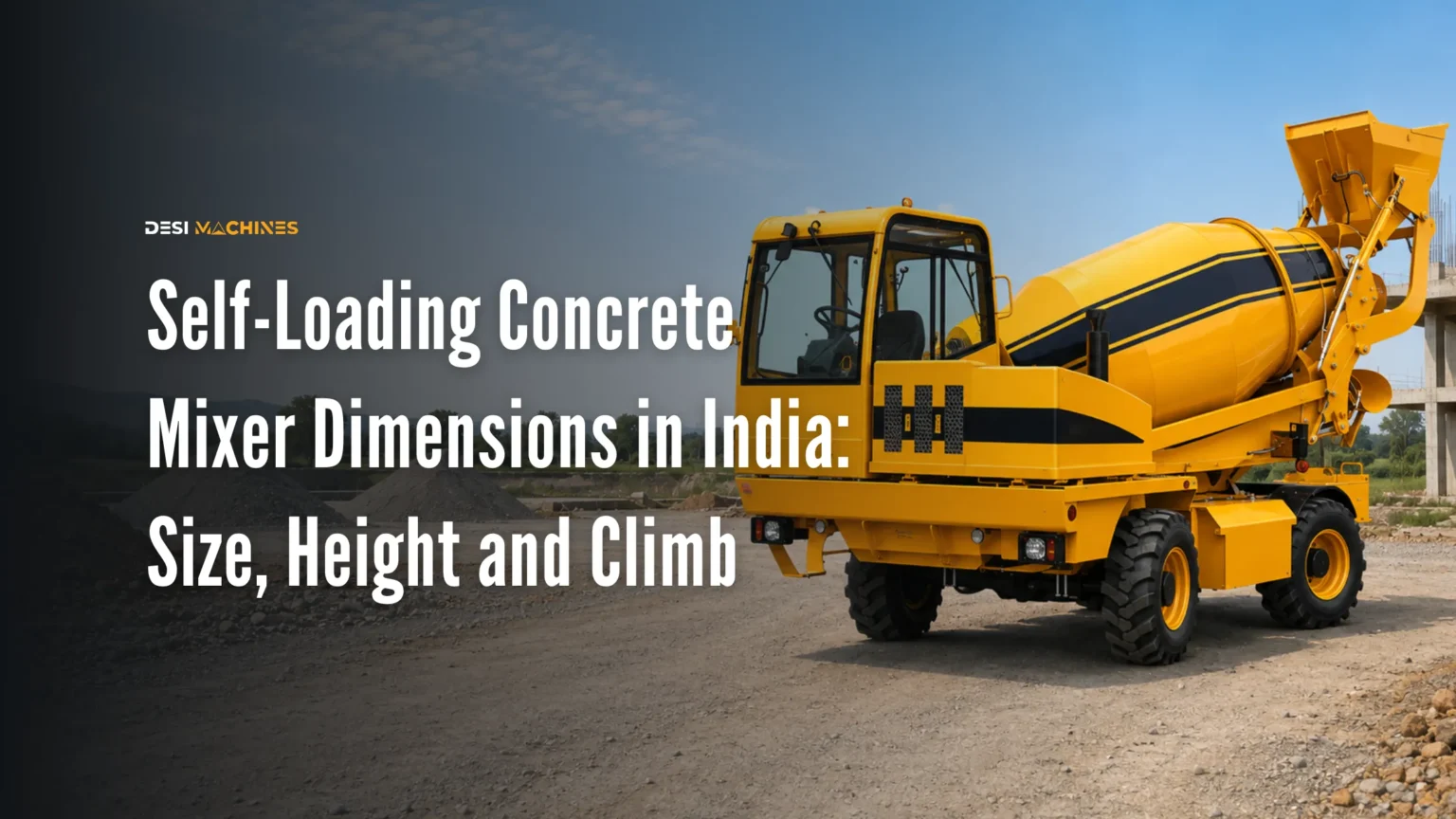
A self-loading concrete mixer is a four-wheel-drive machine that scoops its own sand, stone and cement with a front bucket, weighs the mix, turns it in a rotating drum, and then drives to the pour on its own wheels. Because it drives itself instead of waiting for a truck, self-loading concrete mixer dimensions decide more than they do on any other concrete machine: the width has to clear your gate, the height has to clear the wires, and the machine has to climb whatever ramp your site actually has.
Across the 38 self-loading mixers listed on DesiMachines, the published figures run from 2,065 mm to 2,530 mm wide (about 6 ft 9 in to 8 ft 4 in), 2,800 mm to 4,470 mm tall (about 9 ft 2 in to 14 ft 8 in) and 4,703 mm to 7,780 mm long. They travel at 20 km/h to 30 km/h and are rated to climb slopes of 16° to 28°. This guide explains what each of those numbers means on a real site, and shows two places where the obvious assumption is wrong.
How big is a self-loading concrete mixer?
It is roughly the size of a tractor with a trailer, but taller and heavier. The machines sort naturally into three sizes by drum capacity, meaning the volume of mixed concrete the drum holds in one batch, and the catalogue splits cleanly at 2.5 m³ and 4.0 m³, with no machine listed between 3.2 m³ and 4.0 m³.
| Size class (drum) | Machines | Overall width | Overall height | Ground clearance | Top speed | Rated climb |
|---|---|---|---|---|---|---|
| Small, 2.0–2.5 m³ | 11 | 2,065–2,420 mm | 3,295–4,470 mm | 280–385 mm | 21–27 km/h | 16°–28° |
| Mid, 2.8–3.2 m³ | 6 | 2,140–2,450 mm | 2,800–4,300 mm | 300–385 mm | 20–28 km/h | 16°–25° |
| Large, 4.0–5.4 m³ | 16 | 2,190–2,530 mm | 2,920–4,400 mm | 355–400 mm | 22–30 km/h | 16°–25.5° |
Figures as per the current August 2026 spec sheets. Not every machine publishes every field: 36 of the 38 publish width, height and length, 33 publish drum capacity, top speed and unladen weight, 28 publish a usable climbing figure, and only 23 publish ground clearance. Where a machine publishes a small range rather than a single number, the lower figure is used here.
Unladen weight runs from 5,000 kg to 9,560 kg (5 to 9.6 tonnes) and engines from 48 HP to 112 HP. Every one of the 33 machines that states a drive type is four-wheel drive, so 4WD is not something you shop for in this class. You get it either way.
For how the drum volume translates into concrete delivered, and how that compares with a truck-fed pour, see the guide to self-loading mixers against transit mixers.
Will a self-loading mixer fit through my site gate?
Almost certainly on width, and that is the surprise. Across all 36 machines that publish it, overall width spans only 2,065 mm to 2,530 mm, just 465 mm between the narrowest and the widest machine on the books. The narrowest is the VENUS ULTRA 2.0 at 2,065 mm; the widest is the AJAX ARGO 4800 at 2,530 mm, and its drum is more than twice the size.
What that means in practice: if your approach can take a loaded tractor-trailer, width will not stop a self-loading mixer. A 3 metre gate clears every machine listed. Choosing a smaller drum to squeeze through a gap buys you less than half a metre.
Height is the dimension that actually catches people out. Overall height runs from 2,800 mm to 4,470 mm, a spread of more than 1.6 metres and three times the variation you get in width. Low-tension power lines, a compound gate with a lintel, a tree branch over the village approach: those are what stop the machine, and the tallest machines are close to 15 feet.
Measure the height of everything the machine has to pass under before you shortlist, not after. Of all the self-loading concrete mixer dimensions on a spec sheet, this is the one that sends a machine home again. Height and ground clearance are both worth confirming with the dealer for the exact variant, because attachments and tyre choice move them. The self-loading concrete mixer tyre size guide sets out which rim and tyre each machine runs.
Compare live self-loading concrete mixer models and check the published dimensions of each one against your own gate and approach.
Does a bigger drum mean a taller, tougher machine?
No, and this is where buying by size goes wrong. Two examples from the catalogue make it plain.
On height, the tallest machine in the entire class is a small one. The Tarle SLM 2200 holds 2.2 m³ and stands 4,470 mm tall, taller than the AJAX ARGO 4800 at 4,290 mm, which carries a drum more than twice the size. A small drum does not give you a low machine.
On climbing, the pattern breaks the same way: the best climber in the class is a 2.1 m³ machine and the weakest is a 4.6 m³ one.
There is one more trap worth knowing. The number in the model name is usually the drum size in cubic metres, but not always. An AJAX ARGO 2000 holds 2.0 m³, a CONMAT CSLM 4300 holds 4.3 m³, a Tarle SLM 3000 holds 3.0 m³ — the rule holds across most brands. It does not hold for Universal: the UNIVERSAL SLM – 2 is listed at 3.2 m³ and the UNIVERSAL SLM – 4 at 5.4 m³. Read the drum figure on the spec sheet rather than the badge on the machine.
How steep a slope can a self-loading mixer climb?
Between 16° and 28°, depending on the machine — and the machine’s size has almost nothing to do with it. Gradeability is the steepest slope a machine can pull itself up, written in degrees. A 16° slope rises about 29 cm for every metre you travel forward. A 28° slope rises about 53 cm per metre, which is steeper than most ramps you will ever build.
Here is the part that matters. The Schwing Stetter SLM 2100, one of the smallest machines listed at 2.1 m³, is rated at 28°, the highest figure in the class. The Apollo Carmix 46 FX, at 4.6 m³ one of the largest, is rated 16°–17°, the lowest. Buying the bigger machine to handle a steep site would get you the weaker climber.
The reason is that climbing ability follows the drivetrain and the brand’s design, not the drum. All three Apollo Carmix machines listed, at 2.3 m³, 3.0 m³ and 4.6 m³, publish the same 16°–17° figure. Tripling the drum changes the rated climb by nothing at all. Meanwhile the CONMAT CSLM 4300 at 4.3 m³ is rated 25.5°, and the Bull VMP 4000 at 4.0 m³ is rated 25°.
Treat the rated figure as a dry, firm-surface number. A loaded drum, wet mud or loose murram will all take a bite out of it, so leave yourself margin rather than buying to the exact slope you have.
How fast does a self-loading concrete mixer travel?
Top speed runs from 20 km/h to 30 km/h across the 33 machines that publish it, with 26 km/h typical. The slowest listed is the UNIVERSAL SLM – 2 at 20 km/h and the quickest the UNIVERSAL SLM – 4 at 30 km/h.
Read that as a site figure, not a road figure. At 25 km/h a self-loading mixer can move itself across a large site, between two blocks of a housing project, or down a village road to the next pour a couple of kilometres away. It is not a machine for crossing town, and it is not a substitute for a transit mixer when the concrete is coming from a batching plant several kilometres off.
Speed also has nothing to do with size here: the same brand supplies both the slowest and the fastest machine in the list, and the faster one has the bigger drum.
How much ground clearance does a self-loading mixer need?
The 23 machines that publish the figure sit between 280 mm and 400 mm (11 to 16 inches) off the ground. The AJAX ARGO 2000 is the lowest at 280 mm; the Tarle SLM 4300 the highest at 400 mm.
Ground clearance is what decides whether the machine crosses a rutted approach, a kerb, or the lip where your site road meets the highway without grounding. Unlike height and climb, this one does broadly track size: the large class starts at 355 mm while small machines go down to 280 mm. So if your approach is rough, the bigger machines have an honest advantage.
It is also the figure fewest machines publish, so ask the dealer directly if your approach is bad. Where a spec sheet is silent, “not specified” is the truthful answer, and it is worth getting in writing before you commit.
What should I measure on my site before buying?
Check your site against the published self-loading concrete mixer dimensions before you shortlist, not after the machine arrives. Five measurements do it:
- The lowest thing the machine must pass under. Power lines, gate lintels, branches. Compare it against 4,470 mm to be safe with any machine in the class, or against the specific model’s published height.
- The narrowest point on the approach. Anything over 3 metres clears every listed machine, so this rarely decides the purchase.
- The steepest ramp the machine has to climb, loaded. Measure the rise over a fixed length: 29 cm per metre is about 16°, 47 cm per metre about 25°.
- The worst part of the approach surface. Ruts and kerbs point you towards the 355–400 mm clearance machines.
- The turning space at the pour itself. Length runs to 7,780 mm (about 25 ft 6 in), and the machine has to swing its drum to discharge.
If the numbers are tight, or the work is seasonal, hiring first is the cheaper way to find out. The guide to renting a self-loading mixer covers rates and what to check on handover. If you are looking at a second-hand machine instead, the same measurements apply, alongside the checks in the guide to buying a used self-loading mixer.
It is also worth reading how the drum is driven and how mixer capacity and load weight work, since both change what the machine weighs when it is full. The full range of machine types is set out in the guide to concrete mixer types, and the rest of the series sits in the concrete mixer guide.
Self-loading concrete mixer dimensions, in short
Width barely varies, from 2,065 mm to 2,530 mm across every machine listed, so a 3 metre gate clears them all and width almost never decides the purchase. Height does the deciding, running from 2,800 mm to 4,470 mm, and the tallest machine on the books carries one of the smallest drums. Rated climb spans 16° to 28° and follows the brand and drivetrain rather than the size, so a 2.1 m³ machine can out-climb a 4.6 m³ one. Top speed of 20–30 km/h makes it a machine that delivers its own concrete around a site, not across a district. Measure your lowest wire and your steepest ramp first, then pick the drum.
Browse the full range of self-loading concrete mixers and concrete mixers to compare published dimensions model by model, and confirm the exact variant with the dealer before you commit.
Size is only half of what decides whether the machine keeps working. It also has to carry its own diesel and mixing water, and how much of each it holds is set out in self-loading concrete mixer fuel and water tank capacity.
Size decides access; the cycle decides the day. Self-loading mixer productivity and output per hour works out how many batches a machine of each drum size actually turns out.
Prices, specifications and features are indicative, vary by variant, location and date, and should always be confirmed with the official OEM or authorised dealer before any purchase decision. DesiMachines is not liable for decisions taken on the basis of information that may have changed after publication.