
 Excavator
294 models
Excavator
294 models  Backhoe Loader
51 models
Backhoe Loader
51 models  Crane
68 models
Crane
68 models  Concrete Mixer
79 models
Concrete Mixer
79 models  Wheel Loader
54 models
Wheel Loader
54 models  Compactor / Roller
45 models
Compactor / Roller
45 models  Motor Grader
42 models
Motor Grader
42 models  Dozer
41 models
Dozer
41 models  Concrete Pump
66 models
Concrete Pump
66 models  Skid Steer Loader
11 models
Skid Steer Loader
11 models  Telehandler
13 models
Telehandler
13 models 


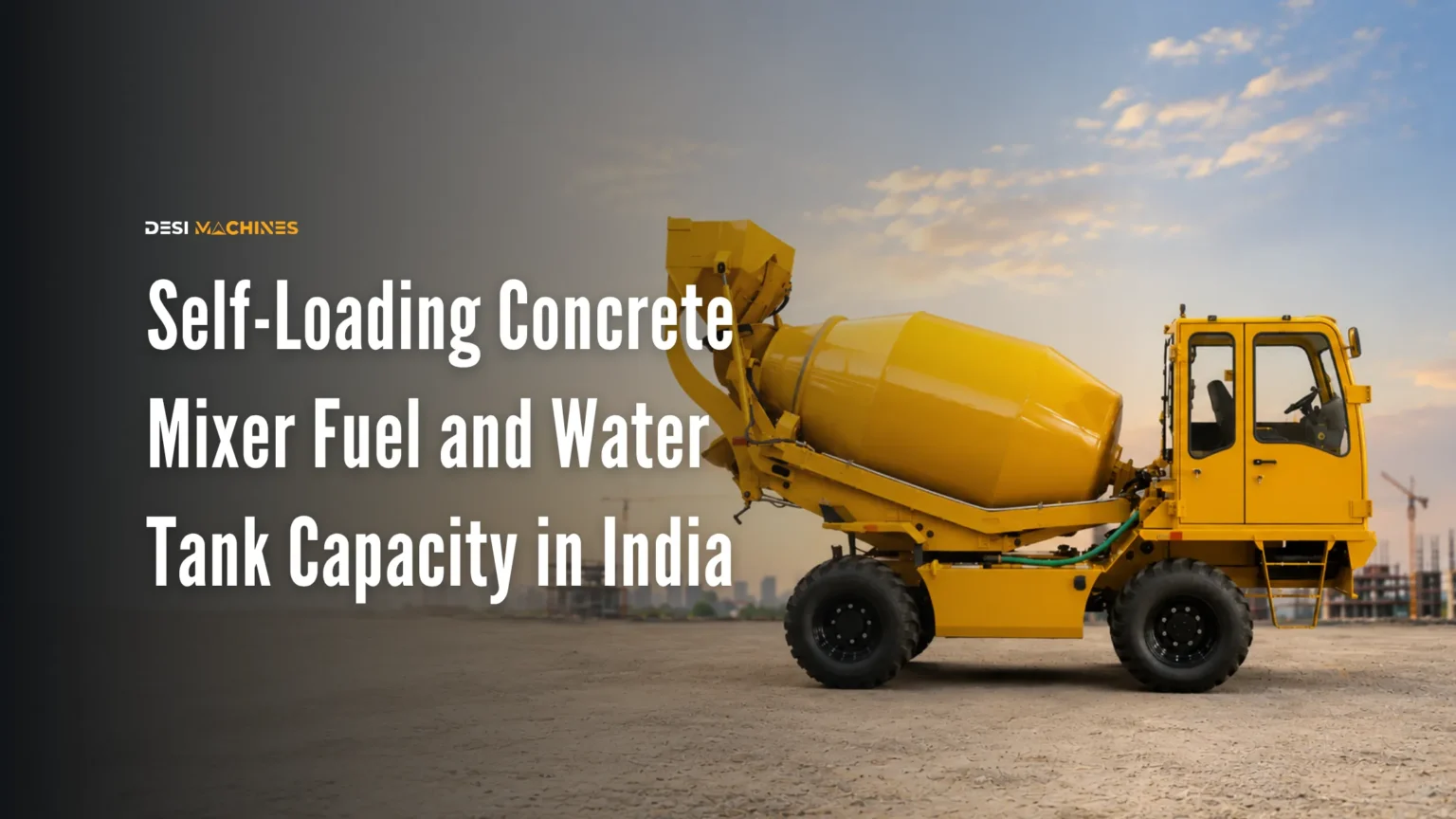
A self-loading concrete mixer is a wheeled machine that loads its own aggregate, mixes concrete on the spot and drives the finished load to the pour. Because it does the whole job alone, it has to carry its own diesel, its own mixing water and its own hydraulic oil. Self loading concrete mixer fuel tank capacity runs from 64 to 135 litres across the machines listed on DesiMachines, while the water tank holds a great deal more, from 360 to 1,160 litres, as per the current August 2026 spec sheets.
Those two tanks decide how often the machine stops working. Diesel you can carry to site in a drum. Water, on a rural road project or a canal bank, is usually the harder one to find, and a machine that empties its water tank every second batch will spend more of the day waiting for a tanker than mixing concrete. This guide gives both figures for every machine that publishes them, explains the simple rule that links water tank size to drum size, and covers the hydraulic oil and water pump numbers that sit on the same page of the spec sheet.
What is the fuel tank capacity of a self-loading concrete mixer?
It runs from 64 to 135 litres, and the median machine carries 110 litres. Of the 38 self-loading mixers listed here, 31 publish a fuel tank figure.
The tank grows with the drum, but not by much, and it flattens out at the top. The smallest machines, with drums of 2.0 to 2.5 m³, carry 64 to 120 litres. The largest, at 4.0 to 4.8 m³, carry 110 to 135 litres. So a machine with more than twice the drum volume carries only about a quarter more diesel. That is worth knowing before you buy, because it means the big machine does not give you a proportionally longer working day — it gives you bigger batches and the same sort of refuelling routine.
The 135 litre figure is the ceiling across the whole segment. Three machines reach it: the AJAX ARGO 4800, the AJAX ARGO 4500 and the VENUS ULTRA 4800. The floor of 64 litres belongs to the AJAX ARGO 2000 and the ARGO 2500.
Fuel and water tank capacity by model
The table below groups the machines by drum size, because that is what a buyer shortlists on first. Every figure is taken from the machine’s own published specification. Where a machine does not publish a field, the cell is marked “Not specified” rather than filled with an estimate.
Self-loading concrete mixer fuel, water and hydraulic tank capacity in India — as per current August 2026 specifications
| Model | Drum | Fuel tank | Water tank | Hydraulic tank |
|---|---|---|---|---|
| Small, 2.0–2.5 m³ | ||||
| AJAX ARGO 2000 | 2.0 m³ | 64 L | 360 L | See note below |
| AJAX ARGO 2500 | 2.5 m³ | 64 L | 420 L | See note below |
| VENUS ULTRA 2.0 | 2.0 m³ | 70 L | 400 L | 90 L |
| MACONS MST 2 | 2.0 m³ | 120 L | 600 L | Not specified |
| Schwing Stetter SLM 2100 | 2.1 m³ | Not specified | 380 L | Not specified |
| Schwing Stetter SLM BEE 2.1 | 2.1 m³ | Not specified | 380 L | Not specified |
| Tarle SLM 2200 | 2.2 m³ | 80 L | 580 L | Not specified |
| JOHN SLCM 2.2 | 2.2 m³ | 65 L | 450 L | 115 L |
| Apollo Carmix 23 FX | 2.3 m³ | 95 L | 2 × 225 L | 70 L |
| Schwing Stetter SLM 2600 | 2.4 m³ | Not specified | 380 L | Not specified |
| CONMAT CSLM 2500 | 2.5 m³ | 100 L | 500 L | 112 L |
| Mid, 2.6–3.8 m³ | ||||
| VENUS ULTRA 2600 | 2.6 m³ | 90 L | 450 L | 90 L |
| CONMAT CSLM 2800 | 2.8 m³ | 100 L | 625 L | 112 L |
| AJAX ARGO 3000 | 3.0 m³ | 100 L | 600 L | See note below |
| Tarle SLM 3000 | 3.0 m³ | 100 L | 600 L | Not specified |
| VENUS ULTRA 3.0 | 3.0 m³ | 100 L | 650 L | 100 L |
| Apollo Carmix 30 FX | 3.0 m³ | 130 L | 2 × 275 L | 70 L |
| VENUS ULTRA 3200 | 3.2 m³ | 110 L | 650 L | 110 L |
| VENUS ULTRA 3800 | 3.8 m³ | 110 L | 700 L | 110 L |
| Large, 4.0–4.8 m³ | ||||
| VENUS ULTRA 4.0 | 4.0 m³ | 100 L | 1,000 L | 100 L |
| MACONS MST 4 | 4.0 m³ | 130 L | 900 L | Not specified |
| Bull VMP 4000 | 4.0 m³ | 90 L | 2 × 360 L | 110 L |
| CONMAT CSLM 4200L | 4.2 m³ | 120 L | 900 L | 112 L |
| CONMAT CSLM 4300 | 4.3 m³ | 120 L | 900 L | 112 L |
| Schwing Stetter SLM 4300 | 4.3 m³ | Not specified | 750 L | Not specified |
| Tarle SLM 4300 | 4.3 m³ | 110 L | 800 L | Not specified |
| JOHN SLCM 4.3 | 4.3 m³ | 120 L | 750 L | 115 L |
| Fiori DBS 4300 | 4.3 m³ | 110 L | 870 L | 125 L |
| MACONS MST 4.5 | 4.5 m³ | 130 L | 900 L | Not specified |
| AJAX ARGO 4500 | 4.5 m³ | 135 L | 800 L | See note below |
| VENUS ULTRA 4500 | 4.5 m³ | 135 L | 1,000 L | 110 L |
| Schwing Stetter SLM 4600 | 4.6 m³ | Not specified | 750 L | Not specified |
| Apollo Carmix 46 FX | 4.6 m³ | 130 L | 2 × 580 L | 85 L |
| AJAX ARGO 4800 | 4.8 m³ | 135 L | 800 L | Not specified |
| CONMAT CSLM 4800 | 4.8 m³ | 120 L | 1,000 L | 112 L |
| VENUS ULTRA 4800 | 4.8 m³ | 135 L | 1,000 L | 110 L |
Two machines listed here, the UNIVERSAL SLM-2 and SLM-4, publish neither a fuel nor a water tank figure and so do not appear in the table.
Comparing live models side by side is easier on the self-loading concrete mixer listings, where each machine carries its full specification.
How much water does a self-loading mixer carry?
Between 360 and 1,160 litres, with a median of 675 litres across the 36 machines that publish the figure. That is five to nine times the diesel tank on the same machine.
The water tank is the one number on this page that follows a clean rule. Divide the water tank by the drum capacity and almost every machine lands near 200 litres of water for each cubic metre of drum. The median across all 36 machines is exactly 200, and 30 of them sit between 160 and 230. Only the MACONS MST 2 sits well clear of the pattern, carrying 600 litres against a 2.0 m³ drum, or 300 litres per cubic metre.
That rule is useful when you are shortlisting. If a machine you are shown carries much less than 200 litres per cubic metre of drum, it will need refilling more often than its rivals for the same output. If you already know your drum size, you can work out roughly what tank to expect and query anything well below it.
Water on these machines does two jobs: it goes into the mix, and it washes the drum and chute down at the end of a pour. Concrete that is allowed to set inside the drum is an expensive mistake, so the washing half is not optional. Plan your site water supply around both, not just the mixing.
One warning that matters more in India than the tank size itself. Adding extra water on site to loosen a stiff load ruins the water-to-cement ratio and quietly weakens the concrete. The tank is there to deliver the design mix and to wash the machine, not to thin a load that has started to go off.
Why do some machines have two water tanks?
Four machines publish their water capacity as two tanks rather than one: the Apollo Carmix 23 FX at 2 × 225 litres, the Carmix 30 FX at 2 × 275 litres, the Carmix 46 FX at 2 × 580 litres, and the Bull VMP 4000 at 2 × 360 litres.
Two tanks usually means one mounted on each side of the machine. The reason is balance. A full 1,160 litre tank weighs about 1,160 kg, and hanging that much weight on one side of a machine that spends its life on soft ground and site ramps is poor design. Splitting it keeps the machine even on its wheels.
The practical point for a buyer is arithmetic. The Carmix 46 FX carries 1,160 litres in total, which is the largest water capacity in the segment — more than the 1,000 litre machines from VENUS and CONMAT. Read as a single figure of 580, it looks mid-sized. Whenever a specification is written in this form, multiply before you compare, and check whether the two tanks are plumbed together or have to be filled separately.
How much hydraulic oil does a self-loading mixer hold?
Hydraulic oil is what drives the loading bucket, the drum and the steering. On the 20 machines that publish a reliable figure, the hydraulic tank holds 70 to 125 litres, with a median of 110 litres.
Unlike the water tank, this figure barely moves with machine size. The Apollo Carmix 23 FX, a 2.3 m³ machine, holds 70 litres; the CONMAT CSLM 4800 at more than twice the drum size holds 112 litres. The hydraulic system is sized by the work it does rather than by the volume of concrete carried, so a small machine with a heavy-duty loading arm can hold nearly as much oil as a large one.
The number matters for one reason above all: cost of an oil change. Hydraulic oil is bought by the drum, and a system holding 125 litres costs meaningfully more to fill than one holding 70. Ask what grade the machine takes and what the service interval is before you compare two machines on price alone. Our guide to hydraulic system maintenance covers what goes wrong and how to prevent it.
A data note on four machines. The AJAX ARGO 2000, 2500, 3000 and 4500 each publish a hydraulic tank figure identical to their own water tank figure — 360, 420, 600 and 800 litres respectively — against a segment that otherwise runs 70 to 125 litres. The ARGO 4800, the fifth machine in the same range, leaves the hydraulic field blank while publishing 800 litres of water. That pattern points to the water figure having been entered twice on those four sheets. We have left them out of the range above rather than guess at a corrected number, and the point has been raised for checking with the manufacturer. Confirm the hydraulic capacity of any ARGO with the dealer before you order oil for it.
What does the water pump capacity tell you?
Twenty-eight machines publish a water pump capacity, and it runs from 230 to 450 litres per minute. The most common figure by a distance is 230 litres per minute, on twelve machines.
This is the rate at which the on-board pump moves water, and it governs two things: how quickly the machine can draw water into its own tank from a site sump or tanker, and how hard the washdown jet hits at the end of a pour. At 230 litres per minute, filling a 900 litre tank from an open source takes about four minutes. At 450, under two.
On a site with a reliable standpipe this barely matters. On a site where water arrives by tanker and the machine has to fill itself while the tanker waits, a faster pump is real money saved. It is a small specification that gets overlooked, and it is worth asking about if your water comes to you rather than the other way round.
How long does one tank of diesel last?
Long enough for a normal working day on most machines, but the honest answer is that we cannot give you a figure in hours, because fuel consumption is not published on these specification sheets. Any litres-per-hour number quoted for a self-loading mixer is an estimate, and it would change with your mix, your aggregate, how far the machine drives between the stockpile and the pour, and how much of the day it spends idling.
Getting your own number costs nothing. Fill the tank to the brim, work a normal day, note the hours on the hour meter, then fill it to the brim again and record the litres. Two or three days of that gives you a litres-per-hour figure for your site and your operator that no brochure can match. Divide the tank size by that rate and you know how your machine fits your working day.
Do the same before buying a used machine and you learn something about its condition. A mixer burning noticeably more diesel than a similar machine on similar work usually has something wrong with it. The used self-loading mixer buying guide covers what to check.
What to check on the tanks before you buy
Four things, none of which need a technician.
Where the filler necks sit. On a machine with a high-mounted water tank you will be lifting cans or running a hose up to shoulder height several times a day. Look at how you will actually fill it on your site, not in the showroom.
Whether the water tank drains fully. Water left in a tank through a cold night in north India can freeze, and water left standing for weeks grows algae that blocks the pump. A tank with a proper drain plug at its lowest point is worth more than a slightly larger one without.
The condition of the pump and its filter. On a used machine the water pump is a common weak point, because it is fed by whatever water the site had. Ask to see it run and watch the pressure at the jet.
Tank mounting. Check the brackets and welds for cracks on a used machine. A full water tank is close to a tonne of moving weight, shaken all day on rough ground.
To see how these tanks sit within the overall size of the machine, and whether it will fit your site at all, read the guide to self-loading concrete mixer dimensions.
A note on the figures in this guide
Every number here comes from the published specification of a machine currently listed on DesiMachines, read in August 2026. Not every machine publishes every field: of the 38 self-loading mixers listed, 36 publish a water tank capacity, 31 publish a fuel tank, 28 publish a water pump capacity and 24 publish a hydraulic tank.
Where a capacity is written as two tanks, the two have been added together for the ranges quoted, and the original form is shown in the table. The four AJAX ARGO hydraulic figures described above are excluded from the hydraulic range. Specifications change between model years and between variants of the same machine, so confirm any figure with the dealer before you plan around it.
Self-loading mixer fuel and water capacity, in short
Across the self-loading concrete mixers listed here, the fuel tank holds 64 to 135 litres and the water tank 360 to 1,160 litres. The water tank is the bigger constraint on almost every Indian site, and it tracks drum size closely at about 200 litres for every cubic metre of drum. Hydraulic tanks run 70 to 125 litres and barely change with machine size, which makes the oil-change cost more even across the segment than buyers expect.
The diesel tank will rarely be the number that decides your purchase. The water tank, the pump that fills it, and whether your site can keep both supplied, very often is. Work out your own diesel burn once the machine is yours, and buy on drum size, reach and dealer support instead.
Browse the current range of self-loading concrete mixers and talk to a dealer about the machine that suits your pours.
Tank sizes decide how often you stop; the cycle decides how much you pour between stops. Self-loading mixer productivity and output per hour sets out the batches per hour behind those refills.
Prices, specifications and features are indicative, vary by variant, location and date, and should always be confirmed with the official OEM or authorised dealer before any purchase decision. DesiMachines is not liable for decisions taken on the basis of information that may have changed after publication.
Read next
For the outside measurements and site access, see self-loading concrete mixer dimensions. To decide between mixing on site and buying ready-mixed, read self-loading mixer vs transit mixer, and for the water arrangements on the truck-mounted machines, see transit mixer drum drive. If you are hiring rather than buying, the self-loading mixer rental guide covers rates and what to check. For the same measurements on other machines, see road roller fuel tank and water tank capacity and excavator fuel tank capacity.
For the rest of the machine beyond its tanks, from the mixing drum and charging bucket to the weighing system and brakes, see the guide to self-loading concrete mixer parts and components.
Machines, tenders and news for this industry: Ready-Mix Concrete