
 Excavator
294 models
Excavator
294 models  Backhoe Loader
51 models
Backhoe Loader
51 models  Crane
68 models
Crane
68 models  Concrete Mixer
79 models
Concrete Mixer
79 models  Wheel Loader
54 models
Wheel Loader
54 models  Compactor / Roller
45 models
Compactor / Roller
45 models  Motor Grader
42 models
Motor Grader
42 models  Concrete Pump
66 models
Concrete Pump
66 models  Skid Steer Loader
11 models
Skid Steer Loader
11 models  Telehandler
13 models
Telehandler
13 models  Dozer
Dozer 


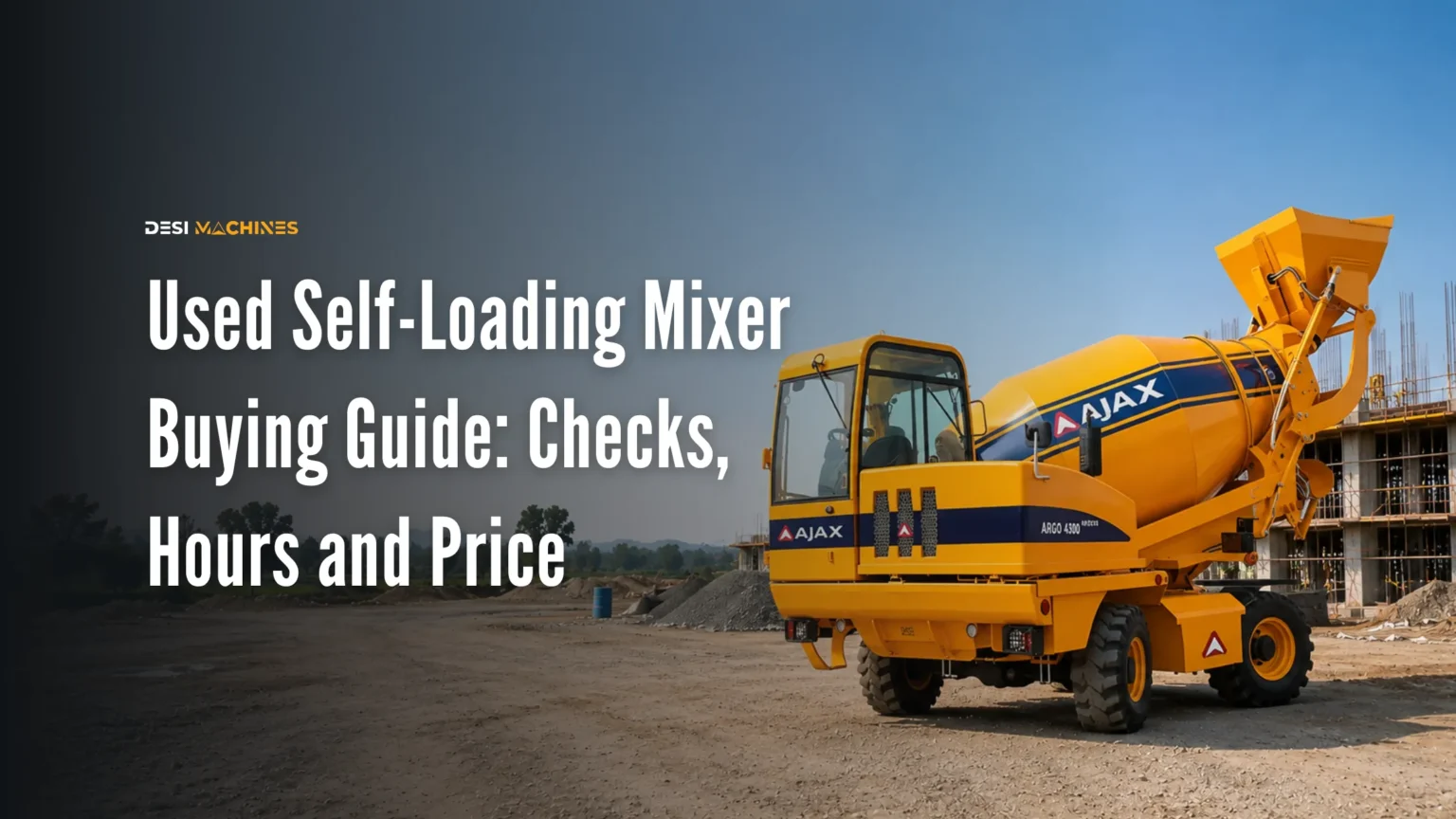
A used self-loading concrete mixer is a second-hand SLCM: a wheeled machine that scoops its own sand, aggregate and cement, weighs the mix, mixes it in a rotating drum and drives it to the pour, all with one operator. Bought new in India these machines run from about ₹27 Lakh to ₹54 Lakh depending on drum size (indicative, as of Aug 2026), which is why a good second-hand unit is often the way a small contractor gets his first one.
The catch is that an SLCM is really three machines welded together. It is a loader at the front, a batching plant in the middle and a mixer at the back, and a used one can be sound in two of those and finished in the third. Judging it is not the same as judging a used backhoe, where the wear is mostly where you can see it.
This guide covers what to check, what the hours actually tell you, what these machines cost new, what a second-hand one should be worth, and which papers must come with it.
What should you check on a used self-loading mixer?
Start inside the drum, because that is where the money is. Get a torch and look at the mixing blades and the drum liner. Blades wear down at the leading edge and go rounded, and once they are worn the machine turns out concrete that looks mixed and is not. A drum reline or a set of blades is a serious bill and it is the single most common hidden cost on a used SLCM.
Then work through the rest in this order.
- The weighing system. This is what separates an SLCM from a mixer on wheels. Load the hopper with the seller watching and see whether the display reads sensibly and returns to zero when empty. Load cells and their wiring take a beating from vibration and water, and a machine whose weighing has been quietly abandoned is being run by guesswork, which shows up later as weak concrete.
- The loading shovel and its pins. Check the bucket edge, the pins and bushes at every joint, and whether the shovel drifts down on its own when held up. Drift means worn cylinder seals.
- The articulation joint. Most of these machines bend in the middle to steer. Get someone to turn the wheel lock to lock while you watch the centre joint for play and for cracked or repaired welds around it. A cracked articulation is a machine you walk away from.
- Drum rollers and the ring gear. The drum turns on rollers and is driven around a large gear. Listen for knocking with the drum rotating empty, and look for a bright, uneven wear pattern on the ring.
- Water system. Pump, tank and flow meter. A leaking water system is cheap to fix but tells you how the machine was looked after.
- Hydraulics and hoses. Look for weeping joints, chafed hoses and fresh paint around any of them. Fresh paint on a hydraulic block usually means a recent leak rather than pride.
- Tyres. Four of them, and they carry a heavy, constantly slewing load on rough ground. A set is a real number to add to the asking price. Check the sidewall code against the self-loading concrete mixer tyre size for that machine before you price a replacement set.
Run the machine through one full cycle before you make any offer: load, weigh, mix, discharge. Most sellers will agree to it, and a seller who will not has told you something.
How many hours is too many on a used self-loading mixer?
As a working line, under about 4,000 hours on a well-kept machine is a straightforward buy, 4,000 to 8,000 is normal second-hand territory where condition decides everything, and past that you are buying the condition of the drum and the engine rather than a machine with a number on it.
Hours on an SLCM are harder to read than on an excavator, and for a specific reason. The hour meter runs while the engine runs, but this machine spends much of its life driving between the stockpile and the pour rather than mixing. Two machines at 6,000 hours can have wildly different drum wear depending on how many cubic metres actually went through them. So ask the question in cubic metres if you can: how many pours a week, over how many years.
Also ask what it was mixing. A machine used on plain concrete for house slabs has had an easier life than one used on a road or canal job with coarse, sharp aggregate. Abrasive mixes eat liners and blades. The meter cannot tell you which one you are looking at, and the drum can.
What does a new self-loading concrete mixer cost in India?
You need this before you can judge a used price. Across the self-loading mixers listed for sale in India, new machines run from about ₹27 Lakh to ₹54 Lakh (indicative, as of Aug 2026), sorted mainly by drum size.
| Drum capacity | Typical new price | Engine power | What it suits |
|---|---|---|---|
| 2.0–2.6 m³ | ₹29–37 Lakh | About 48–58 HP | House slabs, small commercial work, rural sites, narrow access |
| 2.8–3.8 m³ | ₹27–42 Lakh | About 49–75 HP | The general-purpose size for a small contractor |
| 4.0–5.4 m³ | ₹38–54 Lakh | About 108–112 HP | Larger pours, road and canal work, continuous batching |
Prices and specifications indicative, as of Aug 2026, taken across 38 self-loading mixer models. They vary by variant, state and dealer.
Two things to take from that table. Drum size, not brand, sets most of the price. And the bands overlap, because a well-equipped 3 m³ machine from one maker can cost more than a basic 4 m³ from another. Compare live self-loading concrete mixer models and prices before you accept any second-hand quote as a bargain.
How much should a used self-loading mixer cost?
Work down from the new price rather than up from the seller’s number. A machine two to three years old with honest hours, a sound drum and complete papers sits clearly below the new band but nowhere near half of it. By five to seven years the gap widens sharply. Past that, the price is being set by the state of the drum, the blades and the engine, not by the year on the paperwork.
Three adjustments decide whether a discount is real.
The deferred spend. Add up what you will have to spend in the first six months and take it off the asking price before you compare two machines. On an SLCM that list is usually blades, a drum liner if it is due, tyres and a hydraulic service. A machine ₹2 Lakh cheaper that needs a reline is not cheaper.
The weighing system. If the load cells or the display are dead, price the repair in, and price in the risk. A machine that cannot weigh is a machine whose concrete you cannot stand behind, which matters the day a customer asks for a mix design to be met.
The finance. Used-machine loans carry higher rates and shorter tenures than new ones, so two machines at the same headline price can cost very different amounts over the term. Work the full outgo through the equipment finance options and compare it honestly against a new machine. First-time owners are often surprised by how small the monthly difference turns out to be.
Used values also move by region far more than new prices do, so a number that is right in Pune can be wrong in Patna.
Which drum size should you buy second-hand?
Buy for the pour you do most often, not the biggest one you have ever done. An SLCM is only economical if it is working, and an oversized machine is harder to move, harder to sell on and needs more space to turn on a cramped site.
Size also decides whether the machine reaches the work at all. The published dimensions of a self-loading mixer show that ground clearance rises with drum size, but height and rated climb do not follow it, so a bigger second-hand machine is not automatically the one that copes better with a rough approach.
For house slabs, boundary walls and small commercial work, a 2.0 to 2.6 m³ drum is usually enough and it is the easiest size to resell. For a contractor doing mixed work week to week, the 3 m³ class is the general-purpose answer. Go to 4 m³ and above only if you are batching continuously, on roads, canals or larger structures, where the extra output actually gets used.
One point specific to buying used: the small and mid-size machines sell far more readily second-hand than the large ones, because the buyers below you in the market are small contractors. That affects what you can recover when you come to sell it, which is worth as much as the discount you negotiate today.
If you are still weighing this machine against the alternative, the comparison of a self-loading mixer against a transit mixer sets out where each one wins, and the guide to concrete mixer types covers the rest of the family. The full range of concrete mixers shows what each size actually costs new.
Which papers must come with a used self-loading mixer?
An SLCM is a wheeled machine that drives on site and sometimes on public roads, so the paperwork matters more than for a tracked machine.
- The invoice trail from the original purchase, and proof that any loan against the machine has been closed. An unreleased hypothecation is the single most common reason a used-machine sale falls apart late.
- Registration papers where the machine is registered, with the chassis and engine numbers matching what is stamped on the machine. Check them physically, not on the photocopy.
- Insurance, current, and the claim history if the seller will share it. A repaired accident on the articulation joint is worth knowing about.
- Service records. Even a rough diary is better than nothing. What you want to see is regular oil changes and any record of drum or blade work already done.
- A clear seller. The person signing must be the registered owner or hold written authority. Machines bought from an intermediary who “manages” the sale are where the disputes come from.
The general checks that apply to any second-hand machine, including how to structure the payment, are covered in the guide to buying used construction equipment in India.
Is a used self-loading mixer worth buying?
Often yes, and for a clear reason: the work an SLCM does is not sensitive to the machine being new. Site-mixed concrete for a slab, a wall or a rural road does not care whether the drum turning it is two years old or seven, so long as it mixes properly and weighs honestly. The entry price is the barrier for most first-time owners, and a sound second-hand machine removes it.
It is the wrong buy in two situations. If you are supplying concrete to customers who specify a grade and expect it met, a machine with a doubtful weighing system is a liability rather than a saving. And if your work is genuinely continuous and high-volume, the downtime on an older machine costs more than the discount, and a transit mixer fed by a batching plant may be the better shape of investment altogether.
The rest of the used-machine range is covered in the guides to a used excavator, a used backhoe loader, a used wheel loader and a used hydra crane, and the brands available new are compared in the roundup of the best self-loading concrete mixer brands in India. If your concrete is batched at a plant rather than on site, the machine to compare against is a truck-mounted mixer, and the used transit mixer buying guide covers the drum and chassis checks that purchase needs.
Buying a used self-loading mixer, in short
Look in the drum first: blades and liner decide the real price. Read the hours as cubic metres rather than as a number, and ask what the machine was mixing. Anchor the value against new prices of about ₹27–54 Lakh depending on drum size (indicative, as of Aug 2026), then subtract the deferred spend before you compare two machines. Test the weighing system yourself, run one full load-to-discharge cycle, and settle the hypothecation and registration before any money moves.
Compare live self-loading concrete mixers and prices and speak to a dealer about what a comparable second-hand machine is fetching in your state.
Not ready to buy yet? The self-loading mixer on rent guide sets out hire rates, billing basis and the same inspection checks applied to a rented machine.
Prices, specifications and features are indicative, vary by variant, location and date, and should always be confirmed with the official OEM or authorised dealer before any purchase decision. DesiMachines is not liable for decisions taken on the basis of information that may have changed after publication. Figures are taken from our listings at the time of writing.