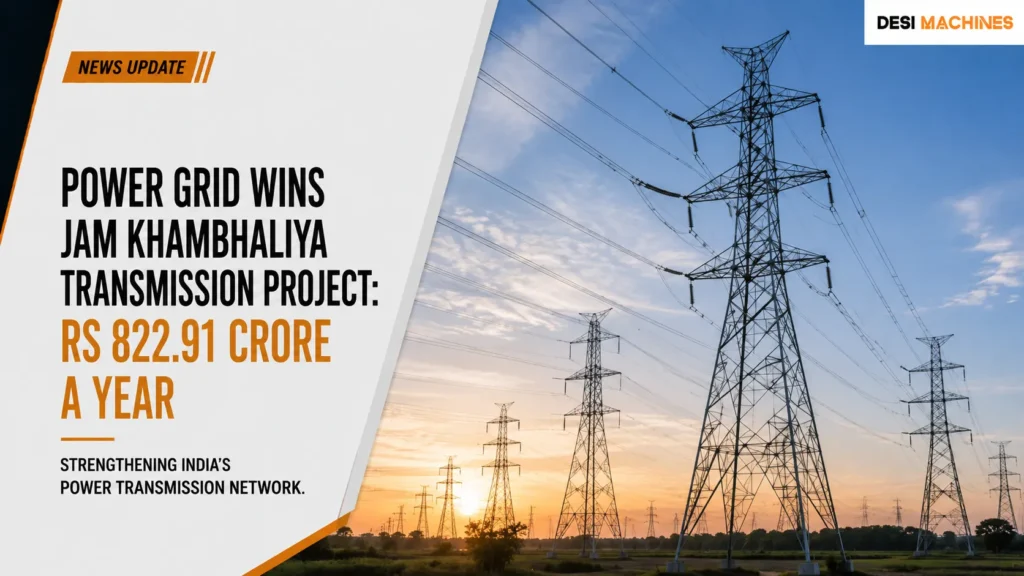
Power Grid Corporation has won the right to build one of Gujarat’s biggest renewable evacuation schemes, and the machine work it creates will be handed out later, in packages, to contractors. If you own or hire earthmoving and lifting plant in Saurashtra, that second step is the one to track.
The quick facts
- Power Grid Corporation of India received the letter of intent on 21 August 2026 for the transmission system integrating renewables from the Jam Khambhaliya renewable energy zone in Gujarat, Phase II (5,500 MW) and Jamnagar Phase-I (1,000 MW), a combined 6,500 MW.
- The discovered annual transmission charge is Rs 822.91 crore, awarded through tariff-based competitive bidding on a build, own, operate and transfer basis. PFC Consulting Limited ran the bid.
- Core scope in the request for proposal: a 765/400/220 kV gas-insulated substation near Kalyanpur with four 1,500 MVA and ten 500 MVA transformers, plus two 765 kV double-circuit lines, Kalyanpur to Jamnagar and Kalyanpur to Saurashtra near Rajkot.
- Scheduled commercial operation for the Kalyanpur substation is 31 March 2030. The asset transfers to the grid owner 35 years after commissioning.
What was awarded, and at what stage
This one moved in two steps. The specialist transmission trade press reported on 19 August that Power Grid had emerged as the lowest bidder on the scheme. The letter of intent followed on 21 August, which is the stage that actually settles who builds it. Power Peak Digest carried the award detail, and mainstream business desks including CNBC TV18 ran the Rs 822.91 crore annual tariff the same evening. Seven bidders had qualified, among them Adani Energy Solutions, Tata Power, Resonia, Dilip Buildcon, PNC Infratech and Dineshchandra R. Agrawal Infracon.
One correction worth making, because it is circulating. An annual transmission charge is not a project cost. Rs 822.91 crore is what the users of this system pay every year once it runs, not what the concrete and steel will cost. No capital outlay has been disclosed, and we are not going to invent one. Separately, an aggregator headline pairing Power Grid with a Rs 26,000 crore contract and a Rs 2.2 lakh crore order book does not survive a check: no first-rank desk carries that award, and the Rs 2.2 lakh crore figure attaches to a borrowing-limit approval, not to an order book.
What it means for buyers
Power Grid does not turn up on site with its own fleet. It wins the concession, then tenders the civil and erection work as engineering, procurement and construction packages. That is exactly the pattern behind our earlier coverage of Bajel Projects taking roughly Rs 700 crore of Power Grid line packages. So the buying signal here is a lead indicator with a long fuse, and the packages are where fleet decisions get made.
Read the scope as two unrelated jobs, because that is what it is. The Kalyanpur substation is a single graded platform: sustained bulk earthwork, cut-and-fill, a motor grader and soil compactors working a defined area for months, then a long concrete phase for transformer plinths, firewalls, cable trenches and the control building. The two 765 kV double-circuit lines are the opposite. They are hundreds of scattered tower foundations along a corridor, which means small-to-mid excavators, piling or rock-breaking depending on strata, and crawler cranes for erection and stringing. Route lengths are not stated in the element schedule, so the tower count, and therefore the real line-side machine demand, is still unknown.
Our take: the platform is likely bigger than the visible electrical scope suggests. The request for proposal lists a 6,000 MW plus-minus 800 kV HVDC terminal station and two 400 MVAr STATCOMs under future provision, meaning space is to be created for them now even though they are not being built now. Earthwork and land preparation for kit that arrives later is a quiet but real quantum of hours, and it is the sort of thing that gets under-scoped at bid stage. Set the annual charge against the Rs 126.54 crore a year Ashoka Buildcon took for a 400 kV air-insulated substation at Sakoli, and the scale gap is roughly six and a half times, which tells you this is a different order of civil job.
Geography matters too. Kalyanpur sits in coastal Devbhumi Dwarka, with the line corridors running through Jamnagar and towards Rajkot. Saline ground, a shallow water table near the coast and cyclone exposure push foundation design and dewatering into the cost sheet, and they favour contractors who already hold local plant over anyone mobilising from outside the state. With commissioning set for March 2030, expect the EPC tenders through FY28 rather than this year.
What to watch
- Power Grid’s EPC package tenders for the Kalyanpur substation and the two 765 kV lines, which is where actual machine demand gets committed.
- Whether the HVDC terminal moves out of future provision into a funded scope, since that would change the site from a substation job into a heavy civil one.
- Route alignment and length disclosures for the Kalyanpur to Jamnagar and Kalyanpur to Rajkot circuits, the number that sizes line-side foundation work.
FAQ
Does Power Grid winning this project mean it will buy construction equipment?
No. Power Grid is the transmission service provider, not the civil contractor. It awards engineering, procurement and construction packages, and those contractors buy or hire the plant. Watch the package tenders, not the concession award.
What does Rs 822.91 crore actually refer to?
It is the annual transmission charge discovered in the competitive bid, paid yearly by the users of the system once it is in service. It is not the construction cost, and no capital cost has been made public.
When would site work realistically start?
The scheduled commercial operation date for the Kalyanpur substation is 31 March 2030. On a scheme of this size that points to EPC awards and mobilisation through FY28, not immediately.
Related on DesiMachines: Bajel Projects Transmission Order: Rs 700 Crore of POWERGRID Lines
Source: Power Peak Digest
Machines, tenders and news for this industry: Power and Renewable Energy

 Excavator
294 models
Excavator
294 models  Backhoe Loader
51 models
Backhoe Loader
51 models  Crane
68 models
Crane
68 models  Concrete Mixer
79 models
Concrete Mixer
79 models  Wheel Loader
54 models
Wheel Loader
54 models  Compactor / Roller
45 models
Compactor / Roller
45 models  Motor Grader
42 models
Motor Grader
42 models  Dozer
41 models
Dozer
41 models  Concrete Pump
66 models
Concrete Pump
66 models  Skid Steer Loader
11 models
Skid Steer Loader
11 models  Telehandler
13 models
Telehandler
13 models