Excavator
294 models
Excavator
294 models  Backhoe Loader
51 models
Backhoe Loader
51 models  Crane
68 models
Crane
68 models  Concrete Mixer
79 models
Concrete Mixer
79 models  Wheel Loader
54 models
Wheel Loader
54 models  Compactor / Roller
45 models
Compactor / Roller
45 models  Motor Grader
42 models
Motor Grader
42 models  Dozer
41 models
Dozer
41 models  Concrete Pump
66 models
Concrete Pump
66 models  Skid Steer Loader
11 models
Skid Steer Loader
11 models  Telehandler
13 models
Telehandler
13 models 


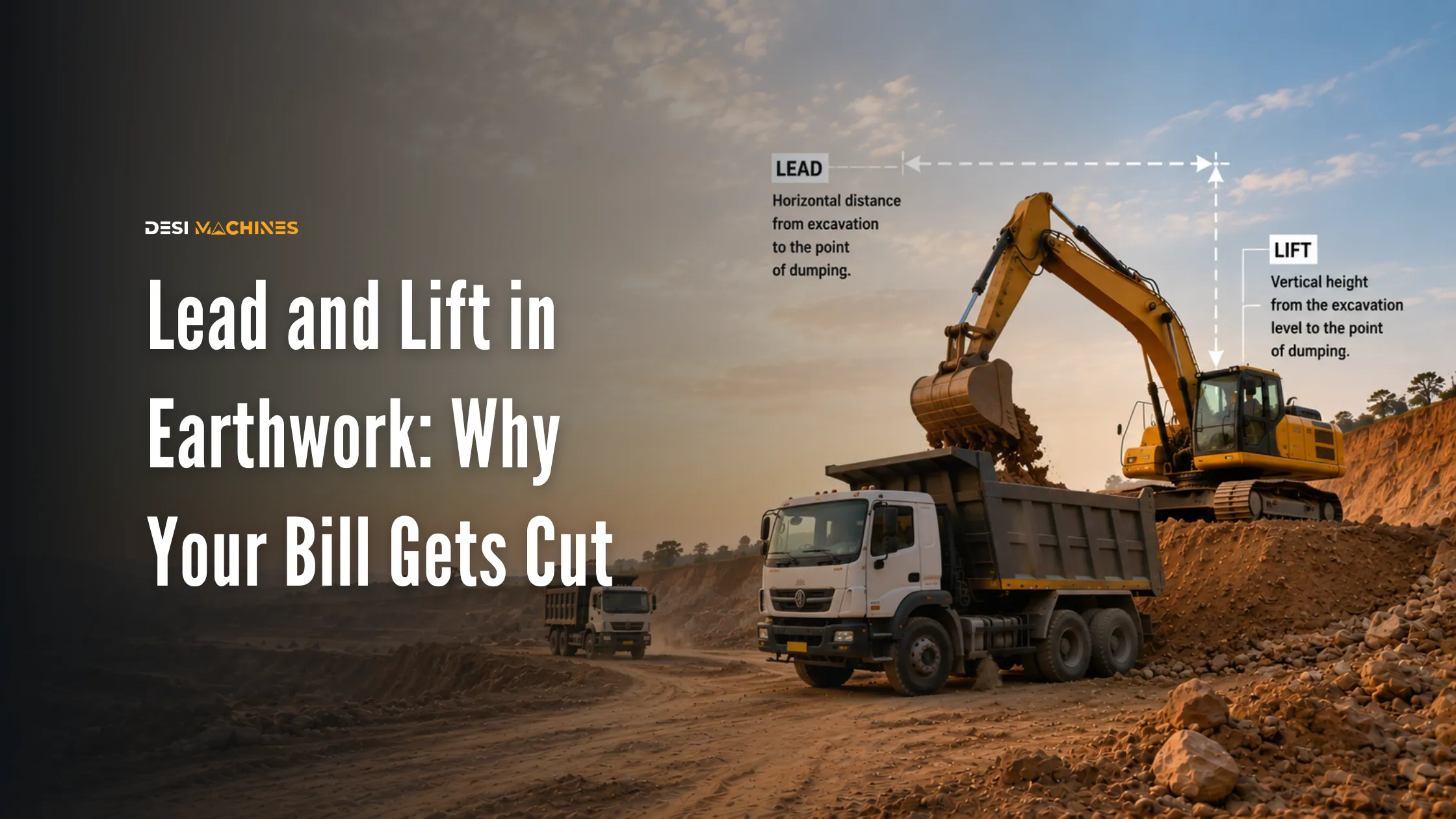
Lead and lift in earthwork are the two distances that decide what your rate actually covers. Lead is how far the earth travels horizontally; lift is how far it is raised or lowered. Every schedule of rates includes some initial lead and lift inside the base rate and pays extra beyond it — but only if the distance was recorded and agreed while the work was happening. Unrecorded haul is unpaid haul, and that is where most earthwork money quietly disappears.
Two words that decide what your rate is worth
An earthwork item is never just a volume. Moving a cubic metre of soil thirty metres and moving it two kilometres are different jobs at the same quantity, and the rate has to distinguish them somehow. Lead and lift are how it does that.
Lead is the horizontal distance from the point of excavation to the point where the earth is deposited. Lift is the vertical height through which it is raised or lowered on the way. Lift here has nothing to do with cranes or lifting equipment, which is a genuine source of confusion on site; in this context it simply means height.
Both are measured separately from the earth itself, and both carry real cost. Lead burns tipper trips, diesel and driver hours. Lift burns machine time, reach and sometimes an extra handling stage entirely.
How lead and lift in earthwork are actually priced
The structure is consistent across schedules even though the numbers are not.
The base rate for an earthwork item covers the excavation plus some initial lead and initial lift. Beyond that initial allowance, extra is payable in defined steps — another slab of distance, another rate. The schedule sets where the allowance ends, how big each step is, and what each step pays.
Here is the part that is worth being blunt about: there is no single national figure for the initial lead, and quoting one from memory is how owners lose money. Central schedules, state PWD schedules, municipal schedules and private clients using their own all set their own. Two jobs in the same district under different clients can allow different initial leads for identical work.
So the only reliable answer to “what lead is included?” is the item description in the schedule attached to your work order. Read the item wording in full, not the rate column. The wording is where the allowance hides.
Where the money actually leaks
The failure is rarely that a client refuses to pay for extra lead. It is that nobody can prove there was any.
The sequence is always the same. You quote assuming the borrow pit or dumping ground nearby. Work starts, that point is not available, and the earth ends up going somewhere farther. The machine and the tippers absorb it because the job has to run. At billing, measurement is taken against the item description, the item covers lead up to a stated distance, and there is no record that anything went beyond it. The extra haul was real, it was expensive, and it is invisible.
| What happened on site | What the bill shows | What fixes it |
|---|---|---|
| Disposal point moved farther mid-job | Base rate only | New lead recorded and signed the day it changed |
| Earth raised from a basement in stages | No lift claimed | Depth and stages entered in the measurement record |
| Soil stacked, then reloaded later | Paid once | Double handling priced as a separate agreed item |
| Longer route forced by site access | Straight-line distance assumed | Actual haul route walked and agreed in writing |
Every fix in that right-hand column happens before or during the work. None of them can be done afterwards, which is why this is a habit rather than a negotiation skill.
Lift, and the jobs that punish you for ignoring it
On flat plot work the lift is usually small enough to forget, and most owners do. The first basement, embankment or hill job is where that habit costs money.
When earth has to come up rather than across, the machine cannot always place it in one movement. It may have to bench the excavation, work in stages, or stack material at an intermediate level for a second machine to move on. That is more machine hours against the same measured volume, and if the item only allows a small initial lift, the rest has to be claimed.
Deep work has its own pricing logic for exactly this reason, which is why piling rates are quoted per metre of depth rather than per unit of volume.
Get it agreed before the machine starts
Four things, none of which take more than an hour on day one.
Walk the actual haul route with the client’s representative rather than measuring it on a map, because site access rarely follows a straight line. Mark the borrow or disposal point on a drawing and have it signed. Get the agreed lead entered in the measurement book at the start of the work, not at the end. And write into the work order what happens if the disposal point changes, because on live sites it usually does.
If the client is a government department, the same discipline protects you further down the line, where the bill also meets royalty deductions and payment timelines. Those are covered in royalty on earthwork and contractor payment delays on government work.
Build the lead into the rate, not just the claim
Recording the lead protects the extra. It does not price the base job for you.
Your own quote still has to carry the haul you know about, and cartage is usually the largest single line in any earthmoving rate. The method for building that up honestly is the same on both sides of the job — digging and disposing, in excavation rate per cubic meter, and importing and placing, in soil filling rate per cft. Both start from your machine’s real hourly cost, which is set out in excavator cost per hour.
Know the lead and lift allowance in your rate
Lead and lift in earthwork are not estimating theory. They are the difference between the earth you moved and the earth you are paid for. The rate you signed already contains an allowance; your job is to know exactly what it is, to price the haul you can foresee, and to record every metre beyond it on the day it happens.
Owners who do this stop arguing at billing, because there is nothing left to argue about. If you are sizing a machine for work where haul distance and reach decide the economics, compare what suits the job across our excavator range before you commit to a rate.
Rates, schemes, specifications and prices change — confirm current terms with the OEM, dealer, bank or contractor before deciding. Lead and lift allowances differ between schedules of rates; always read the item description in the schedule governing your own contract.
Machines, tenders and news for this industry: Railway and Metro