
 Excavator
294 models
Excavator
294 models  Backhoe Loader
51 models
Backhoe Loader
51 models  Crane
68 models
Crane
68 models  Concrete Mixer
79 models
Concrete Mixer
79 models  Wheel Loader
54 models
Wheel Loader
54 models  Compactor / Roller
45 models
Compactor / Roller
45 models  Motor Grader
42 models
Motor Grader
42 models  Dozer
41 models
Dozer
41 models  Concrete Pump
66 models
Concrete Pump
66 models  Skid Steer Loader
11 models
Skid Steer Loader
11 models  Telehandler
13 models
Telehandler
13 models 


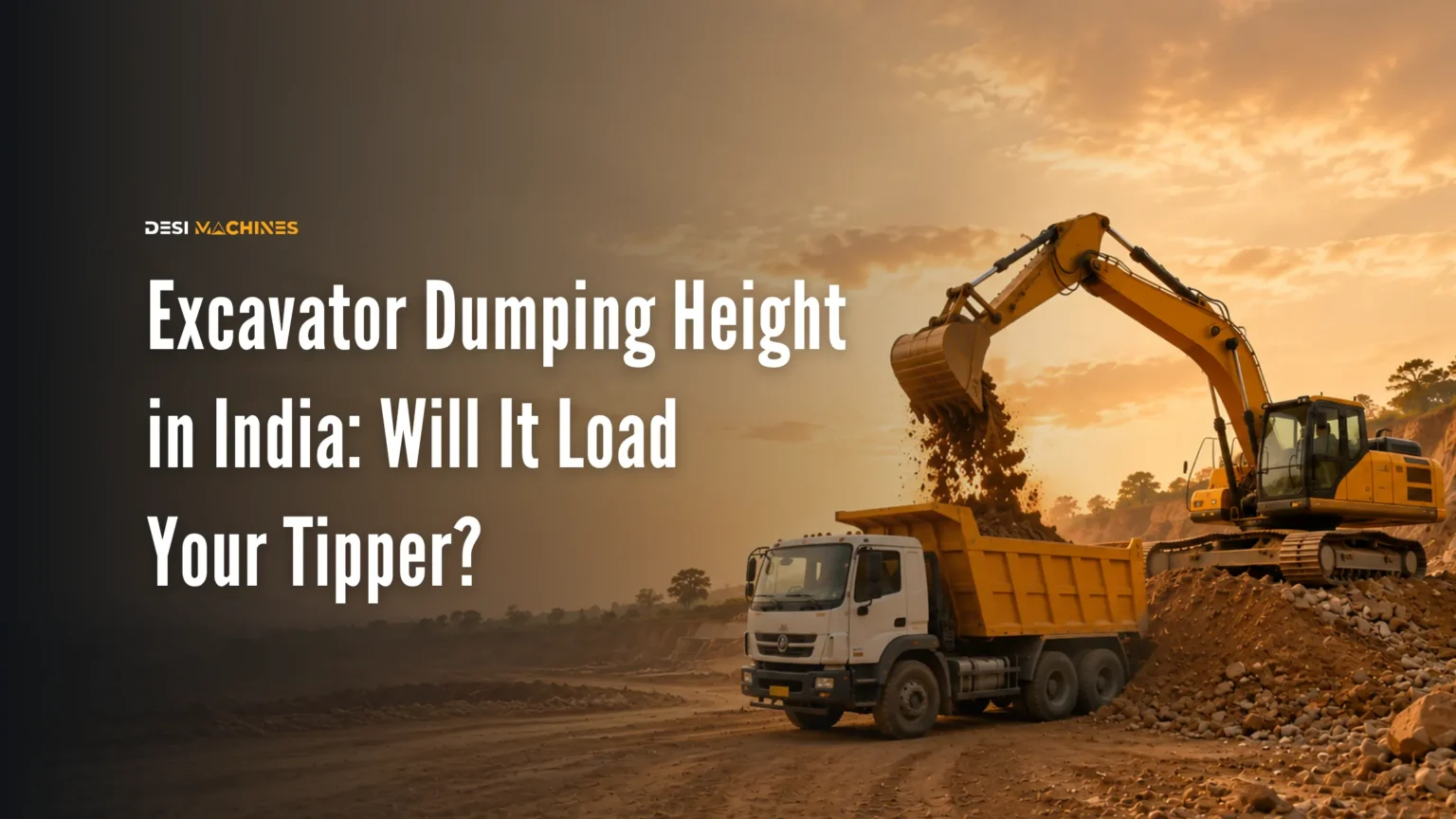
Maximum dumping height is how high an excavator can lift its bucket and empty it. It is measured from the ground the machine stands on to the bucket’s cutting edge at the moment the bucket tips, and it is published in millimetres on every spec sheet. This is the number that decides whether a machine can load your tipper over the side, or whether it can only push soil into a heap on the ground.
Across the 270 excavators listed on DesiMachines that publish a usable figure, dumping height runs from 2,350 mm (2.35 m) on a 1.98 tonne mini machine to 13,800 mm (13.8 m) on an 825 tonne mining machine, as per the current August 2026 spec sheets. The surprise is in the middle. A 20 tonne machine and a 45 tonne machine dump at almost the same height, because weight buys digging force and bucket size, not lift.
What is maximum dumping height on an excavator?
Maximum dumping height is the greatest height at which the bucket can release its load. The machine reaches this point with the boom raised, the arm pulled in and the bucket rolled over, so the figure describes one exact position of the machine, not a comfortable working height.
Two words on the spec sheet look similar and mean different things. Maximum digging height is how high the bucket teeth can reach. Maximum dumping height is how high the bucket floor sits when the bucket tips out. Dumping height is always the smaller of the two, because the bucket has to be above the truck body before the soil can fall in, and the bucket itself takes up that difference.
The gap between them is steady enough to check a spec sheet with. Across the 264 listed excavators that publish both figures cleanly, dumping height sits at a median of 70 per cent of digging height, and 90 per cent of machines fall between 65 and 76 per cent. If a machine you are looking at is far outside that band, the spec sheet has a typing error in it, not a special design.
There is a third word you will meet on some sheets. Tipping height is used by a few manufacturers to mean the same thing as dumping height, and by others to mean the height of the bucket pin. Where a sheet publishes both, read the smaller number as the working figure. Our guide to reading an excavator spec sheet works through the other lines on the same page.
How high the bucket empties is one side of the working envelope; how far it stretches out is the other, and our guide to excavator digging reach gives those figures by size class.
How high can an excavator dump? Heights by size class
Dumping height climbs quickly through the small classes and then flattens. The table gives the published figures for every excavator size class listed on DesiMachines, counted from each machine’s own spec sheet in August 2026.
| Size class | Machines with the figure published | Typical (median) dumping height | Full range |
|---|---|---|---|
| Mini, 0 to 6 Ton | 48 | 3,365 mm (3.4 m) | 2,350 to 4,270 mm |
| Small, 6 to 15 Ton | 45 | 5,750 mm (5.8 m) | 4,534 to 6,760 mm |
| Medium, 15 to 25 Ton | 76 | 6,488 mm (6.5 m) | 6,156 to 7,292 mm |
| Large, 25 to 50 Ton | 44 | 7,005 mm (7.0 m) | 6,365 to 8,110 mm |
| Extra-Large, above 50 Ton | 46 | 8,342 mm (8.3 m) | 6,675 to 13,800 mm |
| Long reach | 11 | 11,171 mm (11.2 m) | 9,275 to 19,100 mm |
The mini excavator range is the one class where this number is genuinely tight, and it is worth checking model by model. A 1.98 tonne SANY SY20U dumps at 2,350 mm. A 5.5 tonne JCB 55Z dumps at 4,270 mm. Both are minis, and one lifts nearly two metres higher than the other.
A few machines were left out of the figures above because their published dumping height contradicts their own digging height on the same spec sheet. Those are named near the end of this guide so you can check them directly with the dealer.
Will an excavator load my tipper?
Almost certainly yes, if the machine is 6 tonnes or heavier. Every excavator in the Small class and above dumps at 4.5 metres or more, which clears the side of a loaded tipper with room to spare. The question is a real one only for mini machines, and for trolleys and trucks carrying high side extensions.
Do the check with a tape rather than by eye, because the height you need is not the one people usually measure.
- Measure from the ground to the highest point of the truck’s side wall, including any wooden or steel extension that has been added. That is the height the bucket must clear.
- Add 300 to 400 mm so the bucket can swing across without catching the rail, and so the soil falls inside rather than spilling down the outside.
- Compare that total against the dumping height of the machine. If the machine’s figure is larger, it will load that truck.
Two things go wrong on real sites even when the arithmetic works. The first is ground level: if the truck stands on a ramp or a higher terrace than the machine, you lose that difference from your margin, and if the machine stands up on the spoil heap you gain it back. The second is reach. Dumping height tells you the bucket can get above the truck, but not that it can get to the middle of the body, and a load dropped on the near rail spills half of it onto the road. Where you are loading a wide truck, check maximum digging reach alongside dumping height.
What is the dumping height of a 20 ton excavator?
A 20 tonne excavator dumps at about 6,200 to 7,000 mm (6.2 to 7.0 m). This is the most common class sold in India, and it is also the class where the brand you choose makes the least difference to this particular number.
| Model | Class | Operating weight | Max. dumping height | Max. digging height |
|---|---|---|---|---|
| SANY SY20U | Mini | 1,980 kg (2.0 Ton) | 2,350 mm | 3,410 mm |
| JCB 55Z | Mini | 5,520 kg (5.5 Ton) | 4,270 mm | 5,660 mm |
| Tata Hitachi NX 80 | Small | 7,500 kg (7.5 Ton) | 5,050 mm | 7,170 mm |
| Komatsu PC130-7 | Small | 12,800 kg (12.8 Ton) | 5,905 mm | 8,345 mm |
| JCB NXT 140 | Small | 14,320 kg (14.3 Ton) | 6,370 mm | 8,800 mm |
| CAT 320D3 GC | Medium | 19,800 kg (19.8 Ton) | 6,250 mm | 9,110 mm |
| Tata Hitachi EX 215LC Prime | Medium | 20,800 kg (20.8 Ton) | 6,230 mm | 8,990 mm |
| SANY SY210C-9 | Medium | 20,900 kg (20.9 Ton) | 6,252 mm | 9,113 mm |
| Volvo EC210 | Medium | 20,700 kg (20.7 Ton) | 6,373 mm | 9,248 mm |
| Tata Hitachi ZAXIS 220LC Ultra | Medium | 21,700 kg (21.7 Ton) | 6,870 mm | 9,700 mm |
| Komatsu PC210LC-10M0 | Medium | 22,000 kg (22.0 Ton) | 6,960 mm | 9,830 mm |
| Tata Hitachi EX 215LC-SLR | Long reach | 21,800 kg (21.8 Ton) | 11,171 mm | 13,465 mm |
Look down the Medium rows. Five brands across six models, all between 19.8 and 22 tonnes, and every one of them dumps between 6,230 and 6,960 mm. Across all 76 machines in that class the whole spread is 1,136 mm, a little over a metre from the lowest to the highest. If you are choosing between two 20 tonne machines, dumping height will not separate them, and you are better off comparing digging force, bucket capacity and dealer support.
Then look at the last row. The same 22 tonne machine in long reach form dumps 4.9 metres higher than the standard version of itself.
Why does dumping height stop growing with machine size?
Dumping height is set by the length of the boom and arm, and those grow slowly as machines get heavier. A bigger excavator is built to move more soil per swing and to push harder into hard ground, so the extra weight goes into a wider undercarriage, a heavier counterweight, a stronger boom and a bigger bucket. The arm gets a little longer. It does not get three times longer.
There is a reason the makers build them this way. A long arm on a heavy machine would be a weak machine: the further the load sits from the centre of the tracks, the less the machine can lift without tipping, and the more the whole frame flexes. Manufacturers keep the arm short and the bucket big because that is what digs well.
The shape of the ladder makes sense once you see what each class is for. A mini machine works in a plot or a narrow lane and loads a trolley. A 20 tonne machine loads tippers all day. A 50 tonne machine loads the same tippers, but fills each one in three passes instead of six. The height barely changes because the truck being loaded has not changed.
This also makes dumping height a poor way to pick a machine size. Size follows from how much soil you must move in a day and how hard the ground is, which our guides to excavator size classes and output per hour work through properly.
How much higher does a long reach excavator dump?
A long reach excavator dumps roughly 70 per cent higher than a standard machine of the same weight. The 12 long reach excavators listed on DesiMachines publish dumping heights from 9,275 mm to 19,100 mm, against a median of 6,488 mm for standard machines in the common 15 to 25 tonne class.
The comparison that shows it best is one machine in two forms. The standard Tata Hitachi EX 215LC Prime at 20.8 tonnes dumps at 6,230 mm. The Tata Hitachi EX 215LC-SLR at 21.8 tonnes dumps at 11,171 mm. Same maker, same weight class, nearly double the height.
A 22 tonne long reach machine therefore dumps higher than any standard excavator below the 50 tonne class, and higher than most above it. The Liugong 930E XLR at 30.2 tonnes reaches 14,305 mm, which is higher than every standard excavator listed, including the 825 tonne mining machines.
That height is not free. A long reach machine carries a much smaller bucket for its weight, works more slowly, and is less stable with the arm stretched out. These machines exist for canal desilting, pond work and slope trimming, where the machine has to stand back from a soft edge. For ordinary tipper loading they are the wrong tool.
How to check dumping height before you buy
Ask for the figure in writing, then check it against the machine in front of you. Four checks cover the usual problems.
- Confirm which figure you have been quoted. If the number you are given is more than about 80 per cent of the machine’s digging height, you have probably been quoted digging height or a bucket pin height, not dumping height.
- Check which arm it applies to. Many machines are sold with a standard arm and an optional long arm, and the spec sheet figure belongs to one of them. A shorter arm means a lower dump.
- Check the bucket. A deeper or larger bucket changes where the load leaves the machine. The published figure assumes the standard bucket, and our guide to bucket capacity explains what a standard bucket means for each class.
- Watch it load your own truck before you sign. On a used machine especially, worn pins and tired hydraulics mean it no longer reaches its published figures. One loading cycle on your own tipper settles the question.
If you are weighing an excavator against a wheel loader for loading work, the two machines are not close on this measure, and the wheel loader dump height guide gives the loader figures for the same comparison.
Compare live excavator models and prices across brands, or narrow down to the 15 to 25 tonne range if tipper loading is the main job.
Spec sheets we could not use
Eight listed machines publish a dumping height that contradicts another figure on their own spec sheet, so their numbers were left out of the tables above. They are named here rather than quietly dropped, because if you are looking at one of these machines you should ask the dealer for the correct figure in writing.
Four publish a dumping height far below what their own digging height allows: the Tata Hitachi EX 5600-7, the Tata Hitachi ZAXIS 890LCH, the Liebherr R 972 Litronic and the Tata Hitachi EX 350LC Prime. Two publish figures that cannot both be right: the Hyundai R230LM SMART Plus lists a dumping height above its own digging height, and the SANY SY60C lists a digging height of 590 mm against a dumping height of 3,930 mm. The SANY SY155W and the Liugong 908FE EV carry the same kind of mismatch.
All eight have been logged for correction. Every other figure in this guide comes straight from the machine’s own published specification.
Excavator dumping height, in short
Excavator dumping height is how high the bucket can empty, measured from the ground the machine stands on, and it runs at about 70 per cent of the machine’s digging height. Indian excavators dump from 2.35 m on a 2 tonne mini to 8.1 m at the top of the 25 to 50 tonne class, with the common 20 tonne class grouped tightly at 6.2 to 7.0 m whatever the brand.
From 6 tonnes upward this number will not decide your purchase, because every one of those machines clears a tipper. It matters in two places only: choosing a mini machine, where the range runs from 2.35 m to 4.27 m, and choosing a long reach machine, where the extra height is the whole point.
Prices, specifications and features are indicative, vary by variant, location and date, and should always be confirmed with the official OEM or authorised dealer before any purchase decision. DesiMachines is not liable for decisions taken on the basis of information that may have changed after publication.
Frequently Asked Questions (FAQ)
Anything above about 4.5 m loads a standard tipper comfortably, which means every excavator from 6 tonnes upward. Measure the highest point of your truck’s side wall, including any added extension, and add 300 to 400 mm of clearance. If the machine’s published dumping height beats that total, it will load the truck. Ground level matters too: a truck standing on a ramp above the machine eats into your margin.
Mini excavators (0 to 6 tonne) dump from 2,350 mm to 4,270 mm, with a typical figure of about 3,365 mm (3.4 m). This is the one class where the number varies enough to decide your purchase: a 1.98 tonne SANY SY20U dumps at 2,350 mm while a 5.5 tonne JCB 55Z reaches 4,270 mm, nearly two metres higher. Check the specific model rather than the class.
No. Maximum digging height is how high the bucket teeth can reach; maximum dumping height is how high the bucket floor sits when it tips out, and it is always the smaller number. Across the 264 listed excavators publishing both figures, dumping height runs at a median of 70 per cent of digging height, with 90 per cent of machines between 65 and 76 per cent. A quoted figure above about 80 per cent is usually digging height by mistake.
Only slightly, and much less than buyers expect. Moving from the 15 to 25 tonne class to the 25 to 50 tonne class raises typical dumping height by just 517 mm, even though the machine weighs twice as much. Extra weight goes into digging force, a bigger bucket and a heavier counterweight rather than into lift. Across the 76 machines in the 15 to 25 tonne class the entire spread is 1,136 mm.
The 12 long reach excavators listed on DesiMachines dump from 9,275 mm to 19,100 mm, about 70 per cent higher than a standard machine of the same weight. A Tata Hitachi EX 215LC Prime at 20.8 tonnes dumps at 6,230 mm; the EX 215LC-SLR at 21.8 tonnes reaches 11,171 mm. The trade-off is a much smaller bucket, slower work and less stability with the arm out, so they suit desilting and slope work rather than tipper loading.