
 Excavator
294 models
Excavator
294 models  Backhoe Loader
51 models
Backhoe Loader
51 models  Crane
68 models
Crane
68 models  Concrete Mixer
79 models
Concrete Mixer
79 models  Wheel Loader
54 models
Wheel Loader
54 models  Compactor / Roller
45 models
Compactor / Roller
45 models  Motor Grader
42 models
Motor Grader
42 models  Concrete Pump
66 models
Concrete Pump
66 models  Skid Steer Loader
11 models
Skid Steer Loader
11 models  Telehandler
13 models
Telehandler
13 models  Dozer
Dozer 


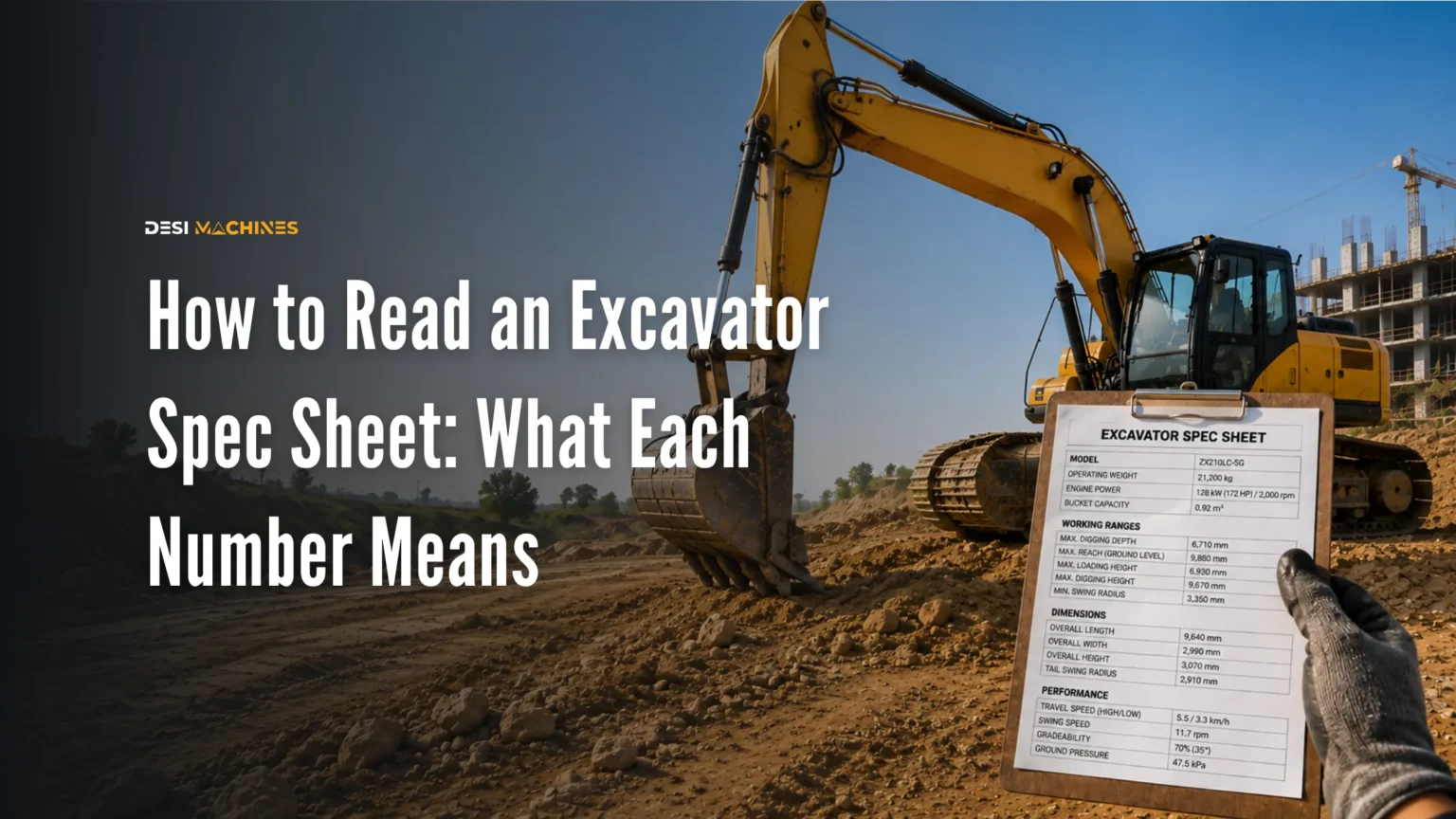
An excavator spec sheet is the table of numbers a maker publishes for each model: weight, engine power, bucket size, how far it digs, and how much oil and diesel it holds. Six of those numbers decide almost every purchase. The rest matter to a workshop, not to a buyer.
The trouble is that several of the terms mean something narrower than they sound. Operating weight is not the weight of the machine on a trailer. Bucket capacity is a volume, not a weight. And maximum digging depth is measured from where the machine stands, not from the top of the boom.
This guide goes through a spec sheet line by line, in plain language, and ends with a worked example from a machine listed today.
What does operating weight mean on an excavator?
Operating weight is the weight of the machine ready to work: the base machine plus a standard boom, arm and bucket, full fuel and oils, and an operator. It is the number that names the class, which is why a machine described as a “20 tonne excavator” has an operating weight near 20,000 kg.
Two things follow from it, and both matter more than the number itself.
It sets what the machine can lift and how stable it is. A heavier machine of the same size class resists tipping better when the arm is stretched out, which is why counterweight is added rather than saved. And it sets what it costs to move: a 20 tonne machine needs a proper trailer and a road permit, while a 7.5 tonne machine can travel on a much smaller one.
Watch for two lookalike terms. Gross vehicle weight or transport weight is the machine as it travels, sometimes without the bucket, and is often quoted for permits. Shipping weight excludes fuel and operator. If two sheets disagree by a tonne, check which of the three you are reading. The class bands themselves are set out in excavator size classes.
Is bucket capacity measured in tons or cubic metres?
Cubic metres. Bucket capacity is a volume — how much the bucket holds, written as m³ — and never a weight. A 1.0 m³ bucket holds one cubic metre of material.
The weight depends entirely on what you are digging. Loose earth runs around 1.4 to 1.6 tonne per cubic metre, sand and aggregate about 1.5 to 1.6, and wet clay or silt more. So the same 1.0 m³ bucket lifts roughly 1.5 tonne of dry soil and appreciably more of wet muck, which is why buckets are sized down for heavy, wet work.
You will also meet two versions of the figure. Heaped capacity is the bucket filled above the rim at the natural angle the material sits at, and is the number usually published. Struck capacity is level with the rim, and is smaller. Compare like with like across two machines, and remember the bucket is an option: the same excavator is sold with several. Options are covered in excavator bucket types, and the actual figures class by class in the excavator bucket capacity guide.
What does rated engine power tell you?
Rated engine power is the power the engine makes at a stated speed, written in horsepower and kilowatts, for example “48 HP (36 kW) @ 2100 rpm”. One kilowatt is about 1.34 HP, so the two figures are the same number in different units, not two separate claims.
Power tracks size closely, so it is a poor way to separate two machines of the same class. What actually decides digging performance is the hydraulics, meaning pump flow in litres per minute and system pressure in MPa. A machine with more flow refills the cylinders faster, and that is what a fast cycle feels like from the seat.
Also look at maximum torque and the engine speed it arrives at. Torque low in the rev range is what keeps the machine pulling through hard digging without the engine bogging. Power by size class across the Indian range is set out in excavator engine power by size class.
How are digging depth and reach measured?
From the ground the machine is standing on. Maximum digging depth is how far below that level the bucket teeth reach at full stretch. Maximum digging reach is how far out horizontally. Both are at full extension, where the machine is least stable and slowest, so treat them as limits rather than as working figures.
Three related lines are worth finding on the sheet:
- Maximum vertical wall cut depth. How deep a straight-sided trench the machine can cut without the wall sloping. Always less than maximum digging depth, and it is the honest number for trench work.
- Maximum dumping height. How high the bucket can empty. This decides whether the machine can load your tipper over its side, which is a common and expensive surprise.
- Minimum swing radius. How much room the tail needs to turn. On a tight site this decides whether the machine fits at all.
Depths by size class are in excavator digging depth by size, and how boom and arm length change all of these figures in the excavator boom guide. Dumping heights for every class, and the check that tells you whether a machine will clear the side of your truck, are in excavator dumping height by size class.
The working-range block on that sheet has one more line worth reading, and we have measured it across every listed machine in our guide to excavator digging reach.
The numbers most buyers skip
Four lines sit further down the sheet and quietly decide whether the machine suits your ground.
Ground bearing pressure, in kPa, is how hard the machine presses on the soil. Lower is better on soft ground and wet fields. It is why a heavier machine on wide track shoes can work where a lighter one on narrow shoes sinks, and why shoe width is quoted next to it.
Digging forces, in kN, come as two figures: bucket digging force (the curl of the bucket) and arm digging force (the pull of the arm). They tell you how the machine handles hard, compacted ground far better than horsepower does.
The full ranges for both figures, class by class, are in the guide to excavator digging force, which also shows how far two machines of the same weight can differ.
Travel speed, low and high, in km/h. A tracked machine is slow by design. If the job means moving up and down a long site all day, the difference between 2.7 and 5.0 km/h adds up.
Service capacities, meaning fuel tank, engine oil, hydraulic tank. These decide how long the machine runs between fills and what a service costs. Figures by model are in the excavator oil capacity reference, and what falls due when in the construction equipment service schedule.
A worked example: reading one machine’s sheet
Take the Tata Hitachi NX 80, a machine listed today, and read what its published figures actually say about the work it suits.
| Spec line | Published figure | What it means for you |
|---|---|---|
| Operating weight | 7,500 kg (7.5 tonne) | Sits at the top of the mini class; travels on a small trailer |
| Rated engine power | 48 HP (36 kW) @ 2100 rpm | Normal for the class; hydraulics, not HP, separate machines here |
| Max. digging depth | 4,060 mm (4.1 m) | Foundations, pipelines, farm ponds; not a deep well in one pass |
| Max. vertical wall cut depth | 3,600 mm (3.6 m) | The honest figure for a straight-sided trench |
| Max. dumping height | 5,050 mm (5.1 m) | Loads a standard tipper over the side comfortably |
| Min. swing radius | 1,730 mm (1.7 m) | Turns in a narrow lane or a compound |
| Ground bearing pressure | 35.3 kPa on 450 mm shoes | Light on soft ground for its weight |
| Bucket / arm digging force | 55 kN / 38 kN | Handles compacted soil; hard rock still needs a breaker |
| Travel speed | 2.7 / 5.0 km/h | Fine within a site; trailer it between sites |
| Fuel tank | 135 L | Comfortably a full working day between fills |
Read together, those numbers describe a machine for confined urban and rural work: it turns in a narrow space, presses lightly on soft ground, digs to about four metres, and loads a tipper. What it is not is a bulk earthmoving machine, and no amount of reading the engine line changes that.
Which numbers should actually decide your purchase?
Work backwards from the job, not forwards from the sheet. In practice five questions settle it.
- How deep do you dig? Compare against vertical wall cut depth, not maximum digging depth.
- What are you loading into? Check dumping height against the side of your tipper before anything else.
- How tight is the site? Minimum swing radius and machine width decide whether the machine can work at all.
- What is the ground like? Soft or wet ground means looking at ground bearing pressure and shoe width.
- How will it get there? Operating weight decides the trailer and the permit, and that is a real recurring cost.
Two figures are less useful than they look. Horsepower barely separates machines within a class. And maximum digging reach is measured at full stretch, where nobody works all day.
Once the shortlist is down to two or three, the deciding factors are usually not on the sheet at all: dealer support, parts availability in your district, and resale demand for the make. Compare live excavator models and prices, or the mini excavator range, and put those questions to the dealer directly.
Reading a spec sheet: the short version
Operating weight is the machine ready to work and names its class. Bucket capacity is a volume in cubic metres, not a weight, and is usually quoted heaped. Rated engine power is one number in two units and rarely separates machines of the same size. Digging depth and reach are measured from where the machine stands, at full stretch, so vertical wall cut depth and dumping height are the more honest working figures. And the lines most buyers skip, such as ground bearing pressure, digging forces, swing radius — are the ones that decide whether a machine suits your ground and your site.
Next, see how these figures turn into output per hour in excavator productivity and output, or what each part on the sheet actually is in excavator components explained. The undercarriage figures are covered separately in the excavator undercarriage guide, and the wider cluster starts at the excavator guide.
One line on the sheet that catches people out is travel speed, because almost every machine publishes two of them: our guide to excavator travel speed explains the high and low ranges.
For the numbers behind that comparison, our reference on excavator digging depth and vertical wallcut sets out both figures by size class across the range.
Before the spec sheet there is the name on the machine, and it carries a size figure of its own. How to read it is set out in the guide to excavator model numbers.
Specification figures on this page are taken from our listings at the time of writing. Prices, specifications and features are indicative, vary by variant, location and date, and should always be confirmed with the official OEM or authorised dealer before any purchase decision. DesiMachines is not liable for decisions taken on the basis of information that may have changed after publication.