Excavator
294 models
Excavator
294 models  Backhoe Loader
51 models
Backhoe Loader
51 models  Crane
68 models
Crane
68 models  Concrete Mixer
79 models
Concrete Mixer
79 models  Wheel Loader
54 models
Wheel Loader
54 models  Compactor / Roller
45 models
Compactor / Roller
45 models  Motor Grader
42 models
Motor Grader
42 models  Dozer
41 models
Dozer
41 models  Concrete Pump
66 models
Concrete Pump
66 models  Skid Steer Loader
11 models
Skid Steer Loader
11 models  Telehandler
13 models
Telehandler
13 models 


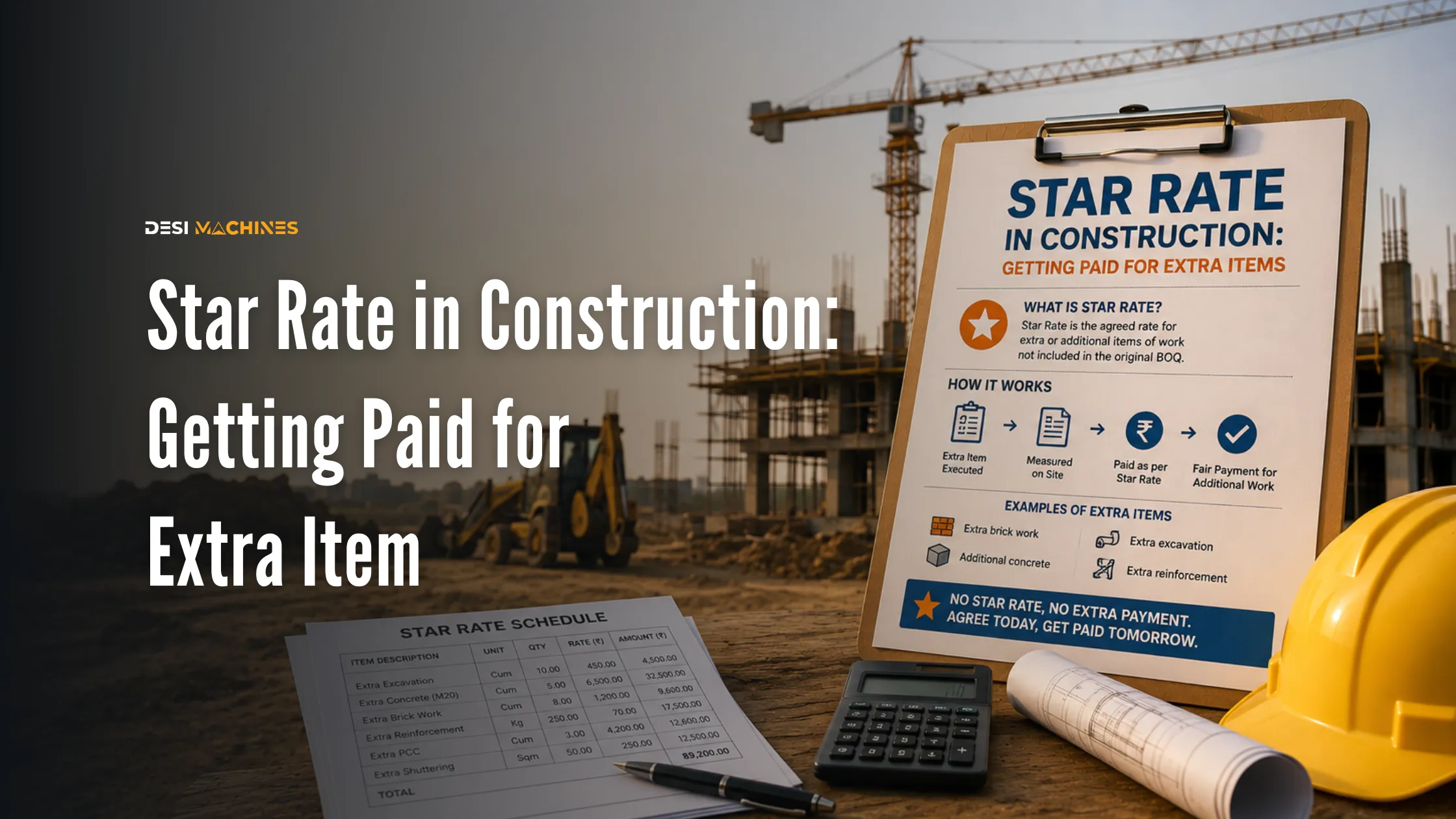
A star rate in construction is the rate built for work that was never in the tendered schedule at all. There is no agreed price to fall back on, so the rate has to be assembled by rate analysis — material at market rate, labour, machinery, carriage, plus the overhead and profit percentage your contract allows — and then sanctioned by the competent authority. Most claims fail on sequence rather than on merit: the work was done before the rate was approved, or the measurements were never jointly recorded.
No site follows the bill of quantities exactly. The soil turns out to be harder than the trial pit suggested, a service line appears where the drawing showed none, or the client asks for something that simply was not tendered.
The work gets done, because work always gets done. Getting paid for it is the separate problem, and it is decided by paperwork created at the time, not by arguments made at the final bill.
What a star rate in construction actually is
Your contract prices a list of items. For anything on that list, the rate is settled — you quoted it, they accepted it, and the only question at billing is the quantity.
An extra item is work of a kind the list never contemplated. Since there is no tendered rate to apply, one has to be constructed. The resulting rate is entered against a starred entry in the bill, and it becomes payable only when the competent authority sanctions it.
That last clause is where the money is won or lost. A star rate you have calculated and submitted is a proposal. A star rate that has been sanctioned is an entitlement.
Extra item or deviation? They are paid differently
Owners use the two words loosely and then get caught out at billing, because the contract does not treat them the same way.
| Situation | What it is | How it gets paid |
|---|---|---|
| The schedule has “excavation in ordinary soil”, you excavate more of it than estimated | Deviation in quantity | At your tendered rate, up to the deviation limit written into the contract |
| Quantity runs past the limit the contract sets | Deviation beyond limit | Usually needs a revised rate to be settled for the excess portion |
| You hit rock, and rock excavation was never in the schedule | Extra item | A new rate built by rate analysis and sanctioned — a star rate |
| An item exists but the specification changes materially | Substituted item | Rate derived from the tendered item, adjusted for the change |
The practical test is whether the work is a bigger amount of something already priced, or something different in kind. More earth is a deviation. Different earth may well be an extra item. If you are billing earthwork, how an excavation rate per cubic metre is built is the reference point for arguing that the new work is genuinely a different item and not a variation of the old one.
Building the rate, head by head
Rate analysis is ordinary arithmetic done carefully. You are reconstructing what one unit of the work costs you, and then adding what the contract lets you add.
| Head | What goes in | Where it gets challenged |
|---|---|---|
| Material | Quantity per unit at the prevailing market rate | Rate not supported by quotations or invoices of the right date |
| Labour | Output per day for the trade, converted to a per-unit cost | Output assumed too low without site evidence |
| Machinery | Hire or owning-and-operating cost for the hours the item needs | Hours claimed exceed what the logbook shows |
| Carriage | Cartage to site over the actual distance | Lead not recorded or not agreed at the time |
| Overheads and profit | The percentage your contract or the department’s rules permit | A higher percentage claimed than the rules allow |
Two cautions on the last two rows. Carriage is the head most often lost, because the distance was obvious to everyone on site and therefore never written down — the same failure that costs owners money on lead and lift in earthwork. And the overhead and profit percentage is not yours to choose. It is fixed by the department’s own rules, and proposing a higher one invites the whole analysis to be sent back.
Where the machinery head is doing the heavy lifting, your own hourly costing has to be defensible. An owner who can show fuel, operator, maintenance and finance cost per hour from records is in a far stronger position than one producing a round figure at the end of the job.
Why good claims get rejected
Look at rejected extra item claims and the pattern is procedural almost every time.
The work was completed before sanction. Once it is buried, backfilled or cast over, nobody can verify what was actually done, and the examining officer has no way to certify a quantity they cannot see.
Measurements were not jointly recorded. A measurement written by you alone is a claim. The same measurement signed by the department’s representative on the day is evidence.
The instruction was verbal. A site engineer telling you to go ahead is not a sanction, and often that engineer has no power to sanction the rate at all.
The analysis arrived late. Market rates are dated. Submitting an analysis months afterwards asks someone to verify prices that have since moved.
None of these are arguments about whether you did the work. That is what makes them so expensive — the work is real, the money is not recoverable, and the reason is a signature that was never obtained.
What to do before the machine starts on the extra work
Get the instruction in writing, even if it is only an entry in the site order book that you photograph the same day.
Record the pre-work condition. Levels, photographs with a date, and a joint measurement of what exists before you disturb it. For anything that will be covered up, this is the only chance you get.
Submit the rate analysis early, while the market rates you are quoting can still be checked, and attach the quotations you relied on.
Bill the item separately and keep it visible. Folding an unsanctioned extra into a running bill rarely makes it easier to pass, and it can delay the whole bill. Where deductions are already coming off that bill — royalty on earthwork is the usual one for excavation jobs — an unresolved extra sitting in the same bill gives the examining officer another reason to hold everything.
And if the extra work is substantial, check what it does to your commitments before you take on the next tender, because your available bid capacity is calculated from work in hand.
Steps to get paid for extra items by star rate
A star rate is not a favour the department does you. It is the mechanism the contract provides for work it did not anticipate, and it is available to any contractor who follows the sequence: written instruction, joint measurement, rate analysis, sanction, then execution wherever the contract permits that order.
The owners who lose money on extra items are almost never the ones who priced them badly. They are the ones who did the work first and started the paperwork afterwards. If delayed or disputed bills are tying up your working capital while these claims are settled, the recovery route for delayed payment on government work is the place to start, and equipment finance options are worth comparing before the gap becomes urgent rather than after.
Rates, schemes, specifications and prices change — confirm current terms with the OEM, dealer, bank or insurer before deciding. Deviation limits, sanctioning powers and the permitted overhead and profit percentage differ between departments and contracts; the clauses in your own contract govern, and your client’s engineer should confirm the procedure before you execute an extra item.
Rates, schemes and charges shown here are indicative and vary by bank, department, state and tender. Confirm the current terms with the dealer, OEM, bank or the tender authority before you commit.