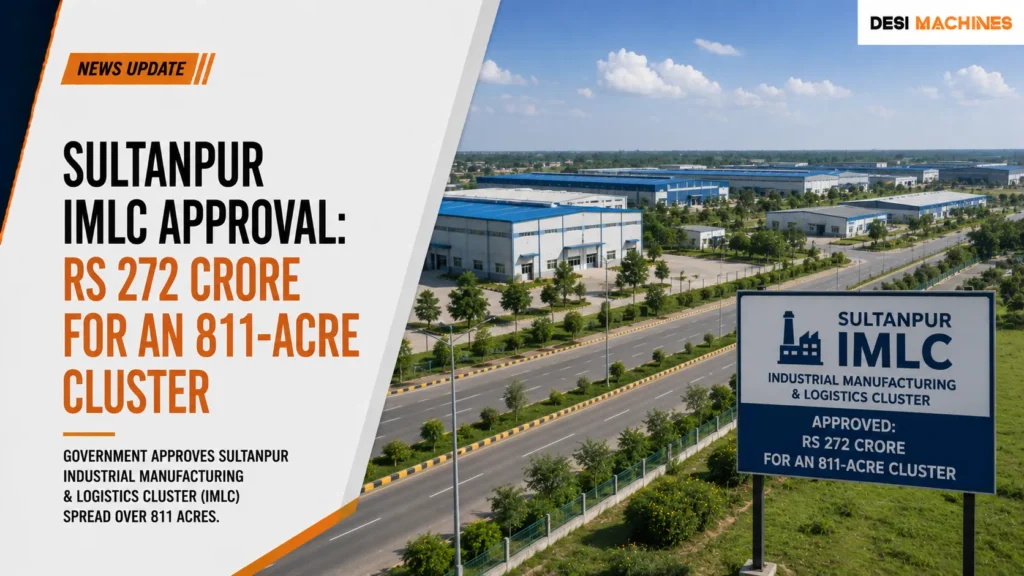
Uttar Pradesh has cleared Rs 272.25 crore to build the trunk infrastructure for an 811-acre manufacturing and logistics cluster beside the Purvanchal Expressway in Sultanpur. For contractors and fleet owners the headline value is the least interesting part. What matters is what the money actually buys, roughly Rs 3.4 lakh an acre, and the fact that the work has still to go out to a global tender.
The quick facts
- The Uttar Pradesh cabinet approved Rs 272.25 crore on 25 August 2026 for an Integrated Manufacturing and Logistics Cluster (IMLC) at Sultanpur, under the state’s industrial corridor scheme.
- The site runs to about 811 acres across nine villages in Jaisinghpur tehsil, alongside the Purvanchal Expressway. UPEIDA is the development authority.
- Scope covers 11.62 km of internal roads and 2 km of approach roads in two-lane and four-lane sections, plus RCC drains, culverts, water tanks, pipeline networks, a fire station, boundary works and electrical substations.
- The cluster is funded entirely by the state with no central share, and contractors are to be selected through global bids.
What the cabinet approved
The decision came at the 25 August sitting chaired by Chief Minister Yogi Adityanath, the same meeting that cleared the Ganga Expressway extension to Haridwar and the Jhansi Link Expressway. Amar Ujala’s Sultanpur edition carried the fullest account, including the village list and the road lengths, while Tarun Mitra reported the fully state-funded structure and the global bidding route. One caution on the acreage: carriers do not agree on it. A Hindi daily sizes the site near 300 hectares against Amar Ujala’s 811 acres, so treat the area as approximate until UPEIDA publishes a layout.
What does Rs 272 crore actually buy?
Divide the sanction by the land and you get about Rs 3.4 lakh per acre. That is enabling-works money and nothing more. No shed, no warehouse and no plant sits inside this figure. The state is buying a serviced platform, and the industries that follow will fund their own buildings later.
That distinction shapes the fleet. An 811-acre park reads like an earthmoving job and is not one. The bulk of the hours go to compaction, because warehouse and factory floors carry static loads and need a proven subgrade rather than deep excavation. Expect soil compactors and tandem rollers to run the longest, with motor graders setting levels across the platform and pavers following on the 13.62 km of internal and approach roads.
The wet services are a separate, and often underrated, front. RCC drains, culverts and buried pipe networks across a site this size are backhoe loader work, not crawler work, with transit mixers and a batching setup feeding the drain and culvert pours. The substations add a handful of crane days rather than sustained lifting.
Terrain is the quiet advantage here. This is flat alluvial Uttar Pradesh country, so nothing caps machine size the way our Arunachal Frontier Highway coverage showed hill geometry doing. A 20-tonne class excavator is comfortably deployable, and haul distances stay inside the site, which favours smaller tipper fleets on short shuttles over long-haul tractor-trailers.
Our take: this is a utilisation story rather than a purchase story for most bidders. Trunk works on a park of this size typically run 18 to 24 months of steady, predictable hours, which argues for hiring the earthmoving tail and owning the paving and compaction train, since that is the kit that will still be earning on the next UPEIDA park. Treat the timeline and package split as unconfirmed until the tender documents land.
What to watch
- The global tender itself, including whether UPEIDA splits the work into road, drainage and electrical packages or awards it as one EPC contract.
- A published layout confirming the site area, which would settle the 811-acre against 300-hectare discrepancy and firm up the per-acre rate.
- Land handover status across the nine villages, which is what usually decides whether mobilisation matches the sanction date.
Planning for this work? Compare compaction and grading machines on DesiMachines, and check live opportunities as UPEIDA packages reach the market.
FAQ
When was the Sultanpur IMLC approved?
The Uttar Pradesh cabinet approved it on 25 August 2026, at the same sitting that cleared the Ganga Expressway extension to Haridwar and the Jhansi Link Expressway.
How big is the Sultanpur IMLC site?
Amar Ujala puts it at about 811 acres across nine villages in Jaisinghpur tehsil. Another carrier sizes it closer to 300 hectares, so the figure should be treated as approximate until UPEIDA publishes a layout.
Has a contractor been appointed?
No. The approval sanctions the money only. Reports say contractors will be selected through global bids, so no winner, package split or start date has been announced.
Related on DesiMachines: Jhansi Link Expressway approved: Rs 7,968 crore cleared by the UP cabinet
Source: Amar Ujala

 Excavator
294 models
Excavator
294 models  Backhoe Loader
51 models
Backhoe Loader
51 models  Crane
68 models
Crane
68 models  Concrete Mixer
79 models
Concrete Mixer
79 models  Wheel Loader
54 models
Wheel Loader
54 models  Compactor / Roller
45 models
Compactor / Roller
45 models  Motor Grader
42 models
Motor Grader
42 models  Dozer
41 models
Dozer
41 models  Concrete Pump
66 models
Concrete Pump
66 models  Skid Steer Loader
11 models
Skid Steer Loader
11 models  Telehandler
13 models
Telehandler
13 models