
 Excavator
294 models
Excavator
294 models  Backhoe Loader
51 models
Backhoe Loader
51 models  Crane
68 models
Crane
68 models  Concrete Mixer
79 models
Concrete Mixer
79 models  Wheel Loader
54 models
Wheel Loader
54 models  Compactor / Roller
45 models
Compactor / Roller
45 models  Motor Grader
42 models
Motor Grader
42 models 
 Concrete Pump
66 models
Concrete Pump
66 models  Skid Steer Loader
11 models
Skid Steer Loader
11 models 


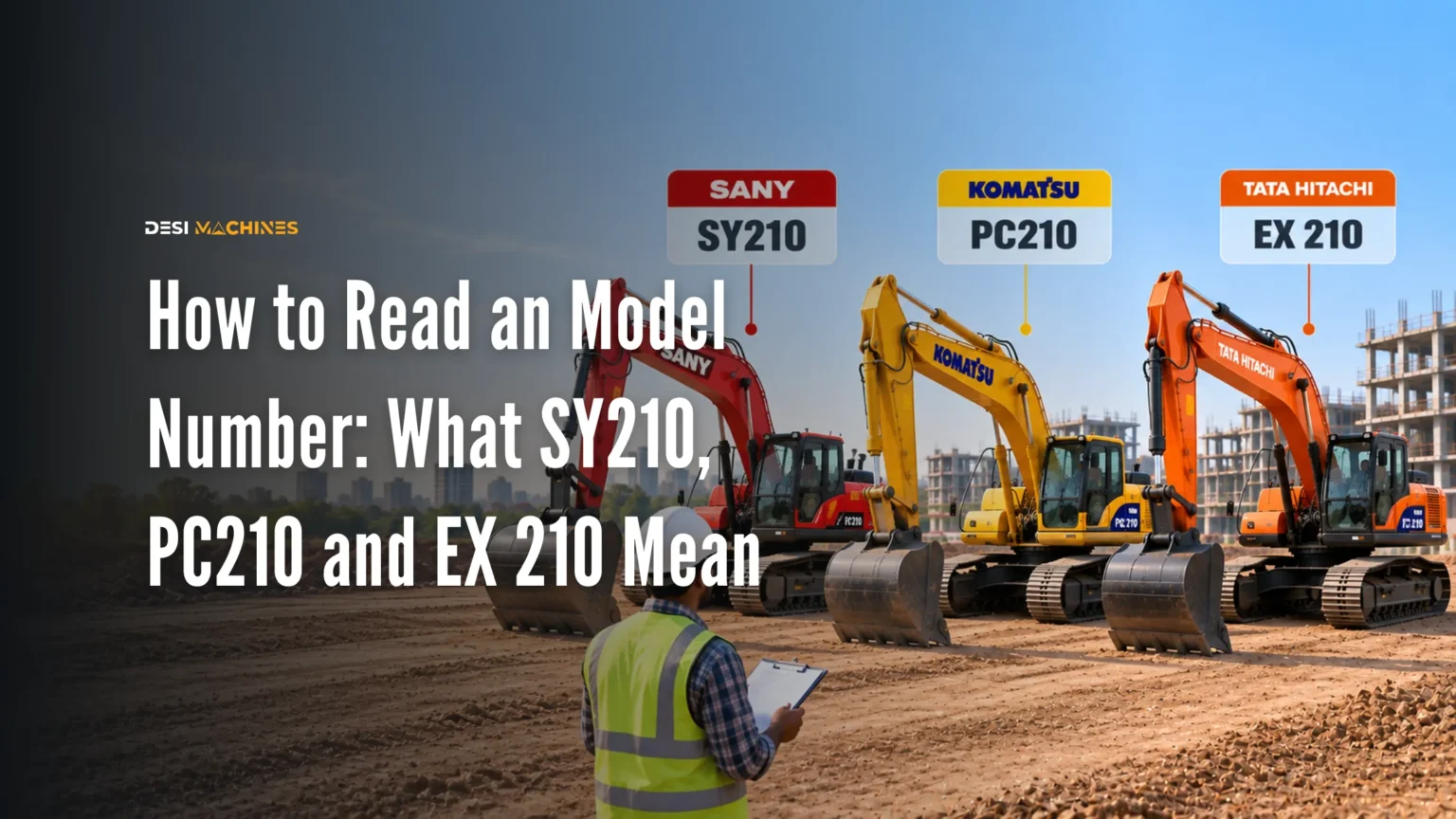
An excavator model number is the code on the side of the machine, like SY210, PC210 or EX 210LC, and on almost every brand sold in India it is a size label: the digits tell you roughly what the machine weighs, and the letters after them tell you what is different about that version. Read SY210 as “about 21 tonnes”. Read the LC on EX 210LC as “longer tracks on the ground”.
That is not a rule of thumb somebody made up. We checked it against every excavator listed on DesiMachines: 294 machines, of which 293 publish an operating weight we could read. Of the 289 that carry a number we could test, 277 follow one of just two rules. This guide sets out both rules, the letters, and the handful of machines that break them.
What does an excavator model number mean?
It is a size code with a version tag attached. Every excavator model name has three parts, and once you can see them separately the whole naming system stops being confusing.
The letters in front are the brand’s product family. SY is SANY’s excavator line, PC is Komatsu’s, EX and ZAXIS are Tata Hitachi’s, R is Hyundai’s and also Liebherr’s, EC is Volvo’s, SK is Kobelco’s, XE is XCMG’s, NXT is JCB’s newer excavator range and BE is BEML’s. They carry no size information at all. A PC210 and an SY210 are the same size machine from two different makers.
The digits in the middle are the size. This is the part worth learning, and it is covered in the next section.
The letters after the digits are the version: a longer undercarriage, a longer boom, a heavy-duty build, an electric drive, a trim level. These change the machine’s job without changing its weight class much.
Once you split a name that way, SANY SY215C-9LC reads as: SANY’s excavator line, about 21.5 tonnes, C-series, ninth generation, long undercarriage. Nothing about it is a mystery. If you want the same treatment for the numbers on the printed spec sheet rather than the ones on the machine, that is a separate job, covered in the guide to reading an excavator spec sheet.
Does the number in an excavator model tell you the weight?
Yes, on almost every brand. Two different rules are in use, and which one applies depends only on the brand.
Rule 1: the number is the weight in tonnes, times ten. Divide the number by ten and you have the operating weight in tonnes. SY210 is 21 tonnes (21,000 kg). PC210 is 21 tonnes. EC220 is 22 tonnes. Across the machines we list, 221 of 225 from these brands fit that rule to within 15 per cent.
Rule 2: ignore the first digit, then read the next two as tonnes. CAT, Liebherr and LiuGong use the leading digit for the product family or generation instead of the size. CAT 320 is 20 tonnes, not 320. Liebherr R 920 is a 20-tonne class machine. LiuGong 922 is 22 tonnes. Of the machines on our lists from these three brands, 56 of 64 fit.
| Rule | Brands (as listed in India) | How to read it | Worked example from our listings | Machines fitting |
|---|---|---|---|---|
| Rule 1: number ÷ 10 = tonnes | SANY (SY), Tata Hitachi (EX, ZAXIS, NX), JCB (NXT, JS), Hyundai (R, HX), Komatsu (PC), Volvo (EC), XCMG (XE), Kobelco (SK), BEML (BE), Kubota, Yanmar, Bobcat, Case (CX), Zoomlion (ZE) | Drop the last digit mentally | SANY SY210C-9 = 20,900 kg; Komatsu PC210-10M0 = 20,900 kg | 221 of 225 |
| Rule 2: drop the first digit, next two = tonnes | CAT (3xx), Liebherr (R 9xx), LiuGong (9xx) | 320 → 20; 922 → 22 | CAT 320D3 = 19,800 kg; LiuGong 922E XD = 22,000 kg; Liebherr R 920 = 21,900 kg | 56 of 64 |
This is why so many different machines are called “a 210”. Tata Hitachi EX 210LC Prime is 20,800 kg, SANY SY210C-9 is 20,900 kg, Komatsu PC210-10M0 is 20,900 kg and JCB NXT 205 is 20,500 kg. They are competing machines in the same weight class, which is the class that does most of India’s earthwork. The class itself is set out in the guide to excavator size classes, and the weights behind it in excavator operating weight.
Comparing machines by number? Browse the full range of excavators by size class and connect with a dealer.
Why do CAT, Liebherr and LiuGong numbers look different?
Because those three use the first digit to say which family the machine belongs to, not how big it is. It is the same idea as a car maker’s 3-series or 5-series.
CAT’s construction excavators are the 300 family, so the 3 is fixed and the size is in the last two digits: 320 is 19,800 kg, 321 is 19,300 kg, 322 is 20,700 kg, 324 is 22,700 kg. Liebherr’s crawler excavators sit in the R 9xx family, so R 920 is a 20-tonne class machine. LiuGong’s are the 9xx family in the same way.
The trap is that a CAT 320 and a SANY SY320 would be very different machines: the CAT is a 20-tonner and an SY320 would be a 32-tonner. If someone tells you they run “a 320”, ask whose 320.
What do the letters after an excavator model number mean?
They mark the version. These are the ones you will actually meet on Indian sites, with what our own machine listings show for each.
| Letters | What it means | What our listings show |
|---|---|---|
| LC (also LCH, KLC, LCS) | Long crawler: a longer undercarriage, so more track on the ground | On the same-number pairs we list, the LC machine’s undercarriage is 190 to 290 mm longer: Tata Hitachi EX 210 is 4,090 mm and EX 210LC is 4,350 mm; Case CX220C is 4,180 mm and CX220C LC is 4,470 mm. On three other pairs both versions publish the same figure, so check the spec rather than assuming |
| LR, SLR, XLR | Long reach: a longer boom and arm for dredging, canal work and deep cuts | Of the 12 long-reach machines we list, the ten publishing a readable figure reach 15.0 to 22.0 m, against a median 9.4 m for the 53 standard machines in the 19.5 to 22.5 tonne band. Their arms run 6.0 to 10.0 m against a standard median of 2.4 m |
| HD, XD | Heavy duty: reinforced structure for rock, quarry and demolition work | 28 machines on our lists carry HD and 8 carry XD, spread across every size class from 20 tonnes upward |
| U | The compact, reduced-tail-swing minis | All 13 U machines we list are between 1,800 kg and 4,200 kg: SANY SY20U, SY35U, XCMG XE28U, Tata Hitachi ZAXIS 23U. Not one is above the mini class |
| GC | CAT’s simpler, lower-cost build of the same size machine | CAT 320D3 GC and CAT 320D3 both weigh 19,800 kg, but the GC is rated at 114 HP (85 kW) against the standard machine’s 134 HP (100 kW) |
| EV, FE EV | Battery electric | 13 machines on our lists sit in the electric class, including the LiuGong 9027FE EV at 2,750 kg |
| Prime, Plus, Super+, Pro, Sparc, Fuel Master | Trim and feature levels, not size | These change the cab, the monitor or the hydraulic tuning. They do not move the machine’s weight class |
The tail-swing point behind the U letter matters more than it sounds on a narrow Indian site, and is worked through in excavator dimensions and tail swing. What LC actually buys you, stability and ground pressure, sits in the excavator undercarriage guide, and what a long-reach boom costs you in lifting power is in the digging reach guide and the excavator boom guide.
How do you read a four-digit mining excavator number?
The same two rules carry straight through to the giants, which is a useful check that they are real conventions and not a coincidence in the middle of the range.
Tata Hitachi EX 1900-6 weighs 191,000 kg, so 1900 ÷ 10 is 190 tonnes. Komatsu PC2000-8 weighs 200,000 kg. Tata Hitachi EX 8000-6, the largest machine we list, weighs 825,000 kg, which is 825 tonnes, against a name that says 800. BEML BE1800D is 175,000 kg.
Liebherr’s mining line keeps its own rule: drop the 9 and read the rest, so R 9250 is 250 tonnes exactly and R 9800 is 800 tonnes. Its middle mining models are the loosest fit anywhere in the catalogue: R 9300 is 252 tonnes and R 9350 is 302 tonnes, both 12 to 16 per cent under what the name suggests. If you are working at that size the mining range is listed under extra-large and mining excavators, and the machine choice is covered in mining equipment in India.
Where the rule breaks down
Twelve of the 289 machines we tested do not fit either rule, and the reasons are worth knowing because each one is a real warning.
A different undercarriage changes the weight without changing the name. The LiuGong 922E Amphibious weighs 29,000 kg against the 22 tonnes its number implies, because pontoons for marsh and dredging work are heavy. Any machine built for water, swamp or a special carrier will read heavy for its number.
Some brands simply use another scheme. Leeboy’s 523, 525E and 525M all weigh 24,200 kg, so the number is not a tonnage at all. SDLG’s E6135Fi and E6150F, and L&T’s LT-300, do not decode from anything published on their own listings. When the number does not resolve, read the operating weight and ignore the name.
Very large machines drift. The four Liebherr mining models above 100 tonnes sit 12 to 16 per cent under their stated numbers, and one mini, the Hyundai HX35AZ at 4,130 kg, sits 18 per cent over.
And a name is never a substitute for the spec sheet. One machine on our own excavator listings publishes its operating weight with the wrong unit, which is exactly why the number on the side of the machine is a starting point and the published weight is the answer. Always read the figure.
Does the model number tell you the price or the year?
No to the price, and only sometimes to the year. Nothing in the digits encodes cost. Two machines called a 210 from different brands, or the same brand in different trims, can sit well apart on price, and price also moves with variant, attachments, location and the month you buy.
The dash number at the end is often a generation, not a model year: the -9 in SY210C-9 and the -10M0 in PC210-10M0 mark which generation of that machine it is. A generation can stay in production for several years, so a -9 machine is not a 2009 machine. For the actual year, read the chassis plate and the machine’s papers, and treat a used seller’s “2019 model” as something to verify rather than believe. The checks are listed in the excavator guide series.
How to use the model number when you are shopping
Three habits will save you time.
Use it to build a shortlist, not to decide. If a contractor tells you the job needs a 20-tonner, the number gets you to the right shelf in seconds: anything reading 200 to 220 from a Rule 1 brand, or 320 to 322 from CAT. Then compare on the specs that decide the job: digging depth, reach, bucket size, engine power.
Watch the letters more than the digits when the sites are tight or wet. Between two machines of the same weight, the LC will be steadier and the standard one easier to float and turn. On a narrow plot the U-series mini is the one that can work against a wall.
Check the weight before you book a trailer. The number is rounded, and the version letters move it. An EX 210LC at 20,800 kg and an EX 215LC at 21,250 kg are both “a 210-class machine” in conversation and 450 kg apart on the weighbridge. For road movement that difference is real.
Compare machines the same way we tested them here: by the published operating weight, not the badge. Browse the full excavator range, the mini excavators and the long-reach machines, and connect with a dealer.
Excavator model numbers, in short
An excavator model number encodes the machine’s size, not its price or its year. On most brands sold in India (SANY, Tata Hitachi, JCB, Komatsu, Hyundai, Volvo, XCMG, Kobelco, BEML) divide the digits by ten to get the operating weight in tonnes. On CAT, Liebherr and LiuGong, drop the first digit and read the next two as tonnes. Across the 289 machines we could test, 277 fit one of those two rules.
The letters after the number are the version, and they matter on site: LC is a longer undercarriage, LR is a long-reach boom, HD and XD are heavy-duty builds, U is a compact mini, GC is CAT’s simpler build, and Prime, Plus and Pro are trim levels. Anything that reads wrong for its number usually has a special undercarriage, or belongs to a brand using its own scheme.
Read next: Excavator size classes in India and how to read an excavator spec sheet. If you are choosing between a tracked and a wheeled machine, start with wheeled vs crawler excavators.
Weights, powers and dimensions in this guide are taken from the machine listings on DesiMachines as of September 2026, and the counts state how many of the 294 listed excavators publish each figure. Prices, specifications and features are indicative, vary by variant, location and date, and should always be confirmed with the official OEM or authorised dealer before any purchase decision. DesiMachines is not liable for decisions taken on the basis of information that may have changed after publication.