Excavator
313 models
 Backhoe Loader
51 models
 Crane
68 models
 Concrete Mixer
79 models
 Wheel Loader
54 models
 Compactor / Roller
45 models
 Motor Grader
42 models

 Concrete Pump
66 models
 Skid Steer Loader
11 models


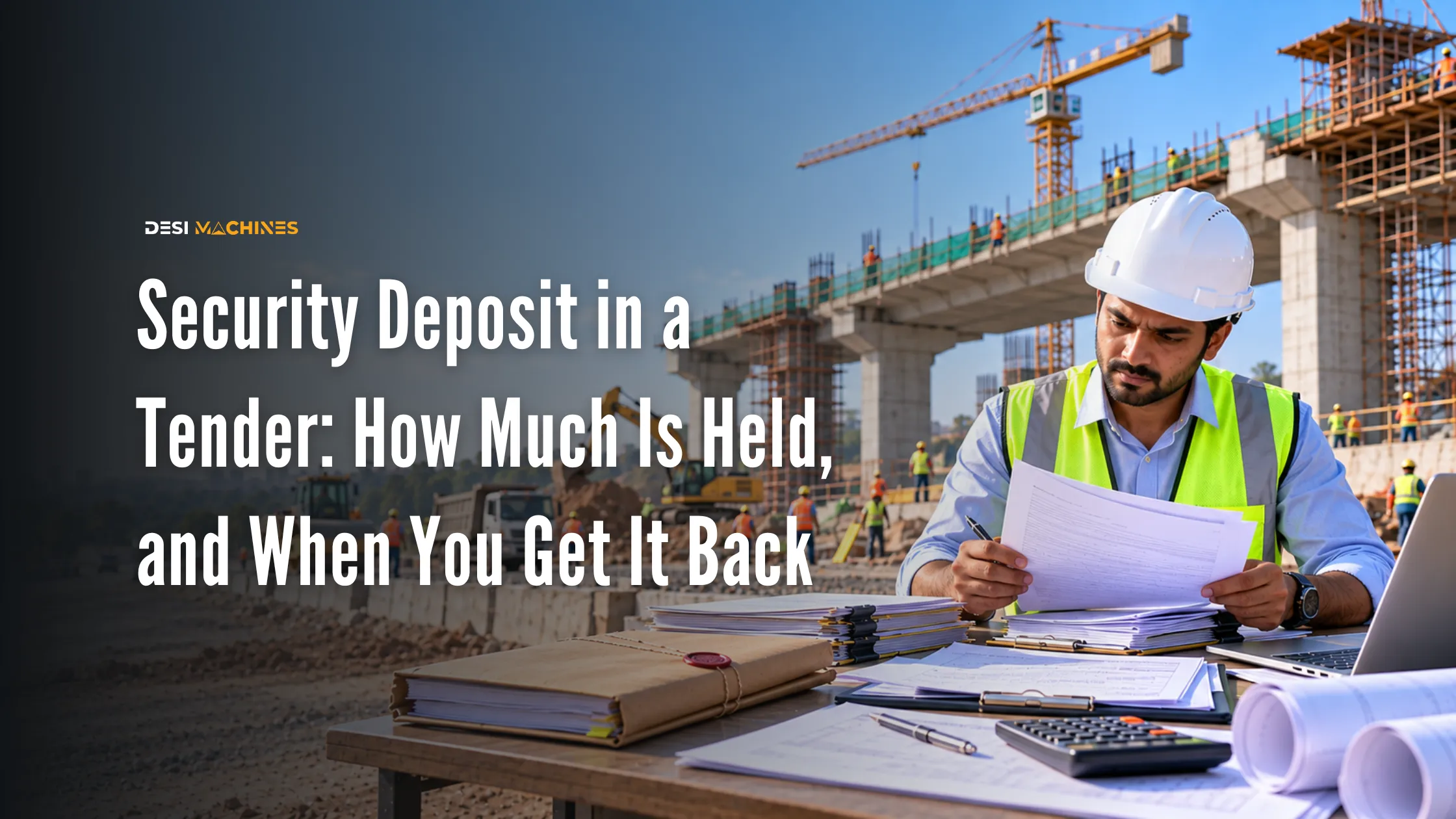
A security deposit in tender is the money your client keeps after the work is awarded, as cover against you not finishing it or not fixing what goes wrong afterwards. On central government work Rule 171 of the General Financial Rules, 2017 sets the performance security as a percentage of the contract value, and a Ministry of Finance memorandum of 12 November 2020 brought that down to 3% for contracts the rule covers, as a pandemic relief that ran for tenders issued up to 31 March 2023. On a ₹50 Lakh contract at 5%, that is ₹2.5 Lakh (indicative) sitting with someone else for two years or more, and most owners never price it.
What a security deposit in tender actually secures
Earnest money answers one question: is this bid serious. The security deposit answers a different one: will this contractor finish the job and stand behind it afterwards. That is why the two live at opposite ends of the contract. The earnest money goes in with your bid and comes back to the losing bidders once the tender is decided; EMD in a tender covers that side in detail. The security deposit arrives only after you have won, and it stays until long after the machines have left site.
For a machine owner that difference matters more than it does for a labour contractor. Your capital is already in the asset. A hydra or an excavator earning on a two-year contract is also financing 5% of that contract value, interest-free, for the client.
Where the money actually comes from
Two routes, and most public works contracts use both at once.
The first is a lump sum you lodge before the agreement is signed, usually as a demand draft, a fixed deposit receipt pledged to the client, or a bank guarantee. The second is a percentage cut from every running account bill you raise, running until the total reaches the ceiling in the contract. The second route is the one that hurts, because it takes money you have already earned and the department’s engineer has already certified.
Where that deduction is called retention rather than security deposit, the mechanics are identical and the sums are the same money by a different name. Retention money in construction contracts works through the deduction side in detail, and retention money vs security deposit sets the two names side by side.
| Money the client holds | When it goes in | When it comes out |
|---|---|---|
| Earnest money / bid security | With the bid, before award | After the tender is decided |
| Performance security | Before the agreement is signed | On completion, per the contract |
| Deduction from running bills | Every bill, until the ceiling | Part on completion, part after the defect period |
| Mobilisation advance recovery | Every bill, if you took an advance | Not a deposit — it is your own advance coming back |
The last row is there because owners routinely read an advance recovery line on a bill as another deposit and panic. It is not. That is the mobilisation advance being repaid out of the work you are doing.
The percentage, and why the tender document beats the rule
Rule 171 of the General Financial Rules, 2017 governs central government procurement and fixes performance security as a band of the contract value. The Ministry of Finance memorandum of 12 November 2020 reduced it to 3% of the contract value, after representations that blocked capital was stopping contractors from bidding at all. That cut was time-bound. It covered existing contracts and tenders issued up to 31 December 2021, a further memorandum of 30 December 2021 extended it to 31 March 2023, and the Bombay High Court read that extension as covering tenders issued up to that date (M/s Shiv and Sons v Union of India, 19 October 2023). The current text of the rules, updated to January 2026, does not carry a flat 3%: it puts performance security for goods and services at 3% to 5%, and says performance security plus security deposit or retention money on works will continue to be 3% to 10%. Several states followed. Kerala’s finance department order of 7 January 2021 cut performance security from 5% to 3% and earnest money from 2.5% to 1.5% for public works in the state.
None of that guarantees the number in front of you. The rules bind central departments; state PWDs, municipal bodies, PSUs and private EPC clients write their own procurement manuals, and courts have seen contracts where the security actually fixed in the agreement sat well above the figure the department’s own circular allowed. Read the clause, not the circular, and if the two disagree, raise it at the pre-bid meeting when it can still be changed.
Security deposit percentage in a CPWD tender
The CPWD General Conditions of Contract 2023 for construction works are the clearest worked case, because so many works contracts copy their structure. They keep two separate holds: a performance guarantee you lodge after the letter of acceptance, within the days set in Schedule F, and a security deposit built up out of your bills.
| What CPWD holds | How much | When it comes back |
|---|---|---|
| Performance guarantee | 5% of the tendered value or the estimated cost put to tender, whichever is higher (from 27 February 2026), plus a top-up if your bid is below 80% of the estimated cost | 80% after the provisional completion certificate, the rest after the completion certificate, without interest |
| Security deposit | 2.5% of the tendered amount, cut at 2.5% of the gross amount of each running and final bill until that total is reached | Not before twelve months after completion (six months for works of ₹10 lakh and below, except road work), or until the final bill is passed, whichever is later |
The top-up for a low bid is the change to watch. On a work with an estimated cost of ₹1 crore, a bid of ₹90 lakh carries a ₹5 lakh guarantee, which is 5% of the estimated cost. Bid ₹75 lakh and the guarantee becomes ₹10 lakh: the same ₹5 lakh plus the ₹5 lakh gap between your bid and 80% of the estimate. Add the ₹1.875 lakh security deposit taken from your bills and about ₹11.9 lakh (indicative) of a ₹75 lakh job sits with the department. A low bid now costs security as well as margin, the same logic as an additional performance security on an unbalanced bid.
Both holds can be given as an insurance surety bond, an account payee demand draft, a fixed deposit receipt or a bank guarantee from a commercial bank, and the deduction from bills can be swapped out against a scheduled bank’s guarantee once it has built up to ₹5 lakh. Choosing between the surety bond and the bank guarantee is a cost question, worked through in surety bond vs bank guarantee. For central procurement, rule 171 of the General Financial Rules, written for goods and services, lists the same forms plus e-bank guarantees and online payment, and keeps performance security valid for sixty days beyond the completion of all contractual obligations, warranty included.
One naming trap. A clause headed “tender security” or “bid security” may not be the security deposit at all: in the General Financial Rules, bid security is the earnest money (rule 170), returned to the winner once the performance security arrives. Check which of the two the clause means before you price it.
What it costs you, in money rather than principle
Take a ₹50 Lakh contract running twenty-four months, with 5% held as security deposit. That is ₹2.5 Lakh (indicative). If your working capital costs 14% a year, holding that sum for two years costs about ₹70,000 in interest you pay on money you have already earned. Against a margin of 8% to 12% on a contract of that size, the deposit alone can eat a tenth of the profit.
The deduction also lands at the worst moment. It comes out of your first bills, exactly when diesel, wages and the first EMI on the machine are all due. Owners fighting that squeeze usually need a working capital loan at 14% to fund a deposit held against them at nil, which is a poor trade and worth avoiding by pricing the cost into the rate instead.
Getting it back
The release is a process, not an event, and it stalls for ordinary reasons rather than bad faith. Budget lapses at the year end. The engineer who certified your work is transferred. The defect period closes but nobody records that it closed.
Four things move it. Apply in writing and quote the clause number, because an application that names the clause is harder to shelve than one that asks politely. Close out the defect list in writing so no open item can be used as a reason to wait. Get the no-dues or no-claim certificate settled early, and read what you are signing before you sign it. Where the contract permits substitution, swap the cash for a bank guarantee at the start so the money is never trapped in the first place.
If you bid public work regularly, the deposit is not an irritation to be managed job by job. It is a standing line in your working capital, and it belongs in your rate. Browse current government and infrastructure tenders and read the security clause before you price the bid, not after you win it.
What a security deposit costs at your capital cost
A security deposit in tender is your own money, held by someone else, for years. The rule sets a band, the memorandum of November 2020 pushed central contracts down to 3% until March 2023, and your tender document decides what actually applies. Work out what the deposit costs you at your own cost of capital, price it into the rate, and swap cash for a guarantee wherever the contract allows it.
If the deposit is what is squeezing your month rather than the work itself, compare equipment finance and working capital options and speak to a lender before the next bill cycle rather than after it.
Rates, schemes, specifications and prices change — confirm current terms with the OEM, dealer, bank or insurer before deciding. The percentages quoted here are drawn from the General Financial Rules and the government orders named above, and the figure that binds your contract is the one printed in your own tender document; confirm it with the tendering authority before you bid.