
 Excavator
294 models
Excavator
294 models  Backhoe Loader
51 models
Backhoe Loader
51 models  Crane
68 models
Crane
68 models  Concrete Mixer
79 models
Concrete Mixer
79 models  Wheel Loader
54 models
Wheel Loader
54 models  Compactor / Roller
45 models
Compactor / Roller
45 models  Motor Grader
42 models
Motor Grader
42 models  Dozer
41 models
Dozer
41 models  Concrete Pump
66 models
Concrete Pump
66 models  Skid Steer Loader
11 models
Skid Steer Loader
11 models  Telehandler
13 models
Telehandler
13 models 


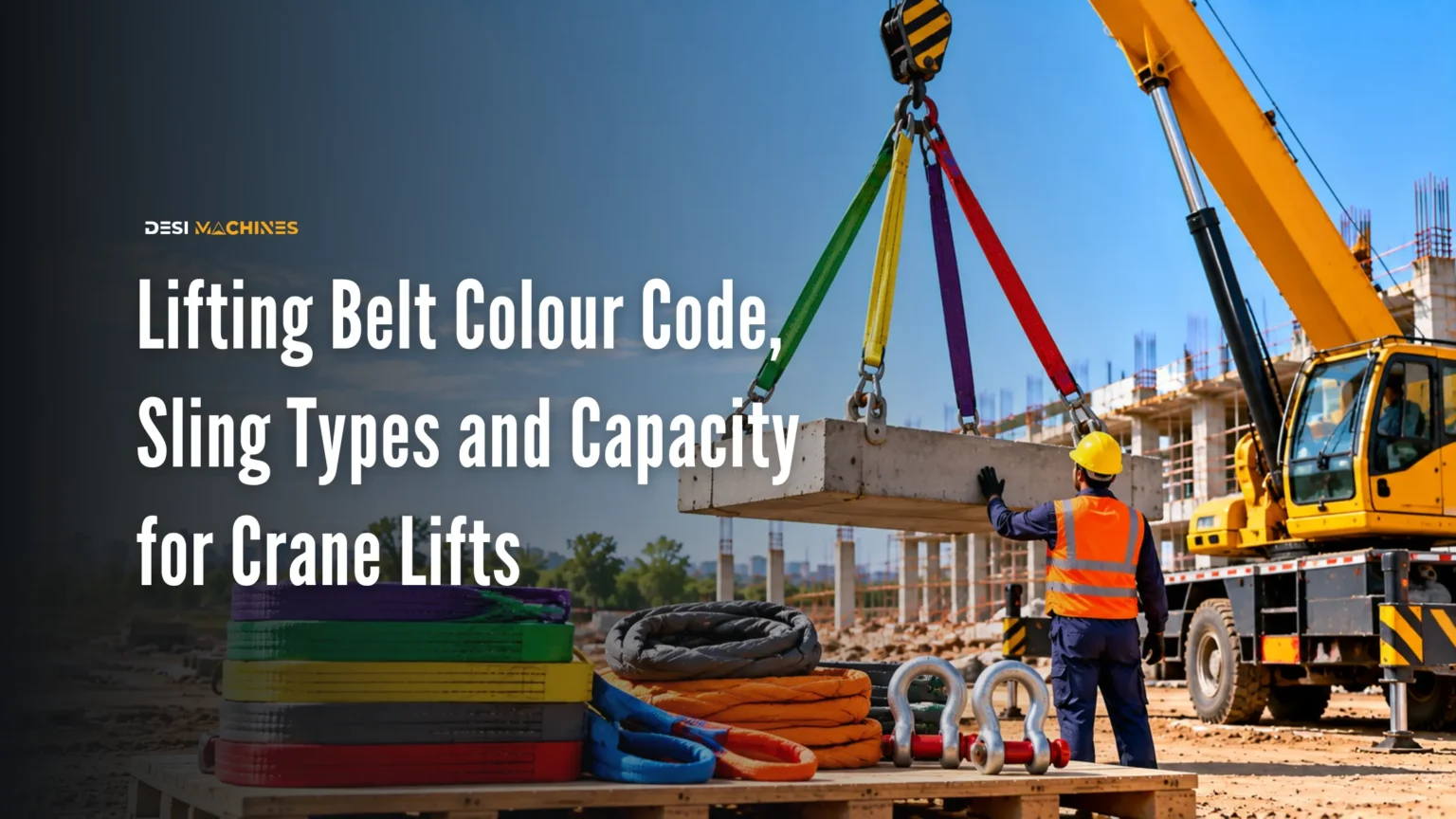
The lifting belt colour code, set by the European standards EN 1492-1 (flat webbing slings) and EN 1492-2 (round slings), gives each working load limit its own colour: violet 1 tonne, green 2 t, yellow 3 t, grey 4 t, red 5 t, brown 6 t, blue 8 t and orange 10 t and above. The colour tells you the rating for a straight, vertical lift at a glance. The label sewn on the belt is still the final word.
On an Indian site, the polyester lifting belt is the sling most crews reach for when a hydra or truck-mounted crane has to lift pipes, precast items, pumps or machinery parts. This guide covers the colour code, the four main sling types, how the way you hitch a sling changes what it can carry, when to throw a sling away, and what new belts cost.
What does each lifting belt colour mean?
| Colour | Working load limit, straight lift |
|---|---|
| Violet | 1 t |
| Green | 2 t |
| Yellow | 3 t |
| Grey | 4 t |
| Red | 5 t |
| Brown | 6 t |
| Blue | 8 t |
| Orange | 10 t and above |
A few things to know about the code. Some makers also stitch one black stripe along the belt for every tonne of rating. Polyester slings made to EN 1492 carry a blue label with the maker, the year, the material, the working length and the WLL. The design factor on these belts is usually 7 to 1, meaning a new 5 t belt should not break below about 35 t; that margin is there for shock loads and wear, not for extra weight. And not every belt sold in India follows the colours: we saw a 6-ton belt listed in violet, the 1-ton colour. If the colour and the label disagree, go by the label, and if there is no label, do not use the belt.
What types of lifting slings are used with cranes?
Lifting slings, together with shackles, hooks and eyebolts, are what Indian safety rules call lifting tackle. There are four main kinds of sling.
| Sling type | What it is | Good for | Watch out for |
|---|---|---|---|
| Flat webbing (lifting belt) | Woven polyester strap with a sewn eye at each end | Painted, polished or soft loads; wide belts spread the grip | Sharp edges, heat, welding sparks |
| Round sling | Endless loop of polyester yarn inside a woven cover | Choke and basket hitches, awkward shapes; the load-bearing core sits inside the cover | Cuts that reach the core, heat |
| Wire rope sling | Steel wire rope with pressed or spliced eyes | Rough, hot or abrasive loads, steel sections | Kinks and broken wires; it can mark soft loads |
| Chain sling | Alloy steel chain with a master link and hooks, often two or four legs | Hot loads, rough use, adjustable leg length | Stretched or bent links; heavier to carry |
For most hydra work on building and road sites, polyester belts and round slings are enough, and they are lighter and safer to handle. Wire rope and chain slings earn their place where loads are rough-edged, hot or dragged. Whatever the sling, it hangs from the crane hook through a hook or a shackle, and the shackle must be wide enough that the belt lies flat. The shackle guide covers how to size that link.
How does the way you hitch a sling change its capacity?
The colour gives the rating for a straight, vertical lift. Wrap the sling a different way and the safe load changes. Multiply the straight-lift WLL by the mode factor below. These are the factors used for EN 1492-1 flat webbing slings.
| Hitch | Mode factor | 5 t (red) belt can carry |
|---|---|---|
| Straight (vertical) | 1.0 | 5 t |
| Choke (wrapped round the load and through its own eye) | 0.8 | 4 t |
| Basket, both legs straight up (parallel) | 2.0 | 10 t |
| Basket, legs 0° to 45° from vertical | 1.4 | 7 t |
| Basket, legs 45° to 60° from vertical | 1.0 | 5 t |
This is a general guide based on machine size class. Always confirm the fit with your machine’s operator manual or the manufacturer before buying or fitting.
Two rules come out of this table. A choke hitch always costs capacity, so a red belt in a choke is a 4 t belt. And the wider the legs spread, the less the sling carries, so do not let sling legs go past 60° from vertical. Remember too that the crane’s own chart must cover the load plus the slings, shackles and hook block. The crane load chart guide explains that deduction.
When should a lifting sling be thrown away?
Look at every sling before the lift, along its full length. The US sling standard ASME B30.9, widely followed by riggers here, lists these signs for taking a sling out of service.
- Webbing belt: missing or unreadable label; cuts, holes, tears or snags; melted, charred or burnt spots; broken or worn stitching in the eyes; knots; faded, stiff or brittle patches from sun or chemicals.
- Round sling: any cut, hole or wear that lets you see the inner core yarns, damaged core yarns, weld spatter, heat damage or knots. Some makers weave a red warning yarn inside the cover; if it shows, stop using the sling.
- Wire rope sling: ten broken wires spread along one rope lay, or five broken wires in one strand in one lay; kinks, crushing or a bird-cage bulge; heat damage; cracked or worn end fittings.
- Chain sling: stretched, bent or twisted links; cracks; heat damage; links that no longer hinge freely; missing identification tag.
Never repair a belt with a knot or a fresh line of stitching on site. Protect belts from sharp corners with a sleeve or a pad, keep them away from welding and hot exhausts, and store them dry and out of the sun. Indian rules ask for lifting tackle to be examined by a competent person at least once every twelve months; the crane safety rules guide covers what the Factories Act and BOCW rules require.
What makes a lifting belt cost more or less?
Four things move the price of a flat webbing sling, and the brand on the label is not the main one. Capacity comes first: a belt is woven polyester, so a higher working load limit simply means more material in the same strap. Length comes second, because a longer belt is more webbing. Note that the length a seller quotes against is the working length from eye to eye, not the overall length.
Ply count is third, and it is the one buyers miss. A double-ply belt costs more than a single-ply belt of the same rating, because the load is carried across two layers of webbing instead of one, and it survives a sharp edge better. Paperwork is fourth. A sling that comes with a test certificate and a legible sewn label costs more than an unmarked belt from a hardware shop, and the unmarked one is the one you must never put on a hook. The label is the only thing that proves the working load limit.
Sling type changes the bracket completely. Round slings, wire rope slings and chain slings are not priced like flat webbing. A chain sling is forged alloy steel rather than woven polyester yarn, so it sits in a different conversation altogether. For a figure on any of them, ask a dealer against the capacity, length and hitch you actually need, and ask for the test certificate in the same breath.
For the machines these slings hang from, see hydra cranes, the truck-mounted crane guide and the crane guide. The hook block and rope on a hydra are explained in hydra crane parts, and slinging a load under an excavator is covered in lifting with an excavator.
Prices, specifications and fitments are indicative, vary by maker, model, city and date, and should be confirmed with the manufacturer or an authorised dealer before buying. DesiMachines is not liable for decisions taken on the basis of information that may have changed after publication.
Machines, tenders and news for this industry: Material Handling
Get a lifting sling price from a dealer near you
Tell us your machine and what you need, and we will ask the nearest dealer to reach out to you with a price.