
 Excavator
294 models
Excavator
294 models  Backhoe Loader
51 models
Backhoe Loader
51 models  Crane
68 models
Crane
68 models  Concrete Mixer
79 models
Concrete Mixer
79 models  Wheel Loader
54 models
Wheel Loader
54 models  Compactor / Roller
45 models
Compactor / Roller
45 models  Motor Grader
42 models
Motor Grader
42 models  Dozer
41 models
Dozer
41 models  Concrete Pump
66 models
Concrete Pump
66 models  Skid Steer Loader
11 models
Skid Steer Loader
11 models  Telehandler
13 models
Telehandler
13 models 


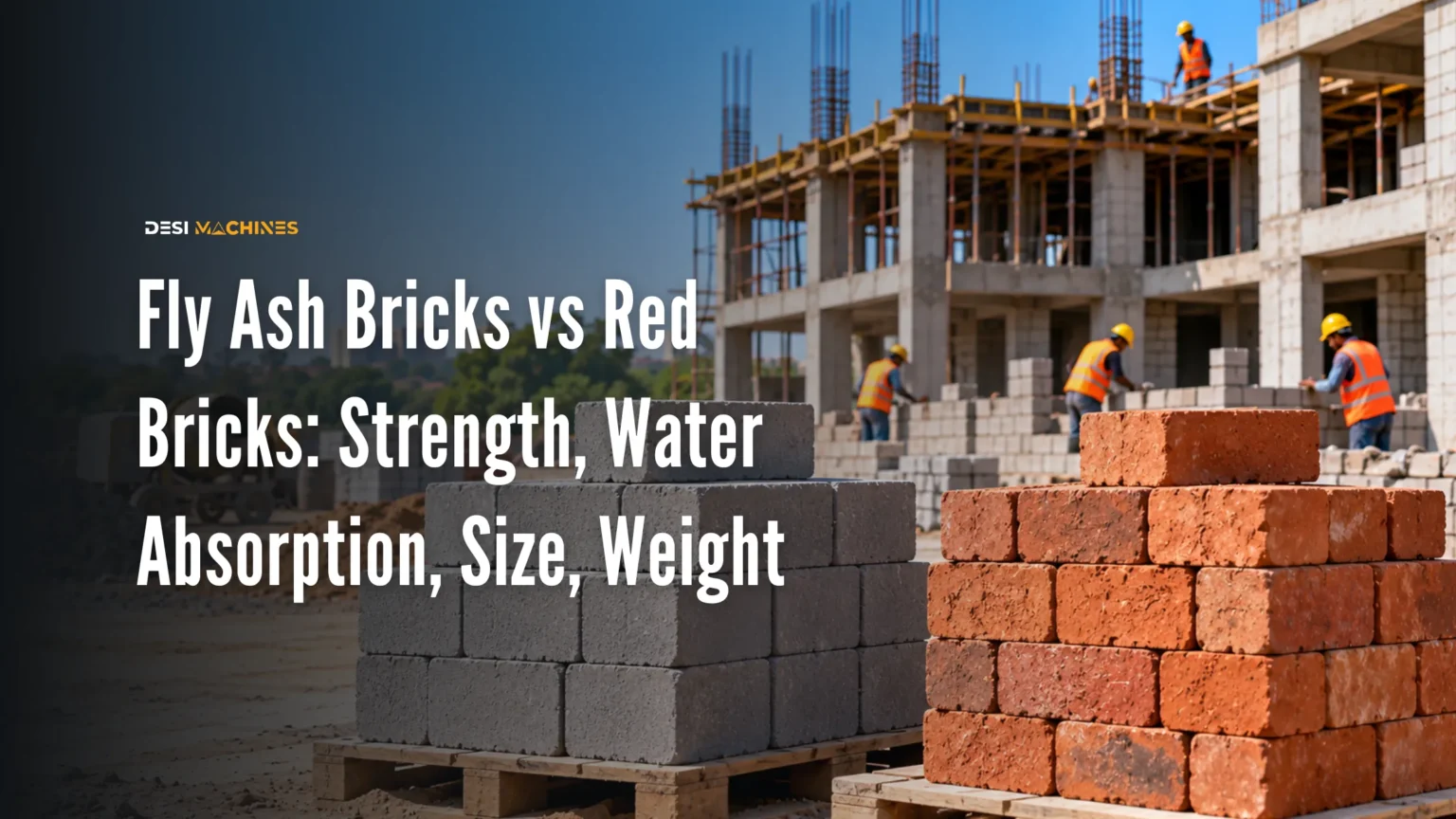
When you choose between fly ash bricks and red bricks for a house wall, the strength class on the test report matters more than the material. Their Indian Standards set the same water absorption limit, the same efflorescence limit and the same sizes, so a fly ash brick and a red brick of the same class do the same job, and the better buy is whichever lot passes the checks on this page from a seller near you.
What really separates them is how each one is bonded, how far up the strength scale each goes, how strictly a single weak brick is treated, and one extra test only the fly ash brick has to pass. This fly ash bricks vs red bricks comparison goes through each of those using the codes themselves: IS 1077 for common burnt clay bricks and IS 12894 for fly ash-lime bricks. Brick rates change by district and season, so this page carries none.
Which is better, fly ash bricks or red bricks?
Neither material wins everywhere. On paper the two standards are close copies of each other, and the table shows where they match and where they part.
Table 1: Red clay brick and fly ash brick compared, as the standards set them
| Property | Red clay brick | Fly ash-lime brick |
|---|---|---|
| Indian Standard | IS 1077:1992 | IS 12894:2002 |
| How it gets its strength | Clay fired in a kiln | Fly ash and lime react with water and harden, no firing |
| Strength classes | 11 classes, 3.5 to 35 N/mm² | 10 classes, 3.5 to 30 N/mm² |
| One brick below the class figure | Not allowed; the lot is checked for the next lower class | Allowed if it is no more than 20% below |
| Water absorption limit (24 hours in water) | 20% up to class 12.5; 15% above it | 20% up to class 12.5; 15% above it |
| Efflorescence (white salt) limit | Moderate up to class 12.5; slight above it | Moderate up to class 12.5; slight above it |
| Drying shrinkage limit | No limit set | 0.15% maximum, average of three bricks |
| Modular sizes | 190 x 90 x 90 mm and 190 x 90 x 40 mm | 190 x 90 x 90 mm and 190 x 90 x 40 mm |
| Non-modular sizes | 230 x 110 x 70 mm and 230 x 110 x 30 mm | 230 x 110 x 70 mm and 230 x 110 x 30 mm |
| Frog (the dent on one face) | 10 to 20 mm deep on hand-moulded 90 and 70 mm bricks | 10 to 20 mm deep, or a solid brick with no frog |
So the honest answer to “which is better” is a question back: better at what, and in which class? A class 10 fly ash brick and a class 10 clay brick are both meant to carry at least 10 N/mm² (newtons per square millimetre, the load a brick takes before it crushes, spread over its face). Both may soak up no more than a fifth of their own dry weight in water. Both come in the same sizes. The differences that do exist are worth knowing before you sign for a truckload, and the sections below take them one at a time.
How is each brick made?
A red brick is burnt. IS 1077 asks for bricks made from suitable soils, hand-moulded or machine-moulded, free from cracks, flaws and nodules of free lime. The firing in the kiln is what turns soft clay into a hard brick, and it is also where most quality problems start: an under-burnt brick stays weak and thirsty, an over-burnt one twists out of shape.
A fly ash brick is never fired. IS 12894 describes it as pulverized fuel ash, the fine ash collected at thermal power stations that burn powdered coal, used “in major quantity” with lime and an accelerator. The ash reacts with the lime in the presence of moisture to form calcium silicate hydrate, the same family of binder that holds hardened cement together, so the standard calls it a chemically bonded brick. Plants may add crushed bottom ash or sand as a coarser material to control water absorption, and additives such as gypsum or cement. The moulded bricks are then cured at set temperatures and pressures.
That difference in making is why the two bricks look different on site. Clay bricks come out in shades of red and brown from the kiln. Fly ash bricks are grey. Both standards ask for bricks of uniform shape and colour within a lot, so a stack with mixed shades is worth a question either way.
One naming trap: there is a third product, the burnt clay fly ash brick, covered by IS 13757. It is clay with some fly ash mixed in, fired like a red brick. It shares the same water absorption and efflorescence limits. When a seller says “fly ash brick”, ask which standard it is made to.
Is a fly ash brick stronger than a red brick?
Not by nature. Strength comes from the class, and both standards sort bricks into classes by their average compressive strength.
The ladders are nearly the same. Clay bricks run in 11 classes from 3.5 to 35 N/mm². Fly ash-lime bricks run in 10 classes from 3.5 to 30 N/mm², and the scope note of IS 12894 points to other standards for anything stronger. When the fly ash standard first came out in 1990 it had only four classes, 7.5, 10, 15 and 20; the 2002 revision added the rest.
Both are crushed the same way, by the method in IS 3495 (Part 1): the brick is soaked in water first, the frog is filled flush with cement mortar, and it is loaded in a compression machine until it fails. Strength is the failing load divided by the area of the bed face. IS 12894 calls its figure the wet compressive strength, and the soaking step means the clay result is a wet result too.
The real difference is how each code treats one weak brick in the sample:
- IS 1077: no single brick may fall below the minimum for its class. If one does, the lot is checked against the next lower class.
- IS 12894: a single brick may fall below the class minimum by up to 20%. A class 10 fly ash lot can contain a brick that crushed at 8 N/mm² and still pass as class 10.
For an infill wall on an RCC frame that difference rarely matters. On a load-bearing wall, where the bricks themselves hold up the roof, it is a good reason to ask the fly ash plant for every individual result in the test report, not only the average.
Which one absorbs more water?
On paper, neither. Both standards allow the same maximum: 20% of the brick’s dry weight up to class 12.5, and 15% for the stronger classes. Absorption matters because a thirsty brick pulls water out of the mortar before the mortar has set, and lets damp travel through the wall.
The test in IS 3495 (Part 2) is simple enough to understand and to copy roughly on site:
- Dry the brick in a ventilated oven at 105 to 115°C until its weight stops changing, let it cool, and weigh it. Call that M1.
- Put it fully under clean water at about 27°C for 24 hours.
- Take it out, wipe it with a damp cloth and weigh it within 3 minutes. Call that M2.
- Water absorption in per cent = (M2 − M1) ÷ M1 × 100.
A brick that weighs 3.0 kg dry and 3.5 kg after soaking has taken in 0.5 kg, which is about 16.7%. That passes for a class 12.5 brick or below and fails for a class 15 brick.
You will not have a lab oven on site, and a sun-dried brick still holds some moisture, so a home version of this test reads a little low. Treat it as a quick screen. If a sample is anywhere near the limit, send bricks to a lab for the proper test.
What is efflorescence, and which brick shows more of it?
Efflorescence is the white, powdery salt that appears on a brick or a new wall after it gets wet and dries. Salts inside the brick dissolve, travel to the surface with the water, and stay behind when the water evaporates. A little washes off. A lot spoils plaster and paint.
Both standards set the same limit: not more than “moderate” up to class 12.5 and not more than “slight” above it. IS 3495 (Part 3) sets the test. The end of the brick stands in 25 mm of distilled water in a shallow dish in a warm, airy room until the water is absorbed and the brick looks dry. The dish is filled again, the brick dries a second time, and it is then rated:
Table 2: Efflorescence ratings in IS 3495 (Part 3)
| Rating | What you see on the brick |
|---|---|
| Nil | No deposit you can see |
| Slight | A thin salt deposit on no more than 10% of the exposed area |
| Moderate | A heavier deposit on up to 50% of the area, with no powdering or flaking |
| Heavy | A heavy deposit on 50% of the area or more, with no powdering or flaking |
| Serious | A heavy deposit with powdering or flaking of the surface |
Which material shows more salt depends on the clay or ash that went into it and how the bricks were made, so neither standard ranks one above the other. Ask the seller for the efflorescence rating of the lot you are buying. For a wall that will stay damp, an outside wall in heavy rain or a plinth near the ground, buy from a lot rated nil or slight.
Why do fly ash bricks have a shrinkage test that red bricks do not?
A fired clay brick has already done its shrinking in the kiln. A fly ash brick has not been fired, and a brick bonded by a chemical reaction with water can still shrink a little as it dries out. Shrinkage in a wall shows up as fine cracks in the joints and plaster.
So IS 12894 adds a requirement IS 1077 does not need: the average drying shrinkage of three bricks, tested by the method of IS 4139, may not exceed 0.15%. On a 230 mm brick that is about a third of a millimetre. It sounds tiny, but it is the reason a fly ash plant’s test report should have one more line on it than a kiln’s. If that line is missing, ask for it.
What size and weight is each brick?
The sizes are identical. Both standards list the same modular sizes, 190 x 90 x 90 mm and 190 x 90 x 40 mm, and the same non-modular sizes, 230 x 110 x 70 mm and 230 x 110 x 30 mm. Both also allow two cut sizes for bonding with the non-modular brick: a 70 x 110 x 70 mm piece and a 230 x 50 x 70 mm piece. The 230 x 110 x 70 mm brick is the one most Indian sites still call the standard brick. For how many bricks and how much mortar a wall needs, see the material calculation guide.
Weight is where the standards go quiet. Neither sets a weight. IS 3792, the Indian guide to heat insulation of buildings, gives burnt brick a density of 1,820 kg/m³, and from that a solid 230 x 110 x 70 mm red brick works out to about 3.2 kg and a solid 190 x 90 x 90 mm one to about 2.8 kg. A frog makes each a little lighter.
IS 3792 has no entry for fly ash-lime bricks, and IS 12894 does not set a density. Any single weight you read for a fly ash brick is one plant’s product, not a rule. The fair way to compare is to weigh ten bricks from each stack you are offered and divide by ten. That one figure also tells you how much load the walls put on the beams and how many bricks a tractor-trolley can carry.
Figure 1: The 20-brick row check for size, from IS 1077 and IS 12894
The check works the same for both materials, because both codes copy it word for word. Pick 20 whole bricks at random, knock off loose bits and small lumps, and lay them in a straight line touching each other on a level floor. Measure the whole row in one go with a steel tape, never by moving a short ruler along it. The row lengths in the figure are the length check. The same 20 bricks turned on their side and on their face give the width and height checks:
Table 3: Limits for a row of 20 bricks
| Brick size (mm) | Length of 20 | Width of 20 | Height of 20 |
|---|---|---|---|
| 190 x 90 x 90 | 3,720 to 3,880 mm | 1,760 to 1,840 mm | 1,760 to 1,840 mm |
| 190 x 90 x 40 | 3,720 to 3,880 mm | 1,760 to 1,840 mm | 760 to 840 mm |
| 230 x 110 x 70 | 4,520 to 4,680 mm | 2,160 to 2,240 mm | 1,360 to 1,440 mm |
| 230 x 110 x 30 | 4,520 to 4,680 mm | 2,160 to 2,240 mm | 560 to 640 mm |
Ten minutes with a tape on the day the truck arrives saves an argument after the bricks are in the wall. Bricks of uneven size mean thicker joints, more mortar and more plaster to hide a wavy face.
Which brick should you use for a load-bearing wall, and which for a partition?
Start from the job the wall does, then pick the class, and only then the material.
On a house with an RCC frame, the columns and beams carry the roof and the walls between them only carry their own weight. Here either brick in a modest class does the work, and the deciding points are practical ones: which lot is truer to size, which arrives with fewer broken pieces, and which one the masons near you are used to laying.
On a load-bearing house, where the walls themselves carry the slab, the engineer’s drawing should name a brick class. Buy that class or higher in either material, and ask for a test report for the lot from a lab, with individual results as well as the average. Because IS 1077 is stricter about a single weak brick, a clay lot that passes its class has no brick below that figure; with fly ash, read the individual results yourself.
For walls that will stay wet, such as an outside wall facing the monsoon or the courses just above ground, choose a higher class. Above class 12.5 both codes tighten absorption to 15% and efflorescence to “slight”, and that is worth more than the material name.
Distance matters too. Fly ash bricks are made where ash is close at hand, near thermal power stations, while kilns are spread across brick-making districts. The brick that is made well and made nearby usually wins on breakage and freight. If the choice is really between bricks and blocks, our comparison of AAC blocks vs red bricks covers weight, heat and where each belongs on the same house.
What to check before you accept a load
The standards give you everything you need to judge a stack in a few minutes:
- Look first. Both codes ask for bricks free from cracks, with smooth rectangular faces and sharp corners. IS 1077 adds no flaws and no lumps of free lime; IS 12894 adds no warping and no organic matter.
- Run the 20-brick row check in Figure 1.
- Weigh ten bricks and note the average, so you can compare stacks and plan loads.
- Ask for the test report of the lot: compressive strength (with individual results), water absorption, efflorescence, and for fly ash bricks, drying shrinkage.
- Look for the maker’s mark. IS 1077 asks for a mark showing the source, in the frog where there is one; IS 12894 asks for the maker’s identification mark or initials. Either may also carry the BIS Standard Mark under licence.
A plant or kiln that cannot tell you the class of what it is selling is telling you something too.
Planning the rest of the wall
Bricks are only part of a wall’s cost and strength. The mortar between them needs the right cement, set out in choosing cement for house construction, and the finish is worked out in the plaster quantity guide. For a boundary wall built from scratch, see the compound wall cost guide, and for the whole house, low-cost house construction.
If you are looking at the other side of the trade, making fly ash bricks rather than buying them, the fly ash brick business guide covers what a plant needs and where its money goes. Lightweight walling is covered in the guide to AAC block sizes and density, and every other material is in the building materials guides.
The footings and the plinth come before the first course of brick. Footing trenches on a small plot are often dug with a backhoe loader such as the JCB 3DX, and a self-loading mixer such as the AJAX ARGO 4500 loads, mixes and delivers the concrete on site. Planning the slab and plinth? Compare concrete mixer models and prices and connect with a dealer near you.
The requirements quoted on this page are published as IS 12894:2002, Pulverized Fuel Ash-Lime Bricks and IS 1077:1992, Common Burnt Clay Building Bricks, with the test methods in IS 3495 (Parts 1 to 3):1992 and the brick density in IS 3792:1978.
Prices, specifications and features are indicative, vary by variant, location and date, and should always be confirmed with the official OEM or authorised dealer before any purchase decision. DesiMachines is not liable for decisions taken on the basis of information that may have changed after publication. Material properties on this page are as published in the Indian Standards named, read in October 2026; always follow the test report supplied by your brick maker or kiln.
Machines, tenders and news for this industry: Building Construction