
 Excavator
294 models
 Backhoe Loader
51 models
 Crane
68 models
 Concrete Mixer
79 models
 Wheel Loader
54 models
 Compactor / Roller
45 models
 Motor Grader
42 models

 Concrete Pump
66 models
 Skid Steer Loader
11 models


An opencast coal mine stops digging at its final wall, but the seam does not stop there. It runs on into the hill, under rock that has become too thick to strip. Highwall mining recovers part of that coal by driving a row of narrow, unmanned tunnels, about 3.5 m wide and up to roughly 350 m long, straight into the exposed seam from the pit floor, without removing the rock above and without sending anyone underground.
The machine that does it, a highwall miner, sits on a bench in front of the seam. A remote-controlled cutting head goes into the coal, steel push beams shove it deeper, and the same beams carry the cut coal back out. Strips of coal called web pillars are left standing between the tunnels to hold up the hill.
The worked numbers below come from a published CIMFR design study for an Indian opencast coal mine. There are no prices, because the method does not change and contract rates do.
Is highwall mining surface mining or underground mining?
Strictly, it is neither. Wikipedia’s article on surface mining, quoting a 2014 report by Yi Luo, calls it a semi-surface and semi-underground coal mining method that grew out of auger mining. The machine and its crew stay in the open air on the pit floor, as in an opencast mine. The coal comes from under undisturbed rock, as in an underground mine.
What separates it from underground mining is that nobody goes in. The CIMFR design team describes the tunnels, called entries or drives, as unmanned, unsupported and unventilated. There are no roof bolts, no fans and no miners at the face. That only works because each entry is narrow, the cutting is done by remote control, and the coal left between entries is sized to stand on its own.
What separates it from opencast mining is that the overburden, the soil and rock lying over the coal, stays where it is. In a pit, every tonne of coal costs a fixed amount of waste to dig and haul, and the stripping ratio in overburden removal measures exactly that. Highwall mining moves almost no overburden at all. For how opencast, underground and quarry working differ in the first place, see the types of mines in India.
When does an opencast mine turn to highwall mining?
When the pit has reached its limit and good coal is still showing in the final wall. A pit usually reaches that limit for one of these reasons:
- The seam dips deeper into the hill, so each new strip needs more overburden moved per tonne of coal, until the sum stops paying.
- The pit has reached its boundary, or houses, roads and rivers on the surface stop it from widening.
- The wall is already as high as the mine’s machines and slope design allow. Wikipedia’s coal mining article notes that past a certain height of highwall it may not be technically possible to go on.
CSIR News reported in July 2009 that many Indian opencast coal mines were reaching their pit limits, that surface dwellings stopped some of them expanding, and that in many the overburden had grown too thick to strip at a profit. The CIMFR study adds a second target: coal locked up between the open pit’s highwall and old underground workings nearby, which neither method could reach on its own.
The final wall is simply the last set of benches described in the guide to bench height in opencast mining. Once no more benching is possible, the highwall miner works from the pit floor, or from a platform built up against the wall.
How does a highwall miner cut coal?
The miner is a launch vehicle parked square to the exposed seam. A surveyor lines it up so each entry runs roughly at right angles to the wall. One cutting cycle has three steps:
- Sumping. The cutter module, a remote-controlled cutting head of the continuous-miner kind with a rotating drum, is pushed forward into the coal.
- Shearing. The cutting boom is raised and lowered so the drum cuts the full height of the seam.
- Adding a beam. When the cutter has moved forward by one beam length, 6.01 m (19.72 ft) on the system Wikipedia describes, the launch vehicle slots another push beam in behind it and the cycle starts again.
Each push beam is a hollow steel section with a screw conveyor (an auger) running inside it. Coal cut at the face travels back through the whole string of beams to the launch vehicle and drops onto a stockpile or a short conveyor, where it is loaded out. When the entry reaches its planned length, the beams are pulled back one by one, the vehicle moves sideways by one entry plus one web pillar, and the next entry begins. The CIMFR paper puts achievable output at about 500 tonnes an hour.
The operator never sees the face. Cameras, gamma-ray sensors that tell coal from rock and, on newer machines, gyro navigation keep the cutter inside the seam and on line. Staying on line matters more than it sounds. If the string drifts sideways over a few hundred metres, it cuts into the web pillar of the entry next door. One guidance system quoted in the CIMFR study claimed an off-track error under 0.2 percent of the depth cut, which works out to 20 cm for every 100 m.
Reading the diagram
1: the highwall, the final face of the opencast pit, with the seam exposed along its foot. 2: a long entry, cut about 3.5 m wide. 3: a web pillar, the strip of coal left between two entries. 4: a short entry cut down the middle of a wide web, near the wall where the rock above is thinner. 5: a barrier pillar, much wider, left after every set of entries. 6: the cutter module at the end of an entry still being cut. 7: the launch vehicle, feeding push beams into the entry. 8: the coal stockpile, where coal from the beams is loaded out. A simplified sketch, not to scale; real panels hold many more entries.
What are web pillars and barrier pillars?
A web pillar is the long, thin strip of coal left between two neighbouring entries. It runs the whole length of the entry, so it looks less like a pillar and more like a wall of coal. Web pillars carry the weight of the rock above the mined tunnels. A barrier pillar is a much wider strip left after every set of entries. Its job is to stop a failure from spreading: if the web pillars in one set crush, the barrier keeps the collapse from running along the whole highwall like falling dominoes.
How wide a web pillar must be depends on load and strength. The load grows with the depth of cover, meaning the thickness of rock above. In the CIMFR calculation each metre of rock presses down by about 0.025 MPa, and a web pillar carries the rock over itself plus the rock over half of each entry beside it. Strength grows with the pillar’s width and falls as the cut gets taller. A 4 m cut needs a wider pillar than a 2 m cut at the same depth. CIMFR worked out strength with its own pillar strength formula, developed by Sheorey in 1992 from Indian coalfield cases, and divided strength by load to get a safety factor.
| Safety factor | What Indian coalfield experience says it means | Where the design used it |
|---|---|---|
| 2.0 or more | Long-term stable, for many decades | Web pillars in the bottom seam, which the seams worked later sit on; barrier pillars with the web pillars on one side crushed |
| 1.5 to 2.0 | Medium-term stable, for a few years | Web pillars in a seam with more seams still to be worked above; barrier pillars with both sides crushed (1.5) |
| About 1.0 | Short-term stable, standing for a few weeks or a month | Web pillars in the top seam, where barrier pillars carry the long-term job |
The design then sized each seam’s web pillars against those targets. The long-entry figures are below.
| Seam and cut height | Depth of cover | Target safety factor | Average entry length | Web pillar width | Coal taken from the panel |
|---|---|---|---|---|---|
| Bottom seam, 4.0 m | 199 to 270 m | 2.0 | 345 m | 13.1 m | 25.7% |
| Second seam from top, 4.0 m | 112 to 182 m | 2.0 | 275 m | 8.1 m | 34.0% |
| Thin seam, 1.8 m | 155 to 229 m | 2.0 | 190 m | 5.0 m | 41.2% |
| Top seam, 4.0 m | 95 to 154 m | 1.0, with barrier pillars | 250 m | 3.6 m | 41.0% |
Three things stand out. The bottom seam’s web pillar is more than three times as wide as the top seam’s, although both are cut 4 m high: it sits deeper, and it has to hold up the seams worked above it for decades. The thin 1.8 m seam gets by with a 5.0 m web at a similar depth, because a short pillar is a strong pillar.
And the wide webs are not wasted. Near the highwall, where the cover is thinner, the design cut a short entry down the middle of each long web. The widths prove it: 4.8 m + 3.5 m + 4.8 m = 13.1 m in the bottom seam, and 2.3 m + 3.5 m + 2.3 m = 8.1 m in the second seam. So for the first 115 to 135 m in the bottom seam, or 35 to 40 m in the second seam, each wide web becomes two narrow ones and the machine takes an extra entry of coal.
The top seam was handled the other way round. Its web pillars were allowed to be short-term only, and the long-term job went to barrier pillars 15 m and 17 m wide, left after every 11 to 13 entries. Each barrier was sized to stay at a safety factor of 2.0 with the web pillars on one side fully crushed, and 1.5 with both sides crushed. The panel between two barriers was kept narrower than 0.6 times the depth of cover, so full rock pressure could never build up in its middle.
Platform work in front of the wall is heavy dozing. If you are planning it, compare mining dozers by blade and weight class and talk to a dealer.
How deep can a highwall miner go, and how much coal does it get?
Entry length is set by both the machine and the ground. The CIMFR study planned entries up to 350 m long, under a 3.5 m unsupported roof span. Wikipedia reports entries of about 370 m (1,200 ft) proven by 2015, with newer gyro-guided machines able to go further. The practical limit is the push force and power it takes to shove an ever longer string of beams, and the web pillar has to be designed for the deepest point the entry reaches.
Recovery is lower than in opencast mining, where the exposed seam is dug out in full, because web and barrier pillars stay behind for good. The published design took about a quarter of the coal in the two deepest seams (24.8 to 26.8 percent per panel) and about two-fifths in the shallower and thinner ones (34 to 41 percent), and estimated 35 to 40 percent for the block as a whole. CSIR News reported designs of up to 60 percent recovery at the first Indian sites. Because the entries are rectangular, they leave less coal behind than the round holes of auger mining.
It is still coal the mine would otherwise have walked away from. And it comes out without stripping a single extra cubic metre of overburden.
How is highwall mining different from auger and underground mining?
All four methods below can work the same coal seam. They differ in who goes where and what is left behind.
| Question | Opencast | Highwall mining | Auger mining | Underground (bord and pillar) |
|---|---|---|---|---|
| Is the overburden removed? | Yes, all of it | No | No | No |
| Where do people work? | In the pit | In the pit, at the launch vehicle | In the pit, at the drill | Underground, at the face |
| What opening goes into the seam? | None; the seam is dug from above | A rectangular entry, about 3.5 m wide in the CIMFR design | A round hole bored by a large spiral drill | Galleries with supported roofs |
| Roof support and ventilation? | Not needed | None; entries are unmanned | None; holes are unmanned | Roof supports and ventilation fans |
| How does the coal come out? | Excavators load it into dumpers | Screw conveyors inside the push beams | Along the spiral flights of the auger | Loaders, conveyors or haulage |
| What coal is left behind? | Little in the area worked | Web and barrier pillars | More than highwall mining, because the holes are round | Pillars, unless they are extracted later |
Highwall mining sits closest to auger mining. Wikipedia’s coal mining article describes augering as spiral drills boring tunnels into a highwall sideways from the bench, and highwall mining grew out of it. The rectangular cut and the remote-guided cutter are what let it reach further and leave less behind.
What does a mine need before a highwall miner can start?
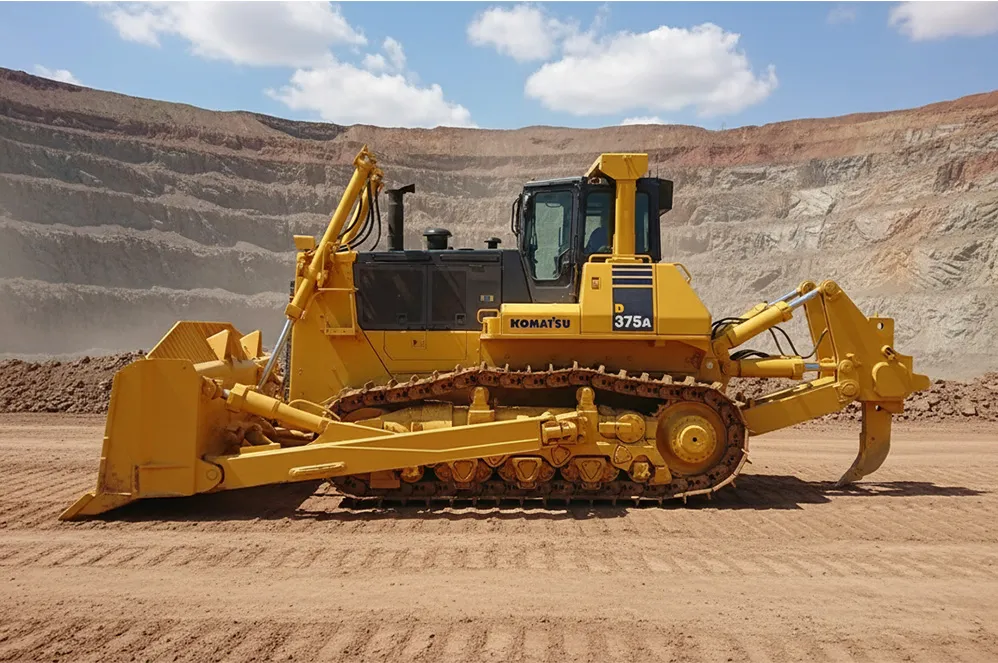
A level platform at the seam floor. The launch vehicle needs a flat, firm working area in front of the wall, wide enough to move sideways along it entry by entry. Mapping of the outcrop, plus core hole data and samples taken while the bench is made, are used to plan the panels the miner will cut. In the CIMFR design the pit was worked from the lowest seam upward: after each seam, the pit bottom was filled up to the floor of the next seam to make a new platform. Spreading and levelling that fill is dozer work, done by machines in the class of the Komatsu D375A-6, Cat D10 and BEML BD355.
Ground data for the pillar design. Depth of cover, seam thickness, the rock parting between seams, and test strengths of the coal and the roof rock above it. The CIMFR design took its rock strengths from National Institute of Rock Mechanics test results. Where two seams lie close together, the web pillars of the upper seam were placed directly above those of the lower one. The study’s models found a staggered layout weaker, with a peak pillar stress of 7.9 MPa against 8.73 MPa for pillars kept in line. Where the roof rock was weak, the design left about 1 m of coal against it to keep the entry roof standing.
A stable wall. The highwall stands over the launch vehicle and its crew for the whole life of a panel, so its slope design matters as much as the pillars. In the CIMFR study the final slope was about 47 degrees, too steep for any more benching, which is why extraction had to climb seam by seam from the bottom. The design also kept a solid barrier of at least 20 m of coal from the mine boundary.
A plan for water and gas. Wikipedia notes that highwall miners can work difficult seams using a controlled water-inflow pumping system, an inert-gas venting system, or both. The pit itself still has to be kept dry, which the guide to mine dewatering covers.
A way to load out. Coal leaves the launch vehicle continuously, so the stockpile has to be cleared just as steadily. That is a job for a big wheel loader feeding dumpers, a machine of the Cat 992K or Tata Hitachi ZW 370-5A kind, depending on output and truck size.
What can go wrong in highwall mining?
Most failures come back to the same two things: a pillar that is too thin for the rock above it, or an entry that went somewhere it should not.
| Problem | Why it happens | How the design guards against it |
|---|---|---|
| Web pillars crush one after another | Pillars too thin for the depth of cover, or thinned by a neighbouring entry that drifted | A safety factor margin, barrier pillars after every set of entries, and panels narrower than 0.6 times the depth of cover |
| The cutter drifts into the next entry | The beam string wanders or rolls sideways over hundreds of metres | Guidance sensors on the cutter, and web pillars sized with the expected drift (about 20 cm per 100 m) allowed for |
| The entry roof falls | Weak roof rock over an unsupported 3.5 m span | Leaving about 1 m of coal against a weak roof, checked in the roof stability design |
| The cutter and beams are trapped inside | A roof fall or pillar failure over the string while it is in the entry | The same pillar and roof margins, and never cutting past the designed entry length |
| Water or gas in the entry | Old workings or water-bearing rock near the seam | Water-inflow pumping and inert-gas venting on the miner, and a dry pit |
| Seams above are damaged | Pillars in the lower seam too weak, or staggered against the ones above | Long-term pillars in the lower seam, stacked in line with the pillars above |
The opencast work around a highwall still needs the usual fleet, from mining excavators to dozers and loaders, and the guide to mining equipment sets out which machine does which job. The rest of the mining series, from benches to haul roads and dewatering, sits on the mining guide hub.
Sources: John P. Loui, P. Pal Roy, A. Kushwaha and U. M. Rao Karanam, CIMFR, “Web and barrier pillar design for highwall mining”, Korean Society for Rock Mechanics international conference, October 2008; Wikipedia, Surface mining: Highwall mining; Wikipedia, Coal mining (contour mining); CSIR News, 15 July 2009, CIMFR designs first highwall mining in India.
Prices, specifications and features are indicative, vary by variant, location and date, and should always be confirmed with the official OEM or authorised dealer before any purchase decision. DesiMachines is not liable for decisions taken on the basis of information that may have changed after publication. Mining method figures in this guide come from the published design study named above and apply to that site’s ground; any real highwall mining design must be worked out for its own seam by qualified mining engineers.
Machines, tenders and news for this industry: Mining · Quarry
