
 Excavator
294 models
 Backhoe Loader
51 models
 Crane
68 models
 Concrete Mixer
79 models
 Wheel Loader
54 models
 Compactor / Roller
45 models
 Motor Grader
42 models

 Concrete Pump
66 models
 Skid Steer Loader
11 models


A lead-acid electric forklift battery wants one long, unbroken charge of six to eight hours after each shift, and regular top-ups of distilled water. A lithium-ion battery charges in one to two hours and can go on the charger at every tea break. Those charging times come from STILL, a European forklift maker, and that one difference decides most of what follows: how you charge, how often you water, and whether a two-shift operation needs a second battery.
This guide is for owners, supervisors and the person who actually plugs the truck in at the end of the day. It covers the charging routine, charger types, watering, battery changeover, the charging room and what shortens battery life. Choosing between lead-acid and lithium in the first place is a separate decision, explained in the guide to electric forklifts. Forklifts are not listed for sale on DesiMachines yet, so every figure here comes from a named maker’s page, an Indian Standard or a safety regulator’s guidance, read in October 2026.
How is an electric forklift battery charged?
Almost every forklift battery in an Indian godown is either flooded lead-acid, where the plates sit in liquid sulphuric acid that you top up with water, or lithium-ion, which is sealed. Each lead-acid cell gives about 2 volts, so an 80-volt pack like the one JCB fits to its electric forklifts is a tray of roughly 40 cells wired together. The pack sits under the operator’s seat, and you open a cover to reach the charging plug.
A modern charger does not push the same current in all the way. It works in stages. First it pushes in a high, steady current while the battery is low. As the voltage rises, the charger holds the voltage steady instead and lets the current fall away. At the end it drops to a very small current that holds the battery full. The Wikipedia article on battery chargers sets out this three-stage pattern for a lead-acid traction battery. The UK Health and Safety Executive (HSE) calls the same idea “fully controlled charging” and says it greatly reduces the risk of overcharging.
The routine at the charger is short, and the order matters. The steps below follow the HSE booklet Using electric storage batteries safely (INDG139):
- Park the truck in the charging area, switch it off and open the battery cover, so gas does not collect under it.
- On a lead-acid battery, look at the water level. It should sit just above the tops of the plates. Add a little distilled water only if the plates are showing.
- Check the charger is switched off. Then connect it, positive to positive and negative to negative, and make sure the plug is fully home.
- Switch the charger on and let it finish. Never charge faster than the battery maker’s maximum rate.
- Switch the charger off before you pull the plug.
- Let a lead-acid battery stand for at least 20 minutes so the gas clears. Then do any proper watering, up to the maker’s level.
Figure 1. One lead-acid charging cycle, start to finish
Stages 1 to 3 follow the three-stage charging pattern for lead-acid traction batteries described on Wikipedia’s battery charger page; the 20-minute stand is from HSE INDG139. A lithium-ion pack is charged by its own charger and battery management system and needs no stand time for gas or watering.
Forklift chargers come in two broad kinds: the older, heavy transformer type and the newer high-frequency electronic type. JCB, for example, says its electric forklifts plug into a GNB high-frequency charger. Either type works if it is the one the battery maker approves for that pack’s voltage and capacity. HSE says to use a charging unit recommended by the maker of the vehicle or the battery, and that is the rule to hold a dealer to.
How long does a forklift battery charge last, and how long does charging take?
Makers publish these figures in different ways, so read each one on its own terms.
Charging time and working time, as each maker publishes it
| Source | Machine and battery | Working time per charge | Charging time |
|---|---|---|---|
| STILL, UK battery-life guidance | Electric forklifts, lead-acid | Not stated | About 6 to 8 hours for a full charge |
| STILL, same page | Electric forklifts, lithium-ion | Not stated | About 1 to 2 hours |
| JCB, electric forklift FAQ | JCB electric forklift, 80 V lead-acid pack | A full 8-hour working day, which JCB equates to about 4 hours of continuous running (duty-cycle specific) | Not stated; plugs into a high-frequency charger |
| Godrej, electric stacker FAQ | Godrej electric stackers | About one shift on a full charge, on average | Not stated |
| Godrej, battery-operated hand pallet truck FAQ | Godrej powered hand pallet trucks | 3 to 5 hours of continuous operation | 2 to 3 hours |
Sources: STILL UK blog “Six tips to maximise your forklift truck battery life”; JCB.com FAQ “How to charge an electric forklift”; Godrej Enterprises intralogistics product FAQs. Read in October 2026. Working time always depends on load, lift height, distance and the operator.
Notice the gap in the JCB figure. An eight-hour shift is not eight hours of driving and lifting. A truck that waits at a loading bay draws almost nothing, so a battery that runs four hours flat out can last a full shift of normal work. The same truck on non-stop container stuffing may need a charge, or a fresh battery, before the shift ends.
Can you charge a forklift battery during breaks?
On lithium-ion, yes. That is what the chemistry is built for. Plugging in for 20 or 30 minutes at a tea break or shift change is called opportunity charging, and Godrej states that its forklift models fitted with lithium-ion batteries allow it without affecting battery life.
On flooded lead-acid, no. STILL’s advice is direct: never partially or opportunity charge a lead-acid battery. Its reasoning is about cycles. STILL puts a lead-acid forklift battery at about 1,000 to 1,500 charging cycles, and a half charge followed by another half charge spends two of them to do the work of one.
The chemistry explains why short top-ups hurt. During charging, the heavier acid sinks to the bottom of each cell. A full charge, which ends with some gassing, stirs it back up. Repeated part-charges leave the acid layered, a condition called stratification, so the top of the plates corrodes and the bottom gathers lead sulphate. That sulphate hardens into crystals (sulphation) that no longer take a charge. Wikipedia’s lead-acid battery article notes that sulphation can be avoided if the battery is fully recharged straight after a discharge. That is the whole case for one full charge a day.
The other end of the cycle matters as much. STILL’s rule of thumb is not to let a lead-acid battery drop below 20 per cent remaining charge, which means using no more than 80 per cent of it. Many trucks enforce this for you. Godrej’s 1.5 tonne electric stacker, for example, locks out lifting once the battery has discharged by 80 per cent, so the operator has to take it to the charger. If your truck does this, it is protecting the battery. Do not ask a mechanic to override it.
How do you water a forklift battery, and what water should you use?
Only flooded lead-acid batteries take water. Valve-regulated “maintenance-free” lead-acid and lithium-ion packs are sealed, and HSE notes you cannot add water to them.
A flooded battery loses water every time it gasses at the end of a charge, so the level keeps dropping with use. Use distilled or deionised water only, as HSE specifies, never tap or borewell water.
Timing is the part most yards get wrong. Before charging, add water only if the plates are exposed. STILL notes that the liquid expands as the battery works, so a cell filled to the top too early can overflow. After charging and a 20-minute stand, bring every cell up to the level the battery maker marks. STILL warns about both mistakes. Too little water lets the plates dry out and turn brittle. Too much spills acid over the top of the battery as it expands, which corrodes the tray and puts acid where operators touch.
Checking 40 cells one cap at a time is slow, which is why single-point watering systems exist: the whole tray fills from one hose connection instead of cap by cap. Flow-Rite, a US maker of such systems, sells them on the promise of faster, safer and more reliable filling than manual watering. On a fleet of trucks the time saved soon adds up, and so does the overflow avoided.
HSE also asks for a written record for each battery: installation date, charging performance and how much water went into which cell. A cell that keeps taking more water than its neighbours is telling you something before it fails.
When do you need a second battery, and how does a battery changeover work?
Do the arithmetic for your shifts. A lead-acid battery needs six to eight hours of charging and then time to cool. That fits neatly into one shift of work followed by an overnight charge. Two shifts a day leave no gap for a full charge, and three shifts certainly do not.
So multi-shift operations on lead-acid usually run two batteries per truck. One works while the other charges and cools, and at shift change they are swapped. STILL describes the fleet version of the same idea: some trucks work while others charge, rotated as needed. Heavy electric trucks use a mechanised form of it, explained in the guide to battery swapping for electric trucks and tippers.
A changeover needs proper equipment, because a forklift battery is heavy. On a counterbalance truck, Wikipedia’s forklift article notes, the large battery may serve as part of the counterweight that stops the truck tipping forward under a load. Three practical points follow from that:
- Lift the battery out with an insulated hoist or a roller stand made for it. HSE warns that batteries can be very heavy and asks for insulated lifting equipment.
- Fit only a battery the truck maker approves for that model. A different pack can change the weight the truck depends on to stay upright, so ask the dealer before you buy a cheaper or lighter replacement.
- Switch off all circuits before you disconnect or reconnect the battery, and keep metal tools off the terminals. HSE says many battery explosions happen while connections are being made or broken.
Lithium-ion changes the sum. Because it can be topped up at every break, a two-shift lithium truck often runs on a single battery, which saves the spare pack, the hoist and part of the charging room. That trade-off belongs to the lead-acid or lithium decision, worked through in the forklift guide linked above. Godrej’s multi-ion battery, a newer option, is covered in the news report on its Indian launch.
Three charging routines compared
| Routine | Best suited for | Pros | Cons |
|---|---|---|---|
| One full charge a day (lead-acid) | One shift, truck idle overnight | One battery per truck; simple; kind to lead-acid cells | Truck is tied to the charger for 6 to 8 hours plus cooling; a heavy shift can run the battery flat early |
| Battery changeover (lead-acid) | Two or three shifts on lead-acid | Truck keeps working round the clock; each battery still gets a full charge | Spare battery, lifting gear and a larger charging room; a heavy, risky handling job at every shift change |
| Opportunity charging (lithium-ion) | Two or three shifts with regular breaks | One battery; no watering; short top-ups in breaks | Higher purchase cost; needs chargers where the breaks happen; harms lead-acid batteries if copied on them |
Built from STILL’s charging guidance, Godrej’s lithium-ion statement and HSE INDG139. Which routine fits depends on your shift pattern and power supply.
How should a forklift charging area be set up?
The danger in a charging room is hydrogen. A lead-acid battery gives off hydrogen and oxygen as it nears full charge, faster still if it is overcharged, and HSE notes that hydrogen in air between 4 and 75 per cent will readily ignite and explode. A spark from a plug, a cigarette or a phone is enough.
HSE’s guidance for the charging area comes down to a few rules:
- Charge only in a dedicated, well-ventilated area. No smoking, no welding or grinding nearby, no mobile phones, and no charging under lights or other equipment that could spark.
- Treat the space within about one metre of a battery on charge as a hazardous zone, where any electrical fitting must be suitable for it.
- Hydrogen rises, so put air inlets low and outlets high, on opposite outside walls or in a door and the opposite wall.
- Keep goggles or a visor, gloves and a plastic apron at the charging point, and train whoever does the charging. Sulphuric acid burns skin and eyes.
HSE also gives a sizing rule for natural ventilation openings in a room people walk into: minimum area of each inlet and outlet = 0.3 × number of cells × overcharging current in amps × 10, in cm². Its own worked example, 24 cells and 20 A, needs 1,440 cm² (about 38 cm by 38 cm) for each opening. Run the same sum for one 80-volt forklift battery of 40 cells on a charger with the same 20 A figure and you get 2,400 cm² each. Use the maximum current your charger maker gives, not this example figure, and if natural ventilation cannot reach the number, HSE says mechanical ventilation with an alarm is needed.
The same discipline applies on a construction site, where a battery machine may be charged off a temporary supply or a DG set. The guide to charging an electric machine on site covers the power connection side.
What shortens a forklift battery’s life?
The Indian Standard for these batteries, IS 5154 (Part 1):2013, lead-acid traction batteries, gives a precise meaning to “battery life”. It counts the charge-and-discharge cycles a battery completes until its capacity falls to 80 per cent of its rated capacity. Every habit below uses up those cycles faster.
Habits that shorten a lead-acid forklift battery’s life
| Habit | What it does to the battery | What to do instead |
|---|---|---|
| Running it below 20% charge | Deep discharge strains the plates and runs the electrics hot (STILL) | Charge at 20% left; respect the truck’s lift lockout |
| Short top-up charges | Uses extra cycles; leaves the acid layered and builds hard sulphate | One full, unbroken charge after each shift |
| Leaving it standing discharged | Sulphate crystals harden and stop taking charge | Put it on charge at the end of the shift, not the next morning |
| Overcharging or a mismatched charger | Heavy gassing, water loss, heat and explosion risk (HSE) | Use the approved charger; let it stop itself |
| Low water | Exposed plates dry out and turn brittle (STILL) | Check on the routine the battery maker sets; water after charging with distilled water |
| Overfilling | Acid overflows, corrodes the tray and terminals | Fill only to the maker’s mark, after charging |
| Heat | Excessive heat damages the battery and cuts its life (STILL) | Charge in a shaded, ventilated area; ask for a battery rated for your conditions |
| Dirt and corroded connectors | Slows charging and causes faults (STILL) | Clean the battery top and terminals every month |
Sources: STILL UK battery-life guidance; HSE INDG139; Wikipedia, lead-acid battery (sulphation and stratification). Lithium-ion packs avoid the watering and sulphation rows but still suffer from heat and from the wrong charger.
Heat deserves a word for Indian conditions. IS 5154 rates capacity at 30 °C and corrects test results by 0.6 per cent for each degree away from it. A battery tested at 20 °C, for example, gives about 6 per cent less than at 30 °C. So a pack does feel stronger on a hot afternoon, but STILL warns that heat shortens its life. A charging bay under a tin roof in May is a poor place for an expensive battery.
What should you check about the battery before buying an electric forklift?
Ask the dealer to put these in writing, for the battery as well as the truck:
- Battery voltage and capacity in Ah, and the rate it is quoted at. IS 5154 rates capacity over a 5-hour discharge at 30 °C, so compare like with like.
- The cycle life the maker states, and what counts as the end of it. IS 5154 measures life to 80 per cent of rated capacity.
- Battery warranty in cycles or years, and what voids it. Missed watering and the wrong charger are the usual exclusions.
- The approved charger model, its input supply (single-phase or three-phase) and its maximum current. You need that current to size the charging room.
- Whether a single-point watering system and a battery discharge indicator with lift lockout are fitted.
- For two or three shifts, the price and weight of a spare battery and the lifting gear to change it, or the lithium alternative.
- Who services the battery and the charger, and how fast they reach your site.
A forklift traction battery is a different product from the 12-volt or 24-volt starter battery in a diesel backhoe or excavator, which cranks the engine and runs the lights. For that kind of battery, read the construction machine battery guide.
Which electric machines can you buy on DesiMachines?
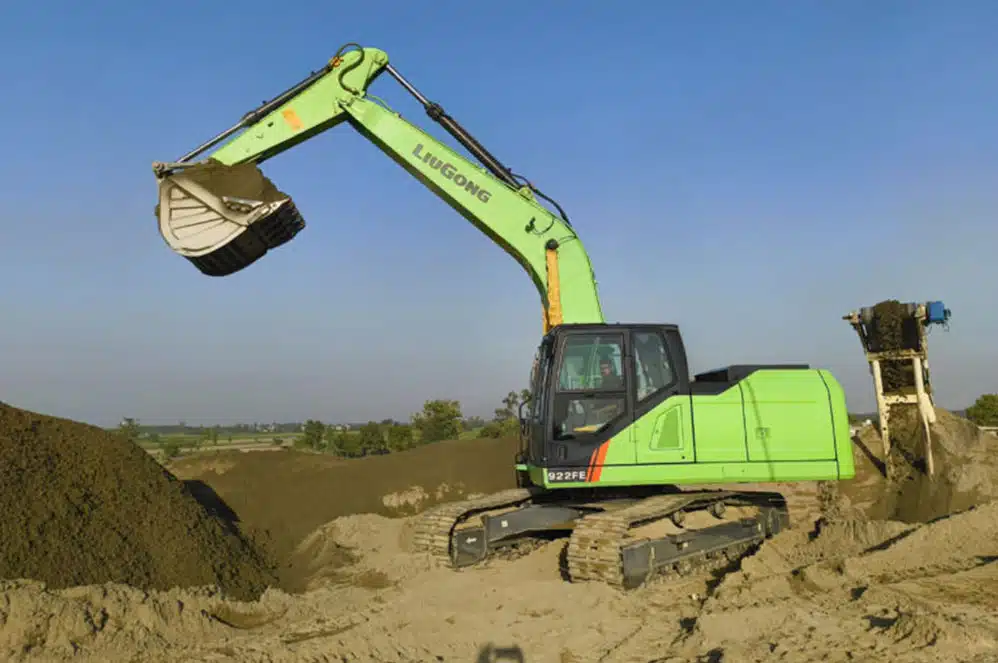
Forklifts are not listed yet, but electric excavators are, and the battery ones need the same discipline: the approved charger, a full charge and a ventilated, sheltered place to charge. The LiuGong 922FE Battery carries an LFP (lithium iron phosphate) battery, per its current specification. The Volvo EC500 Electric is also listed, and the full set is in the electric excavator range. For the wider question of when electric makes sense against diesel, read electric vs diesel construction machines. Stackers and pallet trucks run on the same kinds of battery and are covered in the guide to electric pallet trucks and stackers.
If an electric machine is going on finance, a spare battery or a charger installation is part of the real cost, so include it when you look at equipment finance options. Every electric machine type covered so far is in the guide to electric construction machines. To compare listed electric models and send an enquiry, browse the electric excavator models and prices, and tell the dealer your shift pattern and power supply.
Figures are quoted from STILL’s UK battery-life guidance, JCB.com’s electric forklift FAQ, Godrej Enterprises’ intralogistics product FAQs and the Godrej 1.5 tonne electric stacker product page, HSE leaflet INDG139 (rev1) and IS 5154 (Part 1):2013, read in October 2026. Forklifts and the makers named here are not listed for sale on DesiMachines. Prices, specifications and features are indicative, vary by variant, location and date, and should always be confirmed with the official OEM or authorised dealer before any purchase decision. DesiMachines is not liable for decisions taken on the basis of information that may have changed after publication.