
 Excavator
294 models
 Backhoe Loader
51 models
 Crane
68 models
 Concrete Mixer
79 models
 Wheel Loader
54 models
 Compactor / Roller
45 models
 Motor Grader
42 models

 Concrete Pump
66 models
 Skid Steer Loader
11 models


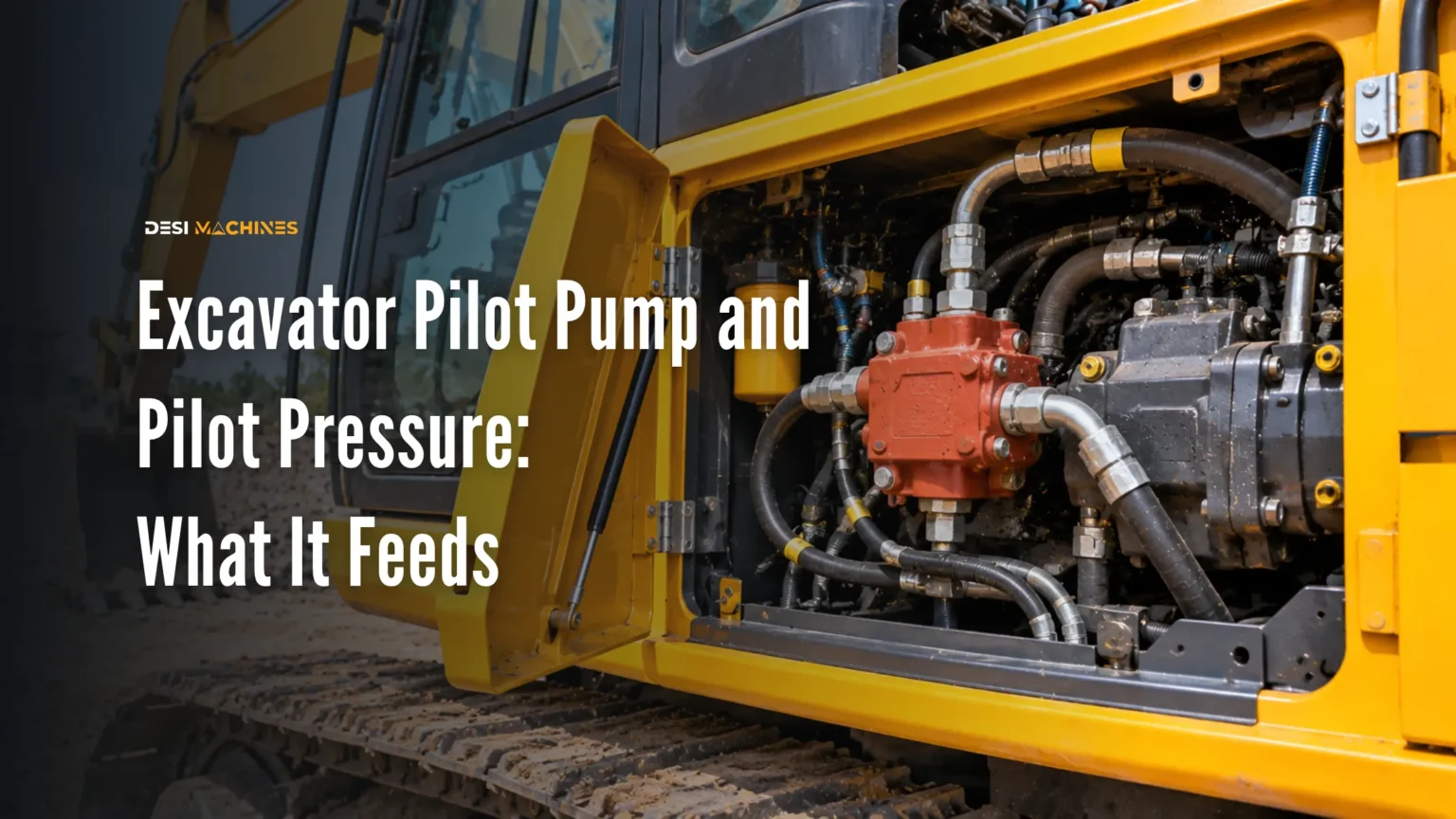
An excavator’s pilot circuit works at 24 to 50 bar (2.4 to 5.0 MPa). The circuit doing the digging on the same machine works at 147 to 373 bar, so the pilot oil carries about a tenth of the pressure, and that thin supply is the reason a light push on a joystick can open a valve holding ten times as much.
The pump that provides it is the pilot pump. It is a small gear pump driven off the back of the main hydraulic pump, turning whenever the engine turns, and it makes none of the oil that digs.
This guide covers what the pilot pump feeds, what pilot pressure does after it leaves the pump, what the figure actually is on machines sold in India, the other parts sitting in that circuit, and how a pilot fault announces itself. It carries no prices, because a pilot pump, a pilot filter or a joystick valve is quoted against your machine and its serial number. If one of those is what brought you here, raise the request with your machine details on the construction equipment spare parts page.
What is a pilot pump on an excavator?
A pilot pump is the small secondary pump that supplies control oil to the valves and joysticks, as opposed to the work oil that moves the boom, arm, bucket, swing and tracks. On almost every hydraulic excavator it is a gear pump: two meshing gears in a tight housing, displacing a fixed amount of oil for each turn. Of the 294 excavators listed in India, 211 name a gear pump in the pilot pump line of their specifications.
Fixed displacement is the point. The two big main pumps on an excavator are variable, swinging their swash plate to make more or less oil as the work demands. Control oil must not behave that way. The joysticks need the same supply at idle and at full throttle, so the pilot pump is built to deliver steady flow at steady pressure, and that flow is a small fraction of what the machine moves: on a 20-tonne excavator the main pumps are rated at 2 x 220 litres per minute, while the entire control circuit runs off one small gear pump.
Physically it is bolted to the rear of the main pump assembly and driven by the same shaft, which is why a pilot pump is often quoted and fitted as part of that assembly rather than on its own. Where it sits among the other hydraulic parts is set out in the guide to excavator parts and components, and the rest of the service items live in the parts and running costs guides.
What does pilot pressure actually do?
Pilot pressure does three jobs: it pushes the spools inside the main control valve, it tells the main pumps how much oil to make, and it feeds the small switching valves around the machine. None of it lifts a load. All of it decides what the oil that does lift the load will do next.
The joystick is where this starts, and a joystick is not a switch. It is a pressure-reducing valve with a lever on top. Move the lever a little and it sends a little pressure; move it to the stop and it sends close to full pilot pressure. Kawasaki Precision Machinery, which builds the pumps and valves fitted to a large share of the world’s excavators, describes its PV series pilot valves as pressure-reducing valves that simultaneously control the spools of multiple control valves and the tilting angle of the variable displacement pumps. The same sheet rates each model by output pressure, rated flow, maximum lever angle and port size, and lists its uses as excavators, mini excavators and rough terrain cranes, with a damped pedal version for travel.
Read that sentence again and the whole architecture is in it. One small movement of a lever is doing two things at once: opening a spool so oil can reach a cylinder, and asking the pump to produce the oil that spool is about to pass. That second part is why a machine with a pilot fault can feel lazy rather than dead, and why the same maker’s excavator control valves are offered for negative and positive control systems, which it names Negacon and Posicon, each setting pump output from the control signal in its own way.
What the spools themselves do is covered in the guide to the excavator main control valve, and the two patterns the levers can be wired to are in excavator joystick controls, including the pattern change valve that swaps the pilot lines feeding the two joysticks.
How much pilot pressure does an excavator run?
Across the excavators listed in India, 202 machines publish a pilot circuit pressure, and 199 of those publish it as a single figure rather than a range. Those 199 run from 2.4 to 5.0 MPa (24 to 50 bar). One value dominates: 113 machines, more than half the set, sit at exactly 3.9 MPa (39 bar).
The figure clusters by maker far more than by machine. Every Komatsu in the set is at or below 3.2 MPa, from the 7-tonne PC71 to the 200-tonne PC2000-8. Every Volvo is at 3.9 MPa. Eight of the nine Kobelco machines are at 5.0 MPa, the highest reading anywhere in the set, and the ninth is the smallest of them.
Table 1: Pilot circuit pressure by maker, excavators listed in India
| Maker | Machines with a published figure | Pilot circuit | Pilot pump type |
|---|---|---|---|
| SANY | 38 | 3.5 to 4.0 MPa (35 to 40 bar) | Gear pump |
| Tata Hitachi | 32 | 2.4 to 4.4 MPa (24 to 44 bar) | Gear pump |
| XCMG | 21 | 3.5 to 3.9 MPa (35 to 39 bar) | Gear pump |
| Hyundai | 21 | 2.9 to 3.9 MPa (29 to 39 bar) | Gear pump |
| Komatsu | 18 | 2.9 to 3.2 MPa (29 to 32 bar) | Gear pump |
| Volvo | 17 | 3.9 MPa (39 bar) | Gear pump |
| JCB | 17 | 3.9 to 4.5 MPa (39 to 45 bar) | Gear pump |
| LiuGong | 15 | 3.9 MPa (39 bar) | Gear pump |
| Kobelco | 9 | 3.2 to 5.0 MPa (32 to 50 bar) | Gear pump |
| BEML | 6 | 2.94 to 3.43 MPa (29.4 to 34.3 bar) | Gear pump |
| Yanmar | 3 | 2.9 to 3.9 MPa (29 to 39 bar) | Gear pump |
| CAT | 1 | 4.1 MPa (41 bar) | Gear pump |
| SDLG | 1 | 3.9 MPa (39 bar) | Not specified |
Narrow the view to one size class and the spread survives. These seven machines are all in the 20-tonne class, within about three tonnes of each other, and their pilot pressure differs by more than half again from the lowest to the highest while their digging pressure stays in a much tighter band.
Table 2: Pilot and implement circuit pressure in the 20-tonne class
| Machine | Operating weight | Pilot circuit | Implement circuit |
|---|---|---|---|
| Tata Hitachi EX 200 Infra | 19,800 to 20,000 kg | 3.9 MPa (39 bar) | 27.9 MPa (279 bar) |
| JCB NXT 205 | 20,500 kg | 4.0 MPa (40 bar) | 34.3 MPa (343 bar) |
| Kobelco SK220 | 20,600 kg | 5.0 MPa (50 bar) | 34.3 MPa (343 bar) |
| Komatsu PC210-10M0 | 20,900 kg | 3.2 MPa (32 bar) | 37.3 MPa (373 bar) |
| SANY SY210C-9 | 20,900 kg | 3.9 MPa (39 bar) | 34.3 MPa (343 bar) |
| Hyundai R210 SMART Plus | 21,200 kg | 3.4 MPa (34 bar) | 32.3 MPa (323 bar) |
| Volvo EC210D | 22,800 kg | 3.9 MPa (39 bar) | 32.4 to 34.3 MPa (324 to 343 bar) |
The practical use of this table is narrow and real: it is the number a technician sets a gauge against. A pilot reading that looks low on one make is normal on another, so the figure to judge a machine by is the one in its own operator manual, not a workshop rule of thumb.
Why doesn’t pilot pressure rise with machine size?
Pilot pressure does not scale with the machine because pilot oil carries a signal, not a load. The spool it has to push and the regulator it has to tilt are roughly the same size on a small machine and a large one, so the pressure needed to move them barely changes.
The listed specifications show it plainly. The smallest machine in the set, the XCMG XE20U at 1,800 kg, runs 3.5 MPa. The largest, the Tata Hitachi EX 2600-6 at 258,000 kg, runs 3.9 MPa. The machine is 143 times heavier and its control pressure is 0.4 MPa higher. Averaged across the set, the 25 machines under 6,000 kg sit at 3.50 MPa and the 38 machines over 40,000 kg at 3.73 MPa.
Now put the work circuit beside it. Implement pressure across the same machines runs from 14.7 MPa on the smallest minis to 37.3 MPa on the heavy classes, a spread of more than two and a half times, because that pressure is what breaks ground. Pressure and flow by size class, for all four circuits, are set out in the guide to excavator hydraulic pressure and pump flow.
This is also the reason a pilot fault feels so out of proportion. A blocked filter the size of a fist can stop a 25-tonne machine from working while its main pumps, rated in hundreds of litres a minute, stay in perfect health.
What else is in the pilot circuit?
Besides the pump, the pilot circuit holds a filter, a relief valve, the gate lock valve, the joystick and pedal valves, often a small accumulator, and the thin lines joining them. Oil leaves the pilot pump, is filtered, is capped at its set pressure, passes the lock valve, waits at the joysticks, and returns to tank from the spool ends once a lever moves.
Figure 1: How pilot oil travels from the pilot pump to the main control valve
The engine drives the main pump assembly, which carries the pilot gear pump on its rear. Pilot oil passes through the pilot filter and past the pilot relief valve, which caps pressure and returns excess oil to the tank. It then passes the gate lock valve, which the lock lever closes, and reaches the joystick and pedal valves. From there a reduced pressure goes two ways: to the spool ends of the main control valve, and back to the main pump regulator to set swash plate angle. Work oil from the main pumps goes separately through the main control valve to the cylinders and motors.
Engine
drive shaft
Main pumps
2 variable
Pilot gear
pump
Pilot
filter
Pilot relief
valve
Gate lock
valve
Joystick and
pedal valves
pressure reducing
Main control
valve spools
to cylinders
Hydraulic tank
pump regulator signal
excess oil
lock lever closes
Blue arrows are pilot oil. The green arrow is the pilot signal arriving at the main control valve. The dashed line is the same signal going back to set pump output. Grey lines return oil to the tank.
The pilot filter is the part owners meet most often. It is finer than the main return filter because the spools and orifices it protects are far smaller, and it is usually a small spin-on or cartridge element near the pilot pump or on the valve block. When it blocks, control pressure drops at the joysticks and the machine goes slow and vague before it goes dead. Change intervals for it and the other elements are in the guide to excavator filters.
Setting the number in Table 1 is the job of the pilot relief valve. It holds the circuit at the rated pressure and dumps the rest to tank, which is why pilot pressure stays steady while engine speed changes.
The gate lock valve is a small solenoid valve in the pilot line that cuts control oil when the lock lever is raised, so a knee against a joystick does nothing. It fails in both directions, and the guide to the solenoid valve covers how to test one.
Thin hoses carry the pilot oil, at roughly eight times lower pressure than a boom line. Those pilot lines still have to be the right assembly, correctly routed and crimped, and hydraulic hose sizes and ratings explains how the circuit decides the hose rather than the machine brand.
Many machines also carry a small pilot accumulator, a steel bottle holding a charge of pressurised oil. Its job is to let the boom be lowered after the engine stops, which matters for a breakdown on a slope and for recovery after a stall.
What are the signs of a pilot pressure problem?
The signature of a pilot fault is everything going weak or dead together while the engine runs normally. Boom, arm, bucket, swing and travel all lose power or stop responding at once, there is no new noise from the pumps, and the machine often still starts and idles perfectly. A single function failing on its own is almost never the pilot circuit, because one pilot supply feeds them all.
Working through it in order:
- Nothing moves at all, engine fine: suspect the lock lever and its gate lock valve first. It is the cheapest and most common cause, and it is a two-minute check.
- Everything is slow, lazy or vague, and worse when hot: suspect the pilot filter and the pilot pump. A partly blocked filter and a worn gear pump produce the same symptom, which is why a gauge reading, not a guess, separates them.
- Normal when cold, dying after an hour: thin hot oil leaks past worn clearances faster, so a tired pilot pump can hold pressure cold and lose it warm.
- One joystick movement is weak or drifts on its own: suspect that joystick valve rather than the supply. Creep when the lever is at rest usually means a worn spool or a broken return spring inside the valve.
- The boom will not lower with the engine off: the pilot accumulator has lost its charge. The machine works, but a recovery option is gone.
- Pressure falls after a hose job: a pilot line fitted to the wrong port or a crimp leaking internally shows up as a general loss of control.
One warning on diagnosis. Dirty oil holds small spools in place, and the valves in a pilot circuit are the smallest on the machine, so a pilot complaint is often really an oil-condition complaint. Checking the oil and the pilot filter before condemning a pump is the order that costs the least.
What should an owner check and keep in the file?
Four things, and the first two cost nothing. Test the lock lever every week: raise it and confirm the controls go dead. Keep the pilot filter on the same schedule as the hydraulic filter instead of treating it as an extra, which is where it quietly gets skipped, and the practice around oil condition and intervals is in hydraulic system maintenance.
Third, copy your machine’s own pilot pressure out of the operator manual and into the service file, with the engine speed it is measured at. Table 1 is for orientation, not for setting a relief valve: 3.2 MPa is healthy on a Komatsu and low on a Kobelco.
Fourth, when a pilot pump is genuinely the answer, note that it usually comes as part of the main pump assembly, and that a quote turns on the machine model and serial number, the pump assembly fitted, whether the gear pump is sold separately on that model, and whether seals, the drive coupling and the pilot filter go with it. Those are the details to send with an enquiry on the construction equipment spare parts page.
If you are choosing a machine rather than mending one, the 20 ton excavator comparison sets the popular models side by side, and the full range of excavators listed in India is where to check specifications and reach a dealer near you.
Where the figures in this guide come from
The pressures, pump types, flows and weights are read from the listed technical specifications of 294 excavators at the time of writing, which is the same data the machine pages show. Of those, 202 publish a pilot circuit pressure and 214 fill in a pilot pump entry, 211 of them naming a gear pump. Three machines publish the pilot figure as a range instead of a single value, so they are counted in the 202 but left out of the maker bands in Table 1. Three others carry something that is not a pump type in the pilot pump line, and none of those is quoted here.
The description of what a pilot valve does, and the ratings a pilot valve is specified by, are from Kawasaki Precision Machinery’s own product sheet, named above. Pressures for your own machine, test points, and the engine speed each figure is measured at must come from its operator manual, which is the only document that can be set a gauge against.
Source: Kawasaki Precision Machinery, PV series pilot valve product sheet (PV48/PVD/PV6P). Machine figures are from the listed technical specifications at the time of writing. Specifications and features are indicative, vary by variant, location and date, and should always be confirmed with the official OEM or authorised dealer before any purchase decision. DesiMachines is not liable for decisions taken on the basis of information that may have changed after publication.
Get a pilot pump price from a dealer near you
Tell us your machine and what you need, and we will ask the nearest dealer to reach out to you with a price.