
 Excavator
294 models
Excavator
294 models  Backhoe Loader
51 models
Backhoe Loader
51 models  Crane
68 models
Crane
68 models  Concrete Mixer
79 models
Concrete Mixer
79 models  Wheel Loader
54 models
Wheel Loader
54 models  Compactor / Roller
45 models
Compactor / Roller
45 models  Motor Grader
42 models
Motor Grader
42 models  Dozer
41 models
Dozer
41 models  Concrete Pump
66 models
Concrete Pump
66 models  Skid Steer Loader
11 models
Skid Steer Loader
11 models  Telehandler
13 models
Telehandler
13 models 


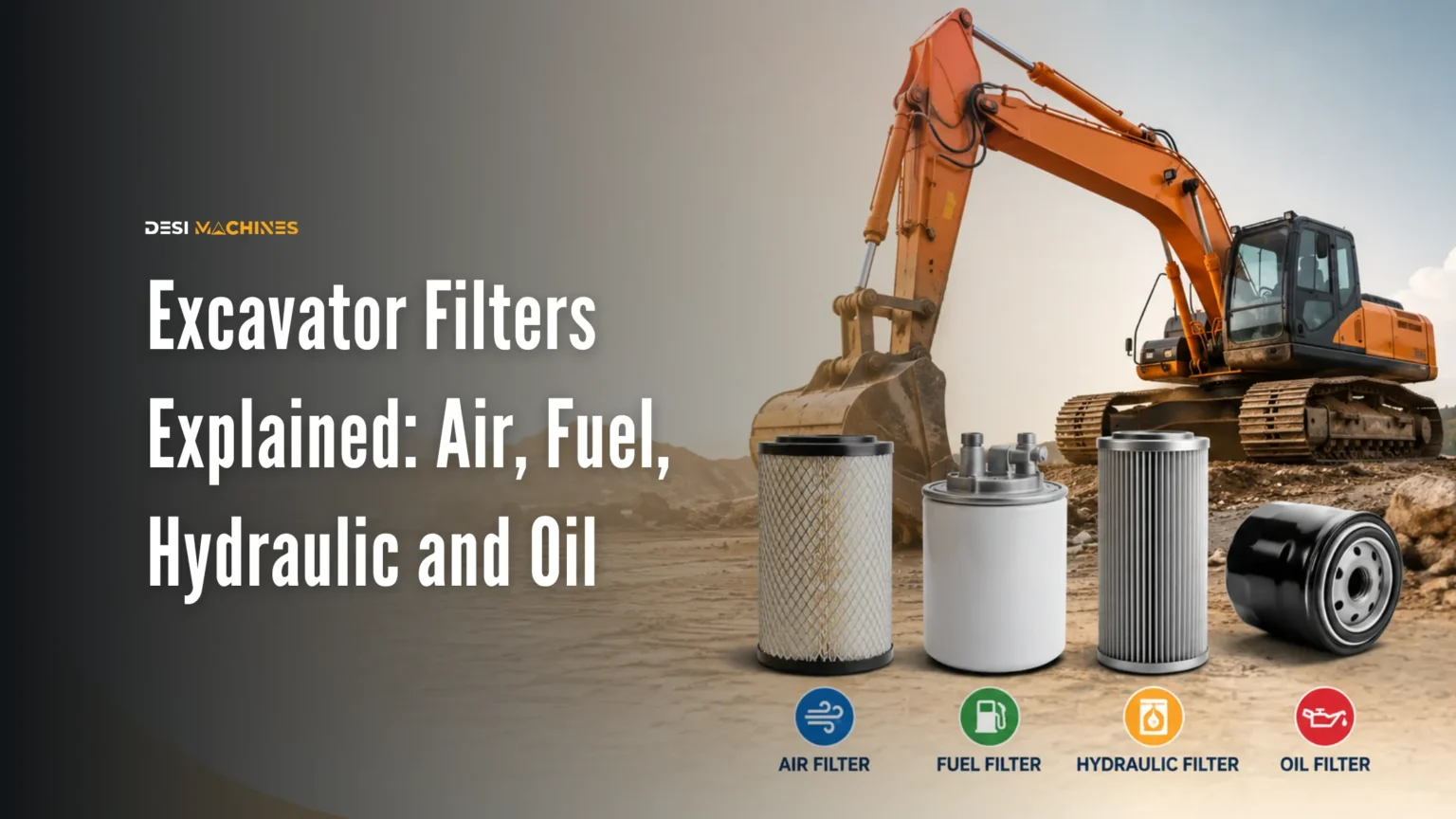
Excavator filters are the replaceable elements that clean the air going into the engine, the diesel going into the injectors, the oil circulating through the engine, and the oil circulating through the hydraulic system. An excavator carries at least four kinds, sometimes six, and every one of them exists to keep grit out of a part that grit destroys.
They are the cheapest items on the whole machine and the ones most often stretched past their life. On an Indian site that is a bad trade. Dust, monsoon water and diesel of uneven quality all load filters faster here than the manual assumes, and a choked filter does not stop the machine politely. It quietly costs you fuel and power for weeks, then takes an expensive component with it.
This guide explains what each filter does, what happens when it blocks, and how to tell which one is causing a problem you are already seeing.
What filters does an excavator have?
An excavator has four filter systems as standard, and two more that are common:
- Air filter: cleans the air the engine breathes. Usually two elements, an outer primary and an inner safety element.
- Fuel filter: cleans the diesel. Usually two stages: a water separator with a clear bowl, then a fine filter close to the engine.
- Engine oil filter: cleans the oil circulating inside the engine. A single spin-on cartridge on most machines.
- Hydraulic filters: clean the oil running the pumps, rams and motors. There is normally a return filter and a pilot filter, and a suction strainer inside the tank.
- Cab air filter: cleans the air the operator breathes. Ignored almost everywhere, and the reason cab air conditioning stops working.
- Breather or vent filter: lets the hydraulic tank and the engine crankcase breathe without drawing dust in.
Each of these protects a different set of parts, and the failure each one prevents is different. That is worth understanding, because owners often treat “filters” as a single line item on a service bill when the four systems have very different consequences.
If your machine is a backhoe loader rather than an excavator, the list is longer. A backhoe loader filter kit adds a transmission filter, because a backhoe is built on a tractor with a gearbox and a drive axle that an excavator does not have.
| Filter | What it cleans | What it protects | What a blocked one causes |
|---|---|---|---|
| Air filter | Intake air | Cylinder liners, pistons, rings, turbo | Power loss, black smoke, extra diesel, scored liners |
| Fuel filter and water separator | Diesel | Injectors, injection pump | Hard starting, misfiring, surging, loss of power under load |
| Engine oil filter | Engine oil | Bearings, camshaft, turbo bearings | Filter goes into bypass and unfiltered oil circulates |
| Hydraulic filters | Hydraulic oil | Pumps, control valve, rams, travel and swing motors | Slow or jerky movement, overheating oil, pump wear |
| Cab filter | Cab air | The operator, and the air conditioning | Weak or no cooling, dust in the cab |
For what sits behind each of these systems, the guide to excavator parts and components maps the machine out part by part, and how to read an excavator spec sheet explains the numbers a dealer will quote you alongside them.
What does the air filter do, and what happens when it chokes?
The air filter stops dust reaching the inside of the engine. A diesel engine swallows an enormous volume of air, and on a dry Indian site that air is carrying fine abrasive dust. Any of it that gets past the filter goes down the inlet, into the cylinder, and acts like grinding paste between the piston ring and the liner.
Most excavators use two elements in one housing. The outer primary element does the work and is the one you clean or change. The inner safety element sits behind it and exists only to catch dust during the few seconds the housing is open, or if the primary tears. It is never cleaned; it is replaced, less often, and always with the engine off.
When the primary element chokes, the engine cannot pull the air it needs and the fuel it is injecting has too little oxygen to burn. The symptoms follow in order: the machine feels flat under load, the exhaust smokes black, and fuel consumption climbs. A choked air filter costs diesel long before it triggers any warning light, which is why fuel consumption is such a useful early-warning gauge. Which engine is actually in your machine changes the part numbers you need, and the guide to engine brands on construction machines in India covers who builds them. If your machine is already smoking, the guide to black smoke from an excavator exhaust works through the causes in order.
Two habits do most of the damage here. The first is blowing the element out with a site air line at full pressure, which drives holes through the paper you cannot see. If you must clean an element, use low pressure from the inside outwards, and hold it up to a light afterwards. The second is running without the element while “the new one is coming”. A few hours of that can cost you a liner.
What do the fuel filters do?
The fuel filters keep water and grit out of the injection system, which is the least forgiving part of a modern excavator. How that system works, and the signs that an injector is failing, are covered in the guide to fuel injectors and injection pumps.
Diesel injection components are machined to clearances finer than a human hair and are lubricated by the diesel itself. Water in the fuel removes that lubrication and corrodes the parts; grit scores them. Neither is repairable in the field, and injectors are among the more expensive things on the machine to replace.
Most machines have two stages. The water separator comes first, usually with a clear bowl and a drain tap at the bottom, and it uses the simple fact that water is heavier than diesel to drop it out. The fine fuel filter comes second, close to the engine, and catches what the separator does not.
Draining the water separator is a daily job that takes fifteen seconds: open the tap, let the water run out until clean diesel appears, close it. In monsoon months it earns its keep several times over, because water gets into fuel through condensation in a half-empty tank as much as through bad diesel. Keeping the tank full overnight is a genuine preventive measure, not an old wives’ tale, since there is less air space in which moisture can condense.
A blocking fuel filter behaves differently from a blocking air filter. The engine starts hard, runs unevenly, and loses power specifically when you ask for it. The machine is fine idling and dies under a heavy dig. If air is bleeding in on the suction side rather than fuel being blocked, you get the same symptoms, so check the filter seals and the bowl O-ring before condemning anything expensive.
What does the hydraulic filter do?
The hydraulic filter keeps metal particles and dirt out of the oil that runs every movement the machine makes. On an excavator this matters more than on most machines, because the hydraulic system is the machine: the boom, arm, bucket, swing and both tracks all run on that oil.
Hydraulic components generate their own contamination as they wear, so the oil picks up fine metal even in a healthy machine. The return filter catches it on the way back to the tank. When that filter is left in past its life it does not simply stop working, which would at least be obvious. It goes into bypass: a spring-loaded valve opens to stop the filter collapsing, and unfiltered oil flows straight past it and back into the tank. From that moment the grit circulating in the system is being pumped through the pump and valves rather than caught.
The symptoms are slow, and easy to blame on age. Movements get slower or jerkier, the oil runs hotter than it used to, and the pump starts to whine. Persistent heat has other causes too, set out in the guide to excavator overheating in India. By the time a pump is noisy, the damage has been accumulating for a long time. Oil grades, cooling and filter changes are covered in the hydraulic system maintenance guide, and the quantities each machine takes are set out in the guide to engine oil and hydraulic oil capacity of excavators.
One rule is worth stating on its own: never change hydraulic oil and leave the old filter in, and never fit a new filter and push it full of old dirty oil. The two go together, and doing one without the other wastes both.
How often should excavator filters be changed in India?
Filters are changed against the hour meter, not the calendar, and the machine’s own service schedule sets the marks. Broadly, fuel and engine oil filters go with the engine oil at the regular service, hydraulic filters run longer, and the air filter is judged on condition rather than a fixed interval.
The hour marks themselves are set out in the guide to the construction equipment service schedule in India, which walks through what happens at the daily check, at 250 hours, at 500 hours and beyond. What that guide also makes clear is the point that matters most here: the manual’s interval is a ceiling, not a target, and Indian working conditions routinely justify a shorter one.
Shorten the interval when the machine is:
- Working in heavy dust, feeding a crusher, working a quarry, or on a dry earthworks site in summer. Air filters here can need attention weekly.
- Running a breaker. A hydraulic breaker puts far more heat and shock into the oil than digging does, and ages it faster.
- Working through the monsoon, where water in fuel and mud on the machine both increase.
- Old, or recently repaired. After any pump or motor failure the system carries debris from that failure for a long time, and the first few filters after a repair should be changed early and cut open. The excavator hydraulic motors guide explains which components that debris reaches first.
The habit that separates a well-run machine from a badly-run one is cheap: cut the old filter open when you change it. A return filter with visible metal in the pleats is telling you something about the pump that no gauge on the machine will.
Looking at machines? Compare excavator models, specifications and prices and connect with a dealer near you.
Does filter quality make a difference?
They do, and filters are the part where the difference is hardest to see and most expensive to get wrong.
A filter is not just a container of paper. What matters is how fine the medium is, how much dirt it can hold before it blocks, whether the pleats stay open under flow, and whether the bypass valve inside it opens at the pressure the machine expects. None of that is visible from the outside, and a cheap filter that looks identical can be filtering a fraction as well while costing a third as much.
The practical position most owners land on is reasonable: fit filters that meet the maker’s specification on the hydraulic and fuel systems, where the parts being protected are the expensive ones, and be more relaxed about cab filters. What is never worth it is a filter of unknown origin on a machine still under warranty, because a fuel or hydraulic failure will be traced back to it. What to check before you fit any part is set out in the spare parts guide.
One warning specific to filters: counterfeits of the major brands are common and are packaged convincingly. Buy from an authorised dealer or an established parts house rather than the cheapest listing, keep the invoice, and be suspicious of a price far below the market.
What are the signs a filter needs changing?
Most filter problems announce themselves as a change in how the machine behaves rather than as a warning light. Read the symptom back to the system it belongs to:
- Black smoke and a flat feel under load, with fuel use climbing. Look at the air filter first.
- Hard starting, misfiring, or dying under a heavy dig while idling fine: fuel filter or water separator.
- Slow or jerky boom and arm movement, hot oil, a whining pump: hydraulic filter, and check the oil level and cooler at the same time.
- Air conditioning gone weak with dust visible on the vents: cab filter, and it is usually the cheapest fix on the machine.
- A service indicator or restriction gauge showing red on the air filter housing: believe it, and do not reset it without changing the element.
None of these are difficult diagnoses, and none need a workshop. What they need is somebody walking round the machine each morning with the habit of noticing. The greasing and lubrication guide covers the rest of that daily walk-round, and the guide to parts and running costs puts filters in the context of what a machine actually costs to keep working.
Filters are the smallest line on an owner’s cost sheet and the one with the largest downside if it is skipped. A set of filters costs a fraction of one injector, and a small fraction of one hydraulic pump.
Ready to buy? Browse the full range of excavators and talk to a dealer about parts support before you decide.
A blocked element usually announces itself on the dash before anyone hears a change in the engine: what that lamp and the other symbols on the display mean is set out in excavator warning lights.
Service intervals, filter specifications and part grades vary by machine, variant and working conditions, and should always be confirmed against your machine’s own operator manual and with the official OEM or authorised dealer. Prices, specifications and features are indicative, vary by variant, location and date, and should always be confirmed with the official OEM or authorised dealer before any purchase decision. DesiMachines is not liable for decisions taken on the basis of information that may have changed after publication.