
 Excavator
294 models
Excavator
294 models  Backhoe Loader
51 models
Backhoe Loader
51 models  Crane
68 models
Crane
68 models  Concrete Mixer
79 models
Concrete Mixer
79 models  Wheel Loader
54 models
Wheel Loader
54 models  Compactor / Roller
45 models
Compactor / Roller
45 models  Motor Grader
42 models
Motor Grader
42 models  Concrete Pump
66 models
Concrete Pump
66 models  Skid Steer Loader
11 models
Skid Steer Loader
11 models  Telehandler
13 models
Telehandler
13 models 


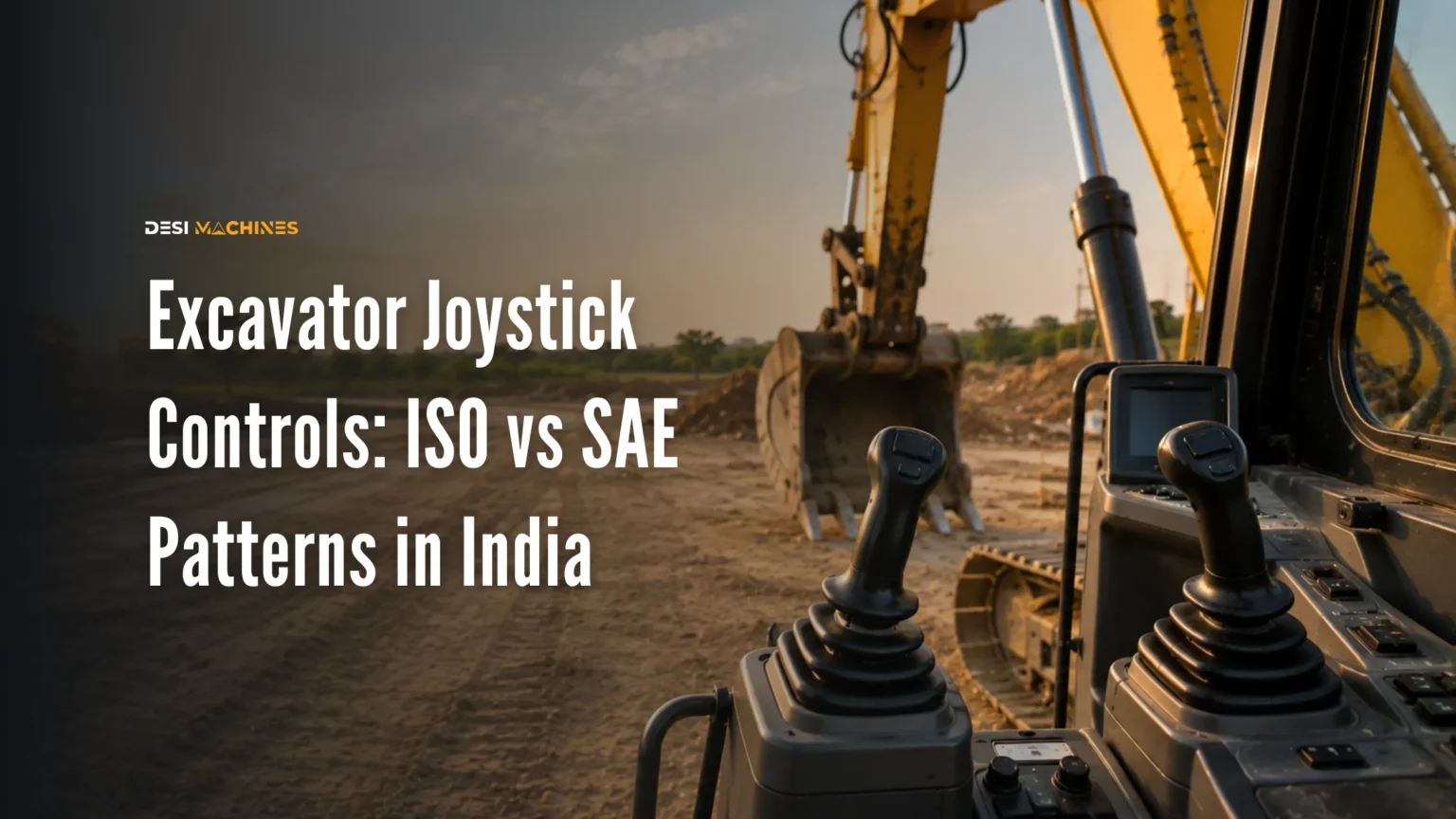
This guide explains what each lever does in both patterns, how to check your machine before you start, whether the pattern can be changed, and how the rest of the cab controls work.
What do the two joysticks on an excavator control?
The two joysticks work four movements between them. Every excavator, from a 1.5 Tonne (1,500 kg) mini machine to a 90 Tonne (90,000 kg) mining class, uses the same four.
Boom is the big lower arm that lifts away from the machine body. Boom up raises the whole front end; boom down lowers it and is what pushes the bucket into the ground.
Stick is the second arm, between the boom and the bucket. Most Indian operators call it the arm or the dipper. Stick in pulls the bucket toward the machine, which is the movement that actually fills the bucket in a normal dig. Stick out pushes it away.
Bucket curls in and dumps out. Curl closes the bucket to hold the material; dump opens it to drop the load.
Swing, also called slew, turns the whole upper body on its bearing, so the cab, boom and engine rotate together while the tracks stay where they are. This is what lets an excavator dig on one side and load a tipper on the other without moving.
Those four are the joystick movements. Travelling is separate, on foot pedals or a second pair of levers, and we come to that further down. The parts themselves are covered in more depth in the excavator components guide, and the excavator boom guide goes into boom design and reach.
What is the difference between the ISO and SAE control patterns?
The difference is which joystick controls the boom and which controls the stick. Swing and bucket sit in the same place in both patterns; only boom and stick swap between the left and right joystick.
In the ISO pattern, the left joystick works the stick and the swing, and the right joystick works the boom and the bucket. In the SAE pattern, the left joystick works the boom and the swing, and the right joystick works the stick and the bucket.
ISO is often called the excavator pattern, and SAE the backhoe pattern, because that is roughly where each one came from. Here is the full layout side by side.
| Joystick movement | ISO pattern | SAE pattern |
|---|---|---|
| Left joystick forward | Stick out | Boom down |
| Left joystick back | Stick in | Boom up |
| Left joystick left | Swing left | Swing left |
| Left joystick right | Swing right | Swing right |
| Right joystick forward | Boom down | Stick out |
| Right joystick back | Boom up | Stick in |
| Right joystick left | Bucket curl in | Bucket curl in |
| Right joystick right | Bucket dump out | Bucket dump out |
Read the two columns against each other and it becomes simple. Swing is on the left in both, bucket is on the right in both, and boom and stick trade places.
Neither pattern is better. An operator who has spent years in ISO will be quicker and safer in ISO, and the same is true in reverse. What causes damage is assuming. A man who steps into a hired machine, pulls the left joystick back expecting the stick to come in, and instead lifts a loaded boom over a labourer’s head has not made a skill mistake. He has made a pattern mistake, and it takes a second.
How do you find out which pattern your excavator is set to?
Check three things, in this order, before the machine does any work.
The cab decal. Almost every machine carries a printed sticker showing the two joysticks with arrows for each movement, usually on the cab pillar beside the seat or on the right console. That decal is the fastest answer. Treat it with some caution on an older or second-hand machine, because if the pattern was ever changed and nobody replaced the sticker, the decal is now lying to you.
The operator manual. Slower but reliable, and it also tells you whether the machine has a pattern changer at all.
A controlled test. Do this on flat ground, with an empty bucket resting on the ground, nobody inside the swing radius, and nothing overhead. Start the engine, release the safety lock lever, and move the left joystick gently forward by a small amount. If the stick pushes out away from you, the machine is in ISO. If the boom drops, it is in SAE. Move it a few centimetres, not the full stroke.
Never work this out by trial and error with a loaded bucket, on a slope, or with people near the machine. This is the check that costs thirty seconds and saves a hospital visit, and it belongs in the same daily routine as the pre-start walk-around covered in the equipment safety, checks and operator training guide.
Can you change an excavator’s control pattern?
On most machines, yes. The usual arrangement is a pattern change valve: a small selector, often under the cab floor plate or behind the operator seat, that swaps the pilot oil lines feeding the two joysticks. Turning it moves the boom and stick functions from one joystick to the other. On newer machines with electronic controls, the same swap can sometimes be done from the display menu.
Three things to know before you change anything.
Not every machine has the valve. Some need a conversion kit, and on a few models the change is a workshop job rather than a five-minute one. Ask the dealer for your specific model before you promise an operator a pattern change.
Get it done through the dealer if the machine is under warranty. Pilot lines carry the control oil for the whole front end, and a leak or a crossed line there is not a small problem.
Replace the decal afterwards. This is the step people skip. A machine that has been switched to SAE but still carries an ISO sticker is a genuine hazard on a shared site, on a rental fleet, or on the day you sell it. Write the new pattern on the sticker if a replacement decal is not available.
If you are inspecting a used machine, add the pattern to your checklist along with hours and undercarriage wear. The used excavator buying guide covers the rest of that inspection, and the excavator undercarriage guide explains what wear on the tracks and rollers is telling you.
Why are backhoe loader controls different from excavator controls?
Because a backhoe loader is two machines in one body, and each end has its own set of controls.
At the front, the loader shovel is worked from the forward-facing driving seat with a single lever, much like a wheel loader. At the back, the operator swings the seat around to face the rear and works the backhoe end with two levers that do the same four movements an excavator does: boom, stick, bucket and swing. The seat turns; the machine does not.
This matters in India more than almost anywhere else, because a very large share of operators learn on a JCB-type backhoe first and move to a tracked excavator later. The four movements they already know carry across. The layout does not, nor does the fact that the whole upper body swings instead of just the boom. That transition is where a pattern mismatch does the most damage, because the muscle memory is real but it is pointing at the wrong lever.
If you are still deciding between the two machine types, the backhoe loader guide and the TLB explainer set out what each one is built to do, and the types of excavators guide maps the excavator side of the family.
What are the other controls in an excavator cab?
The joysticks are only part of it. Six other controls decide how the machine behaves, and a first-time owner should know all of them.
Travel levers and pedals. Two levers stand up in front of the seat, each with a pedal at its base, and each one drives one track. Push both forward together and the machine goes straight. Push one and the machine turns. Push one forward and one back and it counter-rotates, turning almost on the spot.
There is a trap here that catches every new operator. The travel levers drive the tracks, but the operator is sitting on the upper body, which swings. If the house has been swung around, pushing both levers forward drives the machine backwards relative to where you are looking. The habit that prevents this is simple: before travelling, look down at the tracks and find the blade or the drive motors, so you know which way the undercarriage is actually pointing.
The safety lock lever. A lever beside the left armrest, which cuts pilot pressure when it is raised. With it up, the joysticks do nothing at all. It goes up every time the operator leaves the seat, without exception, and it is the reason a machine does not move when someone climbs in and knocks a lever.
Throttle dial. Sets engine speed. Full throttle is not always right — for fine work, lower engine speed gives smoother, more controllable movement and burns less diesel.
Work modes. Most machines sold in India offer selectable modes, commonly labelled something like heavy, standard and economy. They change the balance between hydraulic power and fuel burn. Heavy mode for rock and hard digging; economy for loading loose material or grading.
Auto-idle. Drops the engine to idle automatically after a few seconds with no joystick input, and picks up again the moment you move a lever. On a machine that waits for tippers half the day, this saves real diesel and does it without the operator having to think about it.
Attachment control. A foot pedal or a roller switch on a joystick, feeding the auxiliary hydraulic line for a breaker, a thumb or a shear. What it does depends on what is fitted — see the excavator attachments guide and the hydraulic rock breaker guide for how those lines are set up and sized.
Compact machines follow the same logic in a smaller cab, and skid steers do it differently again — the skid steer steering and controls guide is worth reading if you run both.
What is grade control, and do you need it in India?
Grade control is a system that tells the operator, or the machine itself, exactly how deep the bucket is against the level the job requires. It replaces the man standing in the trench with a level staff.
There are two levels of it. A 2D indicate system uses sensors on the boom, stick and bucket plus a laser or a reference on site, and shows depth and slope on a screen in the cab. The operator still does the digging; the screen just removes the guesswork. A 3D system adds GPS and the job’s design file, so the machine knows the finished level at every point on the site, and on some machines it can hold the bucket on grade automatically.
Whether it earns its keep here depends entirely on the work. On long trenching runs, canal work, large formation levels and anything where a re-dig costs a day, it pays back quickly in fewer passes and less over-excavation. On a mixed contractor’s fleet doing foundations, drain lines and loading, a skilled operator with a good site engineer is still the sensible answer, and the money goes further into the machine itself.
If you are buying, treat it as a separate decision from the machine. Ask the dealer what the base model supports, what the retrofit costs, and who services it in your state. A system nobody nearby can calibrate is a screen that gets switched off by month three.
How long does it take to learn excavator controls?
The four movements themselves take a few days. Coordinating them takes months.
Most people can raise a boom, curl a bucket and swing within a day or two of seat time. What separates that from an operator worth hiring is doing three or four movements together, smoothly, in one continuous motion — boom up while swinging while curling the bucket, then placing the load without a jerk. That coordination is what fills a tipper in four passes instead of seven, and it comes from hours in the seat, not from a manual.
Training in India runs mainly through OEM operator training centres, dealer-run programmes and government skill-development schemes, and what is available varies a lot by state, so ask your dealer what runs near you. Whatever route you take, the pattern check in this guide belongs at the start of it. An operator who has been taught to identify the control pattern before touching the joysticks is already safer than one who has not, regardless of how many hours he has.
Browse the current range of excavators to compare cab layouts and machine sizes, or look at how the classes differ in the excavator size classes guide before you shortlist.
Excavator controls, in short
Two joysticks, four movements, two possible layouts. Swing sits on the left joystick and the bucket on the right in both patterns; boom and stick are the pair that swap. ISO puts the stick on the left and the boom on the right, SAE does the opposite.
Check the pattern before every unfamiliar machine, using the cab decal first and a small controlled test second. Most machines can be switched by the dealer, and if yours is switched, change the sticker on the same day.
Everything else in the cab — travel levers, safety lock, throttle, work modes, auto-idle — is learned once and used forever. The pattern is the one thing that changes from machine to machine, which is exactly why it is the one thing worth checking every time.
When you are ready to compare machines, see the full range of excavators and prices and speak to our team for your state, or read the excavator applications guide to match a machine size to the work you actually do.
Prices, specifications and features are indicative, vary by variant, location and date, and should always be confirmed with the official OEM or authorised dealer before any purchase decision. DesiMachines is not liable for decisions taken on the basis of information that may have changed after publication.