Excavator
294 models
 Backhoe Loader
51 models
 Crane
68 models
 Concrete Mixer
79 models
 Wheel Loader
54 models
 Compactor / Roller
45 models
 Motor Grader
42 models

 Concrete Pump
66 models
 Skid Steer Loader
11 models


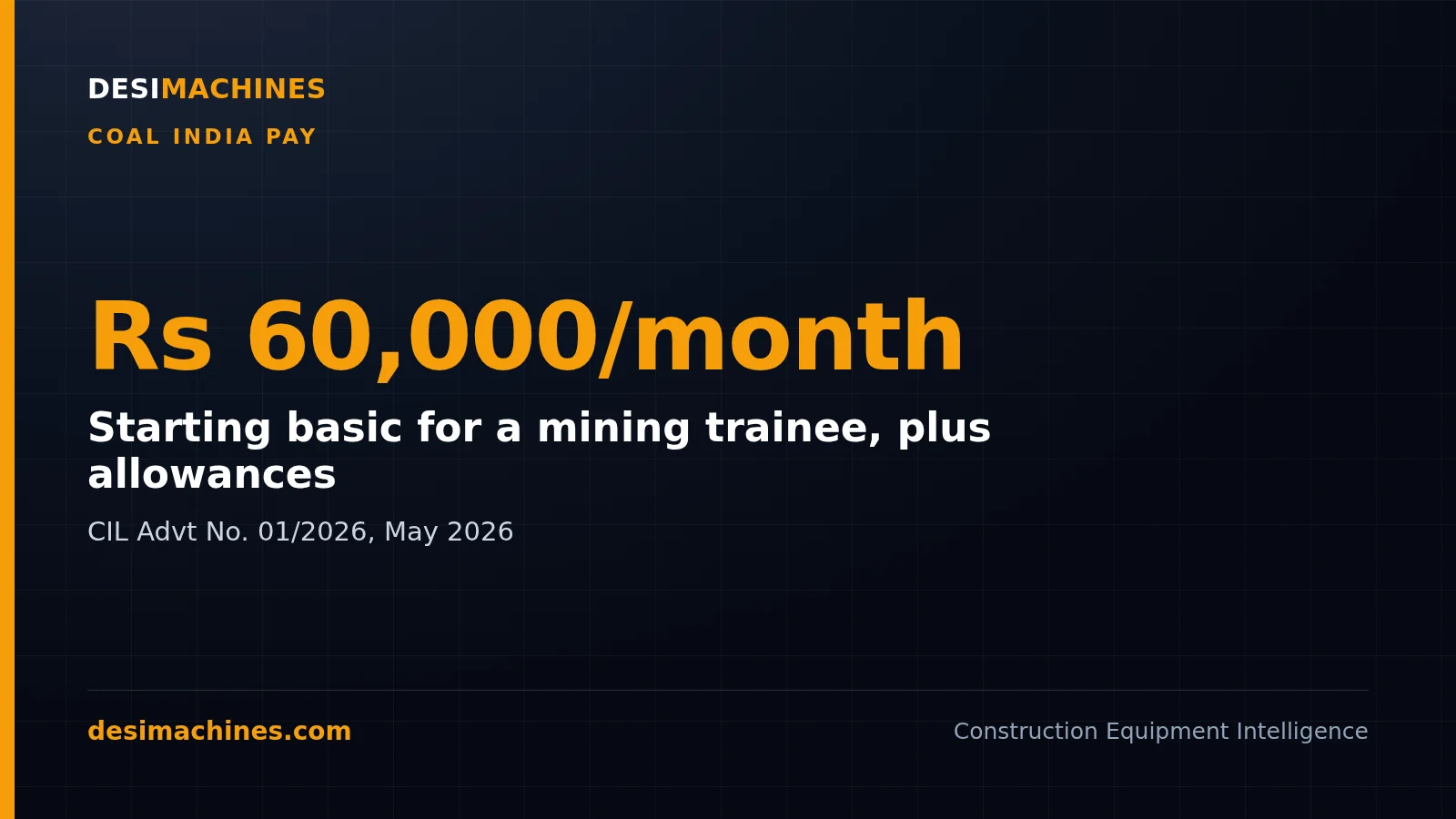
A fresh graduate mining engineer at Coal India starts on a basic of Rs 60,000 a month, on a Rs 60,000 to 1,80,000 scale, under the company’s May 2026 trainee notice, with dearness allowance, HRA and perks on top. That is the clearest published mining engineer salary in India. The published ladder runs to Rs 80,000 to 2,20,000 for a Manager (Mining) holding a First Class certificate at NMDC and Rs 1,20,000 to 2,80,000 for a Coal India General Manager. A diploma holder entering as a Mining Sirdar at Western Coalfields starts on Rs 47,330.25 basic (July 2026). Private mines and mining contractors do not publish pay.
What does a fresh mining engineer earn at Coal India? Rs 60,000 a month in basic pay, before allowances, on a scale that runs to Rs 1,80,000. That figure comes from Coal India’s Advertisement No. 01/2026, issued in May 2026 for 276 Management Trainee (Mining) posts filled on GATE-2025 scores.
The better question is which rung you are on and which certificate of competency you hold. The public sector prints its scales, so the ladder below comes from its notices.
Mining engineer salary in India at Coal India, grade by grade
These are basic pay scales from Coal India’s notices and promotion orders; allowances come on top.
| Post | Basic pay scale (Rs a month) | Source and date |
|---|---|---|
| Management Trainee (Mining), E-1 | 60,000 to 1,80,000 (starts at 60,000) | CIL Advt No. 01/2026, May 2026 |
| Senior Officer (Mining), E2, promoted from the non-executive cadre | 50,000 to 1,60,000 | CIL selection order, 2 Jan 2026 |
| Deputy Manager, Mining I Class or II Class channel, E4 | 70,000 to 2,00,000 | CIL promotion orders, 30 Jan 2026 |
| Manager (Mining I Class), E5 | 80,000 to 2,20,000 | CIL promotion orders, 30 Jan 2026 |
| Senior Manager (Mining I Class), E6 | 90,000 to 2,40,000 | CIL promotion orders, 26 Aug 2025 |
| General Manager, E8 | 1,20,000 to 2,80,000 | CIL Advt LR(09)/2026, 7 Oct 2026 |
Watch the grade numbers. Coal India’s January 2025 trainee notice put management trainees in E-2 at Rs 50,000 and moved them to E-3 at Rs 60,000 after a year. The May 2026 notice calls the Rs 60,000 to 1,80,000 scale E-1 and starts trainees there. Read the scale on your letter, not the grade label.
What the basic leaves out
The notice adds dearness allowance, HRA, cafeteria-style perks and performance-related pay, plus CMPF, pension and gratuity, and says pay varies with the posting. It prints no gross monthly figure, so the honest answer to “mining engineer salary per month” is the basic plus a dearness allowance that changes every quarter.
One deduction catches new joiners. Trainees sign a Rs 3 lakh service bond (plus GST) for 60 months, and Rs 5,000 a month is cut from salary towards it, refunded without interest after five years.
Diploma mining engineering salary in India
A diploma holder’s regular route is a statutory supervisor’s post. Western Coalfields’ Employment Notification No. 2026/69 of 16 July 2026 offered 220 Mining Sirdar posts in T&S Grade-C at an initial basic of Rs 47,330.25 a month under the eleventh National Coal Wage Agreement (NCWA-XI). Dearness allowance, attendance bonus, special allowance, HRA, transport subsidy and medical cover are paid on top. A diploma in mining engineering with an Overman’s certificate, a gas-testing certificate and a first-aid certificate meets the requirement.
The contract route pays a flat figure. NMDC’s Employment Notification No. 04/2026 of 22 April 2026 hired 59 Junior Engineers (Mining) on contract at Rs 60,000 a month consolidated, for up to three years at first, with a rise of up to 5 per cent a year on performance. A diploma was the minimum and a Foreman’s certificate for metal mines was desirable. The rung below, and how to earn that certificate, is set out in how to get a mining foreman certificate.
The contract figure looks higher, but it carries no dearness allowance and no regular grade. The Sirdar’s basic is only the starting line.
Mining engineer salary in Coal India against Odisha and NMDC
Does the mining engineer salary in Odisha differ? At Coal India it does not. Mahanadi Coalfields, the Coal India subsidiary that mines in Odisha, uses the same executive grades and the same wage agreement as the rest. Coal India’s trainee notice says you may be posted to any subsidiary, so you cannot pick Odisha at the hiring stage.
NMDC, the iron ore miner, pays on its own grades. Its Employment Notification No. 02/2026 of 18 February 2026 for the Tokisud North coal mine in Jharkhand set these scales:
- Manager (Mining), M-5, as safety, blasting or production officer: Rs 80,000 to 2,20,000, for a mining degree, a First Class Mines Manager’s certificate (Coal) and three years after it.
- AGM (Mining), M-7: Rs 1,00,000 to 2,60,000, with eight years after the First Class certificate.
- Junior Manager (Survey), M-2: Rs 50,000 to 1,60,000, for a mining or mine-survey diploma with a Mines Surveyor’s certificate.
For who else hires in each mineral, see mining companies in India.
Why the Manager’s certificate moves pay
Years in the job raise your basic by increments. The Manager’s certificate of competency, granted by the Board of Mining Examinations under the Directorate General of Mines Safety (DGMS), decides which posts you can legally hold. Posts are what pay follows.
The Coal Mines Regulations, 2017 set the bar. Regulation 27 says an opencast coal mine handling more than 20,000 cubic metres of material a month needs a manager with a First Class certificate; a smaller one may take a Second Class holder. A belowground mine producing over 2,500 tonnes a month needs a First Class certificate not restricted to opencast work. Regulation 15 lets a mining degree holder sit the First Class exam after two years of practical experience gained after the degree, against five years for a mining diploma.
Metal mines follow the Metalliferous Mines Regulations, 1961. Regulation 34 requires a First Class manager wherever deep-hole blasting or heavy machinery is used to dig and remove earth, stone or mineral. In practice that takes in almost every mechanised opencast metal mine.
The employers price this in. Coal India splits promotions to Deputy Manager into a Mining I Class and a Mining II Class channel, and its senior mining posts in the orders above are all I Class. NMDC asked for a First Class certificate plus three years for every Manager (Mining) post it advertised. A non-executive who earns a Second Class certificate can be selected into the executive cadre as Senior Officer (Mining) on Rs 50,000 to 1,60,000, as Coal India’s 2 January 2026 order shows.
What private mines and contractors pay
Private mine owners, mine developer-operators (MDOs) and overburden-removal contractors do not publish pay scales. Any figure quoted for them is an estimate, and we will not invent one.
What moves the offer is clear enough. The certificate comes first, because every mine needs a certified manager and supervisors. The size of the job follows: a contractor moving overburden with shovels such as the BEML BE1800E loading a dumper fleet needs engineers who can plan benches, haul roads and blasts (see how overburden removal works). Site allowance, camp accommodation, food and shift pattern decide the rest.
One published pointer exists. NMDC’s February 2026 notice asks private-sector applicants for its Rs 80,000 Manager (Mining) grade to show a cost to company of at least Rs 23.10 lakh in each of the last two years. That is an eligibility test, not a pay survey, but it shows what NMDC treats as equal to its scale.
Contractors hire when they win work, so tracking live overburden removal and mining tenders shows which firms are about to staff a new site.
How the mining ladder compares with the site ladder
The public-sector entry for a mining graduate sits well above the private civil band, where a fresher earns roughly Rs 18,000 to 28,000 a month (indicative), as the breakdown of site engineer salary by experience shows. The billing route on the civil side is covered in quantity surveyor salary in India. The trade-off is the posting: remote pits and a five-year bond.
The question to ask before you sign
Ask the employer this: “What will my gross pay be each month in the first year, after dearness allowance, HRA, perks and any bond deduction, and does this post sit on the First Class or the Second Class channel?” The first half tells you what lands in your account. The second tells you how far the post can take you.
Pay scales, allowances and recruitment rules change. Confirm the current terms with the employer’s latest notice, and the certificate rules with DGMS, before you accept or offer a job.