Excavator
294 models
Excavator
294 models  Backhoe Loader
51 models
Backhoe Loader
51 models  Crane
68 models
Crane
68 models  Concrete Mixer
79 models
Concrete Mixer
79 models  Wheel Loader
54 models
Wheel Loader
54 models  Compactor / Roller
45 models
Compactor / Roller
45 models  Motor Grader
42 models
Motor Grader
42 models  Dozer
41 models
Dozer
41 models  Concrete Pump
66 models
Concrete Pump
66 models  Skid Steer Loader
11 models
Skid Steer Loader
11 models  Telehandler
13 models
Telehandler
13 models 


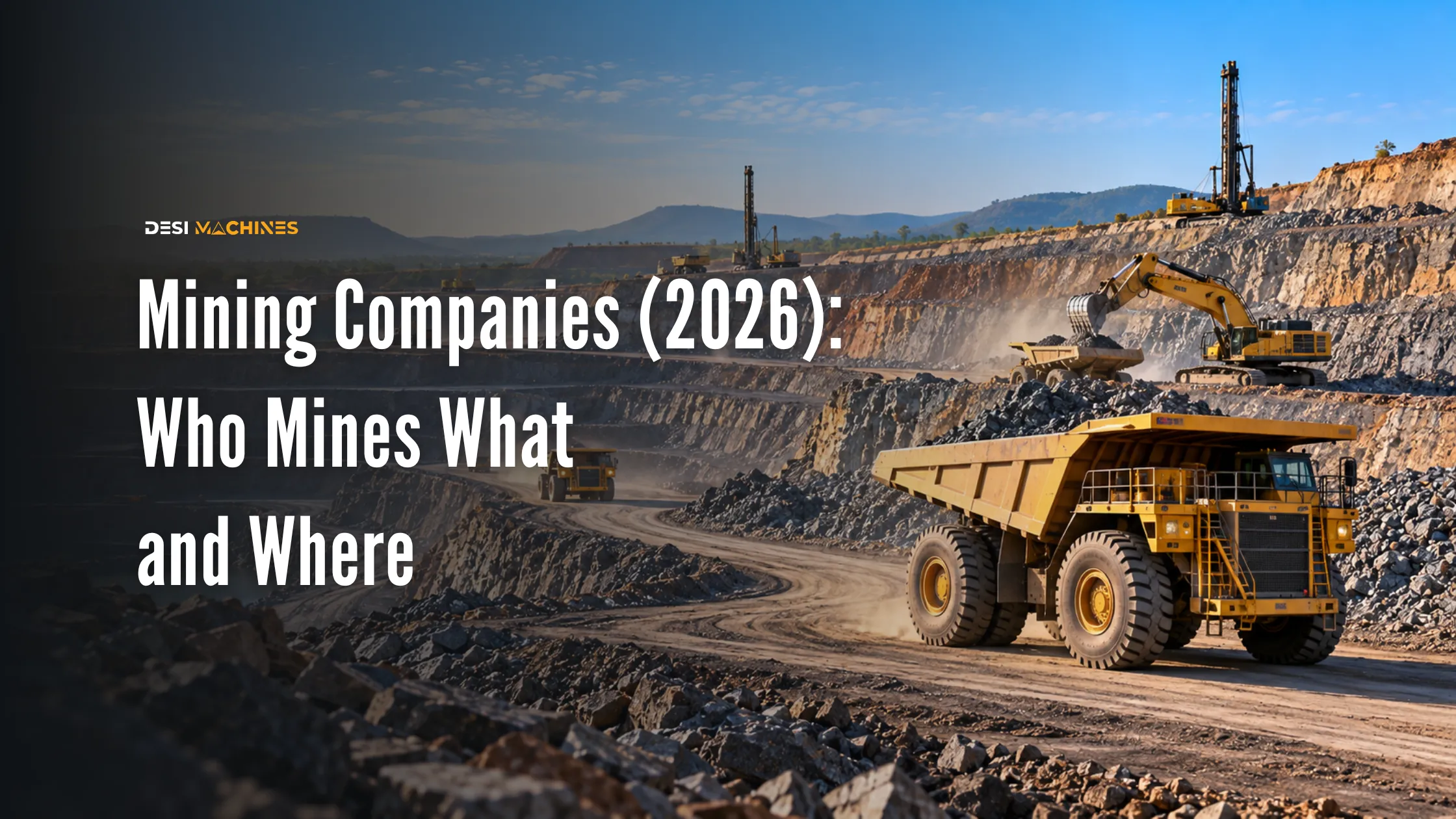
As of October 2026, the top mining companies in India on published output are Coal India, which produced 768.14 million tonnes of coal in the year to March 2026 through eight subsidiaries; NMDC, which produced 53.15 million tonnes of iron ore and became the first Indian company to pass 50 million tonnes; and NLCIL, the largest of eight lignite producers at 21.28 million tonnes. The fastest growth was not at any of them: captive and commercial coal mines lifted output 8.72% to 214.69 million tonnes while Coal India slipped 1.65%. Every figure here is dated and taken from an official government document.
That last number is the one worth watching if you own or hire out machines. Captive and commercial blocks are largely worked on contract, which means the fleets on them are a mix of owned and hired, and the hiring is done several layers below the name on the block. How that chain is put together, which concession a pit holds and who pays whom is set out in the guide to how mining in India is organised. This page is the current scoreboard.
How this list of the top mining companies in India was built
A company appears here when the Ministry of Coal’s own production returns carry its output, or when an official government release does. The coal and lignite tables are ordered by production for the year to March 2026, because that is a dated figure published by the ministry for every company in them. Everywhere else the order is alphabetical and is not a ranking. Where a company publishes no tonnage, it is named with what it does and no number is invented for it.
The coal and lignite figures are marked provisional by the ministry. Subsidiary figures are each rounded, so they need not add exactly to a group total.
Which companies produce the most coal in India?
Coal India mines through eight subsidiaries, each of which is a large mining company in its own right. Mahanadi Coalfields alone raised more coal last year than every captive and commercial mine in the country put together.
| Producer | 2025-26 (MT) | 2024-25 (MT) | Change |
|---|---|---|---|
| Mahanadi Coalfields (MCL) | 218.31 | 225.17 | down 3.05% |
| South Eastern Coalfields (SECL) | 176.29 | 167.49 | up 5.25% |
| Northern Coalfields (NCL) | 140.50 | 139.00 | up 1.08% |
| Central Coalfields (CCL) | 82.21 | 87.54 | down 6.09% |
| Western Coalfields (WCL) | 63.03 | 69.12 | down 8.81% |
| Eastern Coalfields (ECL) | 52.09 | 52.03 | up 0.10% |
| Bharat Coking Coal (BCCL) | 35.52 | 40.50 | down 12.30% |
| North Eastern Coalfields (NEC) | 0.20 | 0.20 | level |
| Coal India, all subsidiaries | 768.14 | 781.06 | down 1.65% |
| Singareni Collieries (SCCL) | 58.00 | 69.01 | down 15.94% |
| Captive and commercial mines | 214.69 | 197.46 | up 8.72% |
| All India | 1,040.83 | 1,047.52 | down 0.64% |
Two lines in that table matter more than the ranking. Singareni Collieries, which describes itself on its own website as a government company working the Godavari valley coalfields, dropped almost 16% in a single year. And the captive and commercial line, at 214.69 million tonnes, has grown past seven of Coal India’s eight subsidiaries.
Coal India also publishes which of its mines carry the load. Its top 35 mines produced 577.03 million tonnes of the group’s 768.14, so a little over a third of the output came from the remaining 242 producing mines. The biggest single pits in the March 2026 return were Gevra in South Eastern Coalfields at 55.80 million tonnes, Dipka in the same subsidiary at 37.49 million tonnes, Kusumunda at 32.70 million tonnes, Jayant and Dudhichua in Northern Coalfields at about 30.00 and 25.00 million tonnes, and Nigahi, also Northern Coalfields, at 25.00 million tonnes. Mahanadi Coalfields runs the longest list of large mines, thirteen of them inside the top 35.
Who mines lignite in India?
Lignite is a separate industry with its own set of companies, most of them state or central public sector undertakings feeding nearby power stations. Eight reported output in 2025-26, for a combined 41.44 million tonnes, down 8.50% on the year.
| Producer | 2025-26 (MT) | 2024-25 (MT) |
|---|---|---|
| NLCIL | 21.28 | 24.16 |
| GMDCL | 7.88 | 8.02 |
| BLMCL | 5.49 | 5.98 |
| GIPCL | 3.03 | 3.42 |
| GSPL | 1.83 | 1.79 |
| RSMML | 0.92 | 1.06 |
| VS Lignite | 0.92 | 0.79 |
| GHCL | 0.09 | 0.08 |
| All lignite | 41.44 | 45.29 |
Only three of the eight grew, and all three were among the smallest. For a machine owner the useful point is scale: six of these companies move less than six million tonnes a year, which is a fleet in the tens of machines rather than the hundreds, and a size at which hired machines are a normal part of the plan rather than an exception.
Which companies mine iron ore and other minerals?
NMDC is India’s largest iron ore producer. The Ministry of Steel announced on 2 April 2026 that it produced 53.15 million tonnes in 2025-26, up about 21%, and sold 50.23 million tonnes, up 13%, becoming the first company in the country’s mining history to pass 50 million tonnes in a year. The ministry named Kirandul and Bacheli in Chhattisgarh and Donimalai in Karnataka as the mines behind the record, each recording its best performance to date. In the same year NMDC commissioned Deposit 4 at Bailadila in Chhattisgarh and brought its first coal mine, in Jharkhand, into operation.
Beyond coal and iron ore the pattern changes. India’s bauxite, zinc, lead, manganese, chrome and limestone are worked largely by a few specialists and by steel, aluminium and cement companies mining captively for their own plants, and most of them publish no mine-by-mine tonnage at all. No figures are given for them here, because none were reachable in a company filing or an official document when this page was written. What a machine owner can take from that silence is that captive mines run to a plant’s appetite rather than to a market, so they run steadily and contract long.
Where is the mining work?
Coal India’s own payments to the central and state exchequers up to March 2026 were made in eight states: Assam, Chhattisgarh, Jharkhand, Madhya Pradesh, Maharashtra, Odisha, Uttar Pradesh and West Bengal. Jharkhand, Madhya Pradesh and Chhattisgarh together accounted for about 69% of the group’s tax and royalty payments in March 2026, which is a fair proxy for where the coal work sits. NMDC’s iron ore mines add Chhattisgarh and Karnataka, and its new coal mine adds Jharkhand again.
Where the coal goes explains who the customer really is. Captive and commercial mines dispatched 212.55 million tonnes in 2025-26, and this is how it split.
| Who took the coal | 2025-26 (MT) | 2024-25 (MT) |
|---|---|---|
| Power stations | 161.53 | 156.85 |
| Captive power plants | 22.37 | 15.60 |
| Steel | 12.22 | 8.18 |
| Cement | 2.57 | 1.82 |
| Sponge iron | 2.04 | 4.88 |
| Other users | 11.83 | 9.90 |
| All captive and commercial | 212.55 | 197.24 |
Three quarters of it is burnt for electricity, and the steel and captive-power lines grew fastest, at 49% and 43%. Those are the blocks being developed now, which is where new fleets are being put together. Dispatch runs a little below production because some coal stays at the pithead.
How a machine owner gets near this work
There is no single register. The state-owned producers buy hire and work packages through e-procurement, and Singareni Collieries, for one, publishes a vendor registration format alongside its tender notices on its own website. The practical route is to pick the coalfield you can physically reach, watch its portal, and bid the smallest packages first to build a record. Captive block holders and the contract operators under them run their own empanelment instead, which turns on machine age, maintenance records, operator strength and whether you can hold a monthly output commitment.
Two things decide most of these assessments and neither is the machine: documentation, meaning insurance, fitness, operator certificates and a clean service history; and whether you can survive a payment cycle that on mining contracts runs long. Live mining and earthwork packages from the government desks are collected under open tenders and opportunities, and the machine side of the question, which size of loading tool suits which pit, is covered in the mining-class excavators above 50 tonnes and in the guide to types of mines in India.
The bottom line
The published figures say two things at once. Coal India is still the industry, at roughly three quarters of national coal output, and it is shrinking slowly. The growth is in captive and commercial blocks, up 8.72% in a year, and those are the mines worked on contract and the ones most likely to need a hired machine this season. Follow the second number, not the first.
If you are weighing a mining contract against the cost of the fleet it needs, start with equipment finance options and with hiring a machine in or out, then read the structure of the work in the guide above before you commit a machine to a pit.
Sources: the coal and lignite figures are from the Ministry of Coal monthly coal statistics for March 2026 (provisional), and the iron ore figures from the Ministry of Steel release of 2 April 2026.
Production figures on this page are provisional and are quoted for the year to 31 March 2026 from the government documents named above. Output, ownership and contracting arrangements change, and should be confirmed with the company, the ministry or an authorised dealer before any bid or purchase decision. DesiMachines is not liable for decisions taken on the basis of information that may have changed after publication.