Excavator
316 models
 Backhoe Loader
51 models
 Crane
68 models
 Concrete Mixer
79 models
 Wheel Loader
54 models
 Compactor / Roller
45 models
 Motor Grader
42 models

 Concrete Pump
66 models
 Skid Steer Loader
11 models


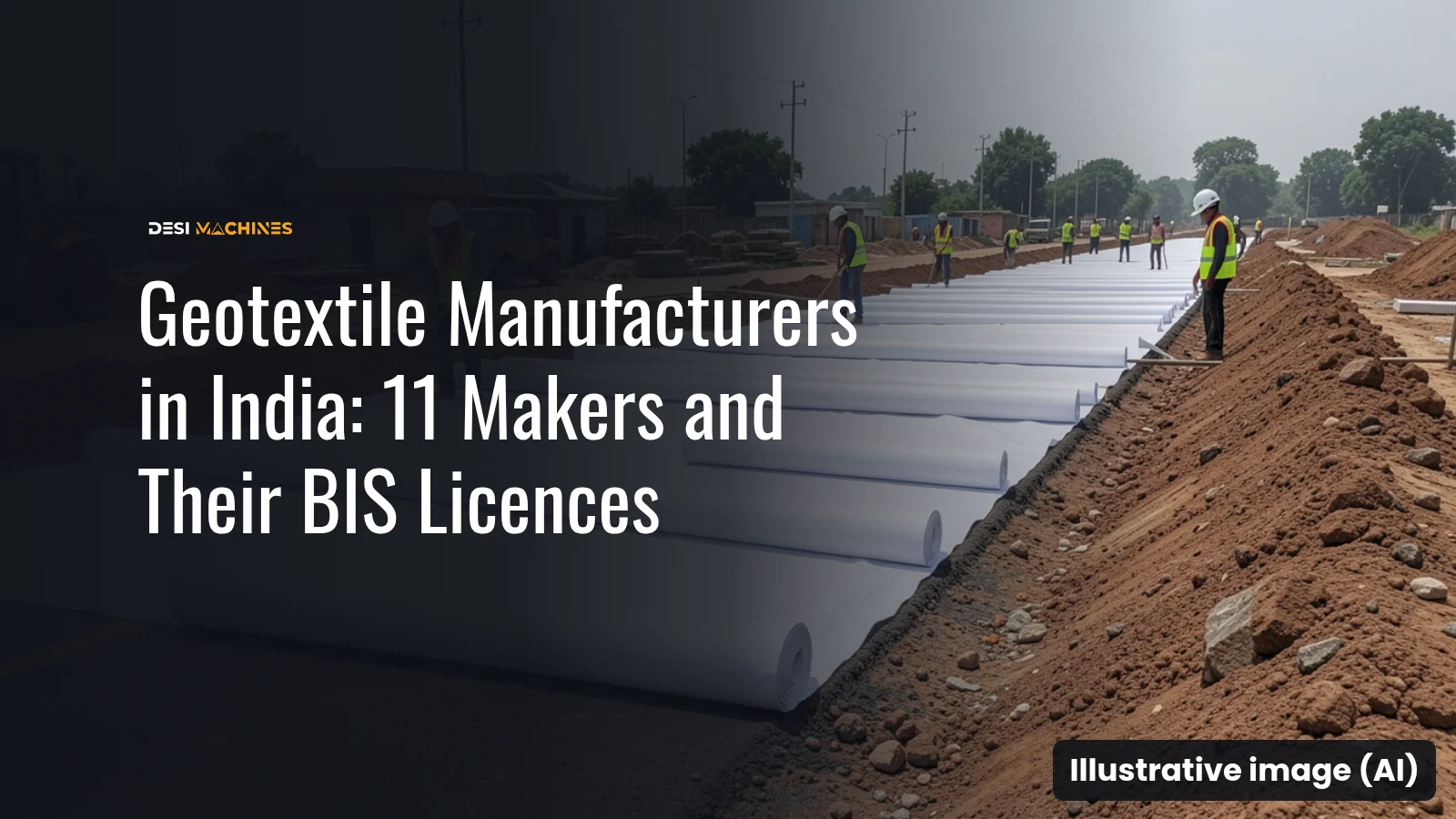
Eleven geotextile manufacturers in India passed our check of their own websites and the Bureau of Indian Standards (BIS) licence register on 11 November 2026: Bros India (Brothers Coir Mills), Garware Technical Fibres, GeoSys India Infrastructures, Gloster, Khator Technical Textiles, Ludlow Jute & Specialities, Maccaferri Environmental Solutions, Strata Geosystems (India), TechFab India Industries, Texcore Textile and Venus Interlinings. Eight make polymer woven, non-woven or geogrid products; three make jute or coir geotextiles in West Bengal and Kerala. BIS showed 7 licences under IS 16362:2024 for geotextiles and 9 under IS 17373:2020 for geogrids, and now lists the older IS 16391:2015 as withdrawn.
Seven. That is how many BIS licences the portal showed on 11 November 2026 under IS 16362:2024, the standard that now covers geotextiles for separation, stabilisation, drainage and filtration under a road. Five firms hold them, and one of them holds three.
If your tender still asks for IS 16391, note that BIS lists that 2015 standard as withdrawn and superseded by IS 16362:2024. What a geotextile does under a pavement and how it is laid are covered in the guide to geotextile and geogrid. The question here is who makes it.
How this list of geotextile manufacturers in India was built
On 11 November 2026 we pulled the BIS licence lists for three geosynthetics standards: IS 16362:2024, IS 17373:2020 for geogrids in reinforced soil walls and slopes, and the withdrawn IS 16391:2015. Fifteen firms held licences. We added seven other makers that buyers ask about, which made 22.
A firm is listed only if its own website lists geosynthetic products, and either the site names an Indian plant or address or its BIS licence names the district. We dropped eleven. Seven licence holders had only a marketplace catalogue or directory listing, or a site that would not load. Four others named no plant or listed no geotextile, or their sites could not be reached; the Kerala State Coir Corporation was one. The list is alphabetical, not a ranking, and many smaller makers are not on it.
Geotextile makers at a glance
| Maker | Plant or address named | What it lists | BIS licence seen |
|---|---|---|---|
| Bros India (Brothers Coir Mills) | Muhamma, Kayippuram and Aryakara, Alappuzha, Kerala | Coir geotextiles 400 to 1,500 GSM; jute geotextiles | None under these standards |
| Garware Technical Fibres | Wai, Maharashtra; licence in Pune district | Woven PP and PET geotextiles, non-woven geotextile, uniaxial and biaxial geogrids, geocells | IS 16362 |
| GeoSys India Infrastructures | Two units, UPSIDC Sikandrabad, Bulandshahr, Uttar Pradesh | Polyester geogrids, geostraps, geocomposites, geobags | IS 17373 |
| Gloster | Two units, Bauria (Fort Gloster), Howrah, West Bengal | Woven and non-woven jute geotextiles | None under these standards |
| Khator Technical Textiles | Naroli, Silvassa, Dadra and Nagar Haveli | Needle-punched non-woven 6 m wide, woven tape and multifilament, geocomposites, geobags | IS 16362 |
| Ludlow Jute & Specialities | Chengail, on the Hooghly near Kolkata, West Bengal | Woven, non-woven and open weave jute geotextiles, jute vertical drains | None under these standards |
| Maccaferri Environmental Solutions | Licence in Pune district, Maharashtra | Non-woven, woven PP/PE and PET composite geotextiles; biaxial and monoaxial geogrids | IS 17373 |
| Strata Geosystems (India) | Daheli, Umbergaon taluka, Valsad, Gujarat | Uniaxial and biaxial geogrids, geocells, knitted polyester geotextile | IS 17373 |
| TechFab India Industries | Silvassa, Dadra and Nagar Haveli; units at Haridwar and Bhopal | PP and PET woven and PP non-woven geotextiles; PET, PP and PVA geogrids; geocells | IS 16362 (3), IS 17373 (2) |
| Texcore Textile | Gharaunda, Karnal, Haryana | Non-woven and woven geotextiles, geocomposites, geocells, geobags | IS 16362 |
| Venus Interlinings | Office in Jaipur; licence in Sikar district, Rajasthan | Non-woven polyester and PP fabric, including geotextiles | IS 16391 (withdrawn) |
As stated on each maker’s own website and in the BIS licence register on 11 November 2026.
Woven, non-woven and geogrid makers
TechFab started in 2003 with woven geotextiles at Silvassa. It added a Haridwar unit in 2020 for rockfall and slope products and a Bhopal unit in 2025 for geogrids, and says it now runs seven manufacturing facilities. Khator Technical Textiles, set up in 2013, is also at Silvassa. Its plant makes needle-punched non-woven 6 m wide, which matters when a carriageway is wider than a standard roll.
Garware started its geosynthetics division in 1998 and sells woven geotextiles in polypropylene (GWF PP) and polyester (GWF PET) for highways and railways. Strata’s site puts its capacity at 350,000 sq m a month: more than 100,000 of StrataGrid geogrid and more than 250,000 of StrataWeb geocell. GeoSys began making geogrids in 2018 at Sikandrabad, near Noida. Maccaferri’s Indian site lists woven and non-woven geotextiles and geogrids, and the group has announced a new Indian plant that will be its second largest worldwide.
Jute and coir geotextile makers in West Bengal and Kerala
Gloster has two manufacturing units at Bauria in Howrah district and lists woven and non-woven jute geotextiles alongside hessian and sacking. Ludlow, established in 1921 on a campus at Chengail by the Hooghly, lists jute geotextiles in several constructions and prefabricated vertical drains made of jute.
In Kerala, Bros India Group’s Brothers Coir Mills runs three units in Alappuzha district. It lists coir geotextiles from 400 to 1,500 GSM, in widths from 50 cm to 4 m and rolls of 10 to 100 m.
Two government notes are worth knowing. A Press Information Bureau release of 20 May 2020 said the Indian Roads Congress had accredited coir geotextiles for rural roads, and that 5 per cent of road length under PMGSY-III would use them: 1,674 km across seven states. A PIB backgrounder of 7 September 2026 says the National Jute Board guides users on design specifications, procurement, testing and installation of jute geotextiles. The jute and coir specifications themselves, IS 14715 and IS 15869, are set out in the guide.
Is there an ISI mark for geotextiles and geogrids?
For some products, yes. The BIS portal shows IS 17373, the geogrid standard for reinforced soil walls and slopes, under a quality control order implemented on 1 January 2024, with 9 licences. The withdrawn IS 16391 carries the same flag. The BIS page for IS 16362:2024 shows 7 licences and no such flag on the date we checked.
Read the register with care. On 11 November 2026 several licences were marked operative although the validity date shown had already passed, with dates in July, August and September 2026. A licence is also tied to a place: TechFab’s five licences all sit in Dadra and Nagar Haveli. Ask for the licence number and check it on the BIS portal against the plant that made your rolls.
What to ask a geotextile maker before you order
- The standard and edition your tender names. If it still says IS 16391:2015, ask the engineer in writing whether IS 16362:2024 applies.
- A test certificate for the batch supplied, against that standard, showing the class or type the specification asks for.
- Roll width and mass per square metre (GSM) exactly as the specification states them. Widths in this list run from 50 cm coir rolls to 6 m non-woven, and a mismatch means more overlaps.
- The BIS licence number and the plant it covers, where the product falls under a licence.
The fabric only works on a subgrade that was cut and compacted first. A grader such as the Mahindra Roadmaster G90, with a 3,000 mm moldboard, trims the level. A single drum roller such as the SANY SSR110C-10 PRO, at 11,200 kg operating weight, gets the density. Compare more motor graders and soil compactors and rollers before you bid.
The same who’s-who approach for other road and building inputs is in bitumen and road material companies in India and construction chemical companies in India.
Find road and highway work to price these materials against on the live tenders and opportunities board.
Company details are taken from each maker’s own website and the BIS licence register as read on 11 November 2026. The list is alphabetical and not a ranking. Standards, licences, product ranges and specifications change — confirm current terms with the maker, dealer or BIS before you order.