Excavator
316 models
 Backhoe Loader
51 models
 Crane
68 models
 Concrete Mixer
79 models
 Wheel Loader
54 models
 Compactor / Roller
45 models
 Motor Grader
42 models

 Concrete Pump
66 models
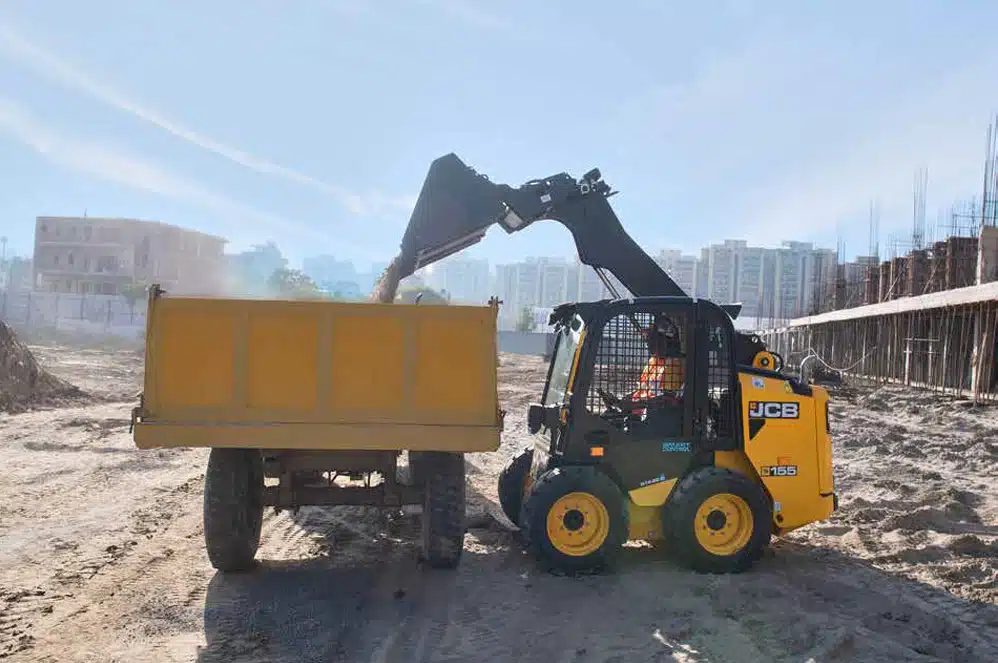
 Skid Steer Loader
11 models


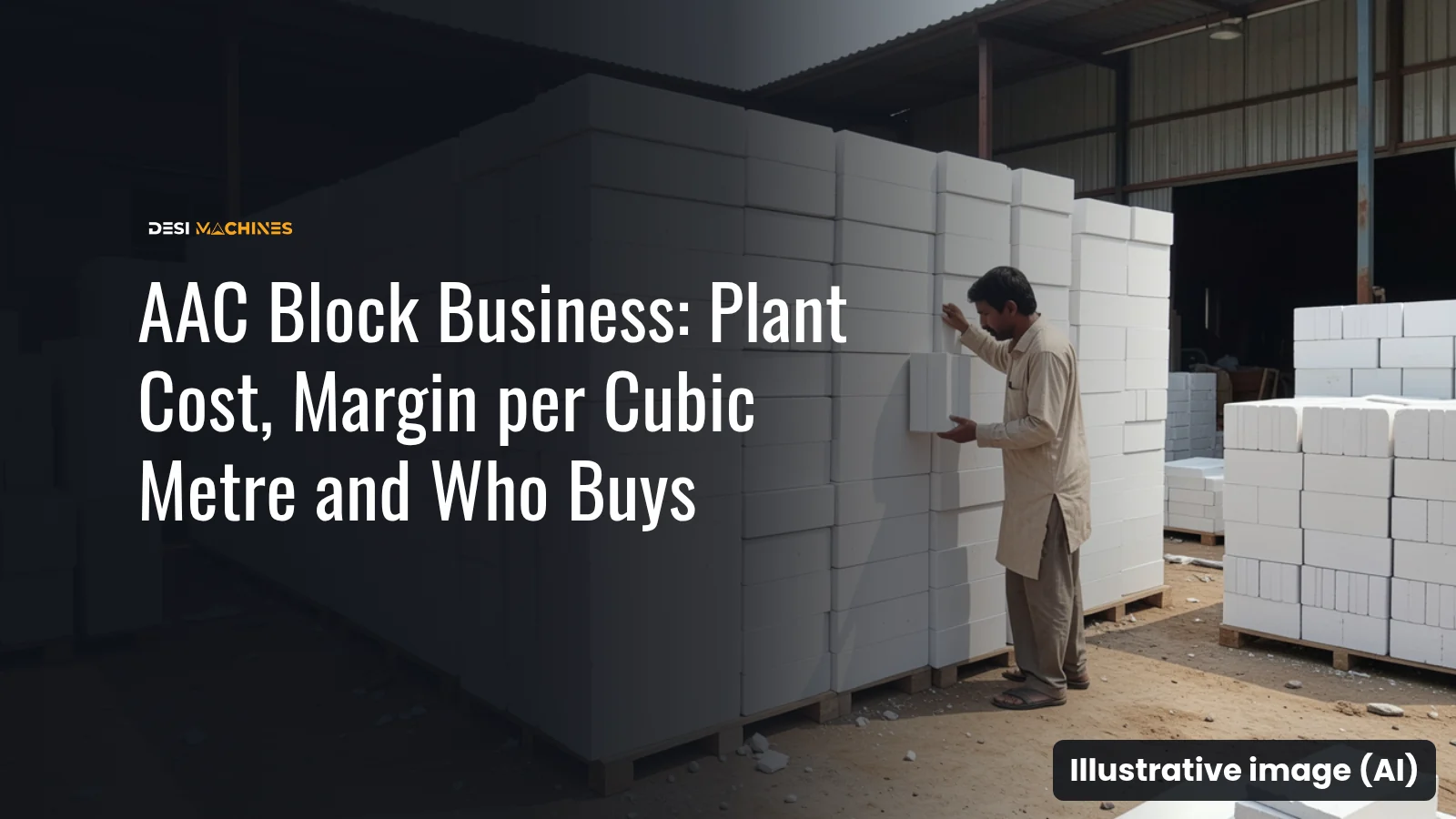
Bigbloc Construction, a listed company that calls itself one of India’s largest AAC block makers, sold 8,26,904 cubic metres in FY2026, 37 per cent more than the year before, and still reported a net loss of about Rs 9 crore. That is the aac block business in one line: the company’s own figures put a 4 lakh cubic metre a year plant at up to Rs 75 crore, blocks sell for Rs 3,300 to 3,900 a cubic metre (indicative), and block margins at the EBITDA level have lately been 8 to 10 per cent. The plant pays only when it runs close to full and sells within a few hundred kilometres of the gate.
Most first-time investors look at AAC blocks the way they look at fly ash bricks: cheap raw material, steady demand, a good margin on a light product. The demand part holds. The rest needs checking against what a listed maker has told the stock exchanges, the only detailed, dated account of AAC plant economics in public.
The figures below come from Bigbloc’s H1 FY2026 investor presentation and its earnings calls, three state rate books and the Indian Standard for the product.
Why an aac block business needs a factory, not a yard
A fly ash brick or a paver block is pressed and then cured in the open. An AAC block is cast as a large cake, cut by wire and then steam-cured under pressure. IS 2185 (Part 3), the Bureau of Indian Standards specification for these blocks, defines autoclaving as steam curing in an autoclave at maximum temperatures generally between 170 and 215 degrees C.
That one step decides the shape of the business. You need pressure vessels, a boiler to raise the steam, a mixing and casting line, cutting machines and the rails and cars that move cakes through the plant. That is a factory with a continuous line, which is why AAC capacity is counted in lakhs of cubic metres a year. What the finished block is, its sizes, density and grades, is covered in the AAC blocks guide.
What a plant costs, and how big it has to be
The clearest published figure comes from Bigbloc’s December 2025 investor presentation, filed with the exchanges:
| Item (Bigbloc presentation, Dec 2025) | Figure |
|---|---|
| Investment for a 4,00,000 cum a year plant, incl. land, machinery, civil | Up to Rs 75 crore |
| Plant and machinery share | 60% (about Rs 45 crore)* |
| Building share | 30% (about Rs 22.5 crore)* |
| Land share | 10% (about Rs 7.5 crore)* |
| Land needed | About 10 acres |
| Capital per cum of yearly capacity | About Rs 1,875* |
| Bigbloc’s own block plants | 2,50,000 to 5,00,000 cum a year |
*Our arithmetic from the presentation’s total and percentage split.
The same presentation counts more than 150 AAC plants in India with about 12 million cubic metres of capacity between them.
What is not published: a current capital figure for a small plant. No state industries department, MSME office or bank profile we found gives one, and consultants’ paid reports are not official. Get an itemised quote from the plant supplier, and do not scale Rs 75 crore down in a straight line: the autoclaves, boiler and cutting line do not shrink in proportion.
What goes into a cubic metre
Bigbloc publishes its mix as shares, which is more than most makers do:
| Input (fly ash AAC block) | Share of mix | What it does |
|---|---|---|
| Fly ash (Bigbloc uses pond ash) | 65% | Silica source, the bulk of the block |
| Cement | 23% | Binder, early strength for cutting |
| Lime | 11% | Reacts with silica under steam |
| Gypsum | 1.1% | Controls setting |
| Aeration agent (aluminium powder) | 0.1% | Releases gas that forms the air cells |
Source: Bigbloc Construction, H1 FY2026 investor presentation, mix chart for fly ash AAC blocks. The chart does not say whether the shares are by weight.
The kilograms of each input per cubic metre, and the steam or fuel per cubic metre, are not published in any official or company document we found. Treat any per-cubic-metre recipe from a machine seller as the seller’s figure until your own trial batches confirm it.
Two cost lessons do show up in the filings. Bigbloc says it uses 100 per cent pond ash and calls that a cost advantage over makers who rely on what it describes as expensive fly ash. And in May 2024 its management said its large capacity gives it better bargaining power on cement, lime and aluminium powder. Moving ash from the stockpile to the feed hopper through every shift is wheel loader work, for a machine such as the ACE ALN 300 or the Hyundai HL630i-V.
What a cubic metre sells for
AAC is sold by the cubic metre. The quarterly local market rates on Kerala PWD’s PRICE portal and Tamil Nadu’s schedule line up closely with what Bigbloc reports; Telangana’s book sits well above both:
| Source | Item | Rate per cum |
|---|---|---|
| Kerala PWD local market rates, Oct-Dec 2026 (published 6-12 Oct 2026), item 8655 | AAC blocks, six district rate points | Rs 3,310 (Thiruvananthapuram) to Rs 3,960 (Palakkad) |
| Tamil Nadu SOR 2025-26 (from 22 Jul 2025), M-0679 to M-0682, excl. GST | 600 mm blocks, 100 to 225 mm thick, priced each | About Rs 3,814 to 3,833* |
| Telangana CSR 2025-26, TBSC-A.III-01 to 04, landing cost | 600 mm blocks, 100 to 230 mm thick, priced each | About Rs 4,964 to 5,083* |
| Bigbloc presentation, Dec 2025 | Selling price range | Rs 3,300 to 3,900 (indicative) |
*Our conversion of the per-block rate to a cubic metre. Kerala’s book does not state whether GST is included.
Bigbloc’s FY2026 revenue of about Rs 283 crore over 8,26,904 cubic metres sold comes to roughly Rs 3,420 a cubic metre, and that figure also includes its panels and mortar.
Margin: a worked example on Bigbloc’s numbers
Take the 4 lakh cubic metre plant from the presentation and run it at 80 per cent, the bottom of the 80 to 85 per cent band Bigbloc calls optimum. That is 3,20,000 cubic metres a year. At Rs 3,300 to 3,900 a cubic metre, revenue is about Rs 106 to 125 crore.
At the 8 to 10 per cent EBITDA margin Bigbloc reported for its block business in May 2026, that leaves roughly Rs 8.4 to 12.5 crore a year before interest, depreciation and tax, on up to Rs 75 crore of capital. At the 25 per cent peak margin the company has seen, the same plant would earn Rs 26 to 31 crore. The gap between those two rows is the whole investment case.
The filings show how quickly it closes. Bigbloc’s EBITDA margin went from 25 per cent in FY2023 to about 6.2 per cent in FY2026. Management put 5 to 6 points of the latest fall down to pricing pressure and about 2 points to higher operating costs, with realisations down 5 to 7 per cent over the year.
If you are borrowing for the plant or the yard machines, build the repayment on the low row, not the peak one, and compare equipment and plant finance options before you sign for the autoclaves.
Who buys AAC blocks
Bigbloc’s May 2026 call gives the clearest split: 55 to 60 per cent of its sales go through dealers and distributors, 15 to 20 per cent to builders it supplies directly, and about 20 per cent to large corporates such as L&T, Shapoorji and Adani. The presentation adds government supplies and individual buyers to the list.
The market is still mostly red brick. Bigbloc’s own estimate is that AAC holds about 10 per cent of walling volume against roughly 80 per cent for red bricks, while in cities such as Ahmedabad, Vadodara, Mumbai and Pune it says adoption is 80 to 85 per cent or more. How the two materials compare on a wall is set out in AAC blocks vs red bricks, and the established makers you would be selling against are listed in AAC block and roofing sheet makers in India.
Geography limits the customer list. The presentation says freight can reach 15 per cent of the selling price, about Rs 495 to 585 a cubic metre on its own price band, and confines supply to roughly 400 km. That is why plants are built near cities and why your buyers are the builders and dealers within that circle.
Why small AAC plants struggle
Fixed cost is heavy, so a plant at 60 per cent use carries the same autoclaves and boiler as one at 85 per cent; Bigbloc’s own utilisation slid from 83 per cent in FY2023 to 57 per cent in the first half of FY2026, and its margin went with it.
Buying power follows volume, on cement, lime and aluminium powder alike. Quality costs money too: Bigbloc reports a rejection rate under 2 per cent against an industry average that the same presentation puts at 4 to 5 per cent on one slide and 4 to 7 per cent on another. And management traced the old complaints of cracking AAC walls to plants set up “without proper technological know-how”, which is a reputation a new small maker inherits.
The comparison with a fly ash brick unit is useful here. That business, set out in fly ash brick business, starts with a press and grows a shed at a time. An AAC plant cannot.
The question to put to your plant supplier
Before you pay an advance, ask the supplier in writing: at what daily output does this plant cover its fixed cost when blocks sell at Rs 3,300 a cubic metre and the ash comes from the nearest power station? Then ask the ash source how much it will commit to, for how long, and at what landed price. If the answers do not add up to a plant running above 80 per cent within a few hundred kilometres of real buyers, the project is not ready. Builders and departments putting walling work out to tender within that circle are listed on live project opportunities.
Rates, prices, plant costs and company figures change — confirm current terms with the plant supplier, the ash source, your bank and the state rate book before deciding.