
 Excavator
316 models
 Backhoe Loader
54 models
 Crane
68 models
 Concrete Mixer
79 models
 Wheel Loader
54 models
 Compactor / Roller
45 models
 Motor Grader
42 models

 Concrete Pump
66 models
 Skid Steer Loader
11 models


A crusher jaw plate is the toothed manganese-steel plate that does the actual crushing inside a jaw crusher, one bolted to the fixed jaw and one to the moving jaw. It is a consumable, and Metso, the maker of Nordberg crushers, lets the ends of most of its C Series jaw plates wear down to 20 to 25 mm before they must come out.
Every stone crusher has parts like this. A cone crusher wears out a mantle and a bowl liner, and an impact crusher wears out blow bars. They are made to be worn away so that the crusher’s own frame is not, and an owner who changes them on time, in the right metal, gets more tonnes out of every set.
This guide is for a quarry owner, a crusher operator or a contractor about to run a plant for the first time. It explains which parts wear in each type of crusher, what they are made of, how to choose a jaw plate for your stone, when to turn or change each part, what makes them wear too fast, and how to work out what they cost you per tonne. How the whole plant fits together is explained in the guide to the crushing and screening plant. No prices are quoted here.
What are the wear parts in a stone crusher?
Wear parts are the replaceable steel faces that touch the stone. Everything else in the crusher, the frame, the shaft, the bearings and the rotor, sits behind them and should never touch rock at all.
Which parts wear depends on how the crusher breaks stone. A jaw crusher and a cone crusher squeeze it between two surfaces, slowly: Metso’s impact crusher guide puts their crushing movement at 0.5 to 1.5 metres a second. An impact crusher throws stone at 30 to 80 metres a second instead, so its wear parts take hammer blows rather than steady pressure. That difference decides the metal each one is made of.
| Crusher | Main wear parts | Where they sit | What wears them |
|---|---|---|---|
| Jaw crusher | Jaw plates (also called jaw dies), cheek plates | Jaw plates on the fixed jaw and the moving jaw; cheek plates on the two side walls of the crushing chamber | Squeezing and rubbing of large, often blasted, rock |
| Cone crusher | Mantle, bowl liner (also called the concave) | Mantle on the gyrating cone head; bowl liner inside the fixed bowl around it | Squeezing of smaller stone, much of it rock against rock |
| Horizontal shaft impactor (HSI) | Blow bars, breaker plate liners, side liners | Blow bars on the spinning rotor; breaker plate liners on the plates the stone is thrown against; side liners on the frame walls | High-speed impact |
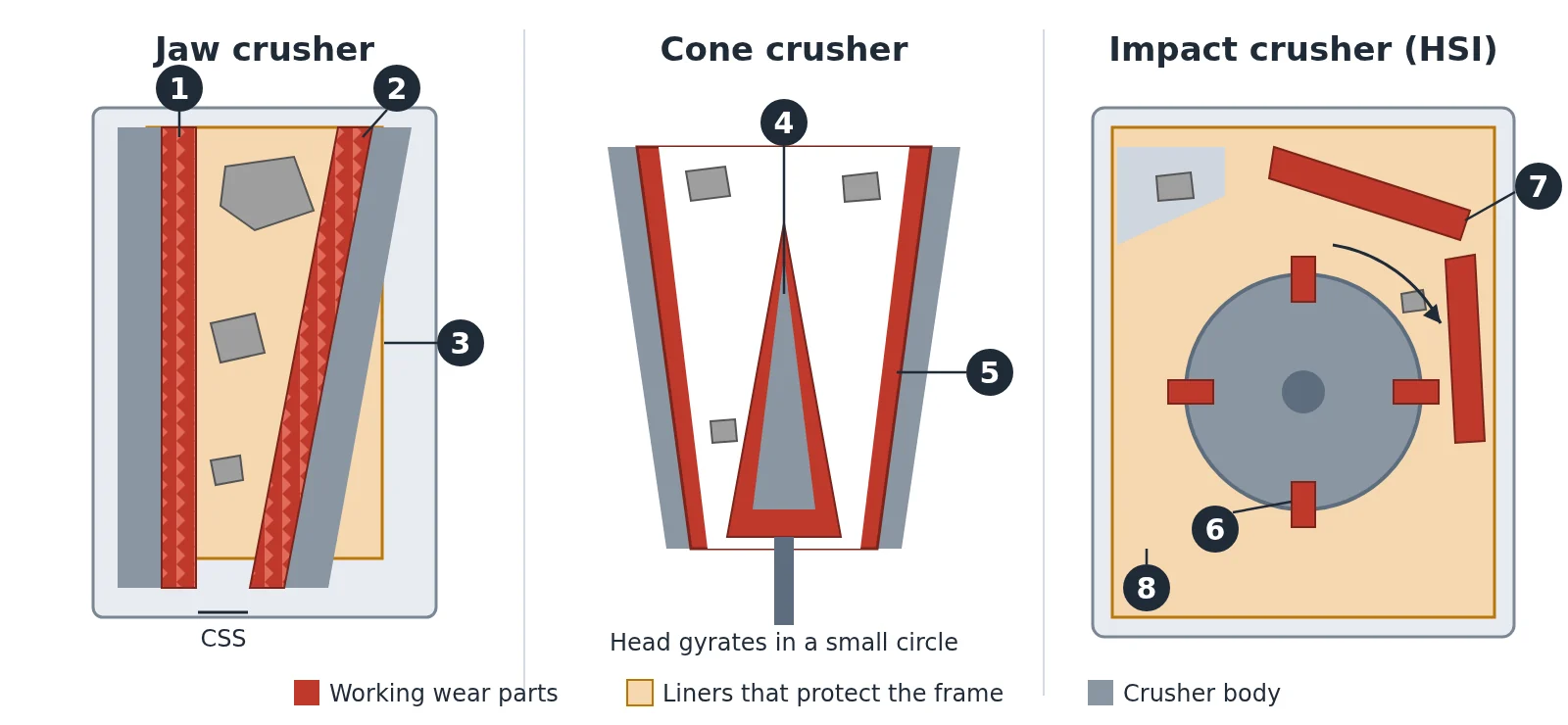
- Fixed jaw plate: usually the fastest-wearing part in a jaw crusher.
- Moving jaw plate: bolted to the swinging jaw (the pitman).
- Cheek plates: protect the side walls of the jaw’s crushing chamber.
- Mantle: the liner on the cone head, which wobbles in a small circle.
- Bowl liner or concave: the fixed liner around the mantle.
- Blow bars: the hammers on the impact crusher’s rotor.
- Breaker plate liners: the faces the stone is thrown against.
- Side liners: protect the impact crusher’s frame walls.
The same names turn up in the jaw crusher vs cone crusher guide, which explains how each machine breaks stone. Here the subject is the steel that gets used up doing it.
What is a crusher jaw plate made of?
Almost always manganese steel, also called Hadfield steel or mangalloy. The classic recipe is about 12 to 14% manganese and about 1% carbon. Metso’s cone liner brochure (2023) calls its own 18% manganese grade the industry standard and offers a 21% manganese grade with added chrome that it says lasts up to 10% longer.
Manganese steel is used because of one unusual property, work hardening. That means the surface gets harder each time it is hit. According to the Wikipedia entry on mangalloy, a new casting is fairly soft, around 200 to 220 on the Brinell hardness scale (HB), but under impact its surface rises to over 550 HB while the metal underneath stays tough instead of turning brittle. A jaw plate therefore gets harder as it works, and that is why the makers tell you to move a part-worn, work-hardened plate rather than throw it away.
Manganese steel is also non-magnetic, unusual for a metal that is mostly iron, and very hard to cut or machine. That is why jaw plates are cast to shape; Metso’s guide notes that even the lifting holes are left as cast.
Makers also sell composite jaw plates for very abrasive rock. Metso’s MX jaws, for example, have a manganese steel body with a harder wear material set into the face where it wears most, and Metso claims double, and sometimes triple, the wear life of a plain manganese jaw.
Which jaw plate tooth profile suits your stone?
The tooth pattern on the face matters as much as the metal. Sharp, widely spaced teeth grip the rock and let fine material fall through. Flat, wide teeth have more metal to wear away, so they last longer in abrasive rock, but they take more power to push through the stone and make more slabby, flat pieces. Metso’s C Series jaw crusher wear parts application guide sets the choice out profile by profile, and Table 2 sums it up.
| Profile | Best for | Trade-off |
|---|---|---|
| Standard | Gravel and non-abrasive rock | Shorter life in abrasive rock |
| Super grip | Gravel and non-abrasive rock, where grip matters | Shorter life in abrasive rock |
| Superteeth | General use in gravel and blasted rock | More tooth surface than standard, still lets fines through |
| Quarry | Abrasive or blasted rock | Longest-lasting flat teeth, but more power, more stress and more slabby stone; fines must be screened out first |
| Quarry thick | Abrasive or blasted rock where life matters most | Fixed jaw plate is 40 mm thicker than the quarry plate; same trade-offs |
| Quarry with super grip | Blasted, difficult or slippery rock, or where fines removal before the jaw is poor | Sharp teeth grip well; balanced power and stress |
| Anti-slab | Rock that breaks into flat slabs | Uneven tooth height cuts down slabby pieces |
For hard, abrasive granite and basalt straight from blasting, the quarry patterns are the usual starting point. For river gravel and non-abrasive rock, Metso points to the standard and super grip patterns. Either way, check the choice against your own feed for one or two sets before you settle on it.
Plates also come in one piece or two. Metso designed its smaller jaws for one-piece plates and the C110 and larger for two-piece plates. One piece is quicker to change, needs no centre wedges and suits mobile crushers. Two pieces last longer when they are rotated as recommended, and Metso says they cut the scrap rate and the cost per tonne.
This is a general guide. Always confirm the part with your crusher’s instruction manual or its maker before buying or fitting.
When should a jaw plate be turned or changed?
Before it wears through. A plate worn through lets the rock reach the crusher parts behind it, and Metso’s guides are blunt that plates must come out before that happens. Metso gives two limits for its C Series jaws, depending on how the plate is held.
| Part | Turn or rotate when | Change when |
|---|---|---|
| Jaw plate held by wedges behind it (for example C105, C3055) | As below for one-piece or two-piece plates | Down to 60 to 65 mm thick, or the teeth are worn flat |
| Jaw plate held by wedges at its ends | As below for one-piece or two-piece plates | Ends down to 20 to 25 mm, or the corrugations are worn flat |
| One-piece jaw plate | First turn when 30% of the tooth profile is worn; second turn when the teeth at the bottom are completely worn | After the second turn, at the limit above |
| Two-piece jaw plate | Each change: worn bottom pieces out, work-hardened top pieces moved to the bottom, new pieces at the top | Bottom pieces at the limit above |
| Cone crusher mantle and bowl liner | No turning step; wear is tracked on the adjusting ring | Before worn through; normally about half the liner’s weight is gone by then |
| Impact crusher blow bar | Turned once, when the first face is used | At the maker’s wear limit for that model (50 to 80 mm on Metso’s NP range) |
Turning a jaw plate does two jobs. It moves the work-hardened part of the plate to where it will do the most crushing, and it keeps the nip angle right. The nip angle is the angle between the two jaw plates. When worn plates open it up too far, the stone slips upwards instead of being caught, and Metso warns that this both cuts output and speeds up wear, because the rock grinds and gouges the plates on every stroke.
Expect the fixed jaw plate to go first. Metso’s indicative chart shows the fixed jaw wearing fastest, ahead of the moving jaw and the cheek plates, and its guide flags single toggle crushers in particular. One warning from the same guide: if a moving jaw plate is turned while it sits in the lower position, a dip called cupping can form at the joint, which lowers output and wears the fixed side faster.
Change plates only with the lifting tool made for them. Metso’s tool locks into two cast lifting holes at each end of the plate, and its guide says to rock the tool back and forth before lifting to prove it is fully engaged. A jaw plate is a heavy casting hanging over people’s hands.
Worn plates also change the gap at the bottom of the jaw, the closed side setting (CSS), so the stone comes out bigger and the screens send more of it back. That is one of the reasons a plant falls short of its rating, as the guide to crusher plant capacity explains. Keep breaking oversize boulders at the quarry face rather than in the jaw: Metso notes that oversize feed loads the crusher’s parts and cuts capacity. If your face needs it, compare rock breaker sizes for excavators and backhoe loaders and connect with a dealer.
What wears out in a cone crusher?
Two liners: the mantle, which covers the cone head, and the bowl liner, often called the concave, which lines the bowl around it. The head gyrates, which means it wobbles in a small circle, so the gap between mantle and bowl liner keeps closing and opening all the way round, and stone is crushed each time it closes.
Cone liners come in chamber shapes. Metso’s HP cone guide (2023) puts standard liners in secondary crushing, with a reduction ratio of 3 to 5 (the feed size divided by the product size), and short head liners in the third and fourth stages for fine crushing, with a ratio of 2 to 4. Fit the chamber that matches your feed size. Feed that is too small for the chamber wears the liners mostly at the bottom, so much of the metal is never used.
The cone wears best when it is choke fed, meaning the chamber is kept full all the time. Metso asks for the stone to stand at least 300 mm above the feed plate, spread evenly all the way round, with sizes mixed rather than coarse on one side and fine on the other. A full chamber crushes rock against rock, which shapes the stone better and saves the liners.
Change the liners before they wear through, or the seating surfaces of the head and bowl get damaged. In normal wear about half of each liner’s weight has been used up by then. Metso suggests keeping a record of how far the bowl has been screwed down to make up for wear (counted in teeth on the adjusting ring), and, once the first set is worn out, painting a line on the dust shell just below the adjustment cap, so each later set shows how close it is to its limit. Sometimes it pays to change a little early: output and product quality can fall towards the end of a liner’s life.
Thicker liners last longer. Metso quotes 20 to 50% more life for its thick cone liners, with the same feed opening but a smaller largest setting.
What are blow bars, and which material lasts longest?
Blow bars are the bars on an impact crusher’s rotor that strike the stone. According to Metso’s NP impact crusher guide (2012), the first hit from a blow bar does about 60% of the size reduction and the breaker plates about 30%, so the blow bars take the most punishment and make up 60 to 70% of the crusher’s wear cost.
There is no single best material, because a blow bar has to balance two things that pull against each other: hardness, which resists abrasion, and toughness, which survives a heavy hit. Table 4 shows how Metso matches the four material types to the job.
| Material | Strength | Use it for | Avoid when |
|---|---|---|---|
| Manganese steel | Highest shock resistance | Primary crushing; feed that may carry tramp iron | More abrasive stone, where martensitic steel usually outlasts it |
| Martensitic steel | Hard and impact-resistant | Primary crushing and recycling; usually outlasts manganese in abrasive stone with feed below 900 mm | Low-shock secondary work, where harder white iron resists abrasion better |
| White cast iron (high chrome) | Very hard, brittle | Secondary and tertiary crushing and asphalt recycling, with well-sized feed | Any tramp iron in the feed: the bars can break apart |
| Ceramic composite (metal matrix with ceramic inserts) | Ceramic hardness on a tough steel or iron base | Abrasive work; Metso quotes two to four times the life of a single-alloy bar | Limestone (Metso advises against it); slag only in the grades made for it |
Tramp iron is any stray steel in the feed, such as a bolt, a drill bit or a broken bucket tooth. A brittle chrome bar that meets it can fail badly, so chrome bars belong only behind a feed you are sure is clean.
Speed matters more than most operators expect. Metso gives blow bar wear as rising with the square of rotor speed, so a rotor run 10% faster wears its bars about 21% faster. Run the rotor no faster than the product you sell needs.
Blow bars are reversible, but only once. Metso recommends changing all of them together (four on its NP rotors), before they reach the wear limit, so the rotor itself is never exposed. Breaker plate liners can be moved around, because the bottom of the chamber wears hardest, and only the worn ones need replacing. Side liners come in two hardness grades, 400 and 520 HB, and two thicknesses, 20 and 30 mm. The same Brinell scale is used for the wear plates on excavator and loader buckets.
Why are my crusher wear parts wearing out so fast?
Usually because of how the crusher is being fed, not because of the parts. Read the wear pattern before you blame the supplier. Table 5 links what you see to the likely cause, drawn from Metso’s jaw, cone and impact crusher guides.
| What you see | Likely cause | What to check |
|---|---|---|
| Jaw plates worn deep at the bottom, top hardly touched | Feed too small, or too many fines reaching the jaw | Is the grizzly removing material smaller than the jaw setting? Is the right jaw size fitted for your feed? |
| Jaw plates worn more on one side than the other | Stone landing on one side of the chamber | Spread the feed across the full width; keep the chamber full |
| Jaw output falling and stone riding up in the chamber | Uneven or worn profile has opened the nip angle | Turn or rotate the plates on schedule |
| Cone liners worn in one narrow band, or cupped | Wrong chamber for the feed, or the cone is not choke fed | Keep stone at least 300 mm above the feed plate; check chamber choice against feed size |
| Cone adjusting ring lifting and banging (ring bounce) | Setting too tight, or fines (0 to 4 mm) packing the chamber | Open the setting slightly; screen out fines before the cone |
| Stone bouncing on top of the cone instead of going in | Nip angle too wide, so stone slips back up instead of being crushed | Check the chamber’s feed opening against your feed size |
| Blow bars cracked or broken | Tramp iron hitting a brittle bar | Clean up the feed, or move to manganese or martensitic bars |
| Blow bars worn unevenly | Uneven feeding or a poor size mix in the feed | Even out the feed; turn the bars early if needed |
| Blow bars wearing faster than the last set | Rotor speed raised, or more abrasive stone | Check the rotor speed; consider a composite bar for abrasive rock |
Rock type sets the baseline. Metso’s cone liner brochure puts “limestone or granite” first among the questions for choosing wear parts, because hard, abrasive rock uses metal faster. That is one reason two quarries with the same crusher can report very different part life.
How do you work out wear part cost per tonne?
Divide what a set of wear parts costs you by the tonnes of stone it crushed. That one figure is the fair way to compare two suppliers, two alloys or two tooth profiles, because a cheaper set that crushes fewer tonnes can cost more in the end.
Work it out like this for each set:
- Add up the price of the set, the labour to fit it and the crushing hours lost while the crusher stood still.
- Note the weighbridge tonnes crushed from the day the set went in to the day it came out.
- Divide the first figure by the second. That is the wear cost per tonne for that set.
Keep a simple logbook beside the crusher: date fitted, part and profile, thickness when fitted, thickness at each check, date turned, date removed and tonnes in between. After two or three sets the logbook tells you more than any brochure about which part suits your rock.
What moves the price of a set? Mostly how much metal it carries and what that metal is. A bigger crusher needs heavier castings, a thick liner carries more metal, and the alloy grade and any ceramic inserts change the price again. Ask for the weight of each part with every quote so you compare like with like. The real question is whether the extra life outweighs the extra price, and only your own cost per tonne answers it.
Wear parts are cast by the crusher makers themselves and by independent foundries. Metso, for example, said in January 2023 that its Ahmedabad foundry casts manganese wear parts for its C Series jaw and GP Series cone crushers, and Puzzolana said in December 2024 that it had expanded its in-house foundries to meet demand for wear parts. For a list of the companies that build the crushers themselves, see the blog on stone crusher manufacturers in India. Wear cost is also one line in the running cost of a crushing unit, set out in full in the blog on stone crusher business profit.
The crusher is only as busy as the machines that feed it. When you equip the quarry face and the loading yard, browse the range of excavators, see what else a site needs in the guide to quarry equipment, and find more crusher guides in the crusher guide section.
Sources: jaw plate profiles, change limits, rotation, lifting and cheek plate figures are from Metso’s Nordberg C Series jaw crusher wear parts handbook (2018) and application guide (2021). Cone liner chambers, choke feeding, wear records and the half-weight rule are from Metso’s Nordberg HP Series cone crusher wear parts application guide (2023); alloy and thick-liner figures are from Metso’s HP Series wear parts brochure (2023). Blow bar materials, wear shares, the speed rule and side liner grades are from Metso’s Nordberg NP Series impact crusher wear parts application guide (2012). Manganese steel properties are from Wikipedia’s mangalloy entry. The Ahmedabad foundry is from Metso’s India investments page (last updated January 2023) and Puzzolana’s foundries from its interview with NBM&CW (6 December 2024). The 21% speed example is our own arithmetic from Metso’s rule.
Prices, specifications and features are indicative, vary by variant, location and date, and should always be confirmed with the official OEM or authorised dealer before any purchase decision. DesiMachines is not liable for decisions taken on the basis of information that may have changed after publication.
Get a crusher wear parts price from a dealer near you
Tell us your machine and what you need, and we will ask the nearest dealer to reach out to you with a price.