
 Excavator
316 models
 Backhoe Loader
54 models
 Crane
68 models
 Concrete Mixer
79 models
 Wheel Loader
54 models
 Compactor / Roller
45 models
 Motor Grader
42 models

 Concrete Pump
66 models
 Skid Steer Loader
11 models


A conveyor belt earns its place in a mine when the same material travels the same route for years; where the loading point shifts every few weeks, dumpers stay the better tool. That is the decision behind every conveyor belt in mining. The system itself is a loop of rubber belt, with a fabric or steel-cord core, running over rows of idler rollers, pulled by a drive pulley at one end and kept tight by a take-up at the other.
Conveyors carry coal from underground faces to the surface, rock from an in-pit crusher to the plant, crushed stone between the boxes of a quarry plant, and ore or coal out to a stockyard or a railway siding. This guide explains the parts of a belt conveyor, the belt types and what grades like M24 and EP 800/4 mean, how troughing and idlers are chosen under the Indian Standard IS 11592, what changes underground, how to judge a conveyor against a dumper fleet, and the safety rules the Bureau of Indian Standards (BIS) sets for belt conveyors.
What is a conveyor belt system in mining?
A conveyor belt system is a fixed or shiftable line of belt conveyors that carries bulk material continuously from a loading point to a discharge point. Material drops onto the belt through a chute at the tail end, rides on the top run of the belt, and falls off where the belt turns round the head pulley. The empty belt then returns underneath to the tail.
A long route is rarely one belt. It is usually a chain of separate conveyors, each tipping onto the next at a transfer point, because a single belt can only be so long before the tension in it gets too high. IS 11592:2000, the BIS code of practice for selecting and designing belt conveyors, makes that one of the first layout checks: keep each conveyor’s length within the recommended maximum belt tension for the belting chosen.
Conveyors can be very long. The longest belt conveyor system in the world, built in 1972, runs 98 km from the phosphate mines of Bu Craa to the coast of Western Sahara. Closer to home, a single cross-border belt runs from Meghalaya to a cement factory at Chhatak in Bangladesh and is listed as the longest single-belt international conveyor. Both figures come from the Wikipedia entry on conveyor belts.
Where are conveyor belts used in a mine?
Belts turn up in four places in mining:
- In underground coal mines, coal cut at a longwall or a continuous-miner face is carried out along the roadways on belt conveyors. The longwall mining guide shows where the face’s steel chain conveyor hands the coal over to these belts.
- In opencast mines, dumpers bring blasted rock or coal to a crusher at the pit edge or inside the pit, and a belt carries the crushed material out. A shiftable conveyor can follow the working face as it moves.
- In crushing and processing plants, every quarry plant is a set of crushers and screens joined by belts, as the guide to the crushing and screening plant explains. Ore plants work the same way; the iron ore beneficiation guide follows the ore from the crusher onwards.
- At stockyards and loading points, belts feed stockpiles, silos and railway loading points, and long overland belts link a mine to a plant several kilometres away.
What are the parts of a belt conveyor?
Every belt conveyor, from a 20 m quarry belt to a long overland line, has the same basic parts. Figure 1 shows where each one sits.
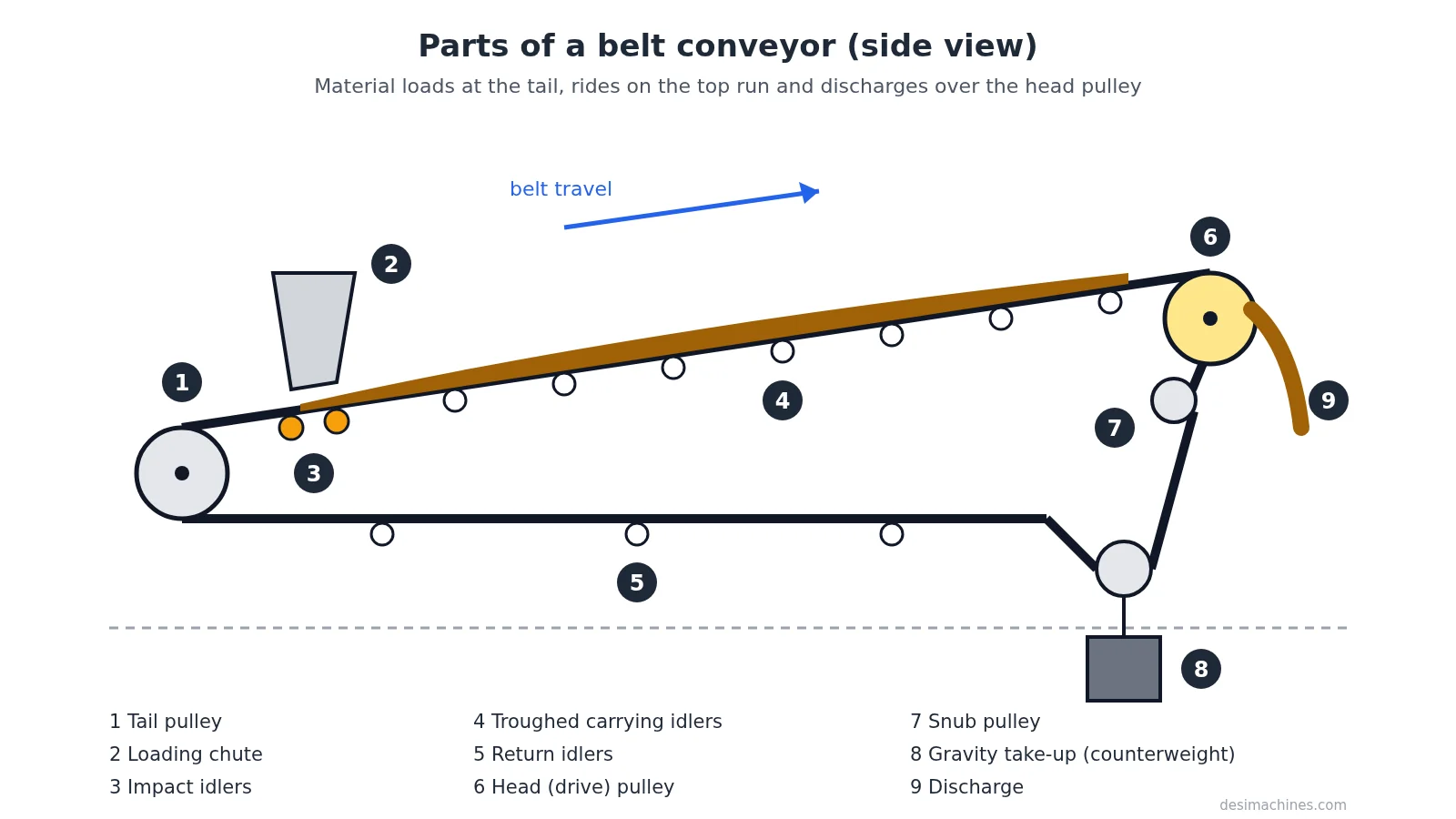
| Part | What it does |
|---|---|
| Belt | Carries the load. A carcass of fabric plies or steel cords gives the strength; rubber covers on top and bottom take the wear. |
| Head (drive) pulley | The motor and gearbox turn this pulley, and friction between pulley and belt pulls the loaded belt along. Material discharges here. |
| Tail pulley | Turns the belt round at the loading end. |
| Snub and bend pulleys | Wrap the belt further round the drive pulley for more grip, and guide it into the take-up. |
| Carrying idlers | Sets of two, three or five free-turning rollers under the loaded run. The side rolls are tilted to form the belt into a trough. |
| Impact idlers | Rubber-ringed rollers under the loading chute that cushion falling lumps. |
| Return idlers | Support the empty belt on its way back, usually flat. |
| Take-up | Keeps the belt tight. A gravity take-up uses a hanging counterweight; a screw take-up moves the tail pulley on short belts. |
| Chute and skirt boards | Guide material onto the centre of the belt and stop spillage at the loading point. |
| Belt cleaners (scrapers) | Scrape off sticky material after discharge, so it does not drop off along the return run. |
The take-up matters more than it looks. IS 11592 asks the designer to set a minimum belt tension so the belt sags only 0.5 to 2 per cent of the gap between two carrying idlers, and never more than 2 per cent. A belt that sags more spills material and wears faster, and a slack belt slips on the drive pulley.
Which types of conveyor belt are used in mining?
Mines use two main constructions, plus special fire-resistant belts for underground work. The Indian Standards below cover each one.
| Belt type | What gives it strength | Where it is used | Indian Standard |
|---|---|---|---|
| Fabric (textile) ply belt | Layers of woven fabric, today usually EP: polyester lengthwise, polyamide (nylon) across | Quarry and plant belts, short and medium in-pit conveyors | IS 1891 (Part 1):2021, general purpose belting |
| Steel cord belt | A single row of steel cables running along the belt | Long, high-tension conveyors: overland belts and main mine trunk lines | IS 15427:2004 (general); IS 15143:2002 (underground and hazardous) |
| Fire-resistant fabric belt | Textile plies with fire-resistant rubber compounds | Underground mines and other hazardous places | IS 3181:1992 |
With fabric belts, IS 11592 prefers fewer plies of stronger fabric to many weak ones, because a thinner carcass bends more easily into the trough and round the pulleys; a belt that is too stiff is hard to trough and to keep running straight. Steel cord is chosen where the belt must stretch very little, trough well and still carry a much higher working tension, so one belt can run much further between transfer points. IS 15427 names steel cord belts by their strength in N/mm of belt width, from ST 500 upwards (ST 800 and ST 1600 are two of its grades). For a sense of the top end, the strongest steel cord belt Wikipedia records is rated 10,000 N/mm, at the Chuquicamata copper mine in Chile.
What do ply rating and grades like M24 mean on a conveyor belt?
A fabric belt carries a code that tells you three things: how strong it is, how many plies it has, and how tough its rubber cover is.
Start with the strength and the ply number. IS 1891 (Part 1) names a belt type by its full-thickness tensile strength in newtons per millimetre of belt width, divided by the number of plies. An EP 800/4 belt has a polyester-polyamide carcass, a strength of 800 N/mm across its full thickness, and four plies of fabric. So a 1,000 mm wide belt of that type must hold at least 800 kN before it breaks. The 2021 standard lists types from 160 N/mm up to 3,150 N/mm.
Then the cover grade. The older 1994 edition of IS 1891 (Part 1) graded the rubber cover M-24 or N-17, and those names are still how many buyers and suppliers in India talk. The number is the cover rubber’s minimum tensile strength. The 2021 edition replaced them with grades H, D and L, which are not one-for-one swaps: H matches M-24 on strength and stretch but sets a tighter abrasion limit.
| Cover grade | Minimum tensile strength (N/mm²) | Minimum elongation at break | Maximum abrasion loss (mm³) | Typical material carried |
|---|---|---|---|---|
| M-24 (IS 1891-1:1994) | 24 | 450% | 150 | Sharp, abrasive material: metallic ores, limestone, granite, quartz, slag, stone chippings |
| N-17 (IS 1891-1:1994) | 17 | 400% | 200 | Moderately abrasive material such as coal, sand, ashes and rubble |
| H (IS 1891-1:2021) | 24 | 450% | 120 | Severe cut and gouge service: ores as mined, limestone and granite as quarried, coke, gravel |
| D (IS 1891-1:2021) | 17 | 400% | 100 | Severe abrasion service, for very abrasive material |
| L (IS 1891-1:2021) | 15 | 350% | 200 | Moderate service: surface coal, sharp sand, ashes, cement |
The 1994 edition gave a full belt name as cover grade, then type, then plies: its own example is M24-200/4, an M-24 cover on a type 200 belt with four plies. The 2021 edition asks for every belt to be marked on its carrying surface at least every 15 m with the maker, the fabric (EP, for example), the type and plies, the cover grade and the year of manufacture, so you can check a delivered belt against the order.
Strength on paper is not working strength. IS 11592 says the factor of safety (how many times stronger the belt is than its highest working tension) runs from 9 to 12.5 for textile belts and 7 to 10 for steel cord belts. For general guidance it takes 10 for a textile belt with vulcanised joints and a gravity take-up, and 7 for steel cord. A weak joint, a hard start or a steep incline pushes the figure up.
How are troughing angle, idlers and slope chosen?
IS 11592 recognises two layouts. A troughed belt rests on idlers whose side rolls tilt up, so the belt forms a channel. It suits high capacity, higher speed and large lumps, and it can climb or descend. A flat belt runs on straight idlers. It suits low capacity and low speed, and the code allows it a slope of at most 6°, with any downhill run undesirable. Belts carrying ore, coal or rock in a mine are normally troughed, since that is the layout the code ties to high capacity and large lumps.
For troughed belts the code, read with IS 8598 for idlers, sets these choices:
- Troughing angle: 15°, 20°, 25°, 30°, 35°, 40° or 45°. The 15° angle is for two-roll idlers only.
- Return idlers: flat, or troughed at 10° or 15°.
- Idler rolls: IS 8598:2019 lists standard roll diameters from 63.5 mm to 219.1 mm, including 108, 133 and 159 mm. Its own designation example is a 133 mm, three-roll, 35° idler set for a 1,000 mm belt.
- Idler spacing: the reference layout behind the code’s friction figures has carrying idlers every 1 to 1.5 m and return idlers about every 3 m, with three-roll 30° carrying sets and 108 to 159 mm rolls.
- Slope: the safe incline depends on the material and comes from IS 8730. A downhill (declined) conveyor must never exceed 12°, whatever it carries.
The material decides much of the rest. IS 11592 rates materials by abrasiveness: coal, aggregate, sand and gravel are mildly abrasive; slag and limestone are abrasive; iron ore, granite, trap rock, sinter and coke are very abrasive. Lump size is rated too, against the largest lump a given belt width can take. The two ratings add up to a speed factor, and the higher it is, the lower the recommended belt speed. An iron ore belt therefore runs slower than a coal belt of the same width. The code also asks for lower speeds on belts with ploughs or trippers that discharge part-way along.
What changes for a conveyor belt in underground mining?
Underground, smoke from a burning belt travels along the same roadways the miners work and walk in. So underground belts follow stricter rules than surface ones.
IS 3181:1992 covers fire-resistant fabric belting for underground mines and other hazardous places. Its tests include a drum friction test, which checks that a belt slipping on a stalled pulley does not overheat to the point of fire, and a propane gallery test, which checks that a flame does not spread along the belt. Steel cord belts for the same work follow IS 15143:2002, as IS 15427 notes in its foreword.
IS 11592 notes that PVC belting is generally chosen for underground mines where there is a fire hazard, and adds layout rules for underground conveyors: a compact drive head, flameproof motors, fire-retarding belting, and fire precautions on the rest of the equipment, especially the fluid coupling and the electrical items. Underground loaders, trucks and their charging are covered in the guide to electric underground mining equipment.
When does a conveyor replace a dumper fleet?
In an opencast mine the usual way to move material is a loading machine with a fleet of dumpers, the system the shovel-dumper combination guide sizes. A conveyor replaces part of that haul only when the job suits it. The table sets the two side by side.
| Question | Belt conveyor | Dumper fleet |
|---|---|---|
| Is the route fixed? | Needs a route that stays put for years, or a shiftable conveyor moved in planned steps | Goes wherever the haul road goes and follows a face that moves every week |
| What size is the material? | Lumps must fit the belt width, so run-of-mine rock is usually crushed first, at an in-pit or pit-edge crusher | Carries blasted rock as it comes off the face |
| What powers it? | Electric motors at the drives | Diesel engines, one per truck, plus tyres |
| What does it need around it? | Steel structure, transfer points, power supply, belt cleaning | A well-kept haul road, a workshop and enough drivers |
| How does it handle a change in output? | Capacity is fixed by belt width and speed | Add or remove trucks as output changes |
A shiftable conveyor is how some opencast mines get a belt close to a moving face. IS 11592 lists the extra data its design needs: the layout of the working face, the level difference between head and tail, planned extensions, how it will be shifted, whether its tripper runs on crawlers or rails, and the maximum ground pressure the floor can take.
The loading machines do not go away with a conveyor. A mining excavator such as the Tata Hitachi EX 1200V or the BEML BE1000-1 still loads dumpers for the short run to the crusher, and at a stockyard a large wheel loader such as the Tata Hitachi ZW550 or the Komatsu WA470-6A feeds the hopper. Compare mining excavators and large wheel loaders for the loading end of a conveyor job. For the dumper side of the choice, the guide to rigid vs articulated dump trucks compares the two truck types, and the bench height guide covers the haul roads they run on.
What safety rules apply to belt conveyors?
Belt conveyors injure people mainly at nip points, where the belt runs onto a pulley or an idler and can pull in a hand or a sleeve. IS 7155 (Part 3):2023, the BIS code of practice for belt conveyor safety, sets these rules among others:
- Guard idlers and pulleys completely at every in-running nip and pinch point: feed points, tension points and convex curves.
- Guard the openings of feed and transfer hoppers and chutes wherever operators can reach them.
- Guard a counterweight take-up so nobody can stand under the weight, or fit blocking devices.
- Protect walkways and plant below the return belt from material that sticks to the belt and falls off.
- Clean pulleys and idlers by hand only when the conveyor has stopped and its starting devices have been made inoperative.
- Feed the belt evenly, never overload it, and do not move the feed point without asking the maker.
On inclined belts the code also wants a guard against material being thrown back, for example after a stop under load. It allows an exception only where every unit load is under 50 kg and the total load on the slope is under 500 kg.
Dust at transfer points is the other daily problem, and the guide to dust suppression in mines covers the sprays and other ways mines keep it down.
How do you look after a mine conveyor belt?
A short daily walk along the belt should check five things:
- Watch whether the belt runs to one side. An uneven load is a common cause, which is why IS 7155 (Part 3) asks for belts to be fed evenly, preferably through a feeder or a carefully designed chute. A belt that keeps rubbing the structure wears out its edges.
- Check that the take-up still has travel left. A belt that has stretched to the end of its take-up will sag between idlers and slip on the drive.
- Listen for noisy idler rolls and look for any that have stopped turning, since a stuck roll rubs against the moving belt.
- Adjust the scrapers so carry-back does not build up on the return idlers, and keep the skirt rubbers sealing at the chute.
- Look at every joint (splice) for lifting edges or broken fasteners before they open up under load.
IS 6687:2002 is the BIS code for selecting, storing, installing and maintaining conveyor belting, and it is worth asking the belt supplier to follow it, especially for how a new belt is stored and jointed on site.
A conveyor only ever carries what the plant around it can handle. The crusher plant capacity guide explains how tonnes per hour are worked out for the crushers and screens a belt feeds, and the vibrating screen guide covers the screens themselves. The overburden removal guide shows how waste is moved in an opencast mine, and the mining equipment guide lists the machines on a typical Indian mine. More guides sit on the mining guide hub.
The design and selection rules in this guide come from IS 11592:2000, Selection and Design of Belt Conveyors, with belt grades from IS 1891 (Part 1), 1994 and 2021 editions, steel cord belts from IS 15427:2004, fire-resistant belting from IS 3181:1992, idlers from IS 8598:2019 and safety rules from IS 7155 (Part 3):2023.
Prices, specifications and features are indicative, vary by variant, location and date, and should always be confirmed with the official OEM or authorised dealer before any purchase decision. Belt grades, design figures and safety clauses should be checked against the current edition of each Indian Standard and with your mine’s engineer before a conveyor is specified. DesiMachines is not liable for decisions taken on the basis of information that may have changed after publication.
Machines, tenders and news for this industry: Mining · Quarry
