
 Excavator
316 models
 Backhoe Loader
54 models
 Crane
68 models
 Concrete Mixer
79 models
 Wheel Loader
65 models
 Compactor / Roller
45 models
 Motor Grader
42 models

 Concrete Pump
66 models
 Skid Steer Loader
11 models


A 185 cfm site compressor burns about 9 litres of diesel an hour at full load, and a 1,000 cfm drilling compressor burns 80 litres or more. Those are the makers’ own figures for air compressor diesel consumption per hour, and what your machine actually burns depends on three things: how much of the shift it runs loaded, the pressure it is set to, and how much air leaks away before it reaches the tool.
This guide puts the makers’ figures in one table by cfm class, shows what the same compressor burns at part load and with no air going out at all, and ends with a simple way to measure your own machine. The numbers come from spec sheets published by Atlas Copco, Chicago Pneumatic and Doosan Bobcat India, and from Atlas Copco’s Compressed Air Manual. Diesel prices change from month to month and from state to state, so the guide stays in litres. Multiply by the price you pay at the pump.
How much diesel does an air compressor use per hour?
At full load, a portable diesel screw compressor working at about 7 bar (100 psi) burns roughly 4.5 to 5.5 litres an hour for every 100 cfm of air it delivers. So a 185 cfm machine burns about 9 litres an hour, a 400 cfm machine about 25, and a 900 cfm machine about 40. Drilling compressors that work at 15 to 35 bar burn more for each cfm, as the last rows of Table 1 show.
| Compressor | Free air delivery, cfm (m³/min) | Working pressure | Engine | Diesel at full load (L/h) | L/h per 100 cfm |
|---|---|---|---|---|---|
| Chicago Pneumatic CPS 110 KD8 | 110 (3.1) | 6.9 bar | 25 hp | 5.0 | 4.5 |
| Chicago Pneumatic CPS 185 KD | 185 (5.2) | 6.9 bar | 49 hp | 9.4 | 5.1 |
| Chicago Pneumatic CPS 185 KDU | 185 (5.2) | 6.9 bar | 49 hp | 8.8 | 4.8 |
| Atlas Copco XAS 185 KDU | 185 (5.2) | 6.9 bar | 49 hp | 8.97 | 4.8 |
| Atlas Copco XAS 188 CD | 189 (5.4) | 6.9 bar | 48.8 hp | 8.97 | 4.7 |
| Atlas Copco XATS 250 KD | 238 (6.7) | 6.9 bar | 65 hp | 13.0 | 5.5 |
| Chicago Pneumatic CPS 400-150 JD | 440 (12.5) / 400 (11.3) | 6.9 / 10.3 bar | 134 hp | 24.5 / 27.6 | 5.6 / 6.9 |
| Chicago Pneumatic CPS 650 JD | 650 (18.4) | 13.8 bar | 250 hp | 39.8 | 6.1 |
| Chicago Pneumatic CPS 900 JD | 867 (24.6) | 6.9 bar | 250 hp | 40.2 | 4.6 |
| Atlas Copco DrillAir V21 | 758 to 725 (21.5 to 20.5) | 16 to 25 bar | 311 hp | about 49 | 6.5 to 6.8 |
| Atlas Copco XRVS 1000 | 1,136 to 910 (32.2 to 25.8) | 15 to 35 bar | 475 hp | about 83 | 7.3 to 9.2 |
| Atlas Copco XRVS 1550 | 1,550 to 1,370 (43.9 to 38.8) | 15 to 35 bar | 775 hp | about 115 | 7.4 to 8.4 |
Three things stand out. The three 185 cfm machines from two makers land within 0.6 litre of each other, at 8.8 to 9.4 litres an hour, so 9 litres is a safe planning figure for that class. Every machine working at about 7 bar, from 110 cfm to 900 cfm, burns between 4.5 and 5.6 litres per 100 cfm, because the engine power each 100 cfm needs at a given pressure is much the same from one maker to the next: about 23 to 31 hp per 100 cfm in the table. And the per-cfm figure climbs as soon as the pressure goes up. The same CPS 400-150 burns 5.6 litres per 100 cfm at 6.9 bar and 6.9 litres at 10.3 bar.
Where these numbers come from matters. They are the makers’ published figures for their North American models: Chicago Pneumatic’s portable compressor leaflet (2018), Atlas Copco’s DrillAir range brochure (2021) and Atlas Copco’s model pages for the XAS and XATS machines, read on 24 November 2026. Compressors sold in India may carry a different engine, so the figure for the exact machine you are offered must come from its own sheet. The pattern by class is what you can rely on.
How do you estimate the litres per hour for your compressor?
Take the free air delivery (FAD) from the compressor’s sheet, the air it actually delivers, and divide it by 100. Multiply by 5 for a machine working at about 7 bar, by 6 to 7 for one set at 10 to 14 bar, and by 7 to 9 for a drilling compressor at 17 bar or more. The answer is the full-load diesel use in litres an hour. A 300 cfm compressor feeding breakers at 7 bar: 300 ÷ 100 × 5 = about 15 litres an hour at full load.
The engine gives a second check. Across Table 1, the machines burn about 0.15 to 0.21 litres an hour for every horsepower of engine at full load. That is handy when the sheet in front of you prints no fuel figure at all, which is common. Doosan Bobcat India’s brochure for its PA1150C waterwell compressor (May 2020) gives 1,150 cfm at a drilling pressure of 300 to 315 psi (about 21 bar) and a 427 hp Cummins engine, but no fuel use. By the horsepower ratio, it sits at roughly 64 to 90 litres an hour at full load, in line with Atlas Copco’s 475 hp XRVS 1000 at about 83. That is our estimate, so ask the dealer for the engine’s fuel map before you plan on it.
Atlas Copco prints a third form on the XATS 250 KD sheet: a specific fuel consumption of 26.4 grams of diesel for every cubic metre of free air at full output. Its 238 cfm is about 404 m³ an hour, which works out to about 10.7 kg of diesel an hour. Diesel weighs a little under a kilogram a litre, so that is the 13 litres an hour printed on the same sheet.
Running cost per hour is then one line: litres per hour × your diesel price per litre. Use the litres your machine really burns across the day, worked out below, and not the full-load figure. The full-load figure overstates a day with breaks in it and understates a day where the pressure is set too high.
How much diesel does a compressor burn at part load and when unloaded?
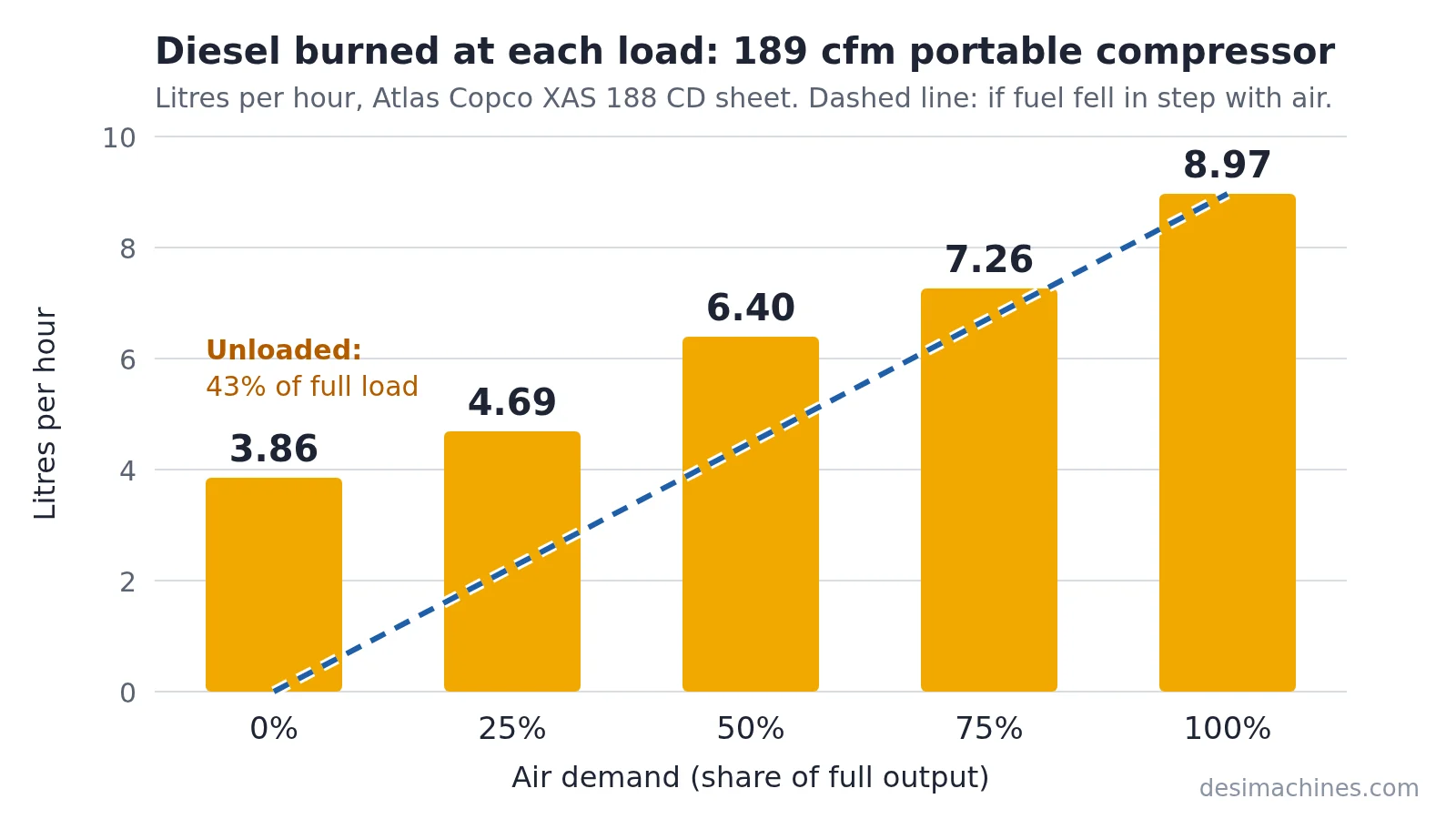
Less than at full load, but far more than most owners expect. Atlas Copco’s page for the XAS 188 CD (189 cfm at 6.9 bar) is one of the few that prints the whole curve, and the XATS 250 KD page prints most of it.
| Air demand (share of full output) | XAS 188 CD (L/h) | Share of its full-load burn | XATS 250 KD (L/h) | Share of its full-load burn |
|---|---|---|---|---|
| 100% | 8.97 | 100% | 13.0 | 100% |
| 75% | 7.26 | 81% | 8.9 | 68% |
| 50% | 6.40 | 71% | 7.4 | 57% |
| 25% | 4.69 | 52% | 6.4 | 50% |
| 0% (running, no air going out) | 3.86 | 43% | Not printed | Not printed |
On the XAS 188 CD, half the air costs about 70 percent of the diesel, and no air at all still costs 43 percent. The XAS 185 KDU sheet gives the same picture: 3.52 litres an hour unloaded against 8.97 at full load, or 39 percent.
The reason is the engine. When the tools stop, the compressor unloads: it closes its intake and stops sending air, but the diesel engine keeps turning so the machine can load again the moment the pressure drops. The XAS 188 CD’s engine runs at up to 2,800 rpm loaded and 1,600 rpm unloaded, and Chicago Pneumatic’s CPS 185 KD drops from 2,700 to 1,800 rpm. A turning engine, a turning air end and the cooling fan all burn fuel.
Makers fight this with capacity control that throttles the intake and slows the engine to match the air being used. ELGi’s PG series brochure (2022) describes 0 to 100 percent stepless control for that reason, and Atlas Copco’s XAS 97 sheet describes an automatic regulator that sets engine speed to demand. Even so, an engine that is running is burning diesel. A compressor left running through a tea break, the lunch hour or while the crew moves to the next slab is burning close to half its full-load diesel and making no air for anyone. If the stop will be longer than a few minutes, let the engine idle for the cool-down its manual asks for and switch it off.
Does a higher pressure setting use more diesel?
Yes. Atlas Copco’s Compressed Air Manual (9th edition, 2019, section 4.2.2) puts it at about 8 percent more power for every 1 bar of extra working pressure, and on an engine-driven compressor more power means more diesel. Table 1 shows the same effect on one machine: the CPS 400-150 burns 24.5 litres an hour for 440 cfm at 6.9 bar, and 27.6 litres for 400 cfm at 10.3 bar.
The common waste is a compressor wound up to its maximum when the tools need much less. The right setting is the tool’s rated pressure plus what your hose and couplings lose on the way, a figure the air compressor cfm calculation guide works out for each hose length. Every bar above that is roughly 8 percent more fuel for no extra work. On a 185 cfm machine burning 9 litres an hour, one bar too many costs about 0.7 litre an hour, or close to 6 litres over an 8-hour shift.
The manual also notes that the extra pressure raises leakage, which is the next drain.
How much diesel do air leaks waste?
A leak costs the air you paid diesel to make. Table 4:7 of the Compressed Air Manual shows how much air escapes through a small hole at 7 bar and the compressor power it takes to replace it:
| Hole diameter | Air lost, l/s (cfm) | Compressor power to replace it |
|---|---|---|
| 1 mm | 1.2 (2.5) | 0.4 kW |
| 3 mm | 11.1 (23.5) | 4.0 kW |
| 5 mm | 31 (66) | 10.8 kW |
| 10 mm | 124 (263) | 43 kW |
A 3 mm hole takes 23.5 cfm. On a 185 cfm compressor that is 13 percent of everything it makes, which at 9 litres an hour full load is a little over a litre of diesel every hour blown into the air. A 5 mm hole takes 66 cfm, more than a third of the same machine. The manual’s table is written for factory air systems, but a hole leaks the same air whatever drives the compressor.
The manual puts typical leakage at 10 to 15 percent of the air produced, and says it rises with working pressure: in its example, lowering the pressure by 0.3 bar cut leakage by 4 percent. On a site the usual places are hose splits, worn claw couplings, loose clamps and the tool’s own fittings. The easy test is to shut every tool with the compressor running. A healthy line holds its pressure and the compressor stays unloaded. If it keeps loading every few seconds with nothing open, air is escaping somewhere between the service valve and the tools.
Worked example: how much diesel does a breaker crew use in a day?
Take a 189 cfm compressor like the XAS 188 CD running jack hammers on a road job for an 8-hour shift. The breakers keep it at full load for 4 hours, at about half load for 2 hours while one breaker is idle, and it runs unloaded for 2 hours through breaks and moves. Using the sheet’s own figures from Table 2:
| Part of the shift | Hours | L/h | Litres |
|---|---|---|---|
| Full load | 4 | 8.97 | 35.9 |
| Half load | 2 | 6.40 | 12.8 |
| Running unloaded | 2 | 3.86 | 7.7 |
| Shift total | 8 | about 7.0 average | 56.4 |
Switch the engine off for the 2 unloaded hours and the shift needs about 48.7 litres, which is 7.7 litres or 14 percent less. Over 25 working days that is about 190 litres saved by one habit. Your running cost for the shift is 56.4 litres, or 48.7 litres, multiplied by your diesel price, and the cost per hour is that figure divided by 8.
The tank covers it. The XAS 188 CD carries 102 litres of diesel, and Chicago Pneumatic gives its CPS 185 KD about 8 hours at full load on a 75-litre tank. Fill up at the end of each day, as Doosan’s portable compressor service schedule asks.
If you are still deciding which size of machine the crew needs, start with the guide to the air compressor for construction and quarry work. On many jobs a hydraulic breaker on an excavator replaces the compressor and jack hammers altogether; the compressor breaker machine guide compares the two set-ups.
How much diesel does a DTH drilling compressor use?
Many times more than a site compressor, because it makes far more air at about three times the pressure. A down-the-hole (DTH) hammer for a borewell or a blast hole works at about 17 to 24 bar, and the compressors that feed it carry engines of 300 to 800 hp. Atlas Copco’s DrillAir brochure (2021) prints full-load fuel of 13, 22 and 30.5 US gallons an hour for its V21, XRVS 1000 and XRVS 1550, which is about 49, 83 and 115 litres an hour (the brochure’s unit label reads “g/h”, and at these engine sizes it can only be US gallons). In India, Doosan Bobcat’s PA1150C carries a 427 hp engine, which puts it around 64 to 90 litres an hour at full load on the horsepower ratio.
For a drilling contractor the number that matters is diesel per metre drilled. Record the litres added and the metres drilled for each hole. The hour meter alone misleads, because the compressor also runs unloaded while rods are added and the rig moves between holes. How much air each hammer size needs is worked out in the DTH air calculation section of the cfm guide, and the rigs themselves are described in types of drilling rigs.
Why is my compressor using more diesel than before?
Compare this week’s litres per hour with last month’s, or with the class figure in Table 1. When it has crept up, one of these is the usual cause:
| What you notice | Likely cause | What to check |
|---|---|---|
| Gauge reads higher than it used to | Pressure setting raised to cover a weak tool | Set it back to the tool’s pressure plus hose loss; about 8% more power per extra bar |
| Compressor loads with every tool shut | Air leak in a hose, coupling or fitting | Soapy water on couplings and clamps; a 3 mm leak takes 23.5 cfm at 7 bar |
| Many hours on the meter, little work done | Machine left running unloaded | Unloaded burn is about 40% of full load; stop the engine on long breaks |
| Pressure falls at the tools, fuel use up | Choked oil separator element or intake filter | Separator change falls due at 1,000 to 2,000 hours; see the maintenance schedule |
| Black smoke, loss of power | Engine fault: injectors, fuel filter or turbo | Engine service by the maker’s dealer |
| Fuel low per hour, but tools always waiting | Compressor too small or too big for the job | Size it from the tools’ air need, not from the last job |
A choked separator element adds a pressure drop inside the machine, so the air end works harder for the same air at the service valve, and a dirty intake filter starves both the engine and the compressor. Both are routine items in the air compressor maintenance schedule. The last row works both ways: a compressor much bigger than the job spends hours unloaded, and the Compressed Air Manual (section 3.1.1.3) suggests a smaller machine where only small quantities of air are needed. How a screw machine behaves under light and changing demand, against a piston machine, is set out in screw vs piston air compressor.
How do you measure your own compressor’s diesel use?
Fill the tank to the same mark at the same time at the end of each day. Write down the litres added and the hour meter reading. Litres added ÷ hours run since the last fill = your real litres per hour on that job. Keep it up for a week, because one day of rain or a broken breaker will mislead you.
Some newer controllers do the sum for you. Atlas Copco lists the current fuel rate and the average fuel consumption among the readings on the XAS 188 CD’s controller. On an older machine, the notebook method is just as good, and it is the same one used for genset fuel consumption on a site DG set.
Read your answer against Table 1. Well above the class figure at full load points to one of the causes in Table 5. Well below it means the compressor spends much of the day idling or lightly loaded, which is diesel spent on standing by. Excavator owners can run the same check on their machines with the guide to excavator fuel consumption per hour.
If you need a compressor for one job and would sooner not carry its diesel and upkeep through the year, you can find machines on rent near your site. The air compressor guides cover choosing, sizing and servicing the compressor itself.
Sources: Atlas Copco model pages for the XAS 188 CD, XAS 185 KDU and XATS 250 KD (read 24 November 2026); Chicago Pneumatic portable compressors leaflet (2018); Atlas Copco DrillAir range brochure (2021); Doosan Bobcat India PA1150C brochure (2020); ELGi PG series brochure (2022); Atlas Copco Compressed Air Manual, 9th edition (2019), sections 3.1.1.3, 4.2.2 and 4.2.3.
Prices, specifications and features are indicative, vary by variant, location and date, and should always be confirmed with the official OEM or authorised dealer before any purchase decision. DesiMachines is not liable for decisions taken on the basis of information that may have changed after publication.
