Excavator
294 models
Excavator
294 models  Backhoe Loader
51 models
Backhoe Loader
51 models  Crane
68 models
Crane
68 models  Concrete Mixer
79 models
Concrete Mixer
79 models  Wheel Loader
54 models
Wheel Loader
54 models  Compactor / Roller
45 models
Compactor / Roller
45 models  Motor Grader
42 models
Motor Grader
42 models  Dozer
41 models
Dozer
41 models  Concrete Pump
66 models
Concrete Pump
66 models  Skid Steer Loader
11 models
Skid Steer Loader
11 models  Telehandler
13 models
Telehandler
13 models 


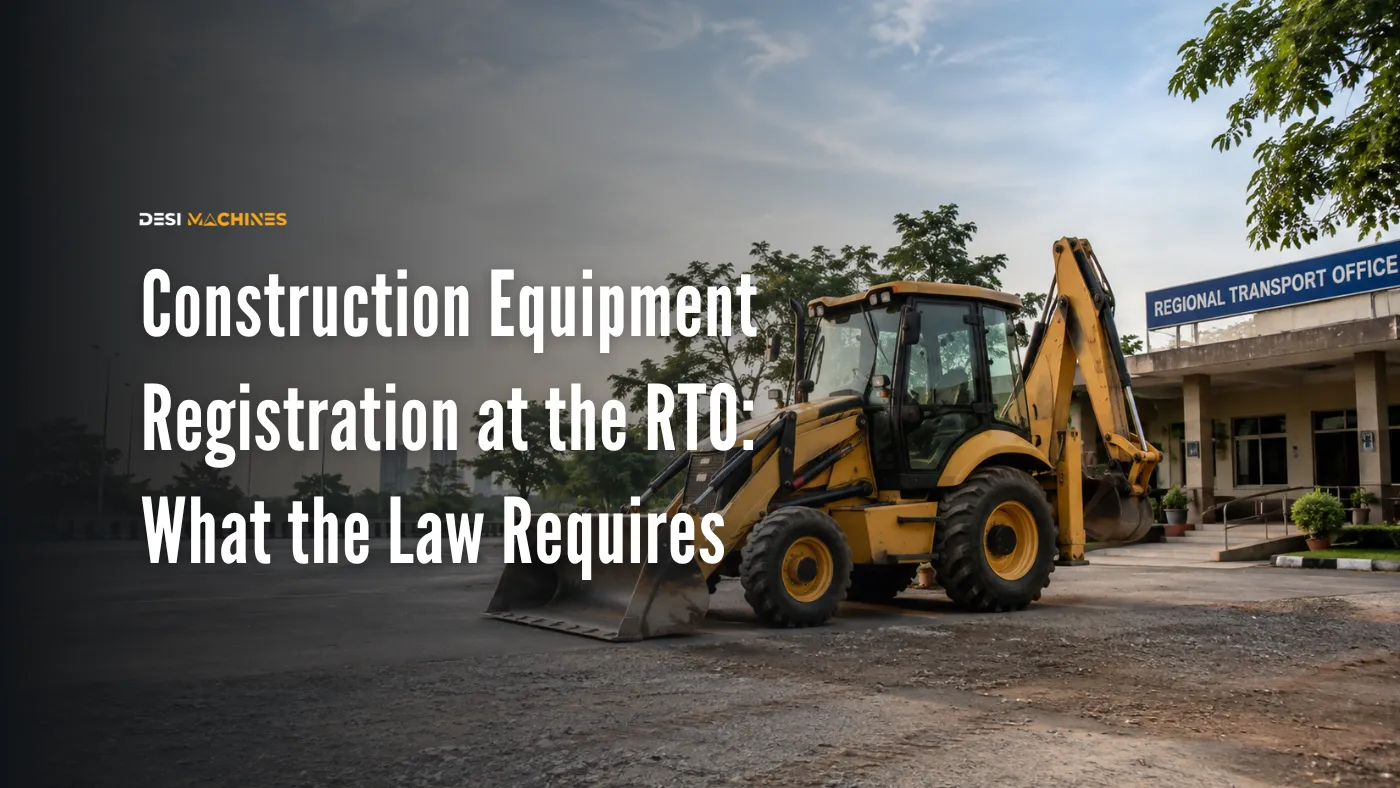
Construction equipment registration is governed by the Motor Vehicles Act, 1988, and the trigger is wider than most owners think. Section 39 bars an owner from causing or permitting a vehicle to be driven in any public place or in any other place unless it is registered. You register where the machine is normally kept (section 40), a temporary registration lasts a maximum of one month and cannot be renewed (section 43), and using a machine in breach of section 39 attracts a fine that may extend to five thousand rupees for a first offence, rising to imprisonment or a ten thousand rupee fine for a repeat (section 192).
When construction equipment registration is compulsory
Most owners carry a rough rule in their head: on the road it needs papers, inside the site it does not. The Act does not say that.
Section 39 reads that no person shall drive any motor vehicle and no owner shall cause or permit the vehicle to be driven in any public place or in any other place unless the vehicle is registered, its registration certificate has not been suspended or cancelled, and it carries a registration mark displayed in the prescribed manner.
Those five words — or in any other place — are the difference between the rule people assume and the rule as written. Registration is not framed around public roads the way the licensing question is. There is one carve-out on the face of the section: it does not apply to a vehicle in the possession of a dealer, subject to conditions prescribed by the Central Government. That is the provision that lets machines sit on a dealer’s yard unregistered, and it is about the dealer, not about you.
This is also where this piece parts company with the licence question. Whether an operator needs a licence turns on the machine being in a public place, and we have worked that through separately in which licence a JCB actually needs. Registration and licensing are two different gates with two different triggers, and passing one says nothing about the other.
Where you register, and in whose name
Section 40 settles the place: every owner shall cause the vehicle to be registered by a registering authority in whose jurisdiction he has his residence or place of business where the vehicle is normally kept.
Read that against how machines are actually bought. The dealer may be in another district, the first job may be in another state, and neither of those decides the registering authority. Where the machine is normally kept does.
Section 41(1) deals with the application itself: it is made in the prescribed form, with the prescribed documents, particulars and information, within the prescribed period. Where a machine is jointly owned, one owner applies on behalf of all, and that person is deemed the owner for the Act’s purposes. Settle that question before the finance paperwork is drawn, because the name on the registration certificate follows through into insurance, hypothecation and, eventually, transferring the RC when you sell.
Section 41(2) requires the prescribed fee, and section 41(3) obliges the registering authority to issue the certificate of registration to the owner.
Temporary registration and the one-month clock
Section 43 lets an owner apply for a machine to be temporarily registered, with a temporary certificate and a temporary registration mark. The limit is the part to plan around: sub-section (2) makes it valid for a period not exceeding one month, and it is not renewable.
There is a proviso for a chassis to which a body has not been attached and which is detained in a workshop beyond that month for the body to be fitted — relevant if you have bought a machine that is being built up before it reaches you.
The practical reading is simple. A temporary registration is a bridge to a permanent one, and the clock starts whether or not your paperwork is moving. If the machine is going straight onto a job, start the permanent application in parallel rather than after the month runs out.
What we are deliberately not quoting
You will notice there is no fee table above, and no list of documents.
That is on purpose. Section 41 puts the form, the documents and the fee into what is prescribed — meaning they sit in the rules made under the Act and in state notifications, not in the Act itself. The same is true of the classification questions owners ask most: what makes a machine a construction equipment vehicle, and which machines fall inside that class. The Act does not use the phrase at all; that definition lives in the vehicle rules.
We could not read the current consolidated rules from an official source while writing this, so we are not printing numbers from one. A fee or a document list copied from a third-party article and presented as law is worth less than nothing when you are standing at a counter. Ask your RTO, or your dealer’s registration desk, for the current list for your machine class in your state.
What running an unregistered machine costs
Section 192 is the enforcement end, and its wording puts the owner squarely in frame: it applies to whoever drives a motor vehicle or causes or allows a motor vehicle to be used in contravention of section 39.
| Offence | What section 192(1) provides |
|---|---|
| First offence | Fine which may extend to five thousand rupees |
| Second or subsequent offence | Imprisonment which may extend to one year, or fine which may extend to ten thousand rupees (not less than five thousand), or both |
The court may impose a lesser punishment for reasons recorded. But the “causes or allows” phrasing is the line that matters to an owner who is nowhere near the machine when it is stopped: sending an unregistered machine out to work is your act, not only the operator’s.
The bigger exposure is usually not the fine. An unregistered machine is a problem for your insurance position and for any claim that follows an incident, and it is a problem on any organised site where documents get checked at the gate.
Registration is one of four separate obligations
Owners routinely treat machine paperwork as a single bundle. It is four gates with four triggers, and each expires on its own schedule.
| Obligation | What it answers |
|---|---|
| Registration | Is the machine itself lawfully on the register, with an RC and a mark |
| Driving licence | Is the person at the controls entitled to operate it |
| Fitness certificate | Is the machine certified fit, and when does that lapse |
| Road tax | Has the tax on the machine been paid, and on what basis |
Diarise all four the week the machine arrives. The renewal you forget is never the one you were thinking about.
Emissions are a fifth, separate clock: a registered machine that drives on public roads has to carry a valid pollution certificate under the Central Motor Vehicles Rules, and the renewal cycle is its own — see whether your machine needs a PUC certificate.
One more mark sits alongside the four above. Where a machine is registered, the registration mark itself has to be displayed in the prescribed high security form — set out in HSRP for construction equipment.
What the Motor Vehicles Act says about registration
Section 39 is wider than the site-versus-road rule most owners run on, section 40 puts the registration where the machine lives, section 43 gives you one non-renewable month of temporary cover, and section 192 puts the penalty on whoever causes or allows an unregistered machine to be used. The fees and documents change by state — get them from the counter, not from an article.
Financing the machine that has to be registered? Compare lenders and indicative rates on our equipment finance page, or browse live excavator models and prices before you commit.
Statutory provisions, prescribed fees and state procedures change, and the position depends on your machine’s classification and the state it is registered in. Confirm the current requirement with your RTO, your dealer or the OEM before deciding.