Excavator
294 models
Excavator
294 models  Backhoe Loader
51 models
Backhoe Loader
51 models  Crane
68 models
Crane
68 models  Concrete Mixer
79 models
Concrete Mixer
79 models  Wheel Loader
54 models
Wheel Loader
54 models  Compactor / Roller
45 models
Compactor / Roller
45 models  Motor Grader
42 models
Motor Grader
42 models  Dozer
41 models
Dozer
41 models  Concrete Pump
66 models
Concrete Pump
66 models  Skid Steer Loader
11 models
Skid Steer Loader
11 models  Telehandler
13 models
Telehandler
13 models 


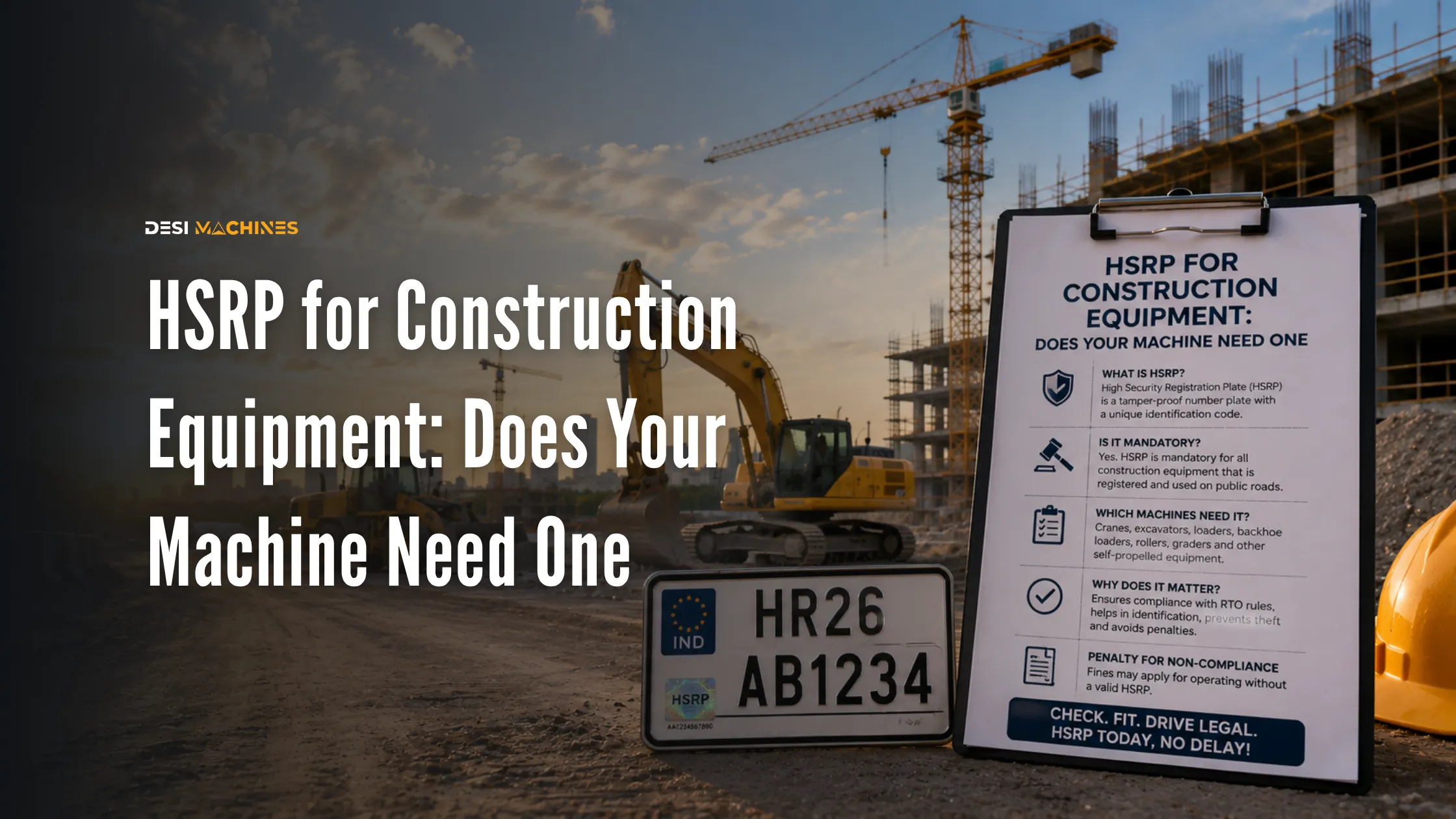
There is no special HSRP for JCB rule. The high security registration plate is simply the only lawful form a registration mark may take under Rule 50 of the Central Motor Vehicles Rules, 1989, and it applies to all motor vehicles. So the question is not whether your machine needs a special plate — it is whether your machine is registered. If it is, the plate follows automatically; if it is not, you have a bigger question than a number plate.
Owners usually meet this at a gate. A site supervisor at an organised project looks at the machine, sees a hand-painted number on a steel plate, and will not let it in. Or a transfer is being processed and somebody asks why the plate does not match the format on everything else in the yard.
The rule behind it is short, specific, and has been in force in this form for a long time.
Why there is no separate HSRP for JCB rule
Rule 50 of the Central Motor Vehicles Rules, 1989 deals with the form and manner of display of registration marks. It says the registration mark referred to in Section 41(6) of the Motor Vehicles Act, 1988 shall be displayed both at the front and at the rear of all motor vehicles, clearly and legibly, in the form of a security licence plate.
That single sentence is the whole answer to most of the questions people ask. There is no machine exemption written into it, and no separate class of plate for construction equipment. If the vehicle is a motor vehicle with a registration mark, the mark takes this form.
Which is why the useful question is the one underneath. Registration is what creates a mark in the first place, and whether a particular machine has to be registered depends on what it is and where it works — set out in our note on construction equipment registration at the RTO. A tracked excavator that never leaves private land sits in a different position from a backhoe loader that drives on public roads every week.
What the rule actually specifies
The specification is unusually detailed for a road rule, and knowing it is what lets you tell a real plate from a convincing copy:
| Feature | What Rule 50 requires |
|---|---|
| Material | A solid unit of 1.0 mm aluminium conforming to DIN 1745, DIN 1783 or ISO 7591, with rounded edges and an embossed border |
| Durability | Reflective sheet guaranteed imperishable for a minimum of five years; colouring of legend and border by hot stamping |
| IND mark | The letters IND in blue at the extreme left centre, one-fourth the size of the registration letters, buried into the foil or hot stamped |
| Anti-counterfeiting | A chromium-based hologram applied by hot stamping. Stickers and adhesive labels are not permitted |
| Identification number | A permanent consecutive identification number of minimum seven digits, laser branded into the reflective sheeting |
| Fitting | Fastened with a non-removable, non-reusable snap lock at the premises of the registering authority |
Two of those lines matter more than the rest to an owner buying a plate.
Stickers and adhesive labels are not permitted. A hologram that peels is not a hologram for the purposes of the rule. This is the single easiest way to identify a plate that will not survive a check.
The plate is fitted at the registering authority’s premises. The snap lock is meant to be non-reusable, so the plate cannot be transferred to another machine. A plate handed to you loose, to be fitted at your yard, has skipped a step the rule treats as part of the process.
The rule also says who may supply plates at all: the registering authority, or approved licence plate manufacturers and their dealers, with manufacturers approved to the specification by the Central Road Research Institute, New Delhi or an agency authorised by the Central Government.
The third mark, and the size your machine takes
Most owners know about the front and rear plates. Fewer know that the rule requires a third registration mark: a self-destructive chromium-based hologram sticker affixed on the left-hand topside of the windshield, printed with the registration number, registering authority and similar details.
It is issued along with the regular marks by the registering authority or the plate manufacturer’s approved dealer, and if it is destroyed, a replacement comes from the manufacturer or dealer rather than from a print shop.
On sizes, the rule sets them by vehicle category:
| Category | Plate size |
|---|---|
| Two and three-wheelers | 200 x 100 mm |
| Light motor vehicles and passenger cars | 340 x 200 mm or 500 x 120 mm |
| Medium and heavy commercial vehicles, trailer or combination | 340 x 200 mm |
| Agricultural tractors | Front 285 x 45 mm, rear 200 x 100 mm |
A registered construction equipment vehicle sits in the commercial band at 340 x 200 mm. Tractors have their own sizes, which is worth knowing on a yard that runs both.
Where this sits among your other obligations
The plate is not a standalone duty. It is the visible end of the registration obligation, and registration is one of several gates that each expire on their own schedule.
| Obligation | What it answers |
|---|---|
| Registration and the mark | Is the machine lawfully on the register, and is the mark displayed in the required form |
| Driving licence | Is the person at the controls entitled to operate it |
| Fitness certificate | Is the machine certified fit, and when does that lapse |
| Road tax | Has the state levy on the machine been paid |
Each has its own trigger and its own renewal. The licence side is covered in which licence a JCB operator needs, the fitness side in the JCB fitness certificate, and the tax side in JCB road tax in India.
One more moment matters. When the machine is sold, the mark and the record move with the paperwork, and a plate that was never compliant becomes the buyer’s problem at exactly the point you want the deal to close cleanly — the sequence for that is in RC transfer for construction equipment.
What we are deliberately not quoting
You will find figures online for what a plate costs and for the last date by which existing vehicles must comply. We are not publishing either.
Plate charges are fixed by state notifications and by the arrangements each state has with approved manufacturers, and they differ. Compliance deadlines for already-registered vehicles have been set, extended and reset by state transport departments more than once. Rule 50 itself contains only a general proviso that the sub-rule applies to already registered vehicles two years from the date of commencement — which is a rule about the rule’s own rollout, not a live deadline you can plan around today.
Anything specific enough to be useful here would be specific to your state and current only until the next notification. Get it from your own registering authority.
Is your machine registered, and should it be?
Stop looking for a machine-specific plate rule, because there is not one. The high security plate is the standard form of a registration mark for every motor vehicle, and the honest question for most owners is the one behind it: is this machine registered, and if not, should it be?
If the answer is that it should be, fix that first. The plate is the easy part once the registration is right, and an unregistered machine is a problem for your insurance position and for site access long before anyone examines the number on the front.
If you are weighing this while deciding whether to keep an older machine on the books at all, compare what current backhoe loader models and prices and excavators look like, and connect with a dealer before spending on an ageing asset.
Rates, schemes, specifications and prices change — confirm current terms with the OEM, dealer, bank or insurer before deciding. Plate specifications are summarised here from the Central Motor Vehicles Rules, 1989 as they stood at the time of writing; charges and compliance dates are set by state notification and must be confirmed with your registering authority.