Excavator
294 models
Excavator
294 models  Backhoe Loader
51 models
Backhoe Loader
51 models  Crane
68 models
Crane
68 models  Concrete Mixer
79 models
Concrete Mixer
79 models  Wheel Loader
54 models
Wheel Loader
54 models  Compactor / Roller
45 models
Compactor / Roller
45 models  Motor Grader
42 models
Motor Grader
42 models  Dozer
41 models
Dozer
41 models  Concrete Pump
66 models
Concrete Pump
66 models  Skid Steer Loader
11 models
Skid Steer Loader
11 models  Telehandler
13 models
Telehandler
13 models 


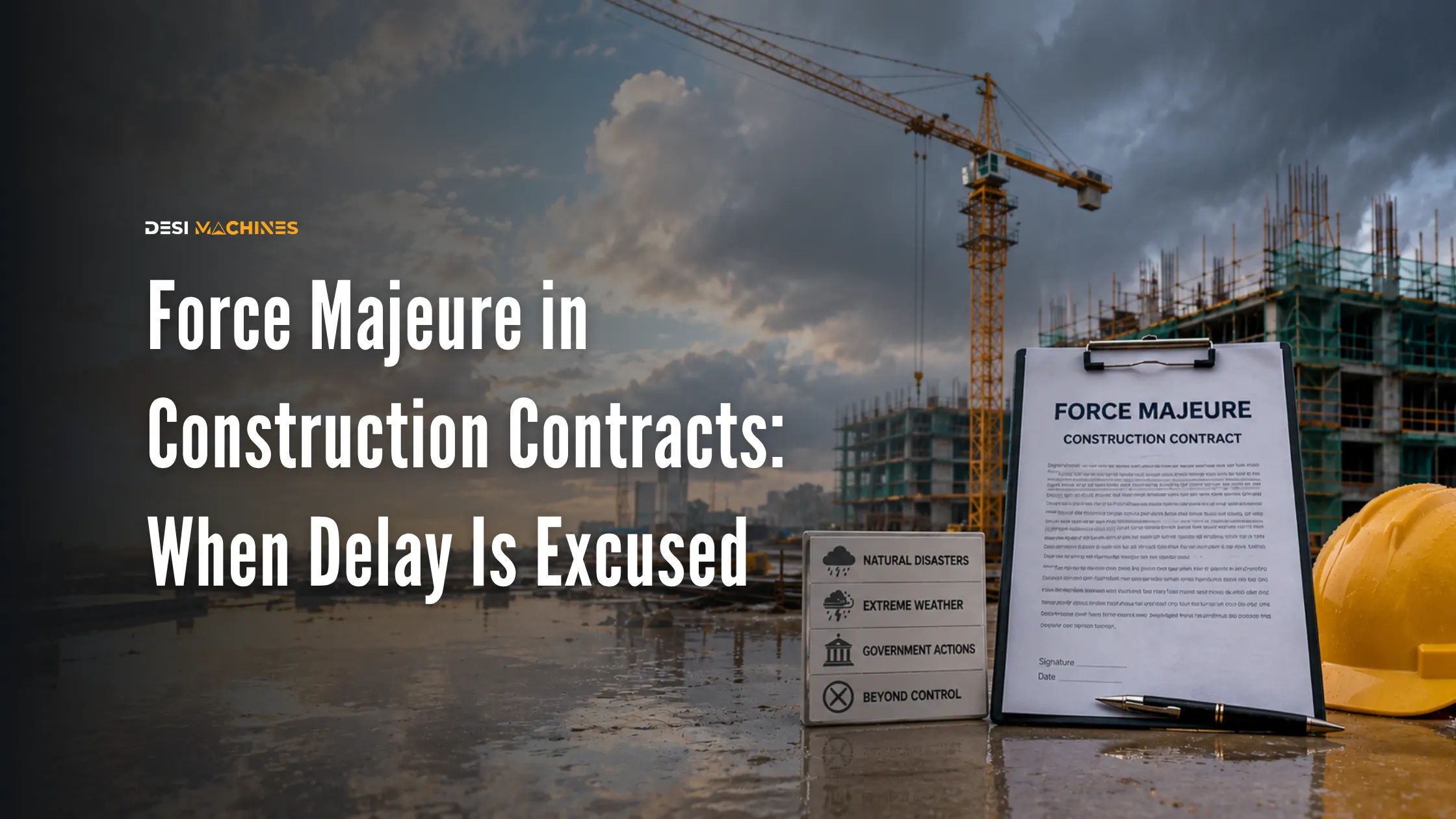
Force majeure in construction contracts is a contractual term, not a statutory one — what it covers is whatever your clause lists, and ordinary monsoon rain is generally not on that list. The fallback in Section 56 of the Indian Contract Act, 1872 is weaker than most contractors assume: it applies where an act becomes impossible or unlawful, and its effect is to make the contract void rather than to give you more time. The relief you actually want is time, and it comes from the clause and the notice you give under it.
Something stops the work. A flood takes the approach road, a district order shuts the site, a quarry ban cuts off aggregate. The programme slips by seven weeks and everyone at site knows exactly whose fault it was not.
Then the final bill is drawn and a delay deduction appears anyway. The argument that follows usually turns on paperwork nobody generated at the time, and on a misunderstanding about what the law actually offers.
Force majeure in construction contracts is a clause, not a law
There is no section of Indian law that defines force majeure, lists qualifying events, or tells you what relief follows. The phrase comes into your contract because somebody drafted it in.
That has one immediate consequence: your clause is the answer. Two contracts with the same department can carry different lists. Some name specific events — flood, earthquake, fire, war, riot, epidemic, government action. Some add a general limb about events beyond the reasonable control of the parties. Some require the event to have been unforeseeable, and some do not.
What the Contract Act does contain are the two neighbouring ideas the clause is built on top of.
Section 32 deals with contingent contracts: contracts to do or not to do something if an uncertain future event happens cannot be enforced unless and until that event has happened, and if the event becomes impossible, such contracts become void. This is the machinery of a contract that provides for an event in advance — which is what a force majeure clause is.
Section 56 deals with supervening impossibility. Its second limb says a contract to do an act which, after the contract is made, becomes impossible, or by reason of some event which the promisor could not prevent becomes unlawful, becomes void when the act becomes impossible or unlawful.
Why Section 56 is a worse remedy than it sounds
Contractors reach for Section 56 because it sounds like a defence. Read the operative words again: the contract becomes void.
That is not an extension of time. It is not relief from a delay deduction. It is the end of the contract. If your position is that you want to finish the work, get the balance released and keep the relationship, a section that discharges the contract is not what you are asking for.
| What you want | Where it comes from |
|---|---|
| More time, and protection from delay damages | The force majeure clause and the extension of time machinery in your contract |
| Money for the idle period | Only if the clause or another contractual right gives it |
| The contract discharged | Section 56, where the act has genuinely become impossible or unlawful |
There is a second reason to be careful. Section 56 sets a high bar — impossible or unlawful. Performance becoming slower, harder, or a great deal more expensive is not the same thing. Steel doubling in price, labour walking off after a festival, a lender withdrawing a facility: these are commercial risks, and they sit with the party that took them.
Section 56 has a third limb worth knowing about, which cuts the other way. Where a person promised to do something which he knew, or with reasonable diligence might have known, to be impossible or unlawful, and the promisee did not know, the promisor must compensate the promisee for the loss. Bidding to a programme you already knew was undeliverable is not a defence; it is a liability.
Why monsoon is usually not force majeure
This is the most common claim and the weakest one.
India has a monsoon every year. It arrives within a broadly known window, and the working assumption behind almost every works programme is that you knew that when you bid. Rates and durations are expected to carry it. A clause aimed at flood or exceptional weather is generally aimed at something well outside the ordinary pattern, not at the pattern itself.
Which is not to say weather claims never succeed. The ones that do are built on the difference between the ordinary and the exceptional, and that difference is a matter of record: rainfall figures for that location and period against the recorded norm, the site diary, the dates the front was actually unworkable, the photographs.
The owners who lose these arguments are the ones who did none of that and produce a general statement about a bad season eight months later. Planning around the season in the first place, rather than claiming against it afterwards, is the more profitable habit — which is the point of working with the construction season in India.
What the clause typically gives you, and what it does not
Most force majeure clauses in Indian works contracts share a shape:
Notice, within a stated period. Almost always in writing, almost always short, and frequently a condition of the relief rather than a formality. This is where claims die.
An obligation to mitigate. You are expected to take reasonable steps to reduce the effect and to resume when you can. A claim that treats the event as a licence to stop everything invites the answer that you did not mitigate.
Relief in time, not usually in money. The typical outcome is that the affected period does not count against you — the completion date moves, and delay damages do not run for that period. Standing costs, idle plant and establishment are a separate question and depend on the exact words.
A long-stop. Many clauses allow either party to terminate if the event runs beyond a stated duration. Worth knowing before you rely on the clause for months.
Because the relief is time, the machinery that actually delivers it is the extension of time application, which has its own notice period and its own record requirements. That is the same lever that protects you against a delay deduction generally, and it is set out in liquidated damages in construction contracts.
What to record while it is happening
Every one of these disputes is decided on the contemporaneous record. Not on what was true, on what was written down at the time.
Serve the notice. In writing, inside the period your clause names, describing the event and stating that you are claiming relief under the clause. Keep proof of delivery.
Date the boundaries. The day the event began affecting the work and the day it stopped. A claim with fuzzy edges gets trimmed at both ends.
Record what could not be done, and what could. Which activities on the programme were blocked, and what you moved resources onto instead. This is your mitigation evidence.
Log the machines. Which units stood idle, from when, and where. If you ever get to a standing-cost claim, this is the only basis for it — and the underlying cost of an idle machine is worked through in the cost of equipment downtime.
Keep the third-party proof. The district order, the notification, the rainfall record, the closure notice. Your own diary is evidence; an official document is better evidence.
The events after the event
A force majeure period rarely ends cleanly. Two things tend to follow it.
The first is a cash-flow gap. Work stopped, bills stopped, and the EMIs did not. If the client’s payment machinery also stalled, the delay stops being about weather and starts being about money — and that has its own route, set out in contractor payment delay on government work.
The second is quality. Work that sat exposed through a flood, or was rushed to recover the programme afterwards, is the work most likely to be called back later. Your obligation for it does not end at completion — see the defect liability period.
If the other side disputes the claim — and on a force majeure notice they often do — the argument is rarely settled on site. It goes to the forum the contract names. Arbitration in construction contracts sets out who may sit as arbitrator, when the clock starts and how long a reference usually takes.
Read your force majeure clause before the next stoppage
Force majeure is a clause, and the clause is the whole of your entitlement. Read yours before the next site stoppage, and note two things: what it lists, and how quickly you have to write.
Do not plan on Section 56. It asks for impossibility or illegality, not hardship, and what it delivers is a void contract rather than a longer programme. The remedy a working contractor actually wants is time, and time comes from a notice served while the water is still on the road.
The other lesson is a pricing one. A programme with no allowance for the season, priced to win, converts every ordinary event into a dispute. If the machines are the constraint on how fast you can recover after a stoppage, compare excavator models and prices and backhoe loaders, and connect with a dealer before the next bid rather than after it.
Rates, schemes, specifications and prices change — confirm current terms with the OEM, dealer, bank or insurer before deciding. The position here is summarised from the Indian Contract Act, 1872 as it stood at the time of writing and is general information, not legal advice; your own force majeure clause governs, and a contractor facing a live claim should take advice on it.