Excavator
316 models
 Backhoe Loader
54 models
 Crane
68 models
 Concrete Mixer
79 models
 Wheel Loader
65 models
 Compactor / Roller
45 models
 Motor Grader
42 models

 Concrete Pump
66 models
 Skid Steer Loader
11 models


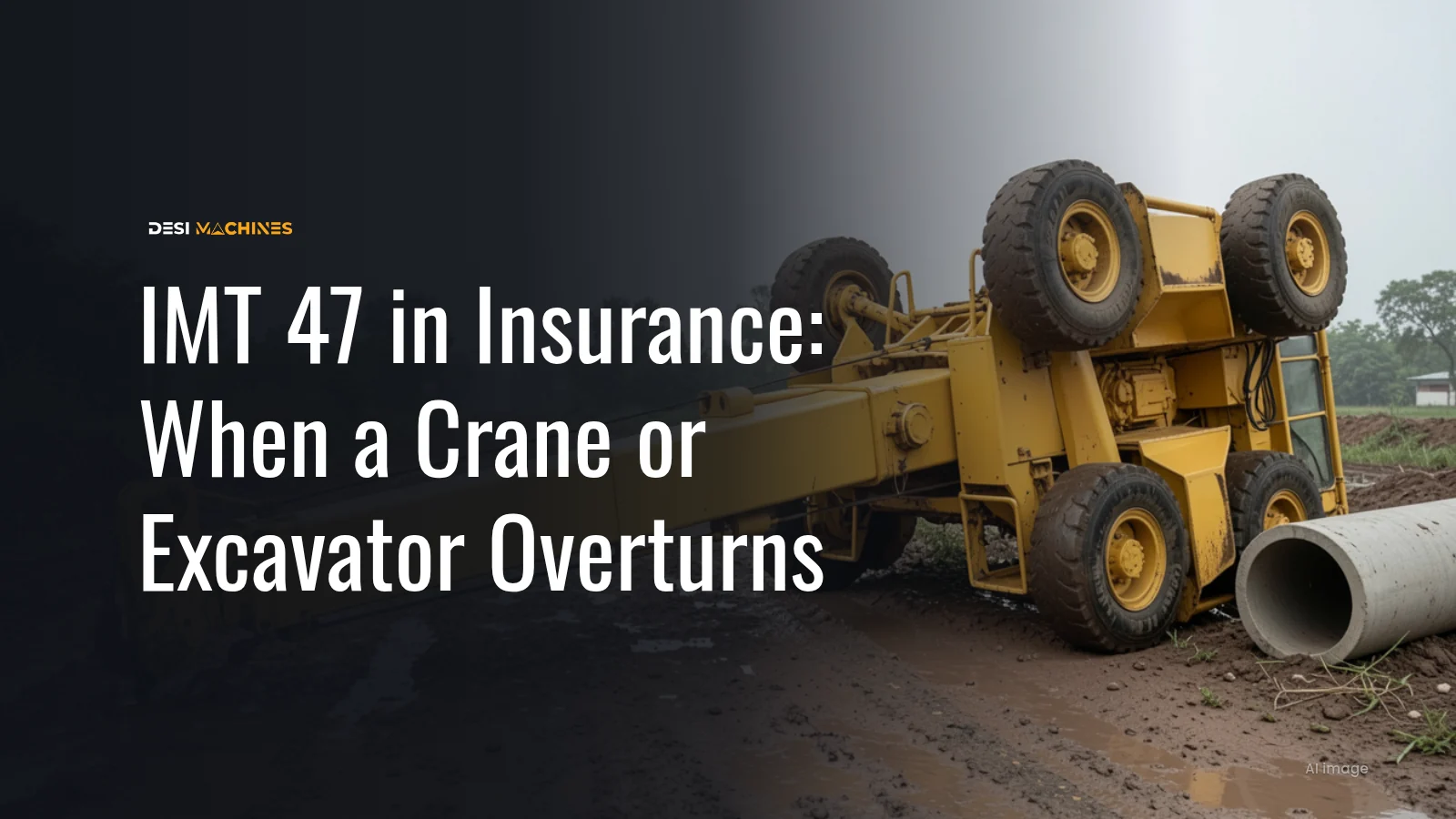
IMT 47 in insurance is the endorsement that stops your motor policy paying for a crane, excavator or other mobile plant that overturns while it is working as a tool. The cover comes back only if the extra premium for overturning shows on your schedule. Fire, explosion, self-ignition, lightning, burglary and theft are still paid when the exclusion applies, and an overturn while the machine is simply being driven sits outside the clause on its plain words.
A hydra crane is lifting a precast culvert section off a trailer on a road-widening job. The operator slews to place it, a rear wheel sinks into the soft shoulder, and the machine goes over on its side. Nobody is hurt. The surveyor’s first question is whether IMT 47 is printed on the schedule. To check the cover on your own cranes and machines, start with construction equipment insurance. Every wording below was read on 23 November 2026.
What does IMT 47 in insurance actually say?
The text comes from the India Motor Tariff 2002. One large private insurer files an IMT endorsement list reproducing the tariff texts, and a second insurer’s commercial vehicle package wording, which includes miscellaneous and special type vehicles, carries the same paragraphs:
“It is hereby declared and agreed notwithstanding anything to the contrary contained in this Policy that in respect of the vehicle insured * the Insurer shall be under no liability- a) Under Section I of this Policy in respect of loss or damage resulting from overturning arising out of the operation as a tool of such vehicle or of plant forming part of such vehicle or attached thereto except for loss or damage arising directly from fire, explosion, self-ignition or lightning or burglary housebreaking or theft. b) Under Section II except so far as is necessary to meet the requirements of the Motor Vehicles Act, 1988, in respect of liability incurred by the insured arising out of the operation as a tool of such vehicle or of plant forming part of such vehicle or attached thereto.”
A note underneath says to omit paragraph (a) for liability-only policies and for “Package Policies where an additional premium has been paid for inclusion of damage by overturning”. The star after “vehicle insured” is a blank for the make, number or “some other means of identification”, so the endorsement is written against a named machine. In the first insurer’s list there is a second note: where a premium reduction is allowed for excluding damage while in use as a tool of trade, the words “resulting from overturning” and the fire-and-theft carve-back are struck out. That version excludes all own damage arising out of work as a tool, not only overturning, and loses the fire-and-theft carve-back.
Which machines carry IMT 47?
The endorsement’s own heading is the list: “Mobile Cranes/Drilling Rigs/Mobile Plants/Excavators/Navvies/Shovels/Grabs/Rippers”. A hydra or truck-mounted crane is a mobile crane. A mobile crane or excavator that is registered and insured as a motor vehicle sits in the miscellaneous and special type class, which the tariff called Class D.
A backhoe loader is not named by that word. Read the schedule instead: IMT 47 is written against a named machine, so if your backhoe’s number sits in its blank, treat it as applying and ask about the overturning premium. IRDAI’s guideline of 29 March 2012 moved seven Class D types, including tractors, dumpers and tippers, into goods carrying vehicles. Cranes and excavators were not among them.
The extra premium that buys overturning back
IRDAI’s guidelines on the erstwhile All India Motor Tariff (IRDA/NL/ORD/MPL/077/03/2012) record that all tariffs stood withdrawn from 1 January 2007, on condition that insurers did not vary the coverage, wordings, clauses and endorsements that were under them. The IRDAI Master Circular on General Insurance Business, listed on 11 June 2024, then speaks of the “de-notification of erstwhile tariffs, general terms and conditions; policy and endorsement wordings”, and its Chapter I, paragraph 3 directs that “Insurers shall not withdraw or decline to offer to any customer any of the erstwhile tariff products”.
So IMT 47 survives as each insurer’s filed wording, and so does the route out of it. Neither wording read here prints a rate for the overturning cover, so the price is the insurer’s to set. What matters is whether the schedule shows the additional premium “for inclusion of damage by overturning”. If it does not, paragraph (a) is live.
One hydra, two overturns: on site and on the road
Take the hydra from the opening, three and a half years old. The bill is illustrative and the deductible assumed; your schedule and the surveyor decide the real figures. Depreciation follows the package wording’s Section I schedule: 25% on metal parts at three to four years, nil on glass, none on labour. In case A it tips while lifting on site. In case B the same hydra, boom stowed and no load, rolls over on a village road while being driven to the next job.
| Item (illustrative) | Bill (Rs) | After depreciation (Rs) | A: tips while lifting, no overturning premium (Rs) | A with overturning premium, or B on the road (Rs) |
|---|---|---|---|---|
| Boom, cabin and guard (metal, 25%) | 3,20,000 | 2,40,000 | 0 | 2,40,000 |
| Cabin glass (nil) | 20,000 | 20,000 | 0 | 20,000 |
| Labour | 1,00,000 | 1,00,000 | 0 | 1,00,000 |
| Deductible (assumed) | – | – | – | -5,000 |
| Insurer pays | – | – | 0 | 3,55,000 |
| You pay | 4,40,000 | – | 4,40,000 | 85,000 |
The gap between the two outcomes is Rs 3,55,000 on one claim, and it turns on two facts: what the machine was doing at the moment it went over, and whether the overturning premium is on the schedule.
The wording does not define “operation as a tool”, so the facts carry the weight. In Sharda Associates (Civil Appeal No 4910 of 2022, decided 25 July 2022), the Supreme Court said that for IMT 47 to apply, “it is essential to establish that the loss or damage was caused due to overturning and that the overturning should arise out of the operation as a tool”. In an earlier revision petition (No. 2993 of 2014, decided 6 October 2015), the National Consumer Disputes Redressal Commission said that if a machine toppled while returning from the work site, it was not being used as a tool and IMT 47 would not apply, and found the insurer had not shown otherwise. Two cases do not make a rule for your claim, but they show what the surveyor will record: where the machine was and what it was doing.
Section I also excludes “damage caused by overloading or strain”, so a load chart exceeded on the lift is a second ground, even with the overturning premium paid. On the road, the driver clause and “Limitations as to Use” still apply.
A backhoe that slides into a trench while digging
A backhoe loader is digging a drain trench along a village road. The edge under its rear wheels gives way, and it slides in and settles on its side. Digging is plainly work as a tool, so with IMT 47 on the schedule and no overturning premium, the insurer will read paragraph (a) against the claim.
The other reading comes from the Sharda case itself. There a JCB 3DX working on a road near Rishikesh fell into a ditch when part of the road gave way. The Supreme Court held the loss was “plainly due to the collapsing of the road”, in the nature of a landslide, which Section I names as a covered peril, and not overturning. Which reading fits a trench edge depends on what failed first: the ground, or the machine’s balance under a full bucket at reach. Photograph the trench wall and the machine’s position before it is righted, and if a claim is refused, what to do when an equipment insurance claim is rejected sets out the next steps.
What paragraph (b) does to third-party claims
If the hydra’s load swings into a neighbour’s wall during a lift, that liability would arise out of operation as a tool, and Section II then pays only “so far as is necessary to meet the requirements of the Motor Vehicles Act, 1988”. The same package wording carries separate endorsements headed “Mobile Plant – Inclusion of Liability to the Public Working Risk” (IMT 54 and IMT 55). Ask which one, if any, is on your schedule, and read third-party liability for construction equipment for the cover that sits beside it.
Why an excavator on a CPM policy is outside IMT 47
Many excavators are not registered for road use, move between sites on a trailer, and are insured on a contractor’s plant and machinery (CPM) policy. IMT 47 is an endorsement to a motor package policy and acts on its Section I and Section II, so a machine with no motor policy has no IMT 47.
The CPM wording read for this piece covers “unforeseen and sudden physical damage by any cause not hereinafter excluded” while the machine is “at the location mentioned therein”, at work or at rest, and its list of exceptions does not use the word overturning. It does exclude “Loss or damage whilst in transit, from one location to another location”, and adds that public liability is not payable while the machinery is on public roads. The trailer trip is the gap to ask about. The construction equipment insurance guide explains which machine belongs on which policy, and contractors all risk insurance covers the project-level policy a tender may ask for.
If the machine is written off, machine total loss claims explains what is paid; lamps, tyres and paint sit under IMT 23 in insurance.
What to check on the schedule before renewal
- Is IMT 47 printed, and is your machine’s registration number written into its blank?
- Does the schedule show an additional premium “for inclusion of damage by overturning”? If not, paragraph (a) is live.
- Was a premium reduction taken for excluding damage while in use as a tool of trade? That version removes more than overturning.
- Which public liability working-risk endorsement, IMT 54 or IMT 55, is on the schedule, if any?
- For a CPM-insured machine: does the policy name every site, and who covers the machine on the trailer between them?
- Does your operator hold the licence the driver clause asks for on road moves?
Ask for the answers in writing, with the endorsement numbers, from your insurer or broker. To compare cover for your cranes, excavators and backhoes, share the RC and the current schedule through construction equipment insurance.
Insurance wordings, endorsements, depreciation scales and premiums differ between insurers and change over time. The wordings, IRDAI documents and court decisions are summarised here in plain terms as read on 23 November 2026, and every claim figure above is illustrative. Confirm your own cover, endorsements and premium with your insurer or broker before you act. DesiMachines is not liable for decisions taken on information that may have changed after publication.