Excavator
316 models
 Backhoe Loader
54 models
 Crane
68 models
 Concrete Mixer
79 models
 Wheel Loader
65 models
 Compactor / Roller
45 models
 Motor Grader
42 models

 Concrete Pump
66 models
 Skid Steer Loader
11 models


The tender evaluation committee first checks that your bid is complete and responsive (signature, EMD or exemption proof, eligibility, conditions), then judges your experience, turnover and technical papers against the tender document, and only then opens price bids of the bidders who passed. It may ask you to clarify a point or send a missing document, but only one that already existed when the bids were opened, and never a change in your rate or the substance of your bid. You see each step as a stage on the e-procurement portal, and the award is published on the Central Public Procurement Portal.
You clicked Freeze Bid at 2.47 in the afternoon, thirteen minutes before the deadline. The bids were opened two days later. Now, a week on, the tender status on the portal reads Technical Evaluation and nothing else.
That silence is by design. From bid submission to award, the central works manual says no bidder should contact the procuring entity about the bid except in writing, and any attempt to influence the evaluation is a breach of the Code of Integrity. Here is what is happening on the other side of the screen, based on the Department of Expenditure’s Manual for Procurement of Works, Second Edition, 2025 (Chapter 6), read on 21 November 2026.
Who sits on the tender evaluation committee?
The manual’s name is Tender Committee; some organisations say Tender Evaluation Committee. Under para 6.2.1, it normally has three members: one from finance, nominated by the Financial Advisor, one representing the user, and others with domain knowledge where needed. A representative of the procuring entity acts as convenor, called the member secretary, and keeps custody of the bids.
Two limits matter. Below a direct acceptance threshold, normally Rs 50 lakh, a single competent authority may evaluate the bids without any committee. Above Rs 50 lakh, Rule 173(xxii) of the General Financial Rules 2017 says no member should report directly to another member. The committee recommends; a separate tender accepting authority approves.
The order the committee works in
In a two-envelope tender, the people judging your technical bid cannot see your price until the technical stage is closed (para 6.1.4). Key steps, such as accepting the technical evaluation and opening the price bids, need the competent authority’s written approval (para 6.2.2).
| Stage | What the committee does | What you see |
|---|---|---|
| Technical bid opening | Opens the first envelope and lists who bid | Status: Technical Bid Opening |
| Preliminary examination | Throws out unresponsive bids (para 6.3.1) | Nothing yet |
| Clarification and shortfall | Writes to bidders with a reply-by date (para 6.3.5) | A letter, email or portal request |
| Technical evaluation | Checks qualification, technical and commercial terms (para 6.4.1) | Status: Technical Evaluation, then the list of qualified bidders |
| Financial bid opening | Opens price bids of qualified bidders only, 2 to 5 days after announcing the date | Status: Financial Bid Opening |
| Financial evaluation | Corrects arithmetic, ranks L1, L2, L3, recommends award (paras 6.4.2, 6.2.8) | Status: Financial Evaluation |
| Award | Accepting authority approves; letter of award issued | Status: AOC, and the award on CPPP |
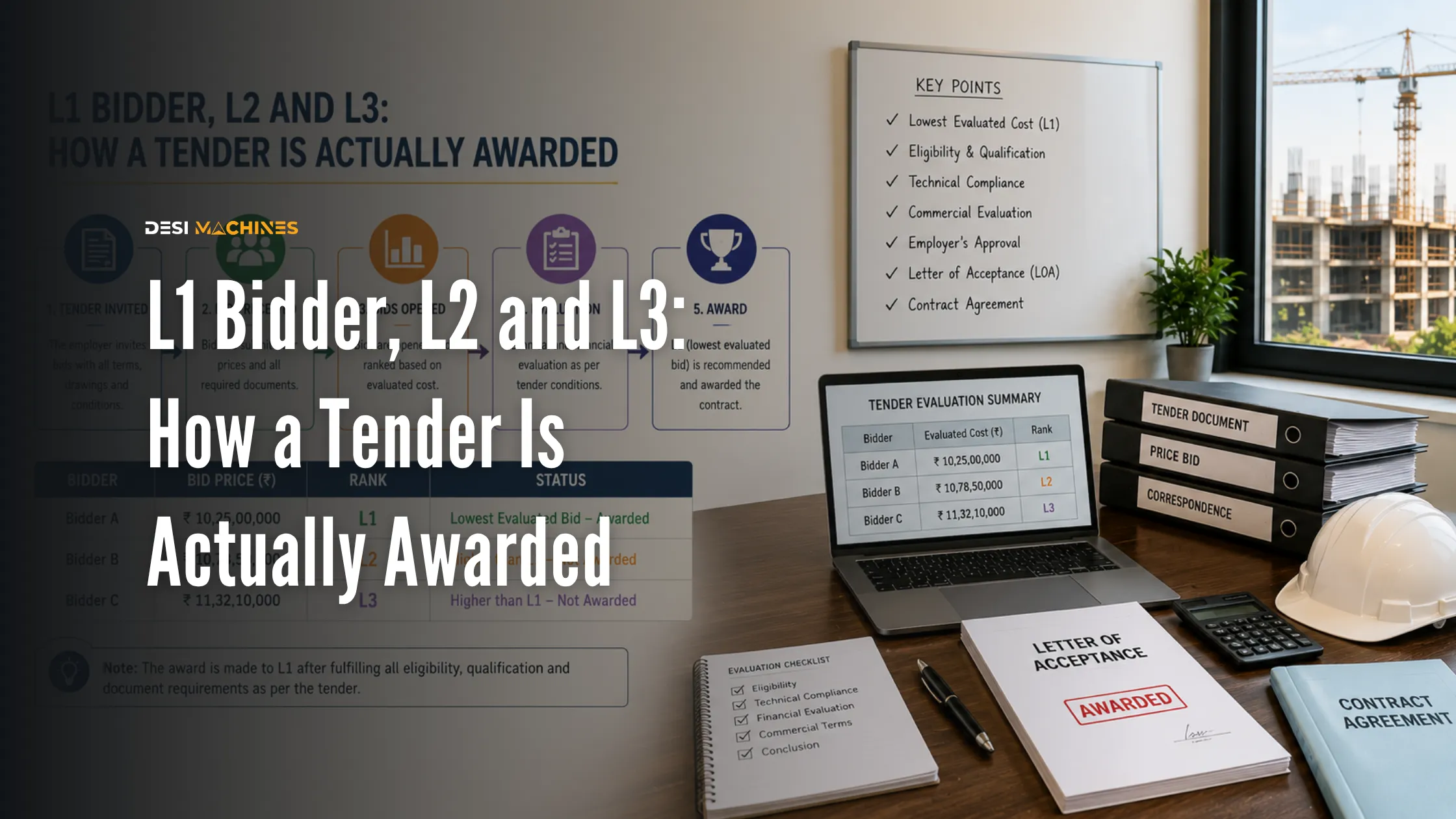
How the price ranking works once the envelopes open, and when a department may negotiate with the lowest bidder, is covered in how a tender is awarded to the L1 bidder.
What gets a bid thrown out at the first look
Para 6.3.1 lists what makes a bid unresponsive before anyone reads your experience. The common ones for a small contractor: the bid is unsigned or not in the prescribed format; the EMD is missing, or an EMD exemption is claimed without acceptable proof; the bidder is not eligible; the bid is conditional; the bid validity is shorter than asked; a required document is missing or the scan is illegible.
After that comes the qualification check against what the notice inviting tenders asked for: similar work, turnover, bid capacity, machinery, registration. Two rules hold the committee to the paper. Rule 173(xii) of GFR 2017 says no new condition that was not in the bidding documents may be brought in, and that responsiveness is judged on the contents of the bid itself. Para 6.4.1 adds that only the bidder’s own credentials count. A parent company’s, a sister firm’s or a subcontractor’s work does not, unless the tender allows a specialised subcontractor.
A bid can also fall at the price stage for being far below the estimate, which is a separate test explained in what makes an abnormally low bid.
Can the committee ask you for missing papers?
Yes, within a tight fence. Para 6.3.5 of the manual allows two kinds of request, both at the committee’s discretion and never as a right of the bidder.
The first is a clarification, to remove a minor ambiguity or confirm that a submitted document is genuine. It comes in writing with a reply-by date, and the bid is liable to be rejected if you miss it. The manual is blunt about the limit: “No change in prices or substance of the bid including specifications, which may grant any undue advantage to such bidder, shall be sought, offered, or permitted. No post-bid clarification at the initiative of the bidder shall be entertained.”
The second is a shortfall document. The committee may ask for it only if it is a historical document that existed when the bids were opened and has not changed since. The manual’s examples are a PAN or GST registration left out, and a contract uploaded without its completion certificate. It then draws the line: only documents already in existence before the submission deadline count, and “no new certificate or contract should be asked for so as to qualify the bidder.” Para 6.3.5(3) adds that a certificate created or signed after bid opening is refused even if it describes something that happened earlier.
| Problem found after opening | Can it be fixed? |
|---|---|
| Missing page, illegible scan, too few copies | Usually yes, as a minor deviation (para 6.3.4) |
| Completion certificate left out, but issued before the deadline | Yes, if the committee asks for it |
| Certificate issued after bid opening | No (para 6.3.5(3)) |
| A new contract added to meet the similar-work criterion | No |
| Rate, BOQ item or specification you want to change | No (GFR Rule 173(xiii)) |
| Words and figures differ in your rate | Words prevail; you must accept the correction or the bid is rejected |
A deviation is substantive, and fatal, when it affects scope or quality, limits the department’s rights or your obligations, or would unfairly improve your position if corrected (para 6.3.4).
Worked example: the missing completion certificate
A backhoe and tipper owner bids for a canal earthwork tender with an estimated cost of Rs 80 lakh. Suppose this notice asks for one completed similar work of at least 80% of the estimate. That is 0.80 x 80 = Rs 64 lakh. The firm’s best job is a Rs 70 lakh earthwork contract finished last year, which clears Rs 64 lakh. The bidder uploads the work order but forgets the completion certificate.
If the certificate was issued before the submission deadline, the committee may ask for it under para 6.3.5(2). The bidder uploads the same certificate by the reply date and stays in the race. If nobody asks, the bid can fail: the committee has no duty to chase the bidder.
If the bidder never collected the certificate and the engineer signs one three days after bid opening, it is refused under para 6.3.5(3), even though the work really was done. Last, if the Rs 70 lakh job turns out not to count as similar, the bidder cannot send a different contract now: that would be a new contract offered to qualify. Getting the experience paperwork right before bidding is covered in work experience certificates for tender eligibility.
Where to read the result
On the central portal, etenders.gov.in, the public Tenders Status search lists each tender under one of these stages, as read on 21 November 2026: To Be Opened, Technical Bid Opening, Technical Evaluation, Financial Bid Opening, Financial Evaluation, AOC, Retender, Cancelled and Concluded. The Results of Tenders page shows the AOC date and the award against each tender ID. Both searches ask you to type a captcha. Para 6.4.1(4) says the technical result is announced, including to failed bidders, but the technical evaluation report itself is confidential.
For the award, GFR Rule 173(xviii) and para 6.5.2 of the manual make publication of the successful bidder’s name mandatory on the Central Public Procurement Portal and on the department’s own website or notice board. A tender that ends in Retender or Cancelled has its own rules, set out in when a tender can be cancelled; one where only your bid survives is discussed under single bid tender.
On timing, para 6.2.5 asks ministries to decide most tenders within 60 days of opening and never beyond 75 days, even for two-packet bids. If bids opened on 2 March, that is 1 May as the target and 16 May as the outer limit. If your bid fails the technical stage, the manual says your bid security should come back within 30 days of that result.
On GeM: bid to RA starts after technical evaluation
On the Government e-Marketplace, the buyer chooses at the time of creating the bid whether it will be a “Bid to RA”. If it is, clause (u) of the GeM General Terms and Conditions 4.0, version 1.29 dated 25 March 2026 says sellers submit technical and commercial bids before closing, and the reverse auction runs only after the buyer completes technical evaluation. Under the 50% rule, the lowest-priced half of the technically qualified bidders go to the auction, rounded up, so 7 qualified bidders means L1 to L4 take part. Under the H-1 rule, everyone except the highest quote goes. With only 2 or 3 qualified bidders, all of them join.
The same document gives sellers who fail the technical round their EMD back within 15 days of that result. The Bid/RA Status list on GeM can be filtered by Technical Evaluated, Financial Evaluated and Bid/RA Awarded. To give the next committee less to question, start with live government tenders for machine owners and contractors whose eligibility you already meet on paper.
A checklist before you click Freeze Bid
- Every work order you rely on has its completion or performance certificate, dated before the deadline, in the same upload.
- Your MSE or other EMD exemption certificate is attached, valid and readable.
- Rates in words and in figures match; words will win if they do not.
- Nothing in the bid sets a condition the tender did not invite.
- You check the portal and your email daily after opening, so a clarification letter does not expire unread.
For the bidding steps before all this, see how to bid for government construction tenders, then pick your next job from current tender opportunities.
Procurement rules, portal screens and timelines change, and state departments and PSUs follow their own manuals. Confirm the evaluation rules in the tender document that applies to you, and with the tender inviting authority, before you act. DesiMachines is not liable for decisions taken on information that may have changed after publication.